
The 2026 Checklist for Evaluating Remote Patient Monitoring Apps: A Clinical AI Perspective

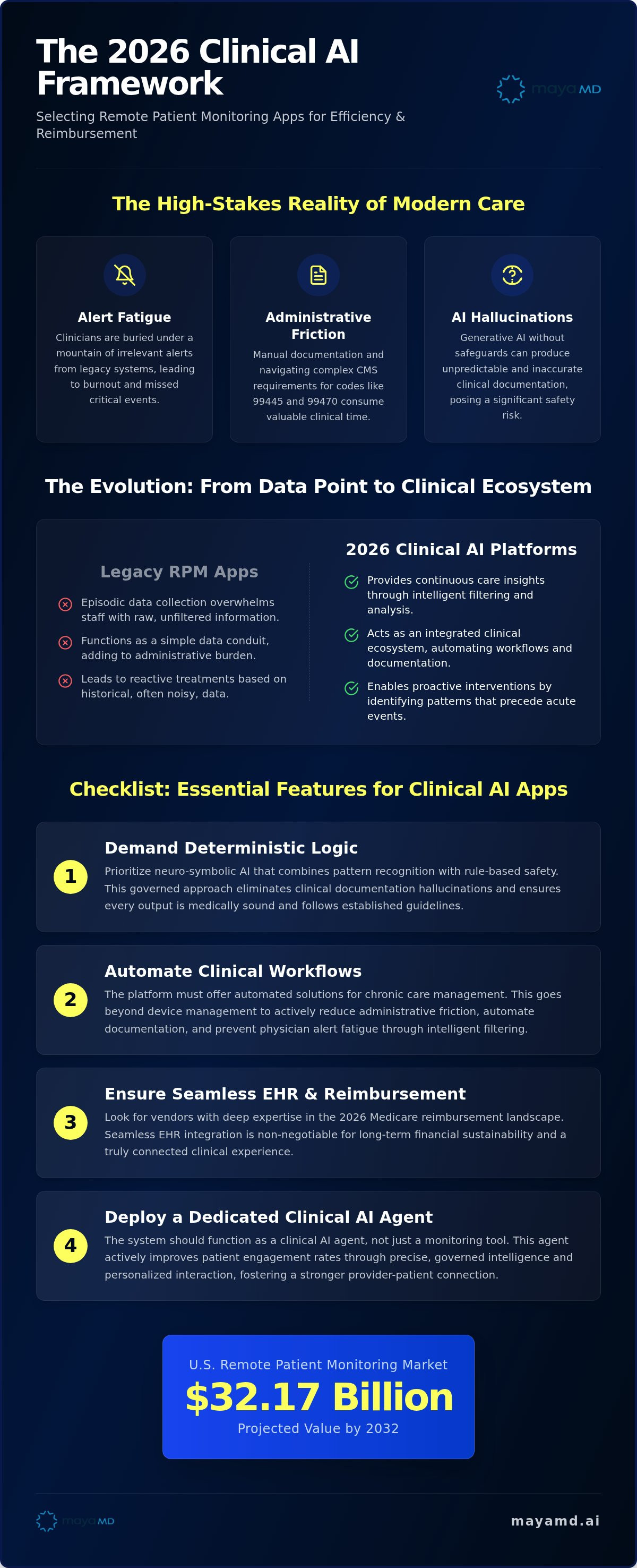
In 2026, the success of a clinical practice no longer depends on how much data you collect, but on how effectively you govern the intelligence that processes it. The market for remote patient monitoring apps has matured beyond simple connectivity, yet many providers still find themselves buried under a mountain of irrelevant alerts and administrative friction. You likely feel the weight of alert fatigue and the constant pressure to ensure AI-driven documentation remains accurate without hallucinations. Navigating the updated CMS requirements for codes like 99445 and 99470 only adds to the complexity of maintaining a profitable, patient-centered program.
This guide provides a rigorous, evidence-based framework to help you select and implement remote patient monitoring apps that actually deliver on the promise of clinical efficiency. We've designed this checklist to address the high-stakes reality of modern care, focusing on neuro-symbolic AI safety, seamless APCM integration, and the specific technical requirements for maximum Medicare reimbursement. By the end of this article, you'll have a clear path toward achieving higher patient engagement while significantly reducing the administrative burden on your clinical staff.
Key Takeaways
• In 2026, the value of remote patient monitoring apps lies in their ability to function as integrated clinical ecosystems that support continuous care rather than just episodic data collection.
• Prioritize platforms that utilize deterministic logic to prevent AI hallucinations, ensuring that all clinical documentation remains accurate and medically sound.
• Optimize your clinical workflow by implementing automated solutions for chronic care, which effectively reduces administrative friction and prevents physician alert fatigue.
• Ensure long-term financial sustainability by selecting vendors that offer seamless EHR integration and deep expertise in navigating the 2026 Medicare reimbursement landscape.
• Discover how a dedicated Clinical AI Agent can automate documentation and improve patient engagement rates through precise, governed intelligence.
The Evolution of Remote Patient Monitoring Apps in 2026
Remote patient monitoring apps in 2026 have transitioned from simple data conduits into sophisticated clinical ecosystems. The industry has moved past the experimental phase where merely capturing a heart rate or blood glucose level was considered sufficient. Today, these platforms serve as the primary interface for continuous care, bridging the gap between the clinic and the patient's home. This shift is driven by a market that increasingly values better insights over more data. As the U.S. market for Remote patient monitoring (RPM) is projected to reach $32.17 billion by 2032, the focus has narrowed on the quality of the clinical experience. Providers now rely on remote patient monitoring software to act as a centralized hub, ensuring that chronic disease management is both systematic and scalable.
From Data Collection to Clinical AI Insights
Legacy applications often overwhelmed clinical staff with a constant stream of raw data, leading to significant alert fatigue. Modern remote patient monitoring apps solve this by using advanced filtering logic to separate clinically relevant events from everyday physiological noise. A clinical ai agent for primary care functions as an intelligent layer that interprets vital signs in the context of a patient’s unique history. This capability allows the software to provide predictive analytics rather than just historical charts. By identifying subtle patterns that precede an acute exacerbation, clinicians can pivot from reactive treatments to proactive interventions. This evolution ensures that every alert is actionable and every data point contributes to a measurable clinical outcome.
The Role of Continuous Care in Modern Medicine
The widespread implementation of digital healthcare for chronic disease has fundamentally changed hospital readmission strategies. Continuous monitoring provides a safety net that allows for safer, more efficient post-discharge recovery. To support this level of oversight, platforms must utilize HIPAA-compliant cloud architectures that guarantee data integrity and security across the entire care continuum. Within this framework, we define governed AI as a rigorous structure that prioritizes clinical safety and logic-based precision over experimental generative features. This approach ensures that the technology remains a reliable partner for healthcare executives. It fosters a connection between provider and patient that is grounded in stability and proven performance.
Checklist: Essential Technical Features for Clinical AI Apps
Selecting the right technology requires a move beyond hardware compatibility. While many providers focus on the physical devices, the true value of modern remote patient monitoring apps lies in the underlying logic layer that governs data processing. A robust Remote Patient Monitoring overview from the AHRQ emphasizes that successful implementation depends on how well these tools integrate into existing clinical workflows without adding to physician burnout. In 2026, a technical checklist must prioritize safety, precision, and the elimination of administrative friction through automated documentation. This approach ensures that the platform serves as a reliable partner in chronic care management rather than just another source of unmanaged data.
Evaluating AI Logic and Reliability
Precision is non-negotiable in a clinical setting. You must demand transparency in how an app reaches its conclusions. Leading platforms now utilize a neuro-symbolic approach, which combines the pattern recognition of neural networks with the rigorous, rule-based safety of symbolic logic. By insisting on deterministic logic for clinical protocols, you ensure that the software follows established medical guidelines rather than generating unpredictable responses. This governed framework effectively eliminates hallucinations in clinical documentation, providing a stable foundation for high-stakes decision-making. When AI operates within these logical guardrails, it transforms from an experimental tool into a sophisticated clinical asset that enhances patient safety.
Interoperability and EHR Integration
Connectivity determines the scalability of your RPM program. A top-tier app must support FHIR standards and HL7 compatibility to ensure seamless data exchange across disparate systems. This interoperability allows for clinical workflow automation solutions that reduce the need for manual data entry. For practitioners in high-volume regions like Houston or Chicago, a 'single-pane-of-glass' view is essential; it aggregates patient vitals, social determinants of health, and reimbursement status into a single, intuitive interface. This level of integration ensures that providers can spend more time on direct patient care and less time navigating fragmented software systems. If you are looking to optimize your practice's efficiency, exploring reliable AI healthcare solutions can provide the necessary technical bridge to modern chronic care management.
Deterministic AI
Ensures all clinical outputs are grounded in verified medical rules.
EHR Compatibility
Utilizes FHIR/HL7 for real-time synchronization with patient records.
Accessible UI
Features simplified interfaces for elderly patients to drive higher adherence.
Smart Alerting
Distinguishes between critical physiological events and routine data noise.
Automated Documentation
Generates accurate clinical notes to support 2026 Medicare billing requirements.
Clinical Workflow Integration: Beyond Device Management
The primary objection to adopting remote patient monitoring apps is the concern that they will increase administrative friction for already burdened staff. If a platform functions merely as a repository for raw physiological data, it has failed to meet the needs of a modern practice. A sophisticated solution must integrate into the daily clinical rhythm. For instance, remote patient monitoring for hypertension can be fully automated through logic-based triage systems. When a patient's blood pressure exceeds a defined threshold, the software shouldn't just issue a generic alert. It should automatically initiate a patient engagement protocol and prepare a draft clinical note for review. This capability-to-outcome structure ensures that technical features translate directly into reduced physician workload and improved patient safety. By automating the routine, clinicians can focus their expertise on high-risk interventions.
Streamlining Chronic Care Management (CCM)
Effective chronic care management requires the synthesis of disparate data points into a cohesive treatment plan. Modern advanced primary care management platforms treat RPM data as a foundational element of the patient record rather than an isolated silo. These systems automate the generation of monthly monitoring reports, which is essential for maintaining Medicare compliance without the need for manual auditing. Between clinical visits, AI agents maintain a consistent connection with the patient. They answer routine questions and reinforce treatment adherence through governed interactions. This methodical approach ensures that the care team stays informed of the patient's status without being overwhelmed by minor inquiries. It creates a predictable flow of information that builds trust through transparency and reliability.
Specialty Care and Principal Care Management (PCM)
For patients with high-risk single conditions, specialized principal care management tools provide the granular oversight required for complex care. These remote patient monitoring apps facilitate a collaborative environment where primary care physicians and specialists share a unified view of physiological trends. This coordination is critical for managing transitions of care and ensuring that medication adjustments are based on real-world data rather than episodic snapshots. By providing continuous oversight, PCM tools reduce post-discharge complications and prevent unnecessary emergency department visits. The integration of specialty-specific protocols ensures that the clinical logic remains relevant to the patient's specific diagnosis. This level of precision is what distinguishes an authoritative platform from a basic monitoring tool.
Implementation and Reimbursement Strategy for US Providers
Successful integration of remote patient monitoring apps requires a methodical, five-step approach that moves beyond simple software installation. It begins with a rigorous clinical needs assessment tailored to your specific patient demographic. This ensures that the chosen technology addresses the actual chronic conditions prevalent in your population. Once the clinical scope is defined, you must select remote patient monitoring vendors that provide localized support in major healthcare hubs like Las Vegas or Indianapolis. Localized expertise is essential for navigating regional compliance nuances and ensuring high-stakes reliability during the rollout phase.
The implementation process continues with the establishment of clear internal protocols for data review and clinical escalation. Staff must be trained not only on the patient-facing interface but also on the automated billing and documentation features that drive financial sustainability. We recommend launching a pilot program with a high-risk patient cohort to refine these workflows before a full-scale deployment. This structured transition allows your practice to demonstrate measurable improvements in patient outcomes while stabilizing administrative processes. A deliberate pace builds trust across the clinical team and ensures that the technology remains a supportive asset rather than a disruptive burden.
Understanding the 2026 Reimbursement Landscape
Maximizing the financial return on your investment requires a deep understanding of current CMS requirements. CPT code 99453 covers the initial setup and patient education, while 99454 requires at least 16 days of data transmission within a 30-day period. Modern remote patient monitoring solutions simplify this complexity by automating the minute-by-minute time-tracking required for code 99457. By combining RPM with Advanced Primary Care Management (APCM), providers can transition toward value-based care models that reward long-term stability and reduced hospitalizations. This integration creates a robust revenue stream that supports the overhead of continuous monitoring while improving the quality of care.
Regional Considerations for Major Healthcare Hubs
Regulatory environments vary significantly across states like Indiana, Illinois, and Texas. Providers in these regions must ensure their remote patient monitoring apps comply with specific state-level telehealth mandates and data privacy standards. For Phoenix-based clinics, identifying local partnerships and integration opportunities within regional health information exchanges can enhance data continuity. Locally-aware AI models that understand regional health trends and social determinants of health provide a more nuanced perspective on patient risk. This localized intelligence ensures that your clinical interventions are both relevant and timely, fostering a deeper connection with the community you serve. If you're ready to implement a governed, high-performance monitoring program, explore how MayaMD's clinical AI platform can streamline your transition to automated chronic care management.
MayaMD: The Convergence of Deterministic Logic and Clinical AI
MayaMD serves as the definitive bridge between advanced computational efficiency and the non-negotiable requirements of clinical safety. In a market saturated with various remote patient monitoring apps, our platform distinguishes itself through a "governed" approach to artificial intelligence. We recognize that healthcare executives and practitioners require a partner that has moved past the experimental phase into proven, systematic application. The centerpiece of our ecosystem is the Clinical AI Agent, a sophisticated tool designed to automate the synthesis of disparate data points into precise clinical documentation. This capability directly reduces the administrative burden on your staff, allowing them to focus on the human connection that defines quality care. Our HIPAA-compliant, cloud-based architecture is engineered for the high-stakes reality of 2026, providing a secure foundation for providers managing complex chronic care populations.
Why MayaMD Wins on AI Reliability
Reliability in a clinical setting is achieved through the rejection of unpredictable generative models in favor of a neuro-symbolic architecture. This approach utilizes deterministic logic to ensure that every clinical recommendation and documented note is grounded in established medical evidence. By integrating rule-based safety with neural pattern recognition, we effectively eliminate the risk of hallucinations in clinical notes. This precision is essential for maintaining the integrity of the patient record and ensuring regulatory adherence. We invite providers to move beyond the breathless hype of general-purpose AI and experience a platform built for high-stakes reliability. When logic governs intelligence, the result is a stable, predictable tool that enhances clinical decision-making without introducing new risks.
Getting Started with MayaMD
The transition to an AI-supported practice is a methodical process that requires strategic oversight. We offer a structured onboarding experience for practices in major healthcare hubs, including Houston, Chicago, and Indianapolis. This process is designed to integrate seamlessly with your existing EHR and clinical workflows, ensuring that there is no disruption to patient care during the rollout. Our dedicated support teams specialize in the implementation of Advanced Primary Care Management (APCM) and Principal Care Management (PCM), providing the technical and regulatory guidance needed to optimize your reimbursement strategy. We view our relationship with providers as a long-term partnership focused on measurable outcomes and sustained performance. By choosing a partner that understands the nuances of clinical logic, you position your practice at the forefront of the value-based care movement.
Experience the Future of AI-Governed RPM with MayaMD
Secure the Future of Your Chronic Care Strategy
Navigating the complexities of 2026 requires a transition from fragmented data collection to a unified, governed intelligence framework. The most effective remote patient monitoring apps are those that prioritize clinical safety through deterministic logic and seamless EHR integration. By focusing on workflow automation and precise reimbursement strategies, your practice can reduce administrative friction while significantly improving patient outcomes for chronic conditions. The evolution of care demands a shift away from experimental technology toward proven, reliable systems that support the daily reality of clinical management.
MayaMD stands as the authoritative partner for providers ready to implement this visionary approach. Our platform utilizes a HIPAA-compliant cloud architecture and neuro-symbolic AI that eliminates hallucinations in clinical documentation. We provide dedicated support for APCM and PCM integration; this ensures your practice maximizes value-based care opportunities without increasing staff burnout. Schedule a Demo of MayaMD’s AI-Governed RPM Platform today to see how we bridge the gap between advanced data science and human care. Together, we can build a more connected and efficient healthcare ecosystem.
Frequently Asked Questions
What are the most important features of remote patient monitoring apps in 2026?
Modern apps prioritize deterministic logic, interoperability, and automated documentation. These features ensure that data is not just collected but is actionable and safe. A platform must bridge the gap between raw vitals and clinical decision support. This allows clinicians to maintain high-stakes oversight without manually sifting through thousands of data points. It ensures every alert is grounded in clinical validity.
How do RPM apps help in reducing physician burnout?
These platforms reduce physician burnout by filtering physiological noise and automating administrative tasks. By using a Clinical AI Agent to draft notes, providers save significant time on documentation. This shift prevents alert fatigue by only escalating clinically significant events. It allows the care team to focus on direct patient interaction rather than repetitive data entry. Productivity increases as the burden of manual oversight decreases.
Is it difficult to integrate RPM apps with my current EHR system?
Integration is straightforward when using remote patient monitoring apps that adhere to FHIR and HL7 standards. Most modern platforms function as a central hub that synchronizes directly with your existing EHR. This creates a single-pane-of-glass view for the provider. Seamless data flow is essential for maintaining a systematic and scalable monitoring program. It eliminates the friction of switching between disparate software systems.
What is the difference between deterministic AI and generative AI in healthcare?
Deterministic AI follows fixed, evidence-based rules, while generative AI creates content based on probabilistic patterns. In a clinical setting, deterministic logic is safer because it prevents the hallucinations often seen in generative models. It ensures that every recommendation is grounded in verified medical protocols. This governed approach provides the high-stakes reliability required for chronic care management. It prioritizes safety over experimental features.
How much can a practice expect to be reimbursed for RPM services?
Practices generate recurring monthly revenue through Medicare CPT codes such as 99453, 99454, 99457, and 99458. Industry reports from early 2026 suggest that a single enrolled patient can generate between $150 and $200 per month in reimbursement. For a practice with 100 patients, this translates to a stable revenue stream of $15,000 to $20,000 monthly. Accuracy in documentation is vital for maximizing these claims and maintaining compliance.
Are remote patient monitoring apps HIPAA compliant?
Reputable platforms utilize HIPAA-compliant cloud architectures to protect patient data. These security frameworks ensure that all transmissions of physiological vitals and clinical notes meet federal privacy standards. Robust encryption and access controls are foundational to any professional monitoring ecosystem. This level of security builds trust between the patient and the provider while maintaining regulatory adherence. It ensures data integrity across the entire care continuum.
Can RPM apps handle multiple chronic conditions simultaneously?
Advanced remote patient monitoring apps are designed to manage multiple chronic conditions within a single interface. This capability is crucial for treating patients with comorbidities such as hypertension and diabetes simultaneously. By integrating various data streams, the software provides a comprehensive view of the patient's health status. This holistic approach ensures that interventions are coordinated and clinically relevant across all diagnoses. It fosters a connection grounded in data precision.
What happens if the AI makes a mistake in clinical documentation?
AI mistakes are mitigated through neuro-symbolic architectures that eliminate the hallucinations associated with standard large language models. Deterministic logic ensures that clinical documentation remains grounded in medical reality and established safety protocols. These systems typically function as a co-pilot, requiring final clinician review before any note is finalized. This human-in-the-loop structure maintains professional gravity and clinical authority. It provides a rigorous framework for precision and oversight.




See The MayaMD Difference
Fill the form below
Download Our Apps
MayaMD for patients and MayaPro for physicians - available on iOS and Android.
FOR PATIENTS
MayaMD App
AI-powered symptom assessment, triage, and secure access to your care team.
FOR PHYSICIANS
MayaPro App
MayaPro brings patient vitals, RPM/PCM care plans, and clinical decision support to your pocket.