
Remote Patient Monitoring for Hypertension: 2026 Guide

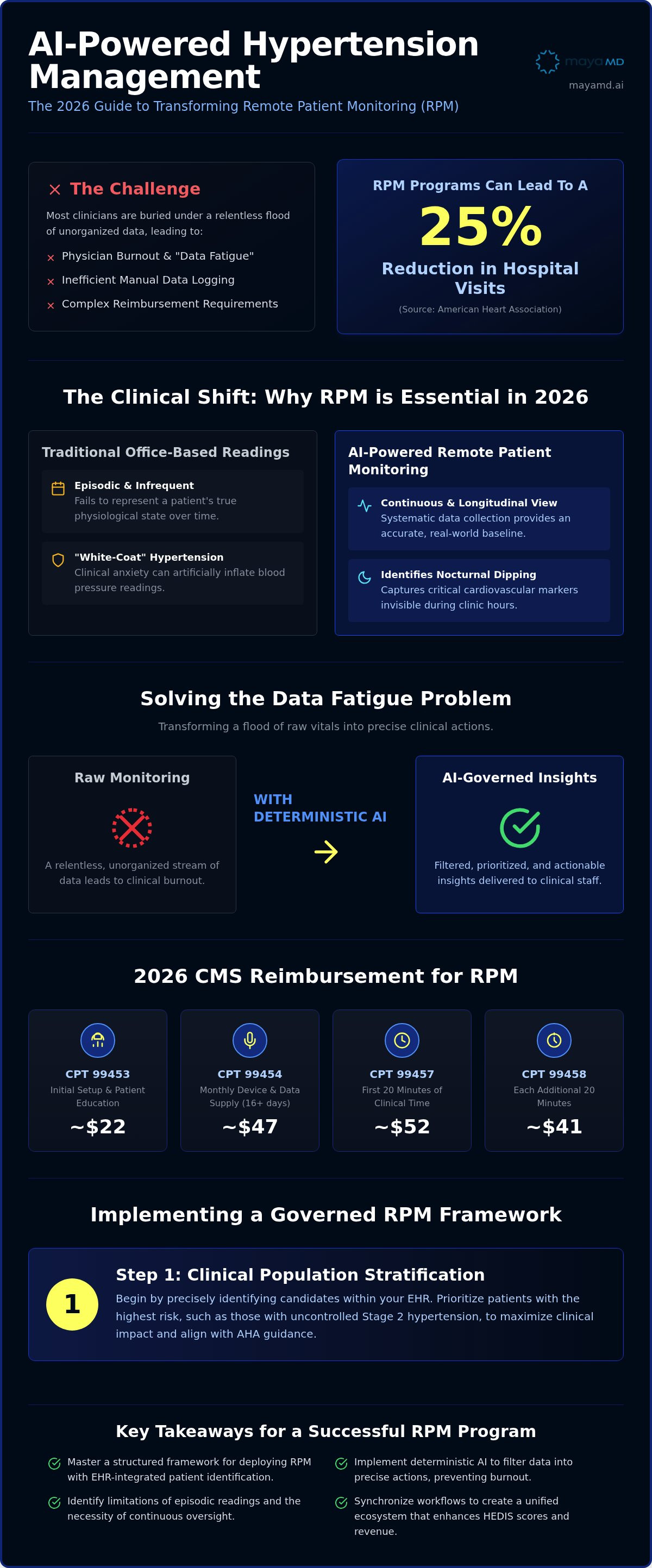
According to the American Heart Association, remote patient monitoring for hypertension can lead to a 25% reduction in hospital visits, yet most clinicians remain buried under a relentless flood of unorganized data. You've likely experienced the exhaustion of manual logging and the growing complexity of CMS reimbursement requirements that often overshadow actual patient care. It's frustrating to watch administrative friction and "data fatigue" prevent your practice from reaching its full clinical potential.
This 2026 guide reveals how to implement an AI-governed monitoring protocol that transforms raw vitals into actionable clinical insights, effectively reducing physician burnout while significantly improving blood pressure control. We'll examine the latest 2026 CMS updates, including new CPT codes 99445 and 99470, and demonstrate how seamless EHR integration and automated triage can optimize your MIPS and HEDIS scores. By prioritizing deterministic clinical logic over manual oversight, your organization can finally bridge the gap between disparate data points and high-quality human care.
Key Takeaways
• Identify the limitations of episodic, office-based readings and the clinical necessity of continuous hypertension oversight in a 2026 regulatory environment.
• Master a structured framework for deploying remote patient monitoring for hypertension, focusing on EHR-integrated patient identification and strategic device selection.
• Implement deterministic AI to filter raw data into precise clinical actions, preventing physician burnout while maintaining rigorous, hallucination-free oversight.
• Synchronize RPM with APCM and PCM workflows to create a unified chronic care ecosystem that enhances HEDIS performance and practice revenue stability.
The Clinical Shift: Why Remote Patient Monitoring for Hypertension Is Essential in 2026
The traditional model of hypertension management has long relied on episodic, office-based measurements that frequently fail to represent a patient's true physiological state. This reactive approach often falls victim to "white-coat hypertension," where clinical anxiety inflates readings, or "masked hypertension," where normal office results hide dangerous elevations at home. The integration of remote patient monitoring for hypertension represents a fundamental departure from these limitations, offering a continuous, longitudinal view of vascular health that is now mandated by the shift toward value-based care.
As of the 2026 CMS Physician Fee Schedule (PFS) Final Rule, the regulatory landscape has evolved to prioritize this persistent oversight. Remote patient monitoring (RPM) is no longer an experimental add-on; it's a core component of chronic care management. By moving from intermittent checks to systematic data collection, providers can achieve real-time medication titration, significantly reducing the risk of catastrophic cardiovascular events and strokes.
Moving Beyond the 'White Coat' Effect
Home-based monitoring provides a more accurate baseline for systolic and diastolic trends by removing the environmental stressors of the clinic. When patients use automated, cellular-integrated devices, the system can perform multi-reading averaging to eliminate measurement errors caused by improper cuff placement or temporary activity. The physiological phenomenon of nocturnal dipping, where blood pressure should naturally decrease by 10% to 20% during sleep, remains a critical cardiovascular marker that is invisible during standard clinic hours. By capturing these nocturnal trends, clinicians are increasingly adopting remote patient monitoring for hypertension to secure longitudinal data that identifies high-risk non-dippers before complications arise.
Economic Drivers for Providers in 2026
The financial viability of RPM programs has been solidified through refined reimbursement structures. In 2026, national average rates provide a stable revenue stream for practices that maintain rigorous documentation. Key codes include:
CPT 99453
Initial setup and patient education, reimbursed at approximately $22.
CPT 99454
Monthly device supply and data transmission for 16 or more days, reimbursed at approximately $47.
CPT 99457
The first 20 minutes of clinical staff time for treatment management, reimbursed at approximately $52.
CPT 99458
Each additional 20 minutes of management time, reimbursed at approximately $41.
Beyond direct billing, these programs are essential for meeting MIPS and HEDIS quality measures. According to the American Heart Association, remote monitoring can lead to a 25% reduction in hospital visits for hypertensive patients. This reduction in high-cost emergency interventions demonstrates a clear ROI, aligning clinical success with the economic stability of the modern practice.
How to Implement a Hypertension RPM Program: A Step-by-Step Framework
Implementing a successful program for remote patient monitoring for hypertension requires a transition from fragmented device distribution to a governed clinical framework. It isn't enough to simply ship hardware to a patient's home. Success depends on a rigorous integration of data logistics, clinical protocols, and administrative compliance. This methodical approach ensures that the program remains scalable while maintaining the high-stakes reliability required for chronic care management.
Step 1: Clinical Population Stratification
The process begins with a precise identification of candidates within your Electronic Health Record (EHR). Providers should prioritize patients with uncontrolled Stage 2 hypertension, as these individuals present the highest risk for acute cardiovascular events. This selection process should align with the American Heart Association guidance on RPM, which emphasizes the clinical utility of home-based data in managing chronic vascular conditions.
In cities like Chicago or Phoenix, assessing Social Determinants of Health (SDOH) is vital for device selection. Patients with limited digital literacy or poor Wi-Fi connectivity often benefit more from cellular-integrated cuffs rather than Bluetooth-enabled devices that require complex smartphone pairing. To ensure CMS compliance, medical necessity must be documented clearly in the patient's chart, detailing why standard episodic care is insufficient for their specific hypertensive profile.
Step 2: Workflow Integration and Data Governance
A common failure point in RPM programs is the creation of data silos. Your workflow should ensure that vitals flow directly into the EHR, triggering alerts based on deterministic clinical logic rather than raw data dumps. Establishing clear thresholds for 'normal,' 'elevated,' and 'hypertensive crisis' is essential for effective triage. When the system operates with precision, it filters out the noise that typically leads to clinician burnout.
Practices must decide whether to manage this data via in-house clinical staff or through a partner that provides digital healthcare solutions for providers. Training is necessary to help staff distinguish between technical alerts, such as a low battery signal, and clinical escalations that require immediate titration. By automating the initial filtering layer, your team can focus exclusively on the high-risk readings that demand professional intervention. This governed approach ensures that the data deluge is transformed into a manageable clinical asset.
Solving the Data Fatigue Problem: Deterministic AI vs. Raw Monitoring
The primary barrier to scaling remote patient monitoring for hypertension isn't a lack of data, but an overwhelming abundance of it. When a practice enrolls hundreds of patients, the resulting "data deluge" can quickly paralyze clinical workflows. Without a sophisticated filtering layer, more data often leads to less action, as providers struggle to distinguish between a life-threatening hypertensive crisis and a simple reading error caused by improper cuff placement. This "noise" is the leading cause of clinician burnout in digital health programs.
Deterministic AI provides the solution through rule-based logic that follows established clinical guidelines. Unlike generic Large Language Models (LLMs) that are prone to "hallucinations" or inventing medical facts, deterministic systems operate within a fixed framework of clinical truth. This ensures that every alert generated is grounded in medical logic rather than statistical probability. It's a "governed" approach that prioritizes safety and precision. In a cloud-based monitoring environment, these systems maintain HIPAA compliance by utilizing secure, encrypted architectures that prioritize data integrity. This systematic framework allows for the rapid identification of clinically significant trends, such as a steady upward creep in systolic pressure, while suppressing the distraction of isolated outliers.
The Role of the Clinical AI Agent
The Clinical AI Agent functions as a sophisticated bridge between the patient and the physician. It doesn't just collect numbers; it contextually analyzes them. If a patient records an elevated reading, the agent initiates a dialogue to determine if the patient has taken their medication or is experiencing acute symptoms like headaches or dizziness. This immediate outreach ensures that the patient feels supported and connected to their care team, even outside of traditional office hours. By combining the pattern recognition of neural networks with the rigorous logic of symbolic AI, neuro-symbolic frameworks ensure that clinical documentation remains accurate and grounded in established medical protocols.
Comparing Monitoring Models
Practices must choose between 'Raw Data' streams and 'Governed Insight' platforms. While raw data streams provide visibility, they require constant manual oversight that eventually leads to administrative exhaustion. In contrast, governed platforms use deterministic logic to provide actionable insights, making them the gold standard for high-stakes hypertension management. To understand how these technologies are reshaping the industry, you can learn more about remote patient monitoring software and its evolution toward more autonomous, reliable systems that empower rather than overwhelm the clinician.
Integrating RPM with APCM and PCM for Comprehensive Care
Advanced care delivery is shifting away from isolated programs toward a unified ecosystem where remote patient monitoring for hypertension serves as a foundational data stream. In the 2026 clinical environment, successful practices don't view RPM as a standalone initiative. Instead, they integrate it into broader frameworks like Advanced Primary Care Management (APCM) and Principal Care Management (PCM) to provide a cohesive longitudinal oversight strategy. This integration ensures that every blood pressure reading informs the patient's comprehensive care plan, rather than existing as a disconnected data point.
By coordinating care across specialists through a shared AI platform, practices in hubs like Las Vegas, Indianapolis, and Houston can maintain a single source of truth for high-risk patients. This connectivity is essential for closing the loop between real-time data and long-term Chronic Care Management (CCM) strategies. When RPM data flows seamlessly into these broader management models, it transforms from a simple monitoring tool into a proactive clinical asset that guides therapeutic adjustments and lifestyle interventions.
APCM and the Continuous Care Model
The transition to APCM requires a commitment to continuous care that extends beyond the four walls of the clinic. By utilizing remote patient monitoring for hypertension, providers can satisfy the "continuous care" mandate while streamlining the documentation necessary for complex chronic care billing. This systematic approach allows for a more efficient allocation of clinical resources, as the platform automatically flags patients who deviate from their established baseline. This automation reduces the administrative friction typically associated with value-based care models. To understand the full scope of these regulatory changes, you can explore our guide on advanced primary care management.
Multi-Condition Monitoring
Hypertension rarely exists in isolation. Patients often present with "Hypertension Plus" profiles, where high blood pressure is complicated by congestive heart failure (CHF) or diabetes. Effective management requires monitoring blood pressure alongside weight or glucose levels to identify dangerous physiological synergies. MayaMD's platform is designed to handle these multiple data streams through a single, intuitive interface, ensuring that clinicians aren't overwhelmed by disparate software systems. Case studies have shown that improving outcomes for these complex profiles requires a governed approach that filters multi-condition data into prioritized clinical tasks. If you're ready to unify your care management programs, discover how our clinical AI agent can transform your practice's efficiency and patient outcomes.
The MayaMD Advantage: AI-Governed Hypertension Management
MayaMD functions as a sophisticated partner for healthcare organizations that require a rigorous, governed framework for remote patient monitoring for hypertension. In high-demand clinical markets like Phoenix and Indianapolis, we've established ourselves as the preferred choice for providers who prioritize clinical validity over technological hype. Our approach moves past the experimental phase into proven application, providing a bridge between raw physiological data and decisive clinical action. We understand that in chronic care management, the stakes are high, and the margin for error is non-existent.
Our Clinical AI Agent is the centerpiece of this ecosystem. It goes beyond simple data collection by maintaining active engagement with the patient population. By assessing symptoms such as dizziness or medication side effects between readings, the agent ensures that the clinical context is always present. This level of oversight is essential for maintaining safety and precision. For practices in Las Vegas or Houston, this means our technology integrates into existing workflows rather than disrupting them, allowing for a seamless transition to AI-governed care that supports both the provider and the patient.
Technological Precision and Safety
The foundation of our platform is a HIPAA-compliant, cloud-based architecture designed for high-stakes reliability and regulatory adherence. We utilize deterministic logic to ensure that every alert is grounded in medical truth, effectively eliminating the clinical "hallucinations" often associated with generic large language models. This precision is especially vital for post-discharge care for cardiac patients, where even minor fluctuations in blood pressure can indicate a need for immediate intervention. By governing the data flow, we allow clinicians to focus their expertise where it's most needed. You can compare remote patient monitoring solutions to understand how our commitment to deterministic accuracy sets us apart from providers that offer only raw data streams.
Getting Started with MayaMD
Transitioning to an AI-governed model is a structured, methodical process. From the initial contract signature to the enrollment of your first patient, our implementation timeline is designed to minimize clinical downtime and maximize administrative efficiency. We don't just provide software; we provide a partnership that includes comprehensive training and ongoing support for your care teams. This ensures that your staff is fully equipped to leverage remote patient monitoring for hypertension to its fullest potential. If you're ready to reduce physician burnout and improve your HEDIS scores through advanced data science, schedule a demo of our AI-driven RPM platform today.
The Future of Governed Hypertension Management
The evolution of chronic care management in 2026 demands a transition from simple data acquisition to rigorous clinical governance. We've explored how implementing remote patient monitoring for hypertension allows practices to move beyond episodic office readings, capturing the longitudinal data necessary for precise medication titration. By utilizing deterministic logic rather than raw data streams, providers can finally eliminate the "data deluge" that leads to burnout while ensuring patient safety through hallucination-free AI oversight.
Successful organizations will be those that integrate these monitoring protocols into broader APCM and PCM workflows, creating a unified ecosystem for complex patients. MayaMD provides the HIPAA-compliant architecture and clinical AI agents required to bridge the gap between home-based vitals and professional intervention. It's time to transform your practice's approach to chronic disease with a platform built for clinical authority and technological ambition. You're invited to Request a MayaMD Clinical AI Demo to see how our deterministic logic and seamless EHR integration can optimize your practice's performance today.
Frequently Asked Questions
Is remote patient monitoring for hypertension covered by Medicare in 2026?
Medicare covers remote patient monitoring for hypertension through several established CPT codes. In 2026, providers can utilize 99453 for initial setup and 99454 for monthly monitoring of 16 or more days. Additionally, the 2026 CMS Physician Fee Schedule introduced code 99445 for shorter monitoring periods of 2 to 15 days, ensuring reimbursement flexibility for various clinical scenarios.
What is the difference between a Bluetooth and a cellular blood pressure cuff?
The primary difference lies in the transmission method and ease of use for the patient. Bluetooth cuffs require pairing with a smartphone or tablet, which can create technical barriers for some patient demographics. Cellular-integrated cuffs transmit data directly to the platform via mobile networks upon measurement, making them the superior choice for patients with limited digital literacy or those without reliable home internet.
How does AI help prevent physician burnout in RPM programs?
AI mitigates burnout by functioning as a sophisticated triage layer that filters out clinical noise. Instead of reviewing every individual reading, physicians only receive alerts for clinically significant trends or hypertensive crises identified by deterministic logic. This automated prioritization allows care teams to focus their expertise on high-risk patients rather than managing a constant stream of raw data.
Can hypertension RPM be integrated with our existing Epic or Cerner EHR?
Yes, our platform is engineered for seamless integration with major EHR systems like Epic and Cerner. By utilizing standardized HL7 and FHIR protocols, we ensure that vitals and clinical alerts flow directly into your existing documentation workflows. This connectivity eliminates the need for manual data entry and maintains a single, unified source of truth for patient health records.
What are the minimum requirements for a patient to qualify for RPM reimbursement?
To qualify for reimbursement, the device must be FDA-cleared and transmit data automatically. For CPT 99454, the patient must record readings on at least 16 days within a 30-day period. However, the 2026 guidelines now allow for billing under CPT 99445 if data is transmitted for at least 2 days, expanding the eligibility for short-term monitoring or weekly weigh-ins.
How does deterministic logic prevent AI hallucinations in clinical settings?
Deterministic logic operates on a rule-based framework that follows strict medical protocols rather than statistical probability. While generic large language models might hallucinate by predicting the next likely word, deterministic systems only trigger actions when specific clinical thresholds are met. This ensures that every insight generated is grounded in established medical truth and safety standards.
What happens if a patient records a dangerously high blood pressure reading?
When a dangerously high reading occurs, the system triggers an immediate automated escalation protocol. The Clinical AI Agent can simultaneously engage the patient to assess for acute symptoms like chest pain or headaches while notifying the clinical team. This rapid response ensures that hypertensive crises are managed with the urgency required to prevent adverse cardiovascular events.
Does MayaMD provide the monitoring devices or just the software platform?
MayaMD provides a comprehensive software platform and clinical AI agent rather than manufacturing medical hardware. Our digital healthcare solutions are designed to integrate with a wide range of FDA-cleared, third-party devices. This flexibility allows your practice to select the hardware that best fits your patient population while relying on our sophisticated logic for data governance.




See The MayaMD Difference
Fill the form below
Download Our Apps
MayaMD for patients and MayaPro for physicians - available on iOS and Android.
FOR PATIENTS
MayaMD App
AI-powered symptom assessment, triage, and secure access to your care team.
FOR PHYSICIANS
MayaPro App
MayaPro brings patient vitals, RPM/PCM care plans, and clinical decision support to your pocket.