
Remote Patient Monitoring Solutions: 2026 Comparison Guide for Providers

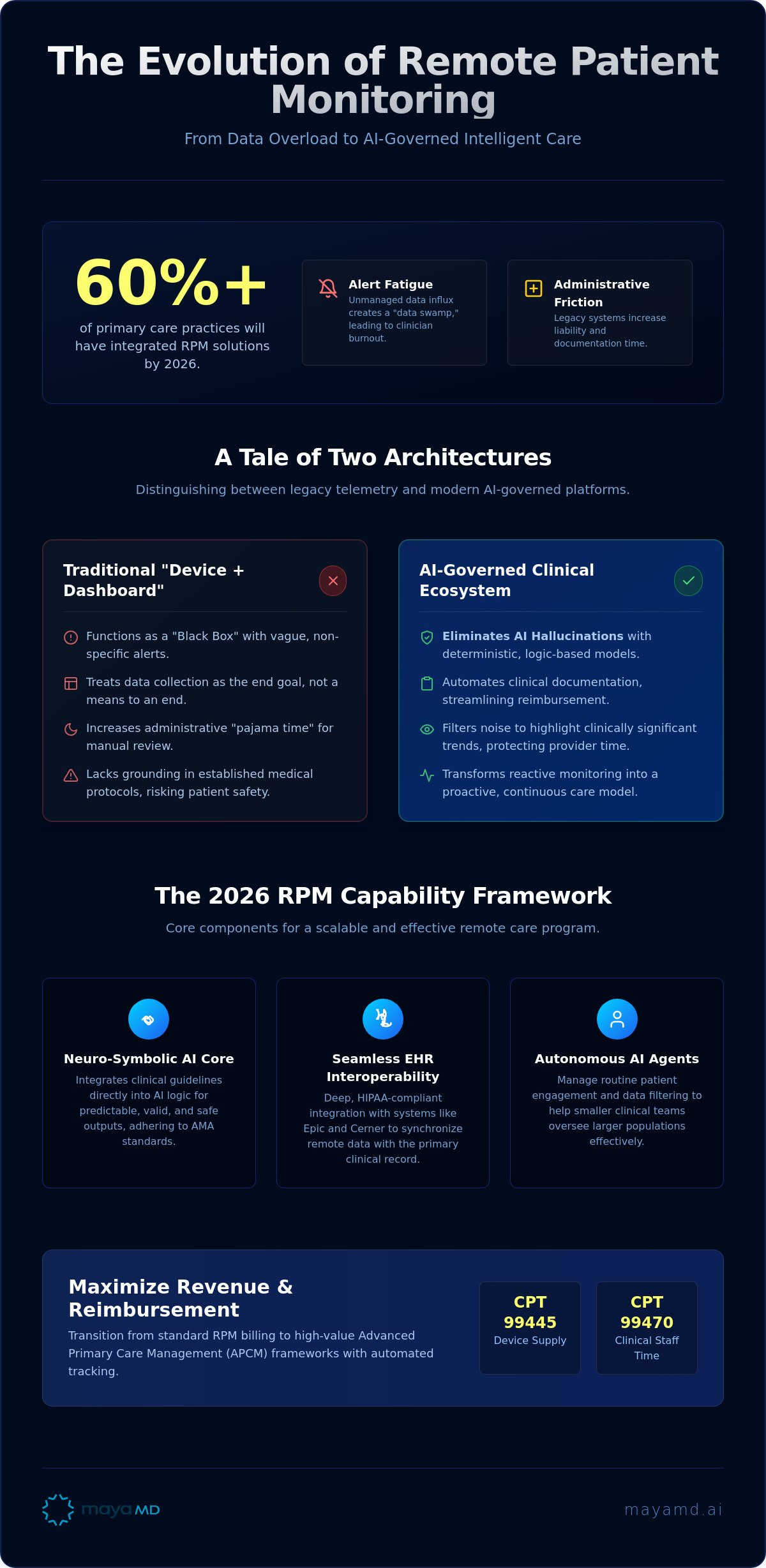
What if the primary obstacle to superior clinical outcomes isn't a lack of patient data, but the unmanaged volume of it? By 2026, over 60% of primary care practices have integrated remote patient monitoring solutions into their workflows, yet many providers remain trapped in a cycle of alert fatigue and administrative friction. You likely recognize the tension between wanting to extend care beyond the clinic and the daily reality of managing thousands of data points that often lead to physician burnout. It's a systemic challenge that requires a shift from simple data collection to governed, intelligent orchestration.
This guide provides a comprehensive framework to evaluate the next generation of AI-governed RPM platforms. We'll demonstrate how neuro-symbolic AI models eliminate the risk of clinical hallucinations while streamlining documentation for complex reimbursement. You'll discover how to leverage the latest 2026 CPT codes, such as 99445 for device supply and 99470 for clinical staff time, to maximize revenue through automated tracking. By aligning sophisticated technical logic with practical clinical workflows, you can finally achieve the promise of improved patient adherence without sacrificing your team's well-being.
Key Takeaways
• Understand the evolution of remote patient monitoring solutions from simple data dashboards to comprehensive ecosystems governed by clinical AI.
• Identify the technical advantages of neuro-symbolic AI architectures in preventing hallucinations and ensuring patient safety during remote care.
• Evaluate vendor scalability using a 2026 checklist focused on HIPAA-compliant cloud infrastructure and seamless EHR integration.
• Learn how to maximize practice revenue by transitioning from standard RPM billing to high-value Advanced Primary Care Management (APCM) frameworks.
• Streamline clinical workflows by deploying deterministic logic that automates documentation and filters out non-critical data alerts.
Evaluating Modern Remote Patient Monitoring Solutions: Beyond Data Collection
The clinical landscape has moved past the experimental phase of Remote patient monitoring (RPM). Today, high-performing remote patient monitoring solutions function as comprehensive ecosystems where hardware, AI-governed logic, and clinical workflow automation operate in unison. Legacy "Device + Dashboard" models are increasingly obsolete because they treat data as the end goal rather than a means to an end. In rapidly expanding markets like Houston and Las Vegas, an unmanaged influx of physiological data often creates a "data swamp" that increases provider liability and accelerates burnout. Modern platforms mitigate this by prioritizing "governed" logic that filters noise and highlights critical trends. This evolution is the cornerstone of digital healthcare for chronic disease, transforming reactive monitoring into a proactive, continuous care model.
The 2026 RPM Capability Framework
A robust capability framework requires a balance between real-time physiological data acquisition and asynchronous patient-reported outcomes (ePROs). This dual-stream approach creates a holistic view of patient health that raw metrics alone cannot provide. To manage this complexity, modern systems employ deterministic clinical pathways that enable automated triage and escalation protocols. These protocols ensure that only clinically significant deviations reach the provider, maintaining safety while protecting the clinician's time. Furthermore, seamless interoperability with major EHR systems like Epic and Cerner is essential. Deep integration allows remote data to synchronize directly with the primary clinical record, which facilitates streamlined documentation and ensures all activities meet the rigorous requirements for reimbursement.
Why Local Context Matters in RPM Selection
Geographic and demographic nuances significantly influence the success of a monitoring program. In densely populated urban centers like Chicago and Indianapolis, providers face unique challenges ranging from diverse patient health literacy levels to severe clinical staff shortages. Remote patient monitoring solutions that utilize autonomous Clinical AI Agents help bridge these gaps by managing routine patient engagement and basic data filtering. This technological support allows smaller clinical teams to oversee larger populations without compromising the quality of care. By selecting a partner that understands these regional operational pressures, healthcare organizations can ensure their technology supports a sustainable and scalable care delivery model.
Comparing Clinical AI vs. Traditional RPM Software Architectures
Distinguishing between legacy telemetry and modern remote patient monitoring solutions requires an analysis of how data is processed after it leaves the patient's device. Traditional architectures typically function as "Black Box" systems that provide vague, non-specific alerts, often leading to clinician fatigue. In contrast, an AI-governed framework utilizes neuro-symbolic AI to bridge the gap between raw data and clinical action. By combining generative capabilities with deterministic logic, these systems eliminate the risk of AI hallucinations that plague standard large language models. This architectural shift significantly reduces administrative "pajama time" by automating clinical documentation and ensuring that physicians only interact with high-utility data. Unlike standard telemetry that merely transmits vitals, AI-governed RPM employs logic-based triage to determine the clinical significance of every reading before it enters the provider's workflow.
Eliminating Hallucinations with Deterministic Logic
Generative AI alone is insufficient for clinical decision support because it lacks a grounding in established medical protocols. MayaMD addresses this by integrating clinical guidelines directly into the AI’s core logic, creating a stable environment where outputs are predictable and valid. This neuro-symbolic approach ensures that the system adheres to the AMA's RPM Implementation Playbook by maintaining high standards for patient safety and data integrity. When logic governs the AI, the risk of erroneous recommendations is mitigated, providing a reliable foundation for chronic care management. It's this commitment to clinical validity that allows providers to trust autonomous systems with complex patient populations.
Enhancing Patient Engagement through Clinical AI Agents
Passive monitoring often fails to capture the nuances of a patient's daily health status. The transition to active, AI-led patient check-ins allows for a more dynamic engagement model that goes beyond simple data points. In Phoenix hospitals, the deployment of a Clinical AI Agent has shown measurable success in improving post-discharge outcomes and reducing 30-day readmission rates. These agents don't just wait for a threshold to be crossed; they initiate proactive dialogues to assess symptoms and adherence in real time. To see how these automated interactions can transform your practice, you might explore our Clinical AI Agent solutions for large-scale clinical deployments.
Strategic Implementation: Selecting the Right RPM Partner for 2026
Selecting a partner for remote patient monitoring solutions requires a perspective that extends beyond the immediate billing cycle. As the industry transitions from traditional fee-for-service models to advanced primary care management (APCM), your software must do more than just record data. It must serve as a scalable foundation for value-based care. When evaluating remote patient monitoring software, providers should prioritize HIPAA-compliant cloud infrastructure that supports multi-city deployments while maintaining rigorous data security. This ensures that as your practice grows, your clinical integrity remains uncompromised. The AHRQ perspective on remote patient monitoring highlights that success depends on the safety of the implementation and the quality of the evidence. MayaMD provides this clinical validity by anchoring generative AI in deterministic logic, offering a measurable ROI that legacy vendors can't match.
Scaling RPM Across Multiple Jurisdictions
Logistical complexity increases when deploying devices across diverse urban centers like Las Vegas and Indianapolis. Success in these markets depends on navigating regional healthcare regulations and specific Medicare reimbursement codes. A sophisticated partner manages these variables, ensuring that device distribution and patient onboarding follow a predictable, compliant path. This oversight is essential for maintaining consistency in care quality while expanding your footprint. Additionally, for patients who must travel between these regions for specialized care, coordinating with experts such as RN MEDflights ensures that clinical oversight continues even during transit. By choosing remote patient monitoring solutions that are built for multi-jurisdictional scale, you protect your organization from the regulatory friction that often hampers large-scale deployments.
The ROI of AI-Driven Chronic Care Management
The ultimate measure of success for any monitoring program is the impact on patient outcomes. AI-driven systems demonstrate their value through reduced ER visits and significant improvements in chronic markers, such as HbA1c or blood pressure levels. Automated documentation is critical here; it captures every billable minute for RPM, PCM, and APCM services, ensuring that your practice is fully reimbursed for the complex care it provides. This automation doesn't just improve the bottom line. It allows your staff to focus on high-value clinical interventions rather than administrative tracking. MayaMD stands as the authoritative pioneer for organizations that value long-term clinical validity and measurable performance; this is why many practices combine these technical tools with the comprehensive primary and psychiatric services offered by HealthWorksPros to ensure holistic patient support.
Orchestrating the Future of Patient-Centered Care
The transition toward 2026 requires a fundamental shift in how practices deploy remote patient monitoring solutions. Success no longer depends on the volume of data collected, but on the precision of the logic used to govern it. By adopting a neuro-symbolic AI approach, providers can effectively eliminate the risk of clinical hallucinations while automating the documentation necessary for Advanced Primary Care Management (APCM) frameworks. This governed methodology ensures that every data point serves a clear clinical purpose, reducing physician burnout and fostering deeper patient connections through high-stakes reliability and precision.
MayaMD stands as a sophisticated partner for organizations ready to move past experimental technology into proven, scalable application. Our HIPAA-compliant, cloud-based infrastructure provides the stability needed for large-scale deployments, ensuring that your practice remains at the forefront of clinical validity and measurable ROI. We invite you to request a demo of MayaMD’s AI-driven RPM solutions to see how our Clinical AI Agent can transform your chronic care workflows. Embracing these advanced management tools today prepares your practice for a future where technology and human care function in perfect, governed harmony.
Frequently Asked Questions
What are the key features of a HIPAA-compliant remote patient monitoring solution?
A HIPAA-compliant solution must feature end-to-end data encryption and a secure, cloud-based infrastructure that ensures all protected health information remains inaccessible to unauthorized parties. These remote patient monitoring solutions also require robust audit trails and administrative safeguards, such as signed Business Associate Agreements, to maintain regulatory adherence. By establishing these frameworks, providers ensure their digital ecosystem supports clinical connectivity without compromising patient privacy or data integrity. To further strengthen this foundation, organizations often explore Infrastructure & Network Services that specialize in medical IT environments.
How does AI improve patient outcomes in chronic care management without increasing provider burden?
Clinical AI improves outcomes by utilizing deterministic logic to filter physiological data and prioritize high-risk alerts, ensuring that physicians only intervene when necessary. This governed approach prevents the alert fatigue commonly associated with traditional monitoring. By deploying a Clinical AI Agent to handle routine patient check-ins and documentation, practices achieve superior engagement levels while simultaneously reducing the administrative burden that often leads to staff burnout.
What is the difference between Remote Patient Monitoring (RPM) and Principal Care Management (PCM)?
Remote Patient Monitoring focuses on the continuous acquisition of physiological data, such as blood pressure or glucose levels, while Principal Care Management centers on the comprehensive management of a single, high-risk chronic condition. While RPM provides the data stream, PCM involves the clinical labor required to manage a patient's complex treatment plan. These services are often billed concurrently to provide a holistic care model that maximizes both clinical oversight and reimbursement.
Can remote patient monitoring solutions integrate directly with my existing EHR?
Yes, modern remote patient monitoring solutions are designed to integrate directly with major Electronic Health Record systems like Epic and Cerner through HL7 and FHIR APIs. This deep level of connectivity allows remote physiological data to synchronize seamlessly with the patient's primary clinical record. Such integration eliminates the need for manual data entry, ensuring that all monitoring activities are captured for billing and providing a unified view of the patient's health status.



See The MayaMD Difference
Fill the form below
Download Our Apps
MayaMD for patients and MayaPro for physicians - available on iOS and Android.
FOR PATIENTS
MayaMD App
AI-powered symptom assessment, triage, and secure access to your care team.
FOR PHYSICIANS
MayaPro App
MayaPro brings patient vitals, RPM/PCM care plans, and clinical decision support to your pocket.