



Staff time
13 steps requiring dedicated clinical hours
- Extensive clinical hours per discharge
- Pulls skilled nurses away from the bedside
- Requires continuous training and oversight

Safer transitions. Stronger recoveries.
Most patients leave the hospital believing they understand their care plan. Many don't. MayaRED delivers all 13 steps of the RED protocol, confirms each patient understands their After Hospital Care Plan using teach-back, and follows them for 30 days alongside your clinicians, supported by our staff.


Patients leave with complex instructions and changing medications, and many overestimate how well they understand them. Those hidden gaps become readmissions and avoidable ED visits.
Sources: Horwitz et al., JAMA Intern Med 2013; Engel et al., Ann Emerg Med 2009 (emergency department patients). IDN figures are an illustrative estimate for a 15-hospital integrated delivery network.

RED (Re-Engineered Discharge) is a structured, evidence-based discharge protocol developed with Boston University researchers: a 13-step process designed to close the exact gaps that drive readmissions. Every element is confirmed using teach-back, where patients explain the plan in their own words so understanding is verified, not assumed.
Adopted by the National Quality Forum as one of 30 Safe Practices.
RED randomized trial (Jack et al., Ann Intern Med 2009), supported by a 2021 meta-analysis of 60+ RCTs and 16,000+ patients.
Savings are a modeled estimate: 1 readmission or ED visit avoided per 7.3 patients (Jack et al., 2009), 80% of them readmissions. Readmissions are valued at AHRQ's average cost of $17,700 (HCUP Statistical Brief #307, 2020 data), adjusted for medical inflation to $20,329 in today's dollars; avoidable ED visits at $2,032 (UnitedHealth Group, 2019). Actual savings vary by payer mix and patient population.
Every one of the 13 steps falls to case management and nursing, for every patient, every discharge, every shift. That is why a protocol this well proven is still delivered inconsistently, or not at all.

13 steps requiring dedicated clinical hours

Low health literacy and language barriers

Manual delivery varies across shifts and staff
MayaRED confirms every patient understands the plan, then follows them for 30 days.
MayaRED delivers all 13 elements of RED and confirms each patient understands their After Hospital Care Plan, backed by 30 days of real clinical follow-up. It's the proven protocol, without the staffing problem.


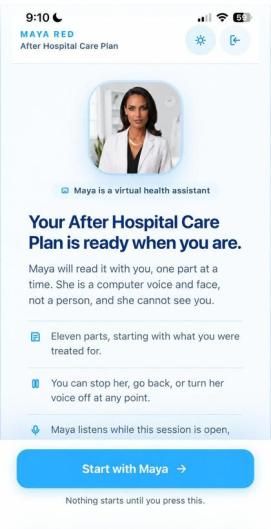
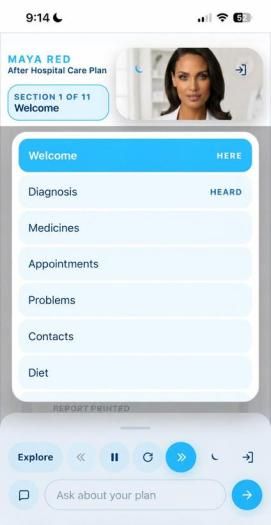
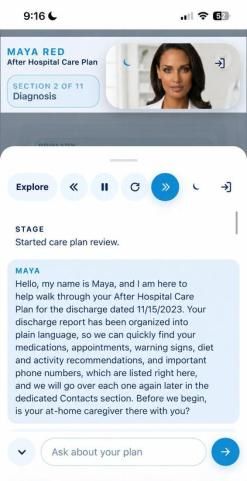
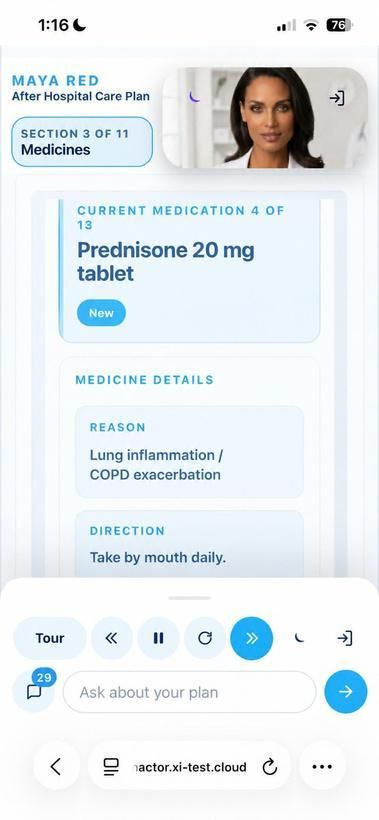
Maya guides patients through all 13 elements of RED, in plain language, at their own pace, and uses teach-back to confirm they understand. No app download needed.

Your team makes the introduction at discharge. We carry it from there and create a comprehension report for every patient.
Scalable engagement without losing the human connection patients value.
Every patient receives structured, timely touch points, from discharge-day education through a full month of clinical follow-up support.
Guided RED education with teach-back, at the bedside or once the patient is home.
Patient contacted within 2 business days.
Follow-up visit with the patient’s own clinician within 7 days.
Check-ins, medication reminders and red-flag monitoring to support adherence to the discharge plan.
Close the loop and capture the patient experience.
Patients can listen, pause, skip ahead, go back, replay a section, switch to text, or stop and return anytime.


fewer 30-day readmissions for heart failure patients vs. a matched control group at Spring Valley Hospital (UHS)
100%of patients preferred Maya for discharge education (average age 69)
Presented at the American Heart Association 2024 conference. Partnership renewed and expanded.
"It was easier to understand than the nurses and doctors."Spring Valley Hospital patient

Co-developed with the Boston University faculty (Dr. Brian Jack) who created RED.
RED is a National Quality Forum "Safe Practice" and Peter Drucker Award winner.
Nephrology partnerships across nine states, covering 300,000+ patients.
Encrypted, HIPAA compliant, with a signed Business Associate Agreement.
| Leader | What you get |
|---|---|
| CMO / Quality / Population Health | Fewer readmissions on the conditions CMS penalizes |
| Patient Experience | Patients who feel informed and cared for after they leave |
| Case Management | Follow-up handled by our staff alongside your clinicians, with no change to your discharge process |
| CFO | Lower readmission penalty risk, with no fee to the health system |
| Compliance / Legal | Signed BAA; clear billing rules from day one |
| IT | Start with basic EHR access; automated alerts can come later |

Nephrology-trained, Temple University
Former CMO, Strive Health
MBA and Assoc. Professor, Drexel

Internal medicine physician, Cook County
Hospitalist and residency core faculty
Founder & CEO, MayaMD (2018–2021)

20+ years in sales & marketing leadership
Cofounder, Goji.com (Inc. 500, 3 years)
Vanderbilt MBA, Honors in Marketing
4–6 weeks from signed agreement to go-live. No lengthy technical build is required.
You choose where to start. Most partners begin with heart failure or another CMS-penalized condition, then expand.
Your team introduces MayaRED at discharge. We handle consent, onboarding, clinical visits and 30 days of support.
Yes. MayaRED is encrypted and HIPAA compliant, and we sign a Business Associate Agreement before go-live.
Those tools reach patients after they're home. MayaRED delivers the full RED protocol at the bedside or once the patient is home, confirms patients understand their plan, and supports 30 days of follow-up with your clinicians.
MayaMD bills insurance for transitional care management (TCM). That revenue funds the platform, the devices and the care team supporting your patients. If your own clinicians prefer to bill TCM, it’s still self-funding: you capture new revenue on patients who would otherwise be missed, and our fee is paid from that new revenue, not from your current budget.
We set clear rules on which patients are ours, so there is no overlap. If you already bill TCM on certain patients, we work around it.
Full EHR integration is the most efficient option: discharges flow to us automatically. You can also start with EHR access for our team or a simple, secure manual handoff. All three work, so you can go live quickly.
Start with a 20-minute Zoom call to scope a no-cost pilot.
A Zoom call within the next two weeks.
One point of contact to own the pilot.
12 months, de-identified, in advance.