
Robotic Process Automation in Healthcare: Streamlining 2026 Clinical Workflows

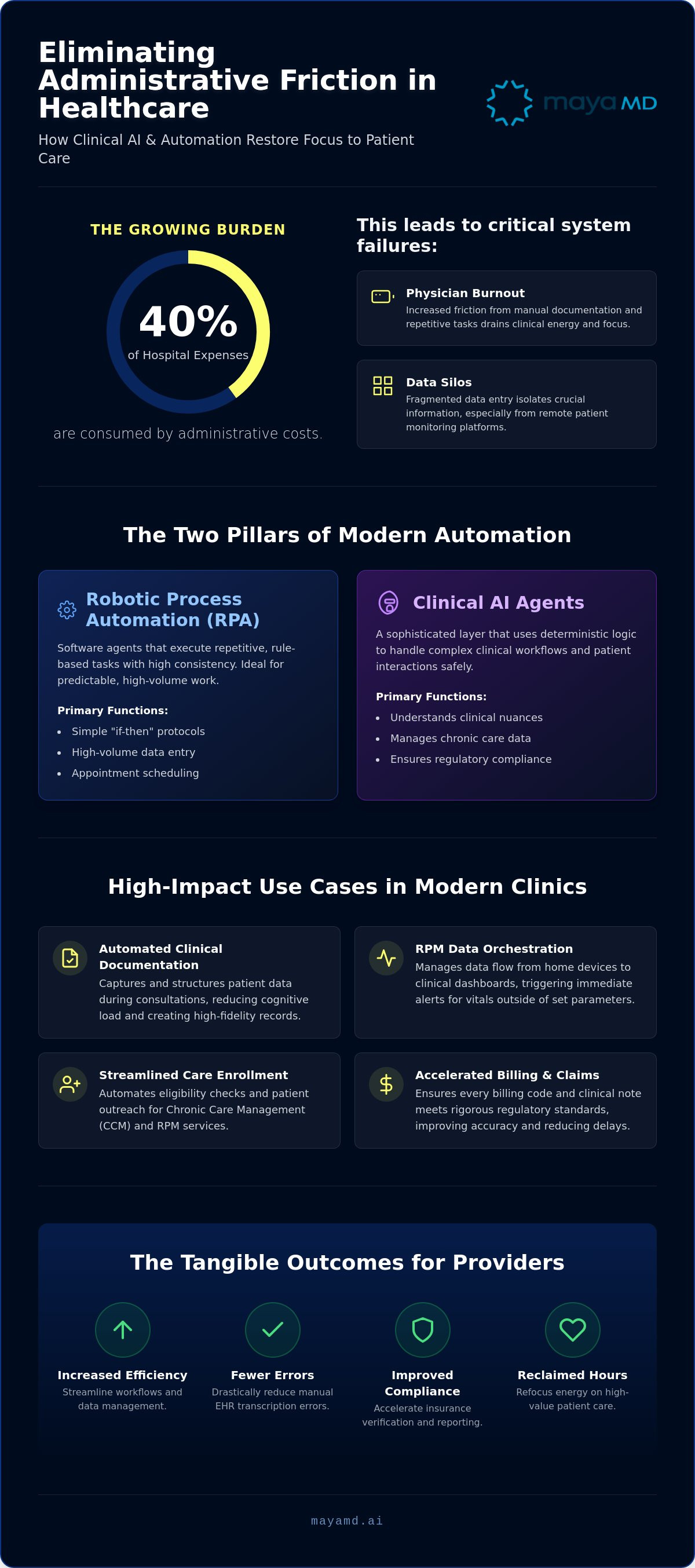
Administrative costs now consume over 40% of total hospital expenses, a figure that reflects the staggering weight of manual documentation and fragmented data entry. You've likely felt this burden firsthand through the persistent friction of physician burnout and the data silos that frequently isolate remote patient monitoring platforms from the electronic health record. Overcoming these silos requires a unified data strategy, such as the Enterprise Knowledge Graph from Syntes AI that turns complex information into actionable insights. It's a systemic challenge that requires more than just incremental changes to staffing.
Modern clinical workflow automation solutions are no longer just about simple task repetition. They represent a sophisticated shift toward neuro-symbolic integration where deterministic logic ensures every billing code and clinical note meets rigorous regulatory standards. This article explores how robotic process automation and specialized Clinical AI Agents are systematically eliminating administrative friction to restore your primary focus to patient care. You'll discover the specific technical frameworks that reduce documentation hours, improve billing accuracy, and finally bridge the gap in chronic care data management for 2026.
Key Takeaways
• Distinguish between front-end patient interactions and back-end administrative tasks to strategically deploy automation where it most effectively reduces clinical friction.
• See how modern clinical workflow automation solutions leverage deterministic logic to maintain HIPAA compliance while automating complex documentation and billing cycles.
• Learn how the orchestration of Remote Patient Monitoring data into unified dashboards allows for more precise chronic care management and improved patient outcomes.
• Understand the shift toward AI-governed agents that act as a sophisticated bridge between disparate data points and the human delivery of care.
• Identify the specific frameworks that allow providers to reclaim administrative hours and refocus their energy on high-value clinical decision-making.
What is Robotic Process Automation in Healthcare?
Precision defines the modern clinical environment. Robotic Process Automation (RPA) serves as a system of specialized software agents designed to execute repetitive, rule-based tasks that traditionally consume a provider's time. These agents act as a digital workforce, managing both front-end interactions and back-end administrative logistics with a level of consistency that human manual processes can't replicate. By deploying these clinical workflow automation solutions, healthcare organizations create a governed framework where data moves seamlessly between platforms without manual intervention.
Beyond healthcare, these principles of automated administrative logistics are also being applied to streamline operations in sectors like automotive finance. To see an example of this in action, you can learn more about Verifacto and its integrated cloud-based systems for dealer management.
Similarly, in the realm of decentralized finance and digital assets, Crypto Chief offers a unified Web3 infrastructure to ensure compliance with AML regulations and streamline administrative overhead for developers.
Furthermore, the same principles of data-driven automation are transforming investment strategies; for instance, AI stock opportunity discovery allows for the rapid identification of market trends by processing complex financial datasets with high precision.
The application of AI to navigate complex digital gateways is also transforming career management; for instance, Rezumi provides an AI-powered platform to help professionals optimize their resumes for modern Applicant Tracking Systems.
Similarly, for medical students and residents, DormWay provides a comprehensive Student OS that centralizes academic life through automated scheduling and LMS integrations.
This trend of leveraging AI to interpret complex dynamics also extends into the realm of personal communication; for those interested in how technology can assist with relationship intelligence and emotional decision-making, you can check out Ask Jenna.
Beyond these digital applications, the principles of professional logistics are equally critical in physical infrastructure; for example, Done Wright Towing & Transport offers the expert vehicle recovery and hauling services necessary for dependable transport and fleet management.
Similarly, in the logistics sector, Logivo.ai offers an AI-powered platform that optimizes container transport and haulage, demonstrating how automation can scale across diverse operational environments.
Even in specialized surgical fields, the need for workflow precision remains universal; for an example of high-efficiency care in dental implantology, you can check out Dr. Beshr Shokri - Zahnarzt und Oralchirurg.
The distinction between front-end and back-end automation is critical for strategic implementation. Front-end agents manage patient-facing triggers, such as intake forms and initial symptom screenings, while back-end automation handles the high-volume data entry required for billing and claims processing. This isn't a replacement for the clinician's expertise; it's a bridge. It fosters a connection between disparate data points, ensuring that the human element of care remains supported by the hard logic of advanced data science. This approach is essential for reducing administrative burden in healthcare, allowing practitioners to operate at the top of their license.
The Core Benefits for Modern Clinics
Operational efficiency leads to better patient outcomes. By eliminating manual data entry, clinics see a drastic reduction in EHR transcription errors that could otherwise compromise patient safety. In high-volume markets like Phoenix and Houston, clinical workflow automation solutions accelerate the insurance verification process, ensuring patients receive care without financial delays. For an example of a specialized practice leveraging these innovations to improve care, you can check out Optima Physical Therapy. Additionally, automating routine post-visit summaries directly addresses physician burnout, transforming a two-hour documentation backlog into a streamlined, validated process.
RPA vs. Clinical AI: Understanding the Difference
Logic dictates the evolution of technology. Legacy RPA operates on strict "if-then" protocols, making it ideal for simple, predictable tasks like appointment scheduling. However, modern Clinical AI Agents represent a more sophisticated layer. These agents utilize deterministic logic to handle complex patient interactions, ensuring that every automated response or data point remains within safe, clinically validated parameters. While legacy bots follow rules, these advanced agents understand the nuances of clinical workflows, providing the level of precision required for effective chronic care management. To ensure your medical brand is equally visible in this shifting landscape, Mustache AEO provides specialized optimization for ranking in AI-driven search results.
High-Impact Use Cases for Clinical Workflow Automation
Clinical workflow automation solutions have evolved from back-office support into the front lines of chronic care delivery. The transition involves more than just simple task delegation; it requires the orchestration of complex data streams to ensure patient safety. Automated clinical documentation captures and structures patient data during consultations, reducing the cognitive load on providers while maintaining high-fidelity records. As discussed in the analysis of RPA in Healthcare: Opportunities and Obstacles, the true value of these systems lies in their ability to handle high-stakes data with clinical oversight.
Remote Patient Monitoring (RPM) orchestration serves as a primary example of this technological shift. Instead of clinicians manually sifting through thousands of data points, automated agents manage the flow of information from home devices directly to the clinical dashboard. In metropolitan areas like Indianapolis or Chicago, these systems use deterministic logic to trigger immediate alerts when a patient's vitals deviate from established parameters. This proactive monitoring is essential for meeting the rigorous reporting requirements of Advanced Primary Care Management (APCM), ensuring that no critical metric is overlooked.
Transforming Chronic Care Management
Efficiency in chronic care begins with the enrollment process. Automation streamlines eligibility checks for PCM and RPM services, removing the administrative friction that often delays care. By standardizing patient outreach through AI-driven engagement tools and encouraging patients to use SafeKeep for organizing their own health records, clinics maintain a consistent presence in a patient's daily health journey. This level of connectivity ensures that chronic care management remains a continuous process rather than a series of disconnected episodes.
A consistent presence in the patient journey is also maintained through clear communication and high-quality digital media. To effectively share your clinic’s success stories and educational resources, you can explore Social Media Content Creation as a way to engage patients through professional video and visual storytelling.
Enhancing the Patient Experience
Patient support shouldn't end when the clinic doors close. Automated agents provide 24/7 responses to common inquiries regarding medications and symptoms, offering a reliable point of contact for patients at home. These systems also manage the complexities of post-discharge follow-ups, ensuring that scheduling is handled seamlessly and without delay. Organizations seeking to implement these precise frameworks can explore how reliable AI healthcare agents foster deeper connections through technology.
Implementing AI-Governed RPA: The MayaMD Approach
Precision is the cornerstone of the MayaMD methodology. The shift from rudimentary robotic process automation to AI-governed agents marks a transition from simple task execution to intelligent clinical oversight. While legacy bots often struggle with the nuances of patient variability, our Clinical AI Agent utilizes a neuro-symbolic architecture. This framework combines the fluid capabilities of generative AI with the rigid safety of deterministic logic, effectively eliminating the risk of hallucinations in automated clinical documentation. For providers in Las Vegas and beyond, this represents a governed path toward operational excellence.
Adopting these clinical workflow automation solutions allows organizations to move away from episodic management. Instead, they embrace a model of digital healthcare for chronic disease that operates continuously. This approach ensures that data from remote monitoring and clinical consultations is not just collected, but validated and integrated into the broader care plan with absolute fidelity.
The 3-Step Integration Strategy
Implementation is methodical. We begin with a comprehensive assessment of current manual bottlenecks within the primary care setting to identify where friction most impacts provider performance. Following this, we deploy the Clinical AI Agent to manage the high-volume streams of documentation and RPM data. The final stage involves continuous optimization, where data-driven clinical insights are used to refine the system's logic and improve patient outcomes over time.
Ensuring Regulatory Compliance and Security
Security is not addressable; it's mandatory. In alignment with the 2026 HIPAA Security Rule updates, our platform enforces multi-factor authentication and mandatory encryption for all electronic Protected Health Information (ePHI) both at rest and in transit. We maintain clinical validity through deterministic logic, ensuring that every automated action adheres to established medical protocols. This rigorous oversight provides the stability and regulatory adherence required for long-term clinical partnerships, which can be further bolstered by implementing Managed MXDR services UK to ensure enterprise-wide threat detection and response.
Advancing the Standard of Clinical Oversight
The integration of advanced clinical workflow automation solutions is no longer a visionary aspiration; it's a structural necessity for the 2026 healthcare landscape. By delegating repetitive administrative tasks to governed software agents, providers can maintain a rigorous standard of care without the burden of manual documentation. This article has detailed the transition from simple bots to sophisticated AI agents that prioritize safety through deterministic logic and neuro-symbolic architecture. These systems provide the high-stakes reliability required to bridge the gap between disparate data points and human-centered care, ensuring that every patient interaction is supported by precise, real-world data.
As you look to optimize your practice, remember that technology should serve as a bridge to deeper patient connection rather than a barrier. MayaMD provides a HIPAA-compliant AI architecture designed by clinicians for clinicians, offering a proven reduction in administrative documentation time. Discover how MayaMD’s Clinical AI Agent can transform your clinic’s efficiency and restore your focus to the art of healing. We invite you to lead your organization toward a more precise, sustainable future where technology and empathy work in perfect harmony.
Frequently Asked Questions
What is the difference between RPA and AI in a healthcare setting?
Robotic Process Automation (RPA) follows rigid, rule-based protocols to execute repetitive tasks like scheduling or data entry. In contrast, Clinical AI Agents utilize deterministic logic to interpret and respond to complex patient data. While RPA mimics human actions, AI mimics human judgment within a governed framework, ensuring that automated responses remain clinically valid and safe for patient care. To further optimize these front-end administrative tasks, you can discover ClicFone and its specialized medical tele-secretariat and online appointment booking solutions.
Can robotic process automation help with Medicare RPM reimbursement?
Yes, automation ensures that the required monitoring time and data points for Medicare reimbursement are captured and logged with absolute precision. By managing the flow of data from home devices to clinical dashboards, these systems generate the necessary documentation for CPT codes like 99457 and 99458. This reduces the risk of audit failures and ensures clinics receive consistent payment for their monitoring services.
How does workflow automation reduce physician burnout in busy clinics?
Workflow automation eliminates the administrative friction that leads to "pajama time," where providers spend hours on documentation after clinic hours. By capturing patient data in real-time and automating post-visit summaries, these clinical workflow automation solutions restore the provider's focus to direct patient care. This shift reduces the cognitive load associated with manual data entry and fragmented EHR navigation. To further support clinician well-being and personal transformation, Paramount Shift offers professional hypnotherapy services that help individuals navigate the emotional challenges of the healthcare field.
For clinicians who also balance academic or professional writing responsibilities, Clarami provides an intelligent research workspace to further reduce the cognitive load associated with synthesizing medical literature and academic documentation.
Is RPA in healthcare HIPAA compliant?
RPA is HIPAA compliant when it's integrated into a platform that enforces mandatory technical safeguards. This includes multi-factor authentication, encryption for data at rest and in transit, and rigorous audit logging. MayaMD's architecture is specifically designed to meet the updated 2026 HIPAA Security Rule requirements, ensuring that electronic Protected Health Information remains secure across every automated clinical touchpoint.
Will clinical automation replace medical assistants or nursing staff?
Automation is not a replacement for clinical staff; it's a strategic tool for augmentation. It removes low-value, repetitive tasks such as insurance eligibility checks and manual transcription, which allows medical assistants and nursing staff to focus on high-value patient interactions. The technology acts as a bridge that supports the human delivery of care with the hard logic of advanced data science, a bridge that is further strengthened by high-quality hardware; for instance, you can learn more about Synergy Medical Inc. and their specialized diagnostic imaging equipment.
How long does it take to implement clinical workflow automation solutions?
Implementation timelines for clinical workflow automation solutions vary based on the depth of the existing EHR integration. However, a modular deployment strategy often allows for the activation of specific agents, such as those for documentation or RPM orchestration, within a matter of weeks. This phased approach ensures that clinics can begin realizing operational efficiencies without disrupting their established daily workflows.




See The MayaMD Difference
Fill the form below
Download Our Apps
MayaMD for patients and MayaPro for physicians - available on iOS and Android.
FOR PATIENTS
MayaMD App
AI-powered symptom assessment, triage, and secure access to your care team.


FOR PHYSICIANS
MayaPro App
MayaPro brings patient vitals, RPM/PCM care plans, and clinical decision support to your pocket.