
The Future of Remote Patient Monitoring Software: A Clinical AI Perspective for 2026

The era of passive data collection has ended. In 2026, the standard for remote patient monitoring software has shifted from merely gathering vitals to actively orchestrating clinical care. You've likely experienced the exhaustion of data fatigue, where a constant stream of alerts creates more work rather than providing clarity. It's natural to feel skeptical of AI in a high-stakes environment, especially when the fear of clinical hallucinations and complex reimbursement cycles for RPM and PCM remains a constant reality.
We're moving beyond experimental technology into a phase of proven, governed application. This article explores how neuro-symbolic AI eliminates the risk of unpredictable outputs by combining deterministic logic with generative capabilities. You'll learn how these advancements align with the latest CMS updates, such as CPT codes 99445 and 99470, to ensure seamless billing and improved outcomes for chronic conditions. We'll detail the transition from fragmented data points to a comprehensive, HIPAA-compliant ecosystem that supports both the provider's workflow and the patient's journey.
Key Takeaways
• Understand the shift from reactive data repositories to proactive clinical orchestration layers that drive automated patient interventions.
• Discover how neuro-symbolic AI frameworks eliminate generative hallucinations by grounding clinical documentation in deterministic logic and systematic frameworks.
• Evaluate enterprise-grade remote patient monitoring software based on its ability to provide bi-directional EHR synchronization and 24/7 patient engagement.
• Implement a phased operational strategy that leverages clinical AI agents to reduce administrative fatigue while maintaining high-stakes regulatory compliance.
• Streamline reimbursement for RPM, PCM, and APCM codes through unified platforms designed for sophisticated, outcome-driven chronic care management.
The Strategic Evolution of Remote Patient Monitoring Software
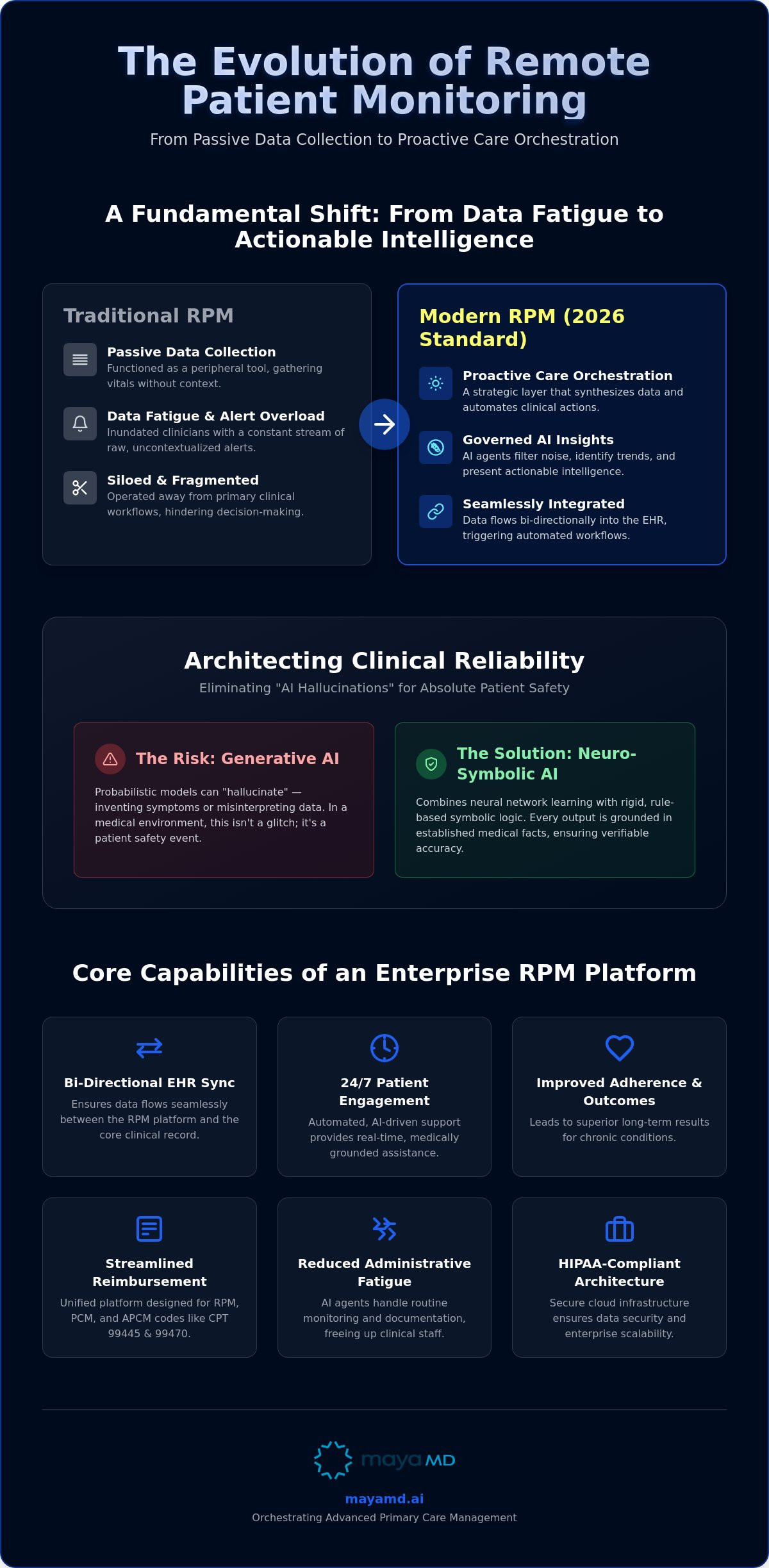
The healthcare infrastructure of 2026 demands more than just connectivity; it requires a systematic synthesis of data and action. For years, Remote Patient Monitoring (RPM) functioned as a peripheral tool for data collection, often operating in a silo away from the primary clinical workflow. Modern remote patient monitoring software has now transcended its role as a simple repository for physiological readings to become a strategic orchestration layer. This transformation relies on a HIPAA-compliant cloud architecture that ensures data security while providing the scalability required for enterprise-level population health management. We're witnessing a definitive move from "connected devices" to "integrated clinical intelligence" where every data point serves a specific diagnostic or therapeutic purpose.
The shift toward integrated clinical intelligence is driven by the necessity for precision. In the past, providers struggled with the "last mile" of data, which involves getting the right information to the right clinician at the right time. By leveraging neuro-symbolic AI, the orchestration layer validates incoming telemetry against established clinical protocols before it ever reaches the physician's inbox. This level of oversight ensures that the care team remains focused on high-priority cases while automated systems handle routine monitoring and documentation. It's a fundamental change in how we perceive the relationship between technology and the practitioner.
Reactive to Proactive
Systems now identify physiological trends before they escalate into acute events.
Siloed to Integrated
Data flows seamlessly into the EHR, triggering automated clinical workflows.
Manual to Governed
AI agents handle routine patient engagement, allowing physicians to focus on complex decision-making.
The Shift from Data Collection to Care Orchestration
Traditional RPM initiatives frequently encountered a common failure point: data fatigue. Clinicians were inundated with raw, uncontextualized alerts that hindered rather than helped decision-making. Today, clinical AI agents act as the primary interface, filtering noise and presenting actionable insights. By utilizing these intelligent agents, care teams can transition from reactive responses to proactive interventions. This systematic approach directly improves patient adherence, as individuals receive real-time support that feels personal and medically grounded, leading to superior long-term outcomes for chronic conditions.
Regulatory Drivers and the Rise of Value-Based Care
The Centers for Medicare & Medicaid Services (CMS) have catalyzed this evolution through updated 2026 guidelines. These regulations prioritize continuous monitoring over intermittent checks, reflecting a broader commitment to value-based care models. This regulatory environment encourages the integration of remote patient monitoring software with Principal Care Management (PCM), creating a holistic framework for high-risk patients. The modern RPM ecosystem serves as a sophisticated bridge that translates raw physiological data into compassionate, high-fidelity human care.
Architecting Reliability: Neuro-Symbolic AI vs. Generative Hallucinations
Clinical reliability is the bedrock of digital health. While probabilistic generative models have gained popularity for creative tasks, their tendency to "hallucinate" creates unacceptable risks in a medical environment. In the context of remote patient monitoring software, an AI that invents a symptom or misinterprets a blood pressure trend isn't just a technical glitch; it's a patient safety event. To solve this, the industry is pivoting toward neuro-symbolic AI. This framework integrates the learning capabilities of neural networks with the rigid, rule-based logic of symbolic AI. For research teams developing these advanced neuro-symbolic systems, MindRove offers high-performance neural interfaces designed to capture the high-fidelity data required for neural model training. By grounding every output in established medical facts, we ensure that patient summaries and post-discharge instructions remain accurate and verifiable.
A "governed" approach to clinical decision support means that the software doesn't simply guess. It follows a systematic framework where every recommendation is cross-referenced against validated clinical guidelines. According to the Agency for Healthcare Research and Quality, the effective use of RPM requires high-fidelity data that care teams can trust for chronic condition management. When remote patient monitoring software uses deterministic logic, it provides a stable foundation for this trust, ensuring that automation supports rather than subverts clinical expertise.
The Mechanism of Deterministic Logic in Care
Safety is built into the architecture through logic gates. By mapping clinical protocols directly into the AI's decision-making pathways, the system ensures that any patient intervention remains within the bounds of standard care. This deterministic approach is essential for maintaining HIPAA compliance, as it allows for secure, private AI models that don't rely on unpredictable public data sets. For example, when documenting chronic care episodes, the AI can automatically verify that the captured telemetry matches the patient's historical baseline, reducing errors in longitudinal documentation. You can see these principles in action by exploring how MayaMD's clinical AI agent orchestrates these complex logic flows.
Reducing Physician Burnout via Intelligent Automation
Data fatigue is a primary driver of physician burnout. Intelligent automation addresses this by performing the "pre-charting" process, where clinical AI agents synthesize raw telemetry into concise, structured notes before the physician even opens the file. This filtered approach prevents alarm fatigue by suppressing non-critical alerts while highlighting significant physiological shifts. The result is a clear capability-to-outcome progression: by implementing automated intake and intelligent filtering, practices can significantly reduce administrative hours, allowing providers to focus on the human elements of care. This transition from manual data entry to governed oversight represents a vital shift in clinical efficiency.
Evaluating Core Capabilities of Enterprise RPM Platforms
Selecting remote patient monitoring software is no longer a search for a hardware vendor; it's a strategic decision to implement a clinical orchestration layer. High-performing enterprise platforms distinguish themselves through bi-directional synchronization rather than simple data pushing. This advanced integration ensures that physiological data doesn't just sit in a silo but actively informs the patient's longitudinal record. By utilizing FHIR standards, these systems facilitate seamless data portability, allowing multi-disciplinary teams to access real-time visualizations that reflect the patient's current status accurately.
Connectivity is a primary pillar of reliability. A device-agnostic approach allows practices to support a wide range of peripherals, from cellular-connected blood pressure cuffs to Bluetooth-enabled glucose monitors. As noted by the FCC on Remote Patient Monitoring, the underlying communications infrastructure is vital for maintaining the "always-on" connectivity required for chronic care. This flexibility prevents technical barriers from excluding patients who may lack sophisticated home networks, ensuring equitable access to care across diverse demographics.
EHR Integration and Interoperability Standards
Interoperability is the cornerstone of modern healthcare scalability. In 2026, the necessity of FHIR standards for data portability is absolute, ensuring that patient information moves securely between disparate systems. MayaMD reduces friction by integrating directly into major clinical workflows, allowing providers to view patient telemetry without leaving their primary EHR environment. This bi-directional flow enables the Clinical AI Agent to pull historical context, ensuring that every alert is grounded in the patient's specific medical history.
The Patient Experience: Engagement and Retention
For elderly patients managing multiple chronic conditions, high-tech solutions must feel high-touch. Personalized care pathways, delivered via Clinical AI Agents, provide the constant support and guidance these patients need to stay adherent to their treatment plans. This approach is mirrored by resources like avonohealth.com, which provides personalized, doctor-guided health and wellness programs through a secure online portal. This digital companionship fosters a sense of security and connection, which is often missing in traditional care models. Patient engagement directly correlates to RPM reimbursement success. When patients feel supported by reliable technology, retention rates rise, leading to the consistent data collection required for successful billing and improved health outcomes.
Operationalizing RPM: Workflow and Regional Implementation
Successful deployment of remote patient monitoring software requires more than a technical installation; it demands a phased operational strategy tailored to the specific clinical environment. Large-scale practices often find that a "big bang" implementation leads to friction and underutilization. Instead, starting with a high-risk pilot group allows care teams to refine their internal protocols and validate the AI's orchestration capabilities before a full-scale rollout. This methodical approach ensures that the technology integrates seamlessly into the daily reality of patient management, fostering long-term stability and provider buy-in.
Staffing considerations are central to this transition. Clinical AI agents don't replace human practitioners but rather augment their capacity by handling the high-volume, low-complexity tasks that traditionally lead to burnout. By automating data triage and routine patient check-ins, the software frees clinicians to focus on the nuances of chronic care management. This capability-to-outcome model transforms the role of the nurse or medical assistant from a data entry clerk into a high-level care coordinator, directly improving the quality of the patient experience during critical post-discharge and transitional periods.
Local Market Dynamics: Houston to Chicago
Healthcare is inherently local. In markets like Indianapolis and Phoenix, where provider shortages are particularly acute, remote patient monitoring software acts as a vital force multiplier for overextended clinics. Conversely, in high-volume urban centers like Las Vegas, providers are utilizing AI to manage massive chronic care populations with a level of precision that was previously impossible. Understanding regional reimbursement nuances and local payer preferences is essential for financial sustainability. For instance, clinics in Houston and Chicago may face different prior authorization hurdles, requiring a platform that can adapt its documentation output to meet specific local requirements.
Managing the Reimbursement Lifecycle
Reliable revenue depends on precise tracking. To satisfy CMS requirements, practices must document at least 20 minutes of monthly clinical time for RPM billing under CPT code 99457. Advanced platforms integrate this with Principal Care Management (PCM) and Advanced Primary Care Management (APCM), creating a comprehensive revenue cycle that captures the full scope of patient care. AI-generated clinical logs provide an audit-proof trail, ensuring that every minute of orchestration is backed by deterministic logic and factual evidence. To see how this level of precision can stabilize your practice's revenue, explore MayaMD's clinical AI solutions today.
MayaMD: Orchestrating Advanced Primary Care Management
MayaMD stands as a sophisticated partner for clinical workflows. By unifying Remote Patient Monitoring (RPM), Principal Care Management (PCM), and Advanced Primary Care Management (APCM) into a single, HIPAA-compliant ecosystem, the platform eliminates the fragmentation that often plagues digital health initiatives. This integration is vital for practices looking to maximize their impact under the 2026 Physician Fee Schedule. While other providers focus on hardware, MayaMD prioritizes the intelligence layer. Our remote patient monitoring software utilizes neuro-symbolic AI to ensure every clinical insight is grounded in deterministic logic, providing the high-stakes reliability required for chronic care management.
The Clinical AI Agent serves as the bridge between disparate data points and human care. Operating with cold, hard logic yet maintaining an empathetic patient experience, this agent provides 24/7 support and automated documentation. This systematic oversight ensures that care teams can scale their operations without compromising the quality of care or risking the hallucinations common in purely generative models. It's a visionary approach where technology fosters connection, allowing practitioners to move past the experimental phase into proven, measurable performance. This level of precision is essential as the U.S. RPM market is estimated to reach 19.14 billion dollars in 2026.
Proven outcomes are the result of rigorous oversight and technological ambition. By leveraging deterministic AI, MayaMD enhances clinical efficiency, reducing the administrative burden that leads to physician burnout. Every technical feature, from bi-directional EHR synchronization to automated billing logs, is designed with a specific outcome in mind: better patient health and a more stable revenue cycle. We don't just provide remote patient monitoring software; we offer a long-term partnership in a rapidly evolving digital healthcare landscape.
The Clinical AI Agent in Action
MayaMD’s agent facilitates advanced primary care management by orchestrating the entire patient journey. From initial digital intake to continuous chronic management, the system streamlines clinical workflows by filtering noise and highlighting actionable physiological trends. This capability-to-outcome model ensures that your practice remains at the forefront of clinical efficiency. We envision a future where AI and human care work in harmony, creating a seamless environment where technology supports the connection between provider and patient rather than obstructing it.
Getting Started with MayaMD
Transitioning to a governed AI platform is a methodical process. We begin with a comprehensive clinical workflow analysis to identify specific friction points in your current management of chronic conditions. Our integration timelines are designed to be predictable, supported by rigorous staff training protocols that ensure your team feels confident using advanced clinical tools. By partnering with MayaMD, you're choosing a reliable expert dedicated to long-term performance and regulatory adherence. Transform your clinical documentation with MayaMD to secure your practice's place in the future of healthcare.
Orchestrating the Future of Precision Health
The transition toward a proactive care model is no longer a theoretical pursuit. By 2026, the integration of neuro-symbolic AI into remote patient monitoring software has redefined the standard for clinical reliability. We've moved past the era of data fatigue and unpredictable generative outputs into a period of governed, deterministic orchestration. This evolution ensures that chronic care management remains both precise and scalable, even in high-volume markets like Houston, Chicago, and Phoenix. The shift from reactive alerts to proactive interventions is now the definitive benchmark for enterprise-level healthcare delivery.
MayaMD provides the HIPAA-compliant architecture necessary to support complex RPM, PCM, and APCM workflows without the risk of clinical hallucinations. By grounding every patient intervention in systematic logic, we empower care teams to focus on high-fidelity human care while our Clinical AI Agent handles the rigorous documentation required for modern reimbursement cycles. It's time to move beyond simple connectivity and embrace a fully integrated clinical intelligence layer. Schedule a Clinical AI Platform Demo to begin your practice's transformation. The future of digital health is one of connection and support; we're ready to help you navigate this transition with confidence.
Frequently Asked Questions
What is the difference between RPM and PCM software?
Remote Patient Monitoring (RPM) focuses on the systematic collection and analysis of physiological data, such as blood pressure or oxygen saturation. Principal Care Management (PCM) is designed for the comprehensive management of a single high-risk chronic condition. While remote patient monitoring software tracks real-time telemetry, PCM software orchestrates the broader care plan and documentation required for patients with complex, condition-specific needs.
How does MayaMD ensure AI clinical documentation is accurate and hallucination-free?
MayaMD utilizes a neuro-symbolic AI architecture that integrates deterministic logic with generative capabilities to eliminate hallucinations. By grounding every clinical summary in a systematic framework of established medical facts, the platform ensures that documentation remains accurate and verifiable. This governed approach prevents the unpredictable outputs often associated with standard large language models, providing the high-stakes reliability required for modern clinical workflows.
Is remote patient monitoring software HIPAA compliant?
Yes, enterprise-grade remote patient monitoring software must adhere to rigorous HIPAA standards to ensure the security of protected health information. MayaMD provides a HIPAA-compliant clinical AI platform that utilizes secure, private AI models. This architecture protects sensitive patient data while maintaining the stability and regulatory adherence necessary for population health management across major clinical networks.
What are the 2026 Medicare reimbursement requirements for RPM?
For 2026, CMS requirements include specific thresholds for device supply and treatment management. CPT code 99454 requires device supply for 16 to 30 days per month, while the new CPT code 99445 covers shorter durations of 2 to 15 days. Additionally, providers must document at least 20 minutes of monthly clinical time under CPT code 99457 to qualify for the full reimbursement rate.
Can MayaMD integrate with my existing EHR system like Epic or Cerner?
MayaMD is designed for bi-directional synchronization with major EHR systems, including Epic and Cerner. By utilizing FHIR standards, the platform ensures that physiological data and AI-generated insights flow seamlessly into the patient's longitudinal record. This integration reduces friction for care teams by allowing them to view telemetry and clinical summaries without leaving their primary electronic health record environment.
How does a Clinical AI Agent improve patient engagement in chronic care?
A Clinical AI Agent improves engagement by providing 24/7 support and personalized care pathways for patients managing chronic conditions. This digital companionship ensures that patients remain adherent to their monitoring schedules, which directly correlates to clinical success. The agent acts as a bridge, offering real-time guidance that feels personal while remaining grounded in the cold, hard logic of clinical protocols.
Do I need to provide devices to my patients for RPM software to work?
Yes, CMS requires that RPM services use medical devices as defined by the FDA to capture and transmit physiological data. While the software orchestrates the care, patients must use peripherals such as cellular-connected blood pressure cuffs or glucose monitors. Many practices choose a device-agnostic platform to support a variety of hardware options, ensuring the technology remains accessible to diverse patient demographics.
What is Advanced Primary Care Management (APCM) and how does AI support it?
Advanced Primary Care Management (APCM) is a unified care model that integrates elements of RPM and chronic care management into a single framework. AI supports APCM by automating the documentation and triage processes, allowing providers to manage large patient populations with greater efficiency. This capability-to-outcome model ensures that high-risk patients receive continuous oversight through a sophisticated, data-driven system that reduces administrative burden.




See The MayaMD Difference
Fill the form below
Download Our Apps
MayaMD for patients and MayaPro for physicians - available on iOS and Android.
FOR PATIENTS
MayaMD App
AI-powered symptom assessment, triage, and secure access to your care team.
FOR PHYSICIANS
MayaPro App
MayaPro brings patient vitals, RPM/PCM care plans, and clinical decision support to your pocket.