
2026 RPM Vendors: Clinical AI Integration Buyer’s Guide

What if the greatest risk to your clinical strategy isn't the hardware you deploy, but the lack of a governed intelligence layer sitting behind it? Most healthcare executives recognize that while data collection is ubiquitous, the administrative burden it places on physicians has reached a breaking point. You likely feel the tension between the need for continuous oversight and the reality of clinical burnout exacerbated by fragmented, non-actionable data. Selecting from the current sea of remote patient monitoring vendors requires more than a checklist of features; it demands a rigorous assessment of how a platform integrates deterministic logic to eliminate AI hallucinations and secure patient safety.
This guide provides a sophisticated framework for evaluating partners through a clinical-first lens that prioritizes EHR connectivity and measurable outcomes. You'll learn how to navigate the 2026 reimbursement landscape, including the application of new CPT codes like 99445 and 99470, while ensuring your technology stack remains compliant with evolving CMS oversight. We'll preview the essential criteria for a "capability-to-outcome" model that transforms remote monitoring from a simple data stream into a seamless, automated extension of your practice's chronic care delivery.
Key Takeaways
• Understand why vendor stability and the shift from raw data transmission to proactive clinical intelligence are the new benchmarks for success in the 2026 landscape.
• Evaluate remote patient monitoring vendors based on their ability to provide native EHR integration and automated triage rather than relying on basic API connectivity.
• Identify the "AI Safety Gap" by prioritizing platforms that utilize deterministic logic to eliminate clinical hallucinations and ensure patient safety in documentation.
• Discover how to operationalize advanced primary care management (APCM) through strategic deployment models and streamlined vendor-managed device fulfillment.
• Learn to transition your practice toward a unified clinical AI ecosystem that bridges the gap between disparate data points and actionable chronic care interventions.
The 2026 RPM Landscape: Moving Beyond Basic Connectivity
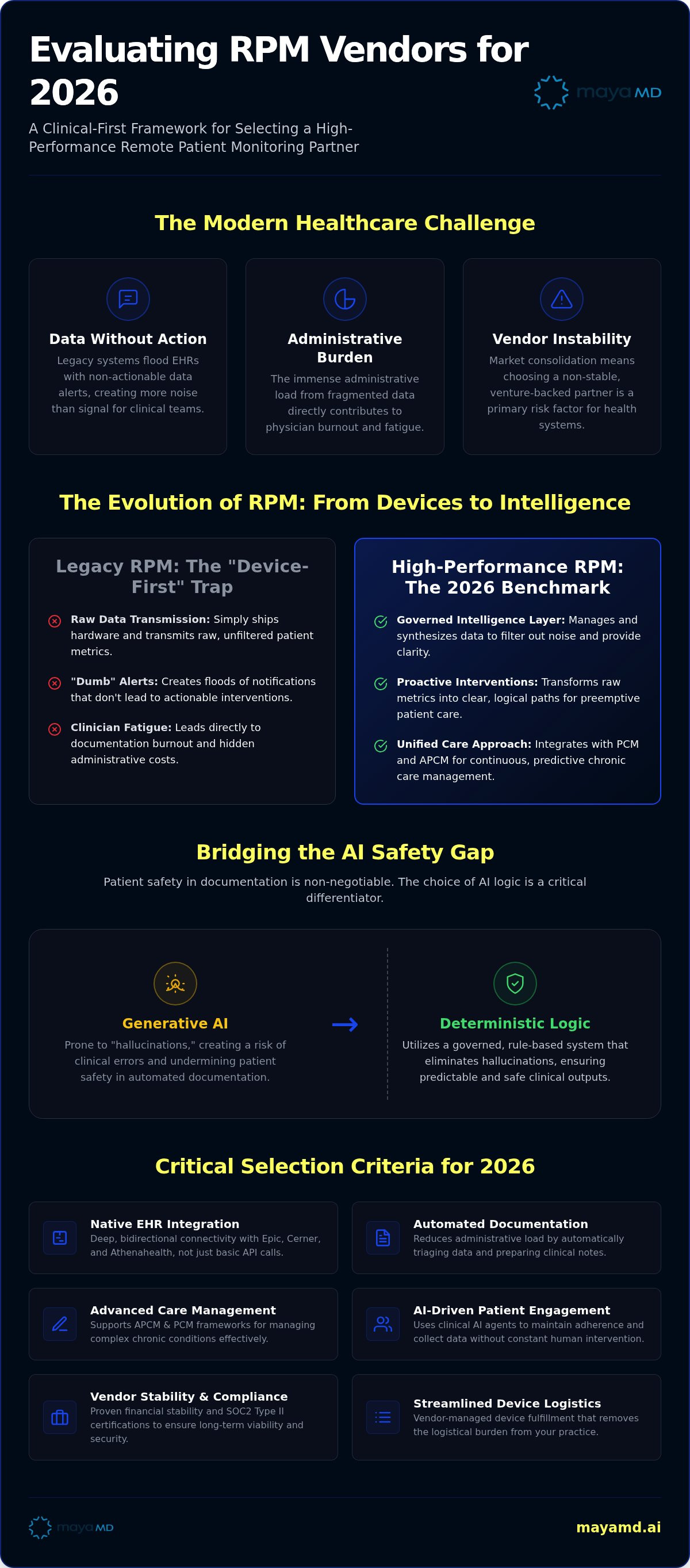
The industry has matured. We've moved past the era where simply transmitting a heart rate or glucose level was considered a technological breakthrough. Today, Remote patient monitoring (RPM) functions as the foundational layer of a sophisticated clinical intelligence ecosystem. In 2026, the distinction between remote patient monitoring vendors is no longer based on who can ship the most hardware. Instead, it's defined by who can provide a stable, governed intelligence layer to manage the resulting data. This evolution is driven by a necessity to move from reactive alerts to proactive, automated interventions that actually support the clinician.
Market consolidation has introduced new strategic risks. As smaller, venture-backed players exit or are absorbed, vendor stability has become a primary risk factor for health systems. Choosing a partner isn't just a technical decision; it's a commitment to a platform that can survive regulatory shifts and the rigorous oversight of the 2026 Medicare Physician Fee Schedule (MPFS). We're seeing a definitive transition from traditional fee-for-service billing toward value-based care models, specifically Advanced Primary Care Management (APCM). This shift rewards providers for measurable patient outcomes rather than simple data collection, making clinical AI integration a requirement for financial viability.
The Failure of "Device-First" Strategies
Hardware logistics are now a commodity. While any vendor can provide a blood pressure cuff, often procured through high-quality exporters like IMT Medical Devices, the true differentiator is how that device interacts with the clinical workflow. Many providers have discovered that "dumb" data alerts lead directly to clinician fatigue. These legacy systems flood the EHR with notifications that don't lead to actionable interventions, creating hidden costs through documentation burnout. High-performance remote patient monitoring vendors now prioritize data synthesis over raw collection. They filter the noise and present only what's clinically relevant, transforming raw metrics into clear, logical paths for patient care.
Defining High-Performance RPM for 2026
Success requires a unified care approach. High-performance RPM now integrates with Principal Care Management (PCM) to support patients with complex chronic conditions through a single clinical AI platform. This isn't about periodic check-ins. It's about continuous care that utilizes predictive analytics as a baseline standard. Modern platforms must anticipate clinical decline before it results in an emergency room visit. In competitive healthcare markets like Chicago and Houston, where large systems are aggressively pursuing value-based contracts, these capabilities are the bridge between disparate data points and human care. They foster the connection and support necessary to manage high-risk populations while maintaining rigorous clinical authority.
Critical Selection Criteria for Remote Patient Monitoring Vendors
Selecting from the pool of remote patient monitoring vendors requires a departure from traditional procurement checklists. It's no longer sufficient to evaluate vendors based on device variety or basic dashboard functionality. We're witnessing a significant shift toward platforms that function as an extension of the clinical team. This means prioritizing HIPAA-compliant cloud architectures and SOC2 Type II certifications as baseline requirements, then looking deeper into how a vendor supports scalability across multi-city networks through Advanced Primary Care Management (APCM) and Principal Care Management (PCM) frameworks. A sophisticated partner understands that the technology must serve the clinical workflow, not the other way around.
Clinical AI Integration
Does the platform support automated triage and documentation to reduce administrative load?
Interoperability
Look for native integration with Epic, Cerner, and Athenahealth that goes beyond basic API connectivity.
Patient Engagement
The use of specialized clinical AI agents to maintain adherence and collect data without constant human intervention.
Regulatory Compliance
Proven adherence to the latest CMS guidelines and robust data security protocols.
Scalability
The ability to support diverse care models across large, fragmented provider networks.
EHR Integration and Workflow Seamlessness
The most effective remote patient monitoring vendors deliver "invisible" integration. This means patient vitals land directly in clinical flowsheets without requiring a secondary login or manual data entry. For high-volume clinics, reducing this friction is vital to preventing staff burnout. Additionally, look for platforms that automate charge capture for CPT codes 99453, 99454, and 99457. When the billing logic is embedded in the workflow, the financial sustainability of the program is secured. This level of connectivity allows physicians to maintain their focus on the patient rather than the mechanics of the software.
Clinical Decision Support (CDS) Capabilities
Alert fatigue is a primary cause of program failure. Intelligent thresholding allows clinicians to customize protocols for hypertension, diabetes, and heart failure. This ensures that only clinically significant deviations reach the provider. The necessity of remote patient monitoring software that evolves with clinical guidelines cannot be overstated. If the platform lacks the deterministic logic to interpret data accurately, it remains a liability rather than an asset. For those seeking a governed approach to these complexities, exploring a clinical AI platform can provide the necessary oversight and help bridge the gap between raw data and actionable care.
The AI Safety Gap: Deterministic Logic vs. Generative Hallucinations
Trust is the prerequisite for clinical adoption. Many remote patient monitoring vendors treat artificial intelligence as a marketing buzzword, offering "black box" solutions that lack transparency. This creates a significant safety gap. While generative models excel at natural language synthesis, they often lack the foundational medical logic required to distinguish between a benign symptom and a clinical red flag. In a high-stakes environment, the danger of ungoverned Large Language Models (LLMs) lies in their tendency to "hallucinate" plausible but incorrect medical information. For clinicians in Chicago's competitive health systems, these errors aren't just administrative nuisances; they're liabilities that compromise the quality of care.
Deterministic logic provides the necessary guardrails. By utilizing a governed approach, a platform ensures that every automated triage decision or clinical summary follows established medical truths and systematic frameworks. This isn't about replacing the physician's judgment. It's about providing a reliable, collaborative expert that presents data with the cold, hard logic of advanced data science. When a system is deterministic by design, it eliminates the "AI summary" anxiety that many practitioners feel. It allows the technology to act as a bridge between disparate data points and human care, ensuring that every insight is both actionable and clinically valid.
Eliminating Hallucinations in Clinical Documentation
Accuracy is achieved through a neuro-symbolic architecture. MayaMD’s Clinical AI Agent utilizes this sophisticated framework to ensure that clinical notes and patient summaries remain grounded in medical reality. By integrating symbolic AI, which follows strict rules and logic, with neural networks that handle language nuance, the platform maintains a rigorous oversight of all generated content. Neuro-symbolic AI represents the 2026 standard for clinical safety by merging the pattern recognition of neural networks with the rigorous, rule-based logic of symbolic systems. This methodology ensures that documentation is not only efficient but also mirrors the precision required in a clinical process.
AI-Driven Patient Engagement
Engagement must move beyond the limitations of simple SMS reminders. Interactive clinical AI agents now facilitate a more sophisticated level of patient connection, particularly in post-discharge care and chronic condition management. These agents provide the support necessary to maintain high adherence rates without increasing the burden on clinical staff. In fact, these governed systems can handle 80% of routine patient inquiries without escalating to a human provider. This automation reduces physician burnout and ensures that patients receive immediate, logic-based responses to their concerns. For remote patient monitoring vendors, the ability to provide this level of automated, safe engagement is what separates visionary partners from simple hardware providers.
Operationalizing RPM: Logistics, Implementation, and APCM
Deploying a successful program in a competitive market like Chicago requires a methodical approach that extends beyond software installation. Clinical leaders often find that the most effective remote patient monitoring vendors are those that offer comprehensive support for the operational burden. This involves a strategic choice between in-house management and vendor-managed logistics. For many, starting with high-risk populations in specific geographic hubs, such as Indianapolis or Las Vegas, allows for a controlled rollout that proves clinical validity before scaling. As the program matures, the focus naturally shifts toward advanced primary care management (APCM), where the goal is holistic, continuous oversight of chronic conditions rather than isolated data points.
Training clinical staff to leverage AI-governed workflows is equally critical. It's not enough to simply provide data; the platform must guide the clinician through the next steps of care. This transition ensures that the technology acts as a bridge between disparate data and human care, maintaining the professional gravity required in a clinical environment. A reliable partner understands that documentation shouldn't be a secondary task, but a seamless byproduct of the monitoring process itself.
The Logistics of Patient Onboarding
Successful onboarding hinges on reducing the technical barrier for elderly patients with chronic conditions. High-performance vendors utilize "white-glove" device fulfillment models, ensuring that pre-configured devices are shipped directly to the patient's home. Cellular connectivity is the standard here, as it eliminates the need for complex Wi-Fi setup, which is often a primary point of failure. By ensuring that the device works "out of the box," providers can maintain high adherence rates and foster a sense of connection and support from the very first interaction.
Workflow Automation and Burnout Reduction
The documentation crisis is the hidden cost of many digital health initiatives. While competitors focus on device logistics, visionary partners address the administrative burden. Implementing clinical workflow automation solutions can save a physician 10 or more hours per week by automating the creation of clinical notes from incoming data. This level of automation streamlines the "Review of Systems" for chronic care visits, allowing practitioners to focus on the human impact of care. If you're ready to eliminate documentation fatigue and prioritize patient outcomes, you can schedule a clinical AI consultation to see these governed workflows in action.
Why MayaMD is the Authoritative Choice for 2026 RPM
In a marketplace crowded with hardware-centric remote patient monitoring vendors, MayaMD distinguishes itself as an Authoritative Pioneer. We've moved past the experimental phase into a proven application of clinical AI that prioritizes safety, logic, and systematic frameworks. Our platform isn't a collection of disparate tools; it's a comprehensive ecosystem that integrates RPM, Principal Care Management (PCM), and Advanced Primary Care Management (APCM) into a single, cohesive interface. This governed approach ensures that every data point collected from a patient's home is filtered through deterministic logic to provide actionable, reliable insights for the clinical team.
Stability and security are the foundations of our partnership model. As an established leader, we provide a HIPAA-compliant, AI-governed architecture that eliminates the risks associated with ungoverned generative models. Our specialized Clinical AI Agent acts as a sophisticated partner, managing patient engagement and routine inquiries with the precision of a trained medical professional. This focus on the human impact of technology allows healthcare executives to foster deeper connections with their patients while maintaining the rigorous oversight required in high-stakes environments.
Integrating RPM into the APCM Framework
The 2026 shift toward value-based care requires more than just monitoring; it requires active management. MayaMD supports the full spectrum of the APCM framework by providing the logic-based triage necessary to improve outcomes in complex chronic care. This capability has made us the preferred partner for large provider networks in Phoenix and Houston, where the demand for scalable, high-performance care management is at its peak. By bridging the gap between raw metrics and clinical interventions, we help practices transition from reactive billing to proactive, continuous care delivery.
Next Steps: Evaluating Your RPM Strategy
Scaling a program from 100 to 10,000 monitored lives requires more than just more devices; it requires a roadmap for workflow optimization. We invite clinical leaders to request a comprehensive workflow audit to identify where AI-governed automation can most effectively reduce physician burnout. This methodical evaluation ensures that your RPM strategy is not only compliant with 2026 regulations but also optimized for long-term clinical performance. If you're ready to move beyond basic connectivity and embrace the future of clinical intelligence, Explore MayaMD’s Remote Patient Monitoring Solutions to begin your transition to a more connected, efficient care model.
Securing the Future of Clinical Intelligence
The 2026 landscape demands a definitive shift from passive data collection to active, governed clinical intelligence. As you evaluate remote patient monitoring vendors, your priority must remain the integrity of the clinical workflow and the elimination of administrative documentation burdens. We've explored how neuro-symbolic AI provides the necessary guardrails to eliminate clinical hallucinations while ensuring that your practice remains compliant with evolving APCM and PCM requirements. This isn't just about software; it's about a HIPAA-compliant, cloud-based architecture that fosters a deeper connection between the provider and the patient through reliable, deterministic automation.
Success in this new era requires a partner that understands the nuances of chronic care management and the high stakes of clinical decision support. By prioritizing a clinical-first framework, you'll reduce physician burnout and improve patient adherence through a seamless, automated extension of your practice. The transition to advanced primary care management is a journey toward measurable performance and enhanced quality of life for your patients. We're here to help you navigate these complexities with the cold, hard logic of advanced data science and the empathy of human care.
Ready to transform your chronic care strategy? Request a Clinical AI Strategy Consultation to discover how a governed platform can bridge the gap between data and human care. Together, we can build a more sustainable, high-performance healthcare ecosystem that prioritizes clinical truth and patient safety.
Frequently Asked Questions
How do remote patient monitoring vendors ensure HIPAA compliance in 2026?
Leading remote patient monitoring vendors maintain compliance through a combination of SOC2 Type II certified cloud architectures and end-to-end encryption for all data in transit and at rest. In the 2026 regulatory environment, this includes rigorous audit trails for AI-generated clinical summaries and deterministic logic to ensure that sensitive patient information remains within secure, governed boundaries. These systematic frameworks prioritize data integrity and patient privacy at every stage of the monitoring process.
What is the difference between legacy RPM software and AI-governed platforms?
Legacy RPM software functions primarily as a data transmission tool that requires clinicians to manually filter alerts and identify trends from raw metrics. AI-governed platforms utilize deterministic logic to provide automated triage and documentation, transforming those raw data points into actionable clinical intelligence. This sophisticated approach reduces the administrative burden on physicians by ensuring that only clinically significant deviations reach the provider's attention.
Can RPM vendors integrate with Epic and Athenahealth simultaneously?
Yes, sophisticated remote patient monitoring vendors can maintain native integrations with both Epic and Athenahealth through HL7 FHIR standards. This dual-connectivity allows vitals to land directly in clinical flowsheets across different provider networks, which is essential for large health systems managing fragmented care environments. It eliminates the "second login" friction and ensures that patient data is accessible within the existing clinical workflow.
How does the 2026 Medicare reimbursement rule affect RPM vendor selection?
The 2026 Medicare Physician Fee Schedule introduced new CPT codes, such as 99445 and 99470, which allow for reimbursement of shorter monitoring durations and smaller increments of clinical staff time. You should select a vendor that automates the charge capture for these specific codes to maximize financial sustainability. Additionally, your partner must help you prepare for proposed 2027 rules that may limit the outsourcing of RPM services to third-party companies.
What should I look for in an RPM vendor for Principal Care Management (PCM)?
Prioritize vendors that offer a unified ecosystem where RPM, PCM, and APCM function on a single clinical AI platform. This integration ensures that patients with complex chronic conditions receive continuous, logic-based oversight rather than isolated monitoring. Look for specialized protocols for high-risk conditions and automated engagement tools that maintain patient adherence without requiring constant human intervention from your staff.
How does MayaMD prevent AI hallucinations in patient documentation?
MayaMD utilizes a neuro-symbolic AI architecture that integrates deterministic logic with generative capabilities to eliminate clinical hallucinations. This governed approach ensures that every clinical summary or patient interaction remains grounded in established medical truth and rigorous symbolic frameworks. By combining the pattern recognition of neural networks with rule-based logic, the platform maintains a level of precision that ungoverned Large Language Models cannot match.
Are cellular devices better than Bluetooth for RPM patient adherence?
Cellular devices are generally superior for patient adherence because they offer a "white-glove" setup that doesn't require smartphone pairing or Wi-Fi configuration. By removing these technical barriers, cellular hardware ensures a more reliable data stream, particularly for elderly patients with chronic conditions. This reliable connectivity is a cornerstone of a successful program, as it fosters a sense of connection and support without technical frustration.
What is the typical implementation timeline for a large-scale RPM program?
A typical implementation timeline for a large-scale program ranges from four to eight weeks, depending on the complexity of your EHR integration. The process begins with a clinical workflow audit and moves through technical configuration, staff training, and the strategic deployment of devices. This methodical approach ensures that the technology is fully integrated into your practice's daily reality before you scale to thousands of monitored lives.




See The MayaMD Difference
Fill the form below
Download Our Apps
MayaMD for patients and MayaPro for physicians - available on iOS and Android.
FOR PATIENTS
MayaMD App
AI-powered symptom assessment, triage, and secure access to your care team.
FOR PHYSICIANS
MayaPro App
MayaPro brings patient vitals, RPM/PCM care plans, and clinical decision support to your pocket.