
Digital Healthcare for Chronic Disease: The Shift to AI-Governed Continuous Care

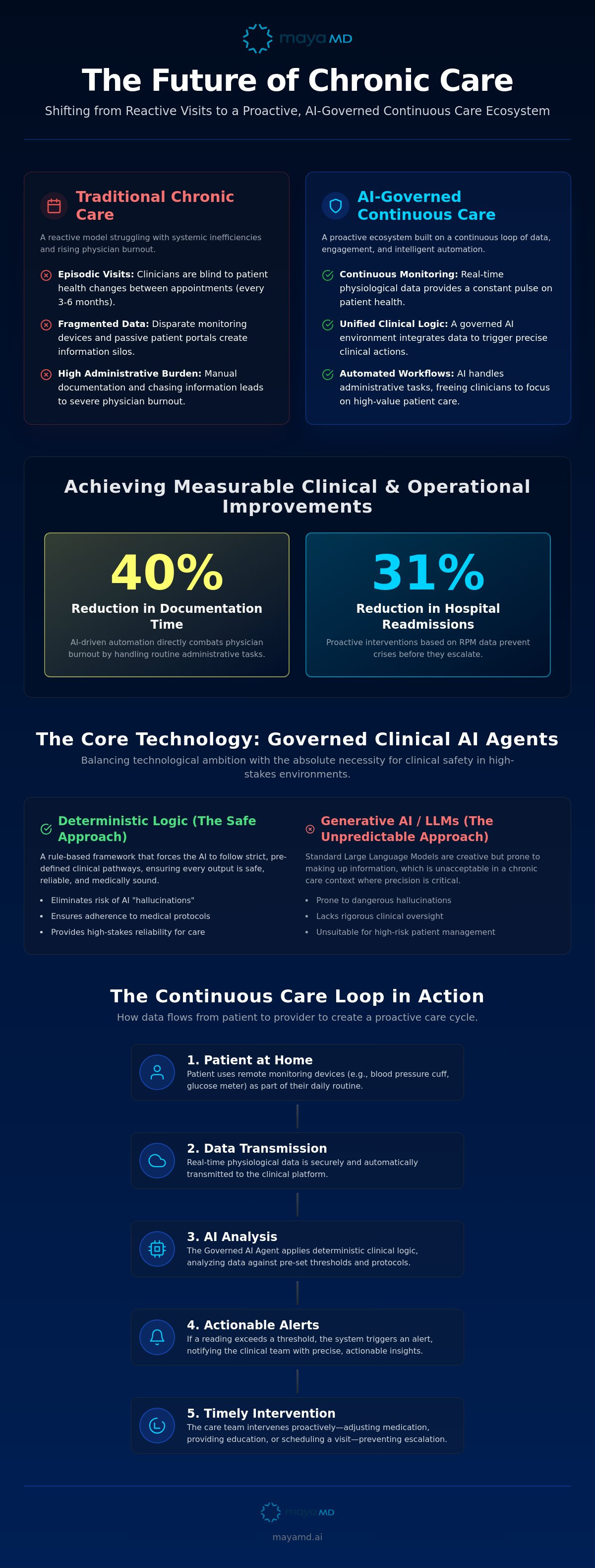
The future of chronic care isn't found in the next blockbuster drug, but in the shift from reactive clinical visits to a proactive, AI-governed continuous care ecosystem. You've likely experienced the mounting pressure of physician burnout from manual documentation and the frustration of managing fragmented data from disparate monitoring devices. It's a common struggle to maintain consistent patient engagement between scheduled appointments. This article demonstrates how advanced clinical AI and remote monitoring frameworks are transforming digital healthcare for chronic disease by moving beyond simple data collection into a governed environment of clinical logic. You'll discover how these systems facilitate automated documentation workflows and scalable Remote Patient Monitoring (RPM) programs. We'll explore the integration of deterministic logic that prevents AI hallucinations, ensuring that technological ambition remains grounded in clinical safety. By the end of this piece, you'll understand how to leverage these tools to achieve improved clinical outcomes for high-risk patients and realize the 40% reduction in documentation time that leading health systems are already reporting.
Key Takeaways
• Shift from reactive, episodic visits to a proactive, continuous care loop that prioritizes patient safety through deterministic logic and rigorous oversight.
• Understand how Clinical AI Agents balance technological ambition with the necessity for clinical safety in highly regulated environments.
• Navigate the 2026 reimbursement landscape for RPM, PCM, and APCM to build a scalable and financially sustainable care ecosystem.
• Learn how AI-driven automation handles administrative tasks, reducing documentation time by up to 40% to directly combat physician burnout.
• Discover how a comprehensive strategy for digital healthcare for chronic disease can lead to improved clinical outcomes and a 31% reduction in hospital readmissions.
The Evolution of Digital Healthcare for Chronic Disease Management
Digital healthcare for chronic disease is no longer a peripheral convenience; it represents a fundamental shift in clinical methodology. This evolution replaces the fragmented, episodic nature of traditional visits with a continuous, tech-enabled care loop. This loop integrates real-time physiological data with structured clinical logic to create a proactive rather than reactive ecosystem. By moving away from the "wait-and-see" model, providers can maintain a constant pulse on patient health, ensuring that interventions occur at the moment of need rather than the moment of crisis. This transition relies on three core pillars: robust monitoring, persistent engagement, and intelligent automation. Each pillar must function within a framework of high-stakes reliability, where the choice of a platform is dictated by its ability to provide rigorous oversight and clinical precision.
The Burden of Traditional Chronic Care Models
The traditional model of chronic care is buckling under the weight of systemic inefficiencies and demographic pressures. In metropolitan hubs like Phoenix and Indianapolis, where physician shortages are increasingly acute, the limitations of episodic care are magnified. When clinicians only see high-risk patients every three to six months, they remain blind to the subtle physiological shifts that precede a major medical event. This lack of visibility results in a high cost of preventable hospitalizations, as patients often don't seek care until their symptoms are advanced. While early iterations of patient portals attempted to bridge this gap, they often failed to solve the engagement crisis. These portals remained passive repositories for data rather than active tools for connection, leaving patients feeling isolated between visits and clinicians overwhelmed by the administrative burden of chasing information.
The Rise of Continuous Remote Patient Monitoring (RPM)
Remote Patient Monitoring (RPM) serves as the foundational layer of modern digital healthcare for chronic disease. By establishing a constant flow of data for conditions like hypertension and diabetes, providers can execute early interventions before symptoms escalate. This represents a critical shift from mere data collection to data-driven clinical action. When a blood pressure reading exceeds a predefined threshold, the system doesn't just record the number; it triggers a governed clinical response. For a comprehensive Digital Health Overview, one can see how these interventions are becoming standardized to improve longitudinal outcomes. The integration of RPM allows for a seamless transition from the clinic to the home, ensuring that the quality of care remains consistent regardless of the patient's physical location. This connectivity fosters a sense of security for the patient while providing the clinician with the precise, actionable insights required to manage complex chronic populations at scale.
Beyond Basic Software: The Architecture of Clinical AI Agents
Static portals and EHRs have served their purpose as record-keeping tools, but they lack the cognitive capacity to manage complex patient populations. The Clinical AI Agent represents the next phase in the evolution of digital healthcare for chronic disease. These agents aren't merely software programs; they are sophisticated entities capable of executing clinical logic with high-stakes reliability. By functioning as a bridge between raw data and human care, they allow clinicians to move past the limitations of traditional health IT. This shift is essential for practices that need to manage high-risk patients without exponentially increasing their staff's workload.
True clinical innovation requires a "governed" approach to artificial intelligence. This means balancing the creative potential of generative models with the absolute necessity for clinical safety. A governed AI ecosystem ensures that every recommendation or documentation entry adheres to established medical protocols. This oversight is vital for maintaining trust between the technology, the provider, and the patient. It's about moving beyond the experimental phase into a proven application where precision is the baseline, not the goal.
Deterministic Logic vs. Generative AI in Healthcare
Standard Large Language Models (LLMs) are prone to hallucinations, which is unacceptable in a chronic care context. Deterministic logic provides a rule-based framework that eliminates this risk by forcing the AI to follow strict clinical pathways. MayaMD champions a "neuro-symbolic" approach. This architecture combines the fluid communication of generative AI with the rigid, symbolic logic of medical rules. The result is an agent that speaks naturally but acts with the precision of a trained clinician, ensuring that documentation remains accurate and clinically valid at all times.
Integrating Real-Time Patient Data with Clinical Logic
These agents act as a force multiplier for primary care teams by processing RPM data the moment it arrives. Instead of a nurse manually reviewing hundreds of blood pressure readings, the AI flags physiological changes immediately. It then automates the heavy lifting of clinical documentation, translating patient interactions into structured notes that are ready for review. This process occurs within a HIPAA-compliant, cloud-based infrastructure, ensuring that data security is never compromised. Teams can finally scale their programs without increasing their administrative load. For those looking to implement this level of oversight, exploring a reliable AI healthcare platform is the logical next step for modern practices.
Navigating Care Management Frameworks: RPM, PCM, and APCM
The 2026 Medicare Physician Fee Schedule has solidified a new era of clinical oversight. For organizations pursuing digital healthcare for chronic disease, the complexity lies in aligning clinical workflows with the specific requirements of various care management frameworks. These aren't isolated billing categories. Instead, they represent a layered care ecosystem where Remote Patient Monitoring (RPM), Principal Care Management (PCM), and Advanced Primary Care Management (APCM) work in harmony to provide continuous support. In healthcare hubs like Chicago and Boston, we're seeing a rapid adoption of these integrated models as practices move away from fee-for-service toward value-based outcomes. This shift is accelerated by the CMS ACCESS model, which emphasizes technology-enabled, longitudinal care over episodic intervention.
Choosing a platform that supports multiple billing codes is no longer optional. It's a strategic necessity. A unified system allows providers to transition patients between different levels of care without losing data continuity or administrative momentum. This integration ensures that the clinical logic and AI governance discussed earlier remain applied across every patient interaction, regardless of the specific billing framework in use.
Remote Patient Monitoring (RPM) and Principal Care Management (PCM)
The distinction between RPM and PCM is rooted in the source of the data and the scope of clinical focus. RPM focuses on the continuous flow of physiological data, such as weight or blood pressure readings, allowing for immediate intervention when thresholds are breached. PCM, by contrast, is designed for the intensive management of a single, high-risk chronic condition. Under 2026 regulations, PCM requires at least 30 minutes of qualifying care per month. Digital tools are an ideal way to facilitate this requirement at scale. They capture every minute of interaction and documentation, ensuring that the 30-minute threshold is met and verified through automated logs rather than manual tracking.
Advanced Primary Care Management (APCM)
Advanced Primary Care Management (APCM) represents the shift toward a more holistic, value-based primary care model. Unlike episodic billing, APCM focuses on the total care coordination of complex patients, streamlining reimbursement for services that were previously difficult to track. This model is becoming the preferred choice for large primary care groups because it rewards the quality of the care loop rather than the volume of visits. By integrating APCM with existing RPM frameworks, practices can create a comprehensive safety net that supports patients throughout their entire journey. This ensures that no high-risk individual falls through the gaps of a fragmented system, maintaining the high-stakes reliability that modern clinical environments demand.
Optimizing Workflows: Reducing Administrative Burnout
The primary objection to adopting new technology in a clinical setting is the fear of increased workload. Many providers worry that digital healthcare for chronic disease will simply lead to more "click fatigue" and administrative overhead. However, a governed AI ecosystem is designed to be the antidote to this exhaustion. By handling the heavy lifting of data entry and administrative routing, AI agents allow clinicians to return to the actual practice of medicine. This isn't just a marginal improvement; it's a fundamental restructuring of how care is delivered and documented.
This efficiency is achieved through a capability-to-outcome flow. When an AI agent manages the initial patient intake and remote monitoring data, it automatically populates the clinical record with structured, actionable insights. This technical feature leads directly to the outcome of reduced physician burnout. Clinicians no longer need to manually bridge the gap between disparate monitoring devices and the patient's chart. Instead, the system provides a unified view that is already contextualized for clinical decision-making, ensuring that every hour spent in the clinic is focused on high-value patient care.
Automated Clinical Documentation and Workflow Automation
Modern AI agents transcribe and code patient encounters in real-time, functioning as a digital scribe that never tires. This capability addresses the "pajama time" crisis, where physicians spend hours at home completing charts. By integrating these automated notes directly into existing EHR systems, the platform ensures that documentation is both accurate and immediate. Clinics utilizing this level of automation have reported up to a 40% reduction in documentation time. This reclaimed time allows for a more sustainable practice model, especially in high-volume primary care environments where documentation requirements are often the biggest barrier to scaling care programs.
Enhancing Patient Engagement Without Staff Intervention
Automated systems provide a level of persistent engagement that human staff simply cannot match. AI agents offer 24/7 support and education, answering routine patient questions and providing guidance on medication adherence without requiring staff intervention. Automated reminders and check-ins ensure that patients remain compliant with their treatment plans between visits. This consistency leads to measurable improvements in HCAHPS scores, as patients feel more supported and connected to their care team. To see how your practice can implement these automated documentation workflows and engagement tools, exploring a unified AI platform is the next logical step toward operational excellence.
Implementing a Governed AI Ecosystem with MayaMD
The transition to a proactive care model requires more than just clinical intent; it demands a technical infrastructure that bridges the gap between advanced computer science and the daily reality of patient management. MayaMD functions as this critical bridge. By providing a unified platform that supports RPM, APCM, and PCM, it allows organizations to move past the limitations of fragmented data points. This integration creates a comprehensive ecosystem where clinical logic is applied consistently across every patient interaction, ensuring that digital healthcare for chronic disease remains safe, precise, and highly effective. For large health systems, the scalability of the Clinical AI Agent means that high-stakes oversight is no longer limited by human bandwidth, but is instead enhanced by it.
The deployment process is designed to be methodical and thorough, mirroring the clinical workflows it is built to support. By establishing a cloud-based, HIPAA-compliant foundation, clinics can begin realizing the benefits of continuous care without the traditional hurdles of complex software implementation. This approach allows for a steady, predictable flow of data that builds trust through transparency and measurable performance.
The MayaMD Clinical AI Agent Advantage
The core of the MayaMD advantage lies in its commitment to reliable, hallucination-free artificial intelligence. While standard generative models pose risks in a medical context, our platform utilizes deterministic logic to ensure every output adheres to strict clinical protocols. This technical oversight results in a secure environment where clinicians can trust the automated documentation and decision support provided by the agent. The HIPAA-compliant, cloud-based architecture ensures that patient data is protected while remaining accessible for real-time intervention. Primary care and specialty clinics find the deployment straightforward, as the system is built to integrate seamlessly with existing EHRs rather than creating another silo of information. This connectivity is what enables health systems to report benchmarks such as a 31% lower readmission rate.
Future-Proofing Chronic Care Management
The 2026 regulatory landscape, characterized by the launch of the CMS ACCESS model and updated Medicare reimbursement codes, signals a definitive move toward global capitation and value-based care. MayaMD prepares organizations for this shift by providing the tools necessary to document and execute complex care coordination at scale. As reimbursement increasingly depends on longitudinal patient outcomes rather than visit volume, having a governed AI ecosystem becomes a strategic necessity. It allows practices to capture the required minutes for PCM and APCM billing automatically, ensuring financial sustainability alongside clinical excellence. To take the next step in your organization's evolution, learn how MayaMD can streamline your chronic care workflows and provide the high-stakes reliability your patients deserve.
Advancing Toward Proactive Clinical Excellence
The transition from episodic visits to a continuous care loop represents a fundamental evolution in how we manage high-risk populations. By leveraging digital healthcare for chronic disease, organizations can move past the limitations of manual documentation and fragmented data. The integration of neuro-symbolic AI is critical in this shift, as it eliminates clinical hallucinations while maintaining the fluid communication necessary for patient engagement. This governed approach ensures that every intervention is grounded in deterministic logic and clinical safety.
Implementing a HIPAA-compliant, cloud-based infrastructure allows for the seamless management of RPM, PCM, and APCM frameworks within a single ecosystem. This synergy not only improves clinical outcomes but also directly addresses the administrative burnout currently straining our healthcare workforce. By adopting these advanced clinical AI agents, practices can finally scale their care programs without compromising the quality of the patient experience. The tools for this transformation are no longer experimental; they're proven applications ready for deployment.
Discover the MayaMD Clinical AI Platform and join the leaders who are redefining the standards of chronic care management. Your journey toward a more connected, efficient, and proactive clinical future starts here.
Frequently Asked Questions
What is the difference between digital healthcare and traditional chronic disease management?
Digital healthcare for chronic disease replaces episodic office visits with a continuous, tech-enabled care loop. While traditional management relies on reactive treatment during scheduled appointments, digital models utilize real-time data to intervene before a crisis occurs. This proactive approach ensures that physiological changes are captured immediately, allowing clinicians to maintain a persistent pulse on patient health without requiring the patient to travel to a physical clinic for every minor adjustment.
How does a Clinical AI Agent reduce physician burnout?
A Clinical AI Agent acts as a digital scribe and triage assistant, handling the heavy lifting of administrative tasks. By automating patient intake and transcribing encounters in real-time, these agents can reduce documentation time by up to 40%. This significantly decreases the "pajama time" physicians spend on charts after hours. The agent ensures that clinical records are populated with structured data, allowing the care team to focus on high-value patient interactions.
Is Remote Patient Monitoring (RPM) covered by Medicare in 2026?
Yes, Remote Patient Monitoring remains a core component of the 2026 Medicare Physician Fee Schedule. CMS has introduced more flexible CPT codes, such as 99445, which allows for billing with as few as two days of patient data in a 30-day period. National average reimbursement rates for codes like 99453 and 99454 continue to support the scalability of these programs, provided the practice adheres to the established clinical oversight and regulatory requirements.
What is Advanced Primary Care Management (APCM) and who qualifies?
Advanced Primary Care Management is a value-based model that rewards holistic care coordination for complex patients. It's designed for primary care groups that manage high-risk individuals requiring intensive support between visits. APCM streamlines reimbursement by moving away from episodic billing toward a model that values the total quality of the care loop. This framework is particularly beneficial for practices participating in the CMS ACCESS model, which launched on July 5, 2026.
How does MayaMD ensure AI clinical documentation is accurate and hallucination-free?
MayaMD utilizes a neuro-symbolic AI architecture that integrates deterministic logic with generative capabilities. This approach forces the AI to follow strict, rule-based clinical pathways, effectively eliminating the hallucinations common in standard Large Language Models. By grounding the AI in symbolic medical rules, the platform ensures that every piece of documentation is clinically valid and adheres to established safety protocols, providing the high-stakes reliability required in professional healthcare settings.
Can these digital healthcare tools integrate with my existing EHR system?
Most modern digital healthcare for chronic disease platforms, including MayaMD, are designed for seamless integration with existing EHR systems. These tools function as a bridge between disparate data points and the patient's primary medical record. By using a HIPAA-compliant, cloud-based infrastructure, the platform ensures that real-time monitoring data and AI-generated notes flow directly into the clinical workflow without creating new data silos or requiring manual entry from staff.
What are the benefits of Principal Care Management (PCM) for specialists?
Principal Care Management allows specialists to focus intensively on a single, high-risk chronic condition that requires specialized expertise. Digital tools facilitate the 20 minutes of monthly care management required for PCM billing by tracking every patient interaction and data review automatically. This ensures that specialists can provide the necessary longitudinal support for complex cases, like advanced heart failure or stage 4 renal disease, while maintaining a financially sustainable and documented care model.
How does digital healthcare improve outcomes for hypertension and diabetes patients?
Continuous monitoring provides a real-time data flow that is essential for managing volatile conditions like hypertension and diabetes. When a patient's blood pressure or glucose levels breach a predefined threshold, the system triggers an immediate clinical response. This level of oversight has led to a 31% reduction in hospital readmission rates for participating health systems. It empowers patients to manage their health daily while giving clinicians the data needed for precise medication adjustments.




See The MayaMD Difference
Fill the form below
Download Our Apps
MayaMD for patients and MayaPro for physicians - available on iOS and Android.
FOR PATIENTS
MayaMD App
AI-powered symptom assessment, triage, and secure access to your care team.
FOR PHYSICIANS
MayaPro App
MayaPro brings patient vitals, RPM/PCM care plans, and clinical decision support to your pocket.