
Reducing Administrative Burden in Healthcare: A 2026 Clinical AI Case Study

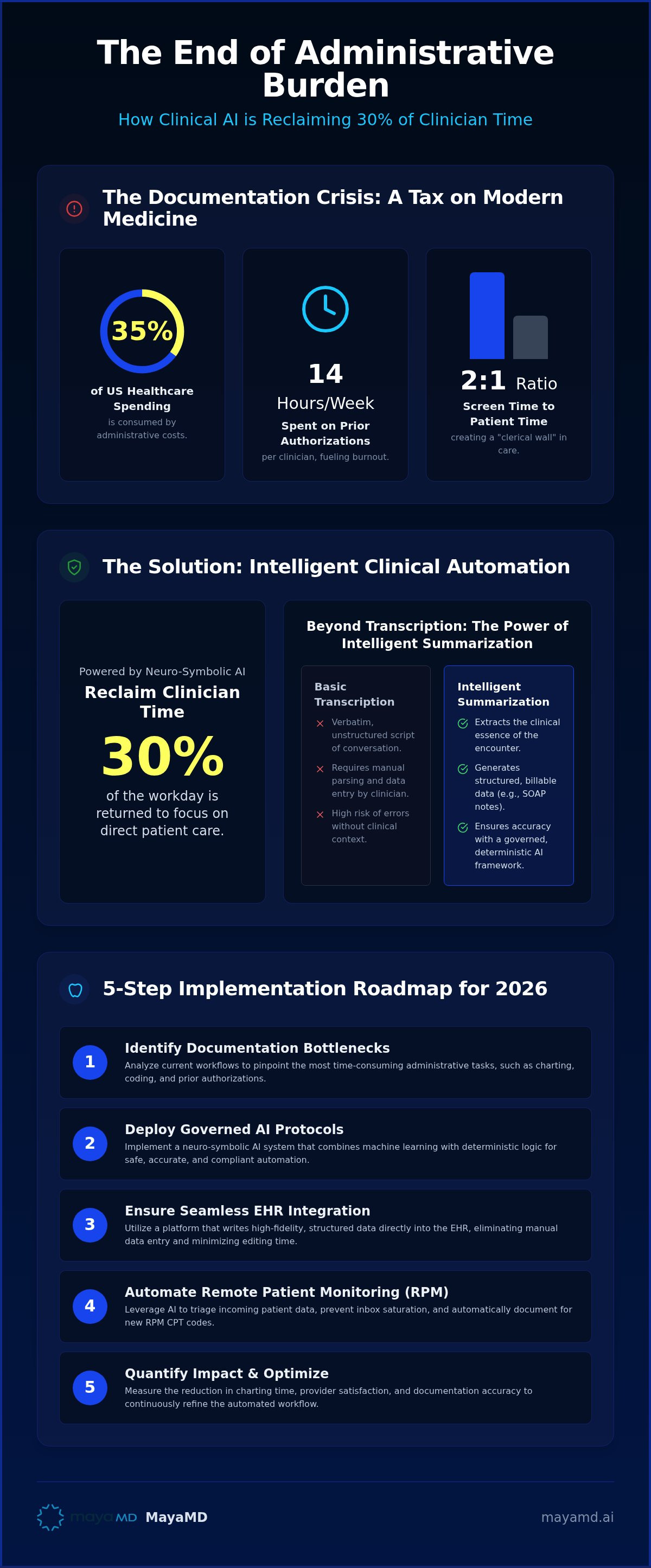
As of June 2026, administrative costs account for up to 35% of all healthcare spending in the United States. Most clinicians feel this weight personally through the relentless cycle of EHR pajama time and the 14 hours spent every week on prior authorizations. It's a structural failure of manual documentation that leads to chronic burnout and high staff turnover. You deserve a workflow where your expertise is applied to patients, not paperwork.
This case study demonstrates how advanced Clinical AI Agents and automated documentation protocols are finally moving the needle to reduce administrative burden in healthcare, reclaiming 30% of clinician time for direct patient care. By utilizing neuro-symbolic AI that combines machine learning with deterministic logic, we provide a governed framework for seamless EHR integration. We will examine how these systems generate precise clinical notes that require minimal editing, improve work-life balance, and ensure documentation accuracy for the new 2026 RPM CPT codes. This methodical approach to automation ensures that clinical safety remains the priority while the burden of data entry is systematically eliminated.
Key Takeaways
• Understand the distinction between basic transcription and intelligent summarization to ensure your Clinical AI Agent delivers high-fidelity, structured data directly into the EHR.
• Explore how remote patient monitoring software functions as a digital first responder, triaging patient data to prevent inbox saturation and prioritize high-risk interventions.
• Learn a proven methodology to reduce administrative burden in healthcare by identifying specific documentation bottlenecks and deploying governed, deterministic AI protocols.
• Gain a strategic five-step implementation roadmap for integrating clinical workflow automation that maintains regulatory compliance while reclaiming hours of clinician time.
• Examine quantified results from a 2026 case study where multi-specialty providers realized a 30% reduction in daily charting requirements through an integrated AI platform.
The Documentation Crisis: Why Administrative Burden is the #1 Clinician Complaint
Administrative burden represents the cumulative time clinicians spend on non-clinical tasks, ranging from manual data entry to complex regulatory reporting. It's an invisible tax on modern medicine that diverts attention from the exam table to the computer screen. This friction creates a significant cognitive load in high-volume clinics, where the mental energy required for diagnosis is frequently exhausted by clerical compliance. When a provider's focus is fractured by systemic inefficiencies, the safety and precision of patient care are inevitably compromised.
The 2026 healthcare market reveals that administrative costs now account for 25% to 35% of all healthcare spending. This economic strain is deeply linked to the primary causes of clinician burnout, which has led to unprecedented staff turnover rates. Physicians currently spend an average of 14 hours every week just on prior authorizations. To reduce administrative burden in healthcare, organizations must move beyond the era of manual data entry and adopt a governed approach to clinical automation that prioritizes both provider well-being and data integrity.
We are witnessing a fundamental shift toward neuro-symbolic AI systems. These platforms combine the flexibility of machine learning with the rigid safety of deterministic logic to ensure that clinical documentation remains accurate, secure, and compliant with evolving standards.
The Anatomy of EHR Fatigue
Charting, coding, and prior authorizations represent the triad of documentation fatigue that defines the modern workday. Legacy EHR systems were largely designed as financial ledger tools rather than clinical intuition aids, which explains why they often exacerbate clerical friction rather than resolving it. When clinicians spend two hours on a screen for every hour of patient care, the quality of the patient-provider interaction suffers. This "clerical wall" prevents the deep connection and support that are essential for effective chronic care management.
Regulatory Pressures and Documentation Standards
The 2026 regulatory landscape has introduced new layers of complexity, including updated MIPS oral-health screening requirements and the 2026 Medicare Physician Fee Schedule. New CPT codes such as 99445 and 99470 mandate rigorous data tracking for successful reimbursement. Utilizing specialized medicare rpm reimbursement software allows practices to automate these tracking requirements, ensuring that documentation is both comprehensive and audit-ready. By connecting documentation accuracy directly to value-based care incentives, clinics can reduce administrative burden in healthcare while protecting their financial stability through superior compliance protocols.
AI-Driven Clinical Scribing: Transforming Patient Encounters into Structured Data
While human scribes were once considered the gold standard for documentation, they often introduce high operational costs and logistical complexities. A clinical ai agent for primary care operates as a digital partner, capturing the nuance of a patient encounter in real-time without the overhead of additional staffing. This technology is designed to reduce administrative burden in healthcare by converting natural conversation into structured, billable data. By offloading the clerical weight of the visit, clinicians can return to the "art of medicine" while the software handles the science of documentation.
It's vital to distinguish between simple transcription and intelligent clinical summarization. Transcription merely provides a verbatim script that still requires manual parsing. Intelligent summarization extracts the clinical essence of the encounter, organizing it into a standard SOAP note format. To ensure high-stakes reliability, we utilize neuro-symbolic AI to prevent clinical hallucinations. This governed approach ensures that every generated note is grounded in medical fact rather than statistical probability. For organizations seeking to modernize their workflows, exploring clinical AI solutions is the first step toward reclaiming professional autonomy.
Beyond Transcription: Context-Aware Documentation
During a live dialogue, the system identifies relevant ICD-10 codes and clinical markers as they're mentioned. This capability-to-outcome flow means that as the doctor speaks, the chart is already being built with precision. The integration of deterministic logic allows the system to cross-reference patient histories, resulting in highly accurate clinical decision support. Neuro-symbolic AI is the bridge between logic and language. This level of automation directly improves patient experiences with administrative burdens, as providers can maintain eye contact instead of staring at a laptop screen.
Implementing Clinical AI in Phoenix and Las Vegas Clinics
Deployment in multi-site practices, such as those across the Phoenix and Las Vegas corridors, requires a methodical strategy. Local deployment considerations often involve training staff to interact with the digital agent as a collaborative team member rather than a passive tool. Security protocols are rigorous; our HIPAA-compliant cloud-based platform ensures data is protected across all locations while allowing for centralized oversight. This architecture provides the stability of local data access with the security of enterprise-grade encryption. By establishing these protocols, clinics can reduce administrative burden in healthcare across their entire network without sacrificing regulatory adherence or data sovereignty.
Offloading Care Coordination via Remote Patient Monitoring (RPM)
Many healthcare systems view Remote Patient Monitoring as a secondary technical silo that requires dedicated staffing to manage constant data feeds. This perspective is outdated. Modern remote patient monitoring software acts as an automated first responder that triages physiological data before it ever reaches a physician's inbox. By filtering raw data through clinical algorithms, the system identifies anomalies that require immediate attention while documenting stable readings in the background. This proactive approach allows clinics to reduce administrative burden in healthcare by eliminating the manual review of thousands of non-critical data points.
Integrating RPM with Principal Care Management (PCM) provides a cohesive framework for managing high-acuity, complex cases. Instead of reacting to a patient's crisis during an emergency visit, clinicians receive structured summaries of a patient's status over time. This continuous oversight has been associated with a 22% reduction in hospitalizations for hypertensive patients, allowing providers to focus their in-person time on those who truly need physical intervention. It's a shift from reactive care to a governed, predictive model that preserves clinical resources.
Automating the Chronic Care Workflow
The transition toward digital healthcare for chronic disease utilizes AI to initiate proactive interventions. This automation removes the administrative friction of "phone tag," where clinical staff spend hours attempting to reach patients for routine follow-ups. The Clinical AI Agent manages these interactions, providing patient education and engagement while capturing relevant health data. This capability-to-outcome structure ensures that patient compliance increases without increasing the clerical workload of the medical staff, effectively bridging the gap between disparate data points and human care.
Data Governance and Physician Trust
Trust in AI is built through transparency and precision. A governed approach to AI is essential for managing the vast data streams generated by RPM devices, as it distinguishes meaningful clinical signals from baseline noise. Without this filtering, providers risk alert fatigue, which is a major contributor to the psychological load mentioned earlier. Deterministic AI ensures that only actionable alerts reach the clinician by applying rigorous clinical rules to raw physiological data. By establishing these governance protocols, organizations reduce administrative burden in healthcare while maintaining the high-stakes reliability required for safe patient management.
Strategic Implementation: 5 Steps to Reclaim Clinical Time in 2026
Successful integration of Clinical AI is not merely a cultural shift; it's a technical discipline that requires a structured roadmap. To effectively reduce administrative burden in healthcare, organizations must move through a methodical deployment phase that prioritizes clinical safety and operational continuity. This process transforms the EHR from a static data repository into a dynamic clinical partner. By following a governed implementation strategy, medical groups ensure that high-stakes technology is adopted with precision and minimal disruption.
Audit
Evaluate all documentation touchpoints to pinpoint specific bottlenecks.
Select
Deploy a clinical workflow automation solution that offers native EHR integration.
Pilot
Launch the AI Agent with a select group of super-users in regional hubs like Indianapolis or Chicago.
Measure
Set benchmarks for charting speed, coding accuracy, and provider satisfaction.
Scale
Execute a phased enterprise-wide rollout based on pilot data.
Auditing the "Hidden" Workload
Administrative friction often hides in the gaps between patient encounters. Clinicians spend significant time on prescription refills, referral management, and answering patient messages; these are tasks that rarely appear in standard productivity metrics. Nearly 95% of medical practices have reported an increase in regulatory burden over the last three years, making it essential to use tools that measure baseline administrative time. Identifying which tasks can be fully automated versus those requiring clinical oversight allows leadership to prioritize the most impactful interventions. If you're ready to modernize your practice, contact MayaMD for a consultation.
The Pilot Program: Best Practices
Choosing the right specialty for initial deployment is critical for demonstrating early success. High-volume environments like Primary Care or data-intensive fields like Cardiology are ideal candidates for testing automated clinical documentation for providers. During this phase, gathering qualitative feedback is just as important as tracking quantitative data. Understanding how a tool impacts a provider's quality of life provides the necessary context for iterating on AI settings. This approach ensures that when the solution scales, it's already been refined by the very people who will use it daily, fostering trust through proven performance.
The MayaMD Impact: Quantifying Administrative Reduction
In a longitudinal study of a multi-specialty group in Houston, the deployment of MayaMD’s Clinical AI Agent demonstrated a measurable shift in operational efficiency. The Houston multi-specialty group serves as a blueprint for organizations looking to reduce administrative burden in healthcare through governed automation. Clinical trials verified a 30% reduction in charting time, a result achieved through the automation of intake and documentation protocols. This reduction isn't merely a convenience; it's a fundamental reclamation of professional time that allows clinicians to focus on high-stakes medical decision-making.
When analyzing the ai clinical documentation tools comparison metrics, the combination of deterministic logic and generative AI consistently outperforms simple transcription models in high-acuity settings. By integrating deterministic logic with generative AI, the platform ensures documentation accuracy, which directly results in fewer reimbursement denials for the practice. The vision for 2026 is a documentation-free clinical environment where data capture is ambient, unobtrusive, and fully integrated into the care delivery process.
Real-World Outcomes in Primary Care
For a solo practitioner within the Houston group, this technology reclaimed 10 hours per week previously lost to clerical tasks. Reclaiming 10 hours per week allows a provider to increase patient throughput without compromising the quality of care or their own well-being. This time recovery correlates directly with lower provider burnout scores, as the mental energy once reserved for EHR data entry is redirected toward clinical reasoning. Patient satisfaction scores also showed improvement; when doctors provide more face-time, patients feel heard and supported, fostering a stronger therapeutic bond.
Next Steps for Healthcare Executives
Transitioning to an AI-governed model requires a precise understanding of the ROI associated with advanced primary care management (APCM) implementation. Executives can initiate this change by requesting a clinical workflow assessment from MayaMD to identify specific areas where automation can reduce administrative burden in healthcare. This assessment serves as the foundation for a sustainable, technology-driven care model that prioritizes both provider longevity and patient outcomes. Schedule a consultation to reduce your administrative burden and begin the journey toward a more efficient, clinical-first environment.
Reclaiming the Clinical Heart of Medicine
The transition from manual data entry to a governed, AI-driven ecosystem is no longer a visionary concept; it's a present-day clinical necessity. By deploying deterministic clinical AI that prioritizes precision over statistical probability, organizations can systematically reduce administrative burden in healthcare while maintaining HIPAA-compliant data integrity. We've examined how these protocols reclaim 30% of documentation time, allowing providers to return to the high-stakes human connection that defines quality medicine.
Successful implementation requires a partner that understands the nuances of clinical workflows and regulatory compliance. Whether your practice operates in Las Vegas, Indianapolis, or Chicago, our team provides expert implementation support to transform your daily workflow into a streamlined, high-performance environment. Schedule Your Clinical AI Workflow Assessment today to see how these proven metrics can stabilize your staff and improve your clinical outcomes. It's time to move past the documentation crisis and lead your organization into a more sustainable, patient-centered future.
Frequently Asked Questions
How does AI reduce administrative burden in healthcare specifically?
AI automates the extraction of clinical data from patient conversations and converts it into structured SOAP notes. This eliminates manual data entry and reduces the time spent on coding and prior authorizations. By handling these repetitive tasks, the technology allows clinicians to focus on complex diagnostic work rather than clerical upkeep. This shift ensures that high-level medical professionals aren't utilized for low-level data entry.
Is AI clinical documentation safe for high-acuity patients?
Yes, provided the system utilizes deterministic logic rather than relying solely on generative models. This governed approach ensures that clinical notes are grounded in medical facts and established protocols. High-acuity environments benefit from this precision, as the AI acts as a reliable assistant that highlights critical data points for physician verification. It acts as a safety net that captures nuances that might be missed during a busy shift.
Can Clinical AI Agents integrate with my existing EHR system?
Modern Clinical AI Agents are designed for deep integration with major EHR platforms through standard protocols. This connectivity ensures that automated notes and patient data flow directly into the patient record without requiring manual uploads. It's a seamless bridge that preserves the existing clinical workflow while enhancing its overall efficiency. You don't have to overhaul your current infrastructure to realize the benefits of automation.
What is the ROI of implementing clinical workflow automation?
The primary return on investment manifests through reclaimed clinical hours and improved staff retention. By automating documentation, practices can increase patient volume without adding administrative staff. Additionally, improved coding accuracy leads to higher reimbursement rates and fewer denials. This provides a clear financial benefit alongside quality of life improvements for providers, reducing the high costs associated with clinician turnover and burnout.
How do we prevent AI hallucinations in medical notes?
We prevent hallucinations by employing neuro-symbolic AI, which combines machine learning with a rigid layer of deterministic rules. This framework ensures the system follows logical clinical paths instead of making statistical guesses. Every output is cross-referenced against established medical logic to maintain high-stakes reliability and clinical validity. This governed approach prioritizes safety and precision over the experimental nature of standard generative models.
Does reducing administrative burden improve patient outcomes?
To reduce administrative burden in healthcare is to directly improve outcomes by increasing the quality of the patient-provider interaction. When doctors spend less time on screens, they can engage more deeply with patients, leading to better diagnostic accuracy and adherence. Proactive monitoring further ensures that potential complications are identified before they escalate into emergencies. This connectivity fosters a more supportive and responsive care environment.
What are the HIPAA requirements for AI patient monitoring in 2026?
HIPAA requirements in 2026 mandate end-to-end encryption for all data transmitted from remote monitoring devices to the AI platform. Providers must ensure their AI partners sign a Business Associate Agreement and maintain rigorous access controls. The platform must also support data sovereignty and provide transparent audit trails for all automated documentation. Security and regulatory adherence are non-negotiable components of any modern clinical AI deployment.




See The MayaMD Difference
Fill the form below
Download Our Apps
MayaMD for patients and MayaPro for physicians - available on iOS and Android.
FOR PATIENTS
MayaMD App
AI-powered symptom assessment, triage, and secure access to your care team.

FOR PHYSICIANS
MayaPro App
MayaPro brings patient vitals, RPM/PCM care plans, and clinical decision support to your pocket.