
AI Clinical Documentation: 2026 High-Acuity Guide

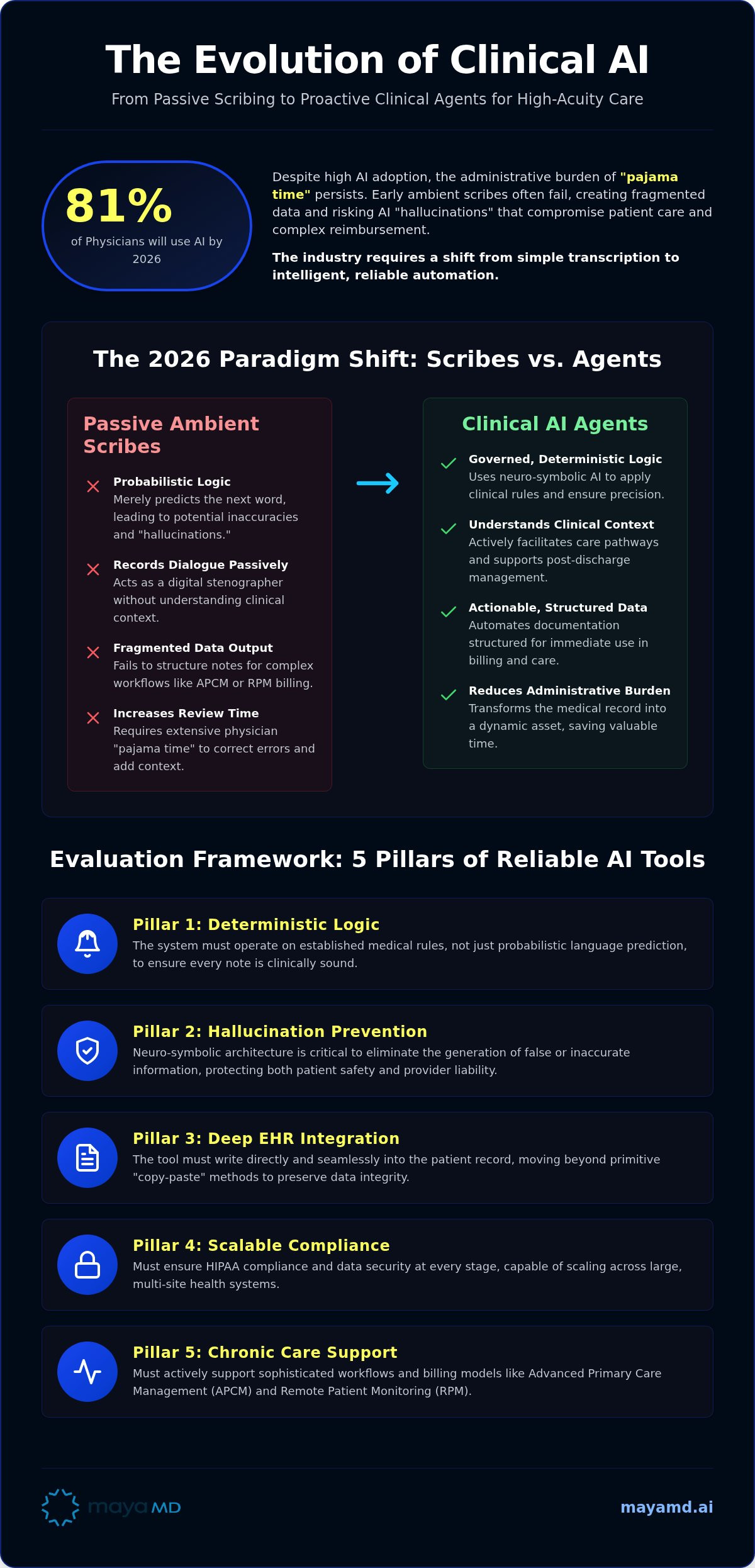
By early 2026, 81% of physicians surveyed by the American Medical Association reported utilizing AI in their professional workflows, yet the burden of administrative "pajama time" remains a critical threat to clinical longevity. You understand that the initial promise of ambient scribing is often undermined by the risk of hallucinations or fragmented data that fails to support complex reimbursement models. This ai clinical documentation tools comparison evaluates the current market through the lens of governed logic, prioritizing systems that offer the high-stakes reliability required for high-acuity chronic care. We will analyze how leading platforms integrate with EHR environments to automate HIPAA-compliant documentation while simultaneously supporting Advanced Primary Care Management (APCM) and Remote Patient Monitoring (RPM) billing. Our evaluation focuses on the evolution of AI agents that utilize neuro-symbolic frameworks to ensure deterministic logic and clinical precision. By the end of this guide, you'll have a clear roadmap for selecting a partner that bridges the gap between disparate data points and sustainable patient care.
Key Takeaways
• Understand the 2026 paradigm shift from passive ambient scribing to proactive Clinical AI Agents that automate complex, high-acuity workflows.
• Utilize a standardized five pillar framework to evaluate technical reliability and clinical validity during the vendor selection process.
• Review our detailed ai clinical documentation tools comparison to identify which platforms offer the deepest EHR integration for large scale health systems.
• Discover how to synchronize automated documentation with Advanced Primary Care Management (APCM) to capture accurate reimbursement for chronic care services.
• Learn how neuro-symbolic AI architectures solve the industry-wide hallucination problem by applying deterministic logic to medical record generation.
The Evolution of Clinical AI: From Ambient Scribes to Clinical AI Agents
Evolution is rarely linear. In the healthcare sector, the transition from manual transcription to automated record keeping has reached a critical inflection point. By 2026, the industry has matured past the "ambient scribe" phase, where the primary goal was simply capturing dialogue. Today, high-volume clinics are calculating the massive opportunity cost of traditional, passive documentation. Every minute a physician spends correcting a generic transcript is a minute lost to patient care or revenue-generating activities. This realization is driving an intensive ai clinical documentation tools comparison among leaders who require more than just a digital stenographer.
Why Passive Scribing is No Longer Enough
Passive tools were designed for a simpler era of medicine. In the current landscape of complex chronic care, "ambient only" solutions often fall short. They lack the structural logic required to support sophisticated workflows like Remote Patient Monitoring (RPM) or Advanced Primary Care Management (APCM). When documentation is fragmented, it fails to trigger the necessary care pathways, leading to missed reimbursement opportunities and suboptimal patient outcomes. In competitive metropolitan markets like Chicago, the administrative burden remains a primary driver of clinician turnover. Providers are no longer satisfied with tools that require extensive "pajama time" to fix AI-generated hallucinations. They need systems that understand the clinical context of the encounter from the start.
The Rise of the Clinical AI Agent
The 2026 standard is the Clinical AI Agent. Unlike a simple LLM scribe that merely predicts the next word in a sentence, a Clinical AI Agent operates with governed, deterministic logic. This shift is particularly evident in regions like Indianapolis and Las Vegas, where primary care groups are consolidating into integrated platforms to manage rising patient complexity. These agents don't just record the past; they facilitate the future of the patient encounter. They support post-discharge care and patient engagement by ensuring that every note is structured for immediate action. A Clinical AI Agent is a tool that integrates documentation with real-time clinical logic to drive proactive care management. By bridging the gap between raw data and actionable insight, these agents transform the medical record from a static document into a dynamic asset for the entire care team.
Evaluation Framework: 5 Pillars of AI Clinical Documentation Tools
Selecting a platform requires a departure from subjective preference toward a governed evaluation framework. When conducting an ai clinical documentation tools comparison, healthcare executives must prioritize technical reliability over aesthetic interface. This five pillar approach ensures that any chosen system maintains clinical validity while scaling across complex, multi-site operations. It's no longer enough to have a tool that records; the platform must actively support the systematic rigor of modern clinical workflows. Decisions made at the infrastructure level today will dictate the quality of care and the integrity of the medical record for years to come.
Pillar 1 & 2: Deterministic Logic and Hallucination Prevention
Standard Large Language Models (LLMs) operate on probabilistic principles, essentially predicting the most likely next word in a sequence. This approach is fundamentally dangerous in a clinical setting where precision is non-negotiable. Neuro-symbolic AI addresses this vulnerability by layering deterministic logic over generative capabilities. This hybrid architecture ensures that every generated note adheres to established medical rules, effectively eliminating the hallucinations common in generic AI models. By applying rigorous clinical frameworks to the generation process, organizations can achieve automated clinical documentation for providers that mirrors the accuracy of a human specialist. This logical oversight is the difference between a tool that assists and a tool that creates liability.
Pillars 3, 4, & 5: Integration, Compliance, and Chronic Care Support
Operational efficiency relies on deep EHR integration that moves beyond the primitive "copy-paste" method. A sophisticated tool must write directly into the patient record, preserving data integrity and reducing administrative friction. The platform must also support the specialized requirements of Principal Care Management (PCM) and Remote Patient Monitoring (RPM). In 2026, multi-state practices require HIPAA compliant patient monitoring that utilizes secure, cloud-based infrastructure to maintain regulatory adherence across different jurisdictions. Compliance isn't optional. Scalability is achieved when the software functions as a bridge between disparate data points and the human care team, ensuring that high-acuity patients receive consistent oversight regardless of geographic location. Organizations looking to bridge the gap between transcription and active care management often find that a Clinical AI Agent provides the necessary governed logic for high-acuity environments.
AI Clinical Documentation Tools Comparison: Leading Platforms for 2026
Market analysis reveals a clear stratification based on organizational complexity and clinical intent. An ai clinical documentation tools comparison must distinguish between platforms designed for high-volume transcription and those engineered for governed clinical intervention. As healthcare systems move toward value-based care, the selection of a documentation partner is no longer just about reducing "pajama time"; it's about the technical capacity to support longitudinal patient management. Organizations must evaluate whether a tool merely records a conversation or actively structures data to drive clinical outcomes.
Enterprise Solutions: Abridge vs. Microsoft DAX
Precision. Integration. Scale. These are the markers of "The Big Three" enterprise players: Abridge, Suki, and Microsoft DAX. These systems excel in deep-linking with Epic and Cerner, a critical requirement for large hospital systems in Houston and other major medical hubs. Abridge, for instance, has secured a dominant position in enterprise environments through custom-negotiated contracts that prioritize system-wide interoperability. However, their primary strength is often their limitation; they are frequently tethered to the physical exam room. While they streamline the immediate note, a significant governance gap exists regarding continuous care management. These tools don't inherently manage the data flow required for complex chronic care once the patient leaves the clinic, often leaving providers to bridge the gap manually.
Specialized vs. Generalist AI Tools
Accessibility. Speed. Simplicity. For solo practitioners in Phoenix or smaller allied health groups, specialized tools like Freed and Heidi Health offer accessible entry points into automated documentation. These generalist tools prioritize ease of use and rapid deployment. Yet, they often struggle with the rigorous advanced primary care management requirements that define the 2026 reimbursement landscape. A simple note is no longer the finish line; it's the starting point for a broader care continuum. Generalist AI frequently lacks the deterministic logic needed to ensure that documentation supports Remote Patient Monitoring (RPM) or Principal Care Management (PCM) billing without manual intervention. Choosing a tool that bridges the gap between documentation and patient monitoring is essential for practices focused on high-acuity chronic care. MayaMD serves as the governed alternative in this space, utilizing neuro-symbolic AI to ensure that documentation isn't just fast, but clinically precise and billing-ready.
Strategic Implementation: Deploying AI in Local Healthcare Ecosystems
Implementation of advanced technology is a clinical process, not just a software installation. Successful deployment requires a shift from viewing AI as a standalone utility to seeing it as a core component of the broader care management ecosystem. An effective ai clinical documentation tools comparison must look beyond features to the actual logistics of deployment within a live medical environment. Administrators often worry about operational paralysis, but a governed, phased approach ensures that patient care remains the priority while the practice evolves toward automated efficiency.
A common concern for leadership at an Indianapolis clinic is the potential for operational disruption. This fear is mitigated by establishing clear protocols for "ambient consent" and patient privacy. Staff members must be trained to explain that the AI agent acts as a digital extension of the care team, prioritizing the security of the medical record through HIPAA-compliant cloud architecture. Integrating these tools into clinical workflow automation solutions ensures that documentation doesn't just sit in a silo; it triggers the next steps in the care plan, from scheduling follow-ups to updating remote monitoring parameters.
The 4-Week Rollout Plan
Precision requires a methodical timeline. During weeks one and two, the focus remains on security audits and EHR sandbox testing to ensure seamless data connectivity. By week three, a clinical pilot begins with a subset of high-acuity chronic patients, allowing providers to validate the AI's logic in real-world scenarios. The final week marks full deployment, where the system is fully synchronized with billing workflows for RPM and PCM. This structured transition prevents the "all-at-once" shock that often leads to staff resistance and ensures that the platform is performing with the high-stakes reliability required for 2026 standards.
Maximizing ROI Through Reimbursement
Value is proven through measurable performance and improved revenue cycles. In Las Vegas practices, automated coding suggestions are already proving vital for navigating the CMS-0057-F rule, which requires more rigorous reporting of prior authorization metrics. By utilizing AI to capture granular data for Medicare RPM reimbursement, clinics ensure they are fully compensated for the time spent on continuous care. AI-driven documentation directly correlates with APCM revenue growth by capturing the clinical complexity required for higher-tier reimbursement levels. Organizations ready to transition from manual notes to an integrated care strategy should explore how the MayaMD Clinical AI Agent synchronizes documentation with proactive chronic care management.
The MayaMD Advantage: Neuro-Symbolic AI for Governed Clinical Care
Selecting the right platform requires looking beyond the surface level of ambient listening. While our ai clinical documentation tools comparison highlights various enterprise and specialized options, MayaMD distinguishes itself through a commitment to governed logic. Most generative systems rely on probabilistic outcomes, which inherently risk clinical hallucinations. MayaMD’s Clinical AI Agent utilizes a neuro-symbolic architecture to ensure that every note is grounded in deterministic medical rules. This approach transforms documentation from a passive record into a proactive asset that supports the most rigorous standards of chronic care management.
Governed AI: Why Deterministic Logic Matters
Safety is the primary metric for high-acuity care. In a traditional Large Language Model, the system predicts the most likely next word without a fundamental understanding of medical necessity or safety protocols. MayaMD’s neuro-symbolic approach combines the fluid communication of GenAI with a rigid layer of symbolic logic. This ensures that documentation for patients with multiple chronic conditions remains accurate, consistent, and hallucination-free. As an "Authoritative Pioneer" in the space, MayaMD prioritizes clinical data integrity to protect both the patient and the provider. By enforcing hard clinical rules during the note generation process, the platform eliminates the need for extensive manual corrections, allowing physicians to trust the output of their digital partner.
The true power of this system lies in its connectivity. Unlike generic scribes that stop at the clinic door, MayaMD creates a seamless synergy between documentation and remote patient monitoring software. This integration allows for real-time updates to care plans based on documented patient encounters. For providers managing APCM and PCM, this means every note automatically supports the data requirements for reimbursement, reducing the "governance gap" found in standard ambient tools. Generic scribes often fall short because they lack the specialized logic required to categorize chronic care data points effectively.
Ready to Transform Your Workflow?
The long-term benefits of adopting a governed AI partner extend far beyond simple time savings. Providers report a significant reduction in administrative burnout and a measurable improvement in patient outcomes when documentation is synchronized with active care management. This transition allows clinicians to return to the human element of medicine, supported by the cold, hard logic of advanced data science. Whether you are leading a large health system in Chicago or a specialized chronic care clinic in Houston, the need for precision remains constant.
The future of 2026 healthcare demands more than just a tool; it requires a sophisticated partner that understands the nuances of clinical workflows. Moving toward an AI-governed ecosystem is the most effective way to ensure long-term practice sustainability and clinical excellence. Take the next step in evolving your practice operations. Schedule a demo of the MayaMD Clinical AI Agent today to see how neuro-symbolic AI can secure your clinical documentation and enhance your chronic care management programs.
Secure the Future of High-Acuity Care
The transition from passive transcription to governed clinical intelligence marks a defining moment for modern healthcare. This ai clinical documentation tools comparison clarifies that while many platforms can record a conversation, few can actively safeguard the medical record against hallucinations. By prioritizing deterministic logic and neuro-symbolic architectures, organizations ensure that every note supports complex chronic care management without introducing liability. This systematic approach allows providers to seamlessly integrate RPM and PCM documentation into their daily workflows, directly supporting sustainable revenue growth through APCM.
Reliability is the foundation of patient trust. Implementing an enterprise-ready, HIPAA-compliant architecture ensures that your practice remains resilient in an evolving regulatory landscape. It's time to move past the limitations of generalist AI and embrace a partner that values precision as much as you do. Experience Governed Clinical AI: Request a MayaMD Demo and discover how deterministic logic can eliminate administrative friction while improving the quality of patient care. Your path to a more efficient, focused, and secure practice begins with a single, strategic choice.
Frequently Asked Questions
How do AI clinical documentation tools handle HIPAA compliance in 2026?
In 2026, AI clinical documentation tools ensure HIPAA compliance through advanced cloud-based infrastructure that utilizes end-to-end encryption and zero-retention data policies. These platforms operate under a Business Associate Agreement (BAA) and are designed to meet the rigorous security standards established by recent federal technology rules. This systematic approach ensures that patient health information remains protected throughout the automated documentation process, providing a secure environment for high-acuity data management.
What is the difference between an AI scribe and a Clinical AI Agent?
The fundamental difference lies in functionality and clinical intent. An AI scribe is a passive tool designed for ambient listening and basic transcription of the patient encounter. In contrast, a Clinical AI Agent is a proactive system that integrates documentation with real-time clinical logic, billing automation, and patient engagement. While a scribe merely records the past, an agent facilitates future care pathways by synchronizing notes with chronic care management workflows.
Can AI documentation tools prevent medical hallucinations?
Yes, advanced platforms can effectively eliminate medical hallucinations by utilizing neuro-symbolic AI architectures. Unlike standard Large Language Models that rely on probabilistic word prediction, these systems apply deterministic logic to the generation process. This ensures that every clinical note adheres to established medical rules and factual data. When conducting an ai clinical documentation tools comparison, it's essential to prioritize vendors that offer this governed, rule-based oversight.
Do these tools integrate with all major EHR systems like Epic and Athenahealth?
Leading AI documentation platforms offer deep-linking capabilities with all major EHR systems, including Epic, Cerner, and Athenahealth. This integration moves beyond simple copy-paste methods by writing structured data directly into the patient's digital chart. This connectivity ensures that clinical notes are immediately accessible to the entire care team, reducing administrative friction and preserving the integrity of the medical record across diverse healthcare ecosystems.
How does AI documentation support Remote Patient Monitoring (RPM) billing?
AI documentation supports Remote Patient Monitoring (RPM) billing by systematically capturing the specific data points required for Medicare reimbursement. These tools structure clinical notes to highlight patient interactions and physiological data trends, which streamlines the coding process. By automating the identification of billable events, providers can maximize their revenue for chronic care services while ensuring full compliance with the most recent CMS reporting requirements.
What is neuro-symbolic AI in a healthcare context?
Neuro-symbolic AI is a hybrid technology that combines the natural language capabilities of generative AI with the rule-based precision of symbolic logic. In a healthcare context, this architecture allows the system to communicate fluently while remaining tethered to clinical safety protocols. This hybrid approach provides the transparency and explainability required for high-stakes medical decision-making, ensuring that the AI operates within a governed framework of medical evidence.
Is there a specific AI documentation tool recommended for chronic care management?
For chronic care management, a specialized system like the MayaMD Clinical AI Agent is recommended over generalist ambient tools. This platform is specifically engineered to support the complex requirements of Advanced Primary Care Management (APCM) and Principal Care Management (PCM). Its ability to synchronize documentation with remote monitoring data makes it a superior choice for organizations focused on the longitudinal management of patients with multiple chronic conditions.
How much time can a physician save by using an AI clinical documentation tool?
Physicians utilizing these tools often report saving several hours per week by eliminating traditional "pajama time" dedicated to manual entry. By automating the creation of comprehensive, HIPAA-compliant notes, clinicians can focus more on direct patient interaction during the encounter. This increase in operational efficiency not only reduces administrative burnout but also allows providers to manage higher-volume clinics without compromising the quality or detail of their clinical documentation.




See The MayaMD Difference
Fill the form below
Download Our Apps
MayaMD for patients and MayaPro for physicians - available on iOS and Android.
FOR PATIENTS
MayaMD App
AI-powered symptom assessment, triage, and secure access to your care team.

FOR PHYSICIANS
MayaPro App
MayaPro brings patient vitals, RPM/PCM care plans, and clinical decision support to your pocket.