
Medicare RPM Reimbursement Software: The 2026 Provider’s Guide to AI-Driven Compliance

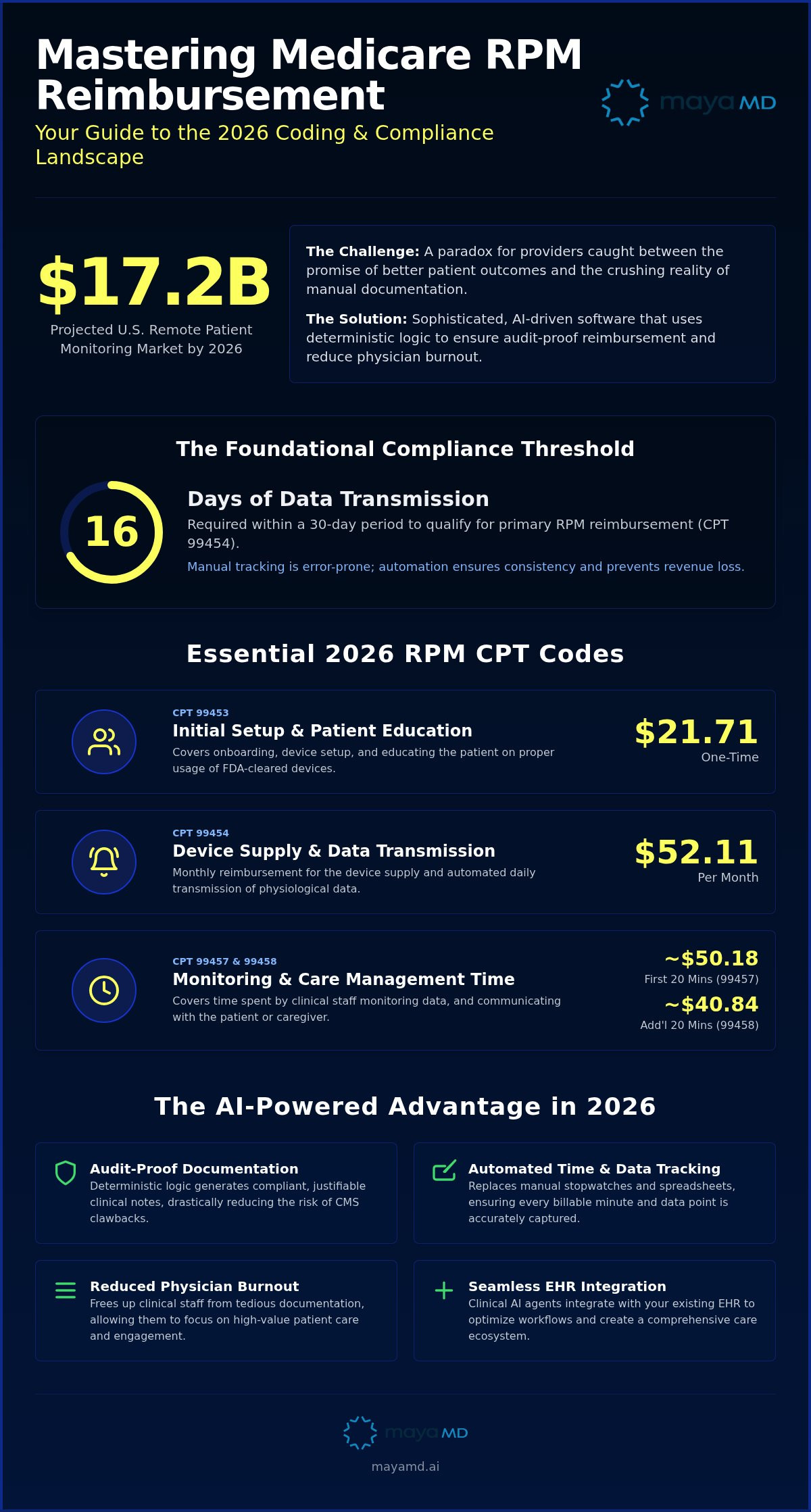
By 2026, the U.S. remote patient monitoring market is projected to reach $17.2 billion. This rapid expansion creates a paradox for providers caught between the promise of better patient outcomes and the crushing reality of manual documentation. You've likely felt the strain of tracking every clinical minute while fearing that a CMS audit might dismantle your hard-earned revenue. It's a systemic challenge that demands more than just a digital stopwatch; it requires sophisticated medicare rpm reimbursement software that acts as a governed technological partner.
This guide will empower you to master the complexities of the 2026 Medicare RPM coding landscape and discover how AI-driven systems use deterministic logic to ensure audit-proof reimbursement. We'll explore how these clinical agents integrate with your EHR to automate documentation and optimize clinical workflows. By examining the nuances of new codes like 99445 and 99470, you'll learn to maximize clinical revenue through a reliable framework that prioritizes both compliance and the quality of patient care.
Key Takeaways
• Understand the 2026 shift toward value-based care and the specific CMS-approved CPT codes required to maintain a compliant, high-performing remote monitoring program.
• Evaluate how advanced medicare rpm reimbursement software leverages AI-driven automation to replace legacy time-tracking and significantly reduce the risk of CMS audits.
• Discover the role of deterministic logic in generating audit-proof clinical documentation that justifies reimbursement while alleviating physician documentation burnout.
• Establish operational strategies for a dedicated care management team to optimize patient engagement and consistently meet critical 16-day data transmission thresholds.
• Explore how integrating RPM with broader care management frameworks, such as APCM and PCM, creates a comprehensive clinical ecosystem for chronic care management.
Navigating the 2026 Medicare RPM Reimbursement Landscape
In 2026, Remote Patient Monitoring (RPM) is no longer viewed as a peripheral technology but as a foundational clinical service. This year marks a decisive shift from volume-based billing toward value-based care integration. CMS has refined its oversight to ensure that remote monitoring provides a continuous stream of physiological data that informs real-time clinical decisions. The integration of medicare rpm reimbursement software into the clinical workflow ensures that these data points are captured with the precision required for audit-proof billing.
Achieving compliance requires adhering to strict technical and operational standards. Every device must be FDA-cleared and capable of transmitting physiological data for at least 16 days within a 30-day period to qualify for full reimbursement under primary CPT codes. Managing these thresholds manually is prone to error and administrative exhaustion. Utilizing robust medicare rpm reimbursement software is essential to provide the systematic oversight needed to track these metrics without overwhelming clinical staff by automating the verification of data transmission daily.
The Evolution of RPM Compliance in 2026
The 2026 Physician Fee Schedule (PFS) emphasizes scalability through the "general supervision" rule. This allows clinical staff to perform monitoring activities under the overarching direction of a billing provider, even if they aren't in the same physical location. It’s a vital provision for practices aiming to scale their chronic care programs. To succeed, providers must synchronize their monitoring efforts with digital healthcare for chronic disease. This synchronization ensures that data isn't just collected but is governed by logic that triggers appropriate clinical interventions based on established safety protocols, thereby bridging the gap between raw data and actionable care.
Eligibility and Enrollment Standards
Patient qualification remains a cornerstone of reimbursement. While RPM was traditionally associated with chronic conditions like hypertension or COPD, the 2026 framework clearly supports its use for acute conditions as well. Enrollment begins with obtaining patient consent, which can be verbal or written, provided it’s documented in the medical record. For new patients or those not seen within the previous year, an initiating visit is required. This visit serves as the clinical foundation where the provider establishes the necessity of monitoring and sets the parameters for the remote patient monitoring software to capture relevant physiological metrics tailored to the patient's specific acuity level.
Essential 2026 CPT Codes for Remote Patient Monitoring
Precision in medical coding is the bedrock of a sustainable remote monitoring program. As CMS continues to refine the 2026 Physician Fee Schedule, understanding the specific triggers for each CPT code is paramount for avoiding clawbacks. While the technical requirements are rigorous, utilizing advanced medicare rpm reimbursement software allows practices to translate raw physiological data into billable clinical events with surgical accuracy. This systematic approach ensures that every minute of clinical staff time is accounted for and justified through governed documentation.
The Core RPM Billing Codes: 99453 to 99458
The standard RPM suite remains the primary vehicle for reimbursement, but the 2026 landscape demands stricter adherence to documentation standards. Following the American Heart Association guidance, providers should leverage these codes to support evidence-based chronic care interventions that drive measurable patient outcomes.
99453
A one-time reimbursement of $21.71 for the initial setup and patient education on FDA-cleared devices. It requires the device to be successfully connected and the patient to be trained on proper usage.
99454
The monthly supply of the device and data transmission, reimbursed at $52.11. This requires at least 16 days of data readings within a 30-day period.
99457
Covers the first 20 minutes of clinical staff time per calendar month, reimbursed at $51.77. This must include interactive communication with the patient or caregiver.
99458
An add-on code for each additional 20 minutes of treatment management, reimbursed at $41.42.
For 2026, CMS has introduced increased flexibility with codes 99445 and 99470. CPT 99445 allows for device supply reimbursement ($52.11) when only 2 to 15 days of data are captured, providing a safety net for patients with lower adherence. Similarly, CPT 99470 offers a pathway for shorter management windows, covering 10 to 19 minutes of clinical time at $26.05. These additions ensure that providers are compensated for their oversight even when traditional thresholds aren't met. If you're looking to streamline this complex billing cycle, exploring clinical AI solutions can help automate the documentation required for these codes.
Integrating APCM and PCM for Comprehensive Reimbursement
In 2026, the most successful practices don't view RPM in isolation. Integrating advanced primary care management (APCM) with your monitoring program creates a unified care model that captures the full spectrum of patient management. While RPM focuses on the physiological data, APCM and Chronic Care Management (CCM) account for the broader coordination of care. CMS rules for 2026 allow for concurrent billing of these services, provided the time spent on each is distinct and non-overlapping. Principal Care Management (PCM) codes further complement this ecosystem by providing specialized reimbursement for single-condition high-acuity patients throughout the 2026 calendar year.
Evaluating Software: Why AI Documentation is the New Standard
The transition from manual oversight to automated precision defines the current era of chronic care management. While legacy systems functioned as basic stopwatches for clinical staff, modern medicare rpm reimbursement software must act as a sophisticated clinical partner. Relying on simple time-trackers creates a documentation gap that leaves practices vulnerable during CMS audits. By adopting automated clinical documentation for providers, organizations can bridge this gap; the software captures the clinical intent behind every monitoring event, not just the duration of the task.
Effective software must provide real-time data visualization to support immediate clinical decision-making. This aligns with the American Heart Association Guidance on RPM, which emphasizes that the value of monitoring lies in its ability to trigger timely interventions. To maximize return on investment, practices are increasingly shifting toward clinical workflow automation solutions. These platforms don't just record data; they orchestrate the entire patient journey from alert to resolution, ensuring that no physiological red flag goes unaddressed due to administrative oversight.
Reducing Physician Burnout with Clinical AI Agents
Clinical documentation is a primary driver of physician burnout, yet it's the very thing that justifies reimbursement. Clinical AI agents solve this by synthesizing complex physiological trends into concise, actionable clinical notes. When reviewing an ai clinical documentation 2026 high-acuity guide, it's clear that the most effective tools prioritize precision over volume. MayaMD’s Clinical AI platform excels here by identifying critical "red flag" data points before they escalate into emergencies. This proactive filtering allows providers to focus their cognitive energy on patient care rather than sifting through thousands of benign data readings.
The Role of Deterministic Logic in Billing Safety
Standard generative AI models often struggle with "hallucinations," which are unacceptable in a medical billing context. Deterministic logic provides a governed framework that ensures AI-generated content remains grounded in established clinical facts and physician-engineered rules. This logic-based approach is what makes MayaMD’s medicare rpm reimbursement software uniquely reliable for regulatory compliance. By using a "governed" AI model, the platform ensures that every clinical note and billing claim is logically sound and verifiable. This systematic oversight protects the practice from the financial risks of clawbacks while maintaining the highest standards of patient safety.
Best Practices for Maximizing RPM Revenue and Patient Outcomes
Maximizing the clinical and financial potential of remote monitoring requires a transition from passive data collection to active, governed management. The most successful practices utilize medicare rpm reimbursement software to create a closed-loop system between physiological data capture and the final billing claim. This systematic approach ensures that administrative burdens don't overshadow the primary goal of patient care. A dedicated care management team is the engine of this process; these professionals oversee alerts in real-time, ensuring that every significant data trend is met with a documented clinical response that justifies the billed time.
Hitting the 16-day data transmission threshold is the most common hurdle for profitability. It's a logistical challenge that requires a proactive patient engagement strategy rather than a reactive one. Practices in high-volume markets like Chicago, Phoenix, and Houston must implement standardized protocols to verify device connectivity within the first 48 hours of enrollment. By maintaining this rigorous oversight, you ensure that the technical requirements for CPT 99454 are met consistently, securing the monthly device supply reimbursement that forms the backbone of your program's ROI.
Optimizing Patient Enrollment and Adherence
Identifying the right patients is the first step toward a sustainable program. In busy clinics across Las Vegas or Indianapolis, providers should prioritize patients with high-acuity chronic conditions who are most likely to benefit from continuous oversight. Educating these patients on the "why" behind the device is critical to preventing device abandonment. Using AI-driven patient engagement tools allows for automated check-ins; these systems send gentle reminders to patients who haven't transmitted data, ensuring the 16-day requirement is met without increasing the manual workload of your clinical staff.
Local Market Dynamics: From Houston to Indianapolis
Reimbursement isn't entirely uniform; it's influenced by local Medicare Administrative Contractor (MAC) variations and regional health challenges. Providers in Houston often face a higher prevalence of diabetes-related complications, necessitating more frequent data transmissions and tighter management windows. Conversely, clinics in Phoenix might focus their RPM workflows on hypertensive patients affected by extreme seasonal heat. Tailoring your clinical workflows to these local realities, while accounting for regional clinical staffing availability, allows you to scale your program effectively. To see how governed AI can transform your practice's compliance, schedule a demonstration of MayaMD’s Clinical AI Agent.
Regularly auditing clinical notes is the final safeguard against revenue loss. Your medicare rpm reimbursement software should facilitate this by providing a clear audit trail of every clinical intervention. These notes must explicitly support the billed CPT codes by detailing the "interactive communication" occurred during treatment management. By verifying that every 20-minute increment of clinical time is backed by a precise, logic-driven note, you protect your practice from the fear of CMS clawbacks and ensure long-term financial stability.
MayaMD: Scaling RPM with Clinical AI and Deterministic Logic
MayaMD serves as a sophisticated partner for organizations navigating the intricacies of modern remote monitoring. It functions as a clinical ai agent for primary care, fundamentally changing how providers interact with patient data. By moving beyond simple data collection, our platform ensures that every physiological alert is processed through a lens of clinical validity. This transition from manual tracking to an AI-governed framework is essential for maintaining a high-stakes clinical environment where precision is the only acceptable standard.
Why MayaMD is the Strategic Choice for 2026
The core of MayaMD’s efficacy lies in its neuro-symbolic architecture. We integrate the adaptive potential of generative AI with the rigid safety of deterministic logic. This prevents the "hallucinations" common in open-ended models, ensuring that every note within your medicare rpm reimbursement software is grounded in established medical facts and physician-engineered rules. For multi-city hospital systems, our cloud-based infrastructure provides a unified ecosystem that supports Advanced Primary Care Management (APCM) goals. It creates a seamless connectivity layer between disparate data points and human care, allowing for a scalable approach to chronic disease management across entire networks.
Specialists also benefit from our specialized principal care management tools. These features allow for high-acuity oversight that complements standard RPM workflows, ensuring that patients with complex single conditions receive the intensive monitoring they require. The result is a comprehensive suite that offers robust audit protection and significantly reduced documentation time. This allows your team to focus on clinical outcomes through reliable, data-driven interventions rather than administrative minutiae.
Getting Started: Your AI-Driven RPM Implementation
Transitioning to an AI-governed model is a methodical process designed to minimize clinical disruption. Our onboarding for clinics in Indianapolis, Chicago, and other major metropolitan areas begins with a thorough assessment of your existing EHR integration. We don't just provide software; we provide a roadmap for clinical excellence. Training your staff on the AI documentation interface is the next critical step. We focus on teaching your care management team how to verify and sign off on AI-generated summaries, maintaining the necessary "human-in-the-loop" oversight required for 2026 compliance.
The final phase of implementation involves a practice-wide ROI assessment. By analyzing the reduction in administrative hours and the increase in accurately captured CPT codes, providers can quantify the impact of their investment. MayaMD provides the cold, hard logic of advanced data science to prove the clinical and financial validity of your program. If you're ready to move past the experimental phase of remote monitoring into a proven, governed application, the path starts with a commitment to technological precision and clinical authority.
Securing the Future of Your Chronic Care Program
The 2026 regulatory environment demands a shift from passive monitoring to active, governed clinical oversight. Success in this landscape requires more than just a digital clock; it necessitates medicare rpm reimbursement software that acts as a reliable extension of your clinical team. By prioritizing deterministic logic and automated documentation, you protect your practice from the financial instability of CMS audits while significantly reducing the administrative burden on your physicians. The integration of RPM, PCM, and APCM into a single, unified platform ensures that your chronic care management remains both clinically effective and financially sustainable.
MayaMD offers a HIPAA-compliant Clinical AI platform designed to eliminate the risks of AI hallucinations through physician-engineered logic. Our system supports high-acuity chronic care management by automating complex documentation and providing the audit-proof notes required for modern reimbursement. We invite you to Request a MayaMD Clinical AI Demo for Your Practice to see how we can optimize your clinical workflows. Embracing these advanced tools allows you to return your focus to what truly matters: the health and well-being of your patients. Your journey toward a more efficient, compliant, and patient-centered practice starts here.
Frequently Asked Questions
Does Medicare cover RPM software costs directly in 2026?
Medicare doesn't provide direct reimbursement for the purchase or subscription of software. Instead, it compensates providers for the clinical labor and technical resources used through specific CPT codes. Your medicare rpm reimbursement software is considered a practice expense that's offset by the revenue generated from monthly monitoring and treatment management services.
What is the minimum data required to bill CPT 99454?
To bill CPT code 99454, you must capture and transmit physiological data for at least 16 days within a 30-day period. This requirement ensures that the monitoring is continuous and clinically significant. If a patient fails to meet this threshold, new 2026 codes like 99445 provide a secondary pathway for reimbursement when only 2 to 15 days of data are recorded.
Can I bill for RPM and Chronic Care Management (CCM) at the same time?
Yes, you can bill for both services concurrently during the same calendar month. CMS allows this integration as long as the clinical staff time spent on RPM is distinct from the time dedicated to CCM. It's critical to maintain separate, non-overlapping logs to demonstrate that each service met its specific time and documentation requirements.
How does AI improve Medicare RPM reimbursement accuracy?
AI improves accuracy by automating the capture of clinical staff time and summarizing complex physiological trends into billable events. Sophisticated medicare rpm reimbursement software uses deterministic logic to ensure that every claim is supported by a precise clinical note. This systematic approach eliminates the common human errors found in manual time-tracking and documentation.
What are the 2026 requirements for FDA-cleared RPM devices?
Devices used for RPM must meet the FDA's definition of a medical device and be capable of automatic, reliable data transmission. They don't necessarily need to be prescribed, but they must be FDA-cleared to measure the specific physiological metrics relevant to the patient's condition. The data must be electronically uploaded rather than self-reported by the patient.
How do I prevent Medicare audits for my RPM program?
Preventing audits requires a governed approach to documentation that prioritizes precision and clinical necessity. You should ensure that every claim for treatment management includes evidence of interactive communication with the patient or caregiver. Regularly auditing your own logs through a logic-based software platform helps identify and correct documentation gaps before CMS reviews occur.
What is the role of a Clinical AI Agent in RPM documentation?
A Clinical AI Agent acts as a sophisticated bridge between raw data and the medical record. It synthesizes thousands of data points into actionable summaries and identifies red flag trends that require immediate intervention. This reduces documentation fatigue for physicians while ensuring that the resulting clinical notes are robust enough to withstand regulatory scrutiny.
Is MayaMD’s RPM platform HIPAA compliant?
MayaMD’s platform is fully HIPAA-compliant and utilizes a secure, cloud-based architecture to protect patient data. We employ rigorous encryption standards and deterministic logic to ensure that AI-generated summaries are safe, accurate, and private. This governed framework allows large hospital systems to scale their RPM programs with confidence in their security protocols.




See The MayaMD Difference
Fill the form below
Download Our Apps
MayaMD for patients and MayaPro for physicians - available on iOS and Android.
FOR PATIENTS
MayaMD App
AI-powered symptom assessment, triage, and secure access to your care team.


FOR PHYSICIANS
MayaPro App
MayaPro brings patient vitals, RPM/PCM care plans, and clinical decision support to your pocket.