
AI for Complex Care: Clinical Governance Framework 2026

Can a machine be trusted with the life of a high-acuity patient when the margin for error is zero? Most providers feel the weight of this uncertainty, especially when ai for complex care management is often associated with unpredictable generative outputs rather than stable clinical logic. You're likely already exhausted by the administrative burden of documentation and the challenge of managing fragmented data across multiple chronic condition specialists. We recognize that for technology to be a true partner, it must prioritize precision and safety over breathless hype.
This article introduces the Clinical Governance Framework 2026, showing how advanced AI architectures are transforming care through deterministic logic and continuous patient monitoring. You'll learn how these governed systems provide a reliable foundation for improved clinical outcomes while streamlining documentation for APCM and PCM billing. We will explore how a Neuro-Symbolic approach creates a bridge between complex data science and the human touch of clinical judgment, ensuring that technology serves as a sophisticated tool for connection rather than a replacement for expertise.
Key Takeaways
• Identify the critical role of neuro-symbolic AI in providing deterministic logic, effectively eliminating the risk of hallucinations in clinical decision support.
• Explore how ai for complex care management facilitates a transition from traditional episodic care to a model of continuous, high-stakes patient monitoring.
• Gain insights into integrating RPM, PCM, and APCM modalities to streamline documentation and maximize 2026 Medicare reimbursement pathways.
• Examine regional implementation strategies tailored to specific demographic stressors, from the heat-related chronic needs in Phoenix to urban health disparities in Chicago.
• Understand how a governed Clinical AI Agent acts as a central nervous system, reducing physician burnout while maintaining rigorous oversight of high-acuity populations.
The Evolution of Complex Care Management in the AI Era
Complex Care Management (CCM) focuses on the most vulnerable patient populations, specifically those with high-acuity needs and multi-morbid conditions. These individuals often navigate a labyrinth of chronic illnesses, requiring synchronized input from multiple specialists. The integration of ai for complex care management represents a fundamental shift in how health systems approach these high-stakes cases. It moves beyond simple coordination toward a model of rigorous, governed oversight that prioritizes patient safety and clinical precision.
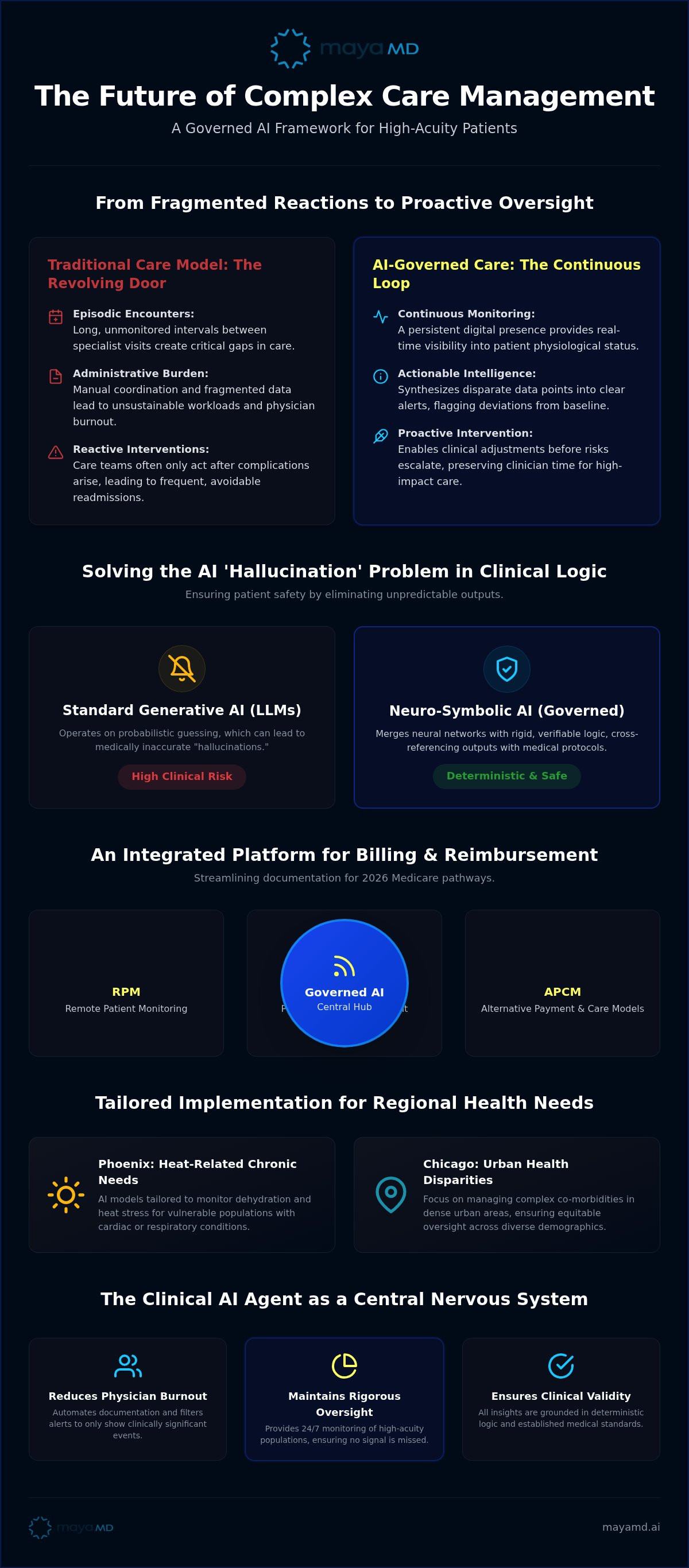
Traditional care models have historically relied on episodic encounters, leaving long intervals where clinicians have no visibility into a patient's physiological status. The 2026 model of care replaces this fragmented approach with continuous monitoring. This transition is supported by a robust framework of clinical governance that ensures all automated insights are accountable to established medical standards. By establishing a persistent digital presence, providers can move away from the "wait and see" methodology that has long characterized chronic disease management.
The High Cost of Fragmented Care
Fragmented care creates a "revolving door" effect, where patients are frequently readmitted for avoidable complications. When specialists work in silos, the administrative burden on the primary care team becomes unsustainable, often leading to missed signals and conflicting treatment plans. The care gap is defined as the critical window of clinical invisibility that occurs between specialist consultations, during which patient risks frequently escalate without intervention. This lack of connectivity is not just a logistical failure; it is a significant driver of rising healthcare expenditures and provider burnout.
Transitioning to Proactive Clinical Oversight
Shifting the focus from reactive treatment to early physiological intervention requires a system that never sleeps. Digital healthcare solutions now enable "continuous care loops," where real-time data informs immediate clinical adjustments. The shift toward digital healthcare for chronic disease allows providers to maintain oversight without increasing the manual workload of their staff. By using deterministic logic to flag deviations from a patient's baseline, these systems ensure that clinicians are only alerted when a meaningful intervention is required, preserving their time for direct patient care.
Neuro-Symbolic AI: Solving the Hallucination Problem in Clinical Logic
The primary challenge in deploying ai for complex care management is the inherent unpredictability of standard generative models. While Large Language Models (LLMs) excel at natural language processing, they operate on probabilistic guessing, which can lead to "hallucinations" or medically inaccurate outputs. In high-acuity environments, these errors aren't just technical glitches; they're clinical risks. Adhering to the WHO guidance on AI ethics, a governed framework prioritizes safety by ensuring that every AI-generated suggestion is cross-referenced with established medical protocols. This is where the Neuro-Symbolic approach becomes essential, merging the fluid communication of neural networks with the rigid, verifiable logic of symbolic AI.
By 2026, the industry standard has moved beyond simple HIPAA compliance toward clinical validity. A Governed Clinical AI Agent doesn't just process data; it applies a layer of deterministic logic to every interaction. This ensures that recommendations remain grounded in peer-reviewed science rather than statistical likelihood. Organizations aiming to bridge the gap between innovation and safety often find that a Clinical AI Agent provides the necessary oversight to support complex decision-making without compromising accuracy.
Deterministic Logic vs. Probabilistic Guessing
MayaMD utilizes a sophisticated architecture where fixed medical rules act as a "gate" for all generative outputs. When a patient reports symptoms, the system doesn't guess a response based on patterns in training data. Instead, it filters the request through a deterministic engine that only allows outputs consistent with validated clinical pathways. This technical safeguard effectively eliminates hallucinations by forcing the AI to prove its logic against a rule-based library before the clinician ever sees a notification. The Clinical AI Agent acts as a tireless auditor, verifying patient-reported data against known protocols to ensure that high-risk signals are never misinterpreted by a probabilistic algorithm.
Ensuring HIPAA-Compliant Patient Monitoring
Securing sensitive Protected Health Information (PHI) requires more than basic encryption; it demands an architecture designed for integrity across disparate networks. For providers operating in major hubs like Las Vegas or Indianapolis, maintaining a consistent security posture is critical when managing data from multiple specialist inputs. To assist with implementation, we have developed a HIPAA compliant patient monitoring checklist that outlines the necessary technical safeguards for 2026. Cloud-based encryption ensures that data remains protected at rest and in transit, while granular access controls prevent unauthorized exposure. This systematic approach to security allows for the seamless flow of information between rural clinics and urban hospitals without risking regulatory non-compliance.
Integrated Modalities: RPM, PCM, and APCM in One Platform
The efficacy of ai for complex care management depends on its ability to unite fragmented clinical workflows. In the 2026 healthcare landscape, managing high-acuity patients requires more than isolated monitoring; it demands a systematic integration of Remote Patient Monitoring (RPM), Principal Care Management (PCM), and Advanced Primary Care Management (APCM). A unified platform eliminates the data silos that traditionally separate primary care providers from specialists, ensuring that every stakeholder operates from a single, governed source of truth. This connectivity is essential for maintaining the clinical integrity of complex care pathways.
The Synergy of RPM and PCM
Device data is meaningless without clinical context. When real-time physiological metrics from RPM devices flow directly into principal care management tools, specialists can adjust treatment plans with surgical precision. The Clinical AI Agent serves as the active bridge in this process, monitoring incoming data streams and identifying deviations that require immediate specialist intervention. This proactive synchronization effectively reduces the need for emergency consultations by addressing risks before they escalate into acute events. It's a model that transforms specialist care from a series of disjointed visits into a continuous loop of clinical oversight.
Streamlining APCM for Primary Care
The 2026 Medicare landscape has placed a renewed emphasis on "whole-person" care through the APCM model. Utilizing advanced primary care management software allows practices to automate routine check-ins and data collection without increasing staff burden. This capability-to-outcome flow is direct: automated data collection leads to higher billing accuracy and ensures that providers are appropriately reimbursed for the intensive coordination required by complex patients. By streamlining these administrative tasks, AI supports a holistic care approach in primary settings, allowing teams to focus on clinical judgment rather than manual data entry.
Precise documentation is the foundation of sustainable complex care. AI-driven platforms automatically track time and interaction data, mapping them to specific reimbursement codes such as CPT 99424 and 99426. With the 2026 Medicare rate increase of 8-10% for these principal care services, the financial viability of high-touch care models has never been stronger. Reliable ai for complex care management ensures that every minute of clinical oversight is captured, verified, and ready for submission, protecting the practice from audit risks while maximizing revenue performance.
Regional Implementation: AI Complex Care in Major US Hubs
The deployment of ai for complex care management is not a monolithic endeavor; it requires deep integration into the specific socio-environmental contexts of the regions it serves. Localized healthcare dynamics dictate the frequency and type of clinical interventions required. In major metropolitan hubs, the challenges range from managing rapid population growth to addressing environmental stressors that exacerbate chronic conditions. By tailoring AI-governed frameworks to these regional nuances, health systems can ensure that high-acuity patients receive oversight that is both relevant and timely.
Sprawling metropolitan areas like Houston present a unique logistical hurdle: distance. For patients in the outer suburbs, frequent trips to downtown medical centers for specialist consultations are often prohibitive. AI enables "care at a distance" by maintaining a continuous clinical presence in the patient's home, effectively shrinking the geographic gap between the provider and the person. This persistent connectivity ensures that a patient's physiological status is always visible to the care team, regardless of their proximity to a physical clinic. Local provider partnerships are essential in this model, as they provide the human infrastructure necessary to act on the insights generated by Clinical AI Agents.
Scaling Care in High-Growth Markets
In high-growth markets like Las Vegas and Phoenix, providers face a dual challenge: a rapidly expanding patient base and an aging demographic particularly susceptible to heat-related chronic stressors. These systems use AI to manage the influx without compromising the quality of individual care. To maintain rigorous oversight, many regional specialist networks are adopting pcm services for healthcare providers, ensuring that principal care management remains a cohesive part of the broader clinical strategy. Similarly, Indianapolis healthcare systems have embraced digital-first complex care to bridge the gap between high-density urban centers and underserved rural outskirts, creating a more equitable distribution of clinical resources.
Addressing Social Determinants of Health (SDOH)
Clinical outcomes are often determined by factors outside the hospital walls. AI agents are now capable of screening for social determinants of health (SDOH) in real-time, identifying local barriers such as transportation challenges in Houston or housing instability in Chicago. By integrating this data into the complex care management care plan, providers can adjust their interventions to account for the patient's lived reality. AI identifies high-risk patients by correlating social barriers with physiological trends, flagging those most likely to experience a setback before a crisis occurs. This holistic oversight allows for a more empathetic and effective management of high-acuity populations. To see how these regional strategies can be unified under a single governed platform, you can explore the Clinical AI Agent solutions designed for modern health systems.
The MayaMD Framework: Orchestrating the Future of Complex Care
The MayaMD Framework functions as the central nervous system for modern health systems, providing the critical connectivity required for successful ai for complex care management. It represents a mature transition from experimental technology to a governed application that prioritizes patient safety through deterministic logic. By moving past the administrative burdens that have long hindered clinical efficiency, providers can finally achieve a state of rigorous oversight that supports, rather than replaces, their expertise. This architecture ensures that every clinical decision is backed by verifiable rules, creating a stable environment for managing high-acuity populations.
Adopting this framework involves a structured roadmap designed for the 2026 regulatory environment. It begins with the integration of disparate data streams into a single, HIPAA-compliant cloud platform, followed by the deployment of Clinical AI Agents that monitor patient status in real time. This systematic approach allows organizations to move from reactive crisis management to a proactive, governed model of care. As an authoritative pioneer in the field, MayaMD provides the technical depth and clinical validity necessary to navigate the complexities of chronic disease management with calm confidence.
Reducing Physician Burnout with AI Documentation
The "2-to-1" problem, where clinicians spend two hours on administrative tasks for every one hour of direct patient care, remains a primary driver of industry-wide burnout. Implementing clinical workflow automation solutions allows practices to eliminate manual charting and redundant data entry. MayaMD's Clinical AI Agent acts as a sophisticated partner, providing a second set of eyes that monitors high-risk signals while simultaneously generating accurate documentation for APCM and PCM billing. This relief from clerical labor provides a significant psychological benefit, allowing physicians to focus their intellectual energy on direct patient intervention and complex decision-making.
Complementing these workflow improvements, Kaika AI provides a workforce alignment platform that ensures clinical teams remain connected to their individual purpose while striving toward the organization's patient-centered goals.
Next Steps: Evaluating the Best PCM Software
Selecting a technology partner is a high-stakes decision that requires a focus on stability and integration. When evaluating top pcm software companies, it's essential to prioritize platforms that offer seamless connectivity with existing EHR systems. MayaMD's integration capabilities ensure that patient data flows securely across the care continuum, providing a comprehensive view of the patient's health journey. This connectivity is the foundation of effective ai for complex care management, ensuring that no data point is left in a silo. We invite healthcare leaders to schedule a clinical discovery session to explore how our governed AI architecture can transform their approach to high-risk patient oversight.
Pioneering the Next Era of Governed Clinical Intelligence
The transition toward ai for complex care management is no longer a futuristic concept; it's a present-day clinical necessity for high-acuity populations. We've examined how the integration of deterministic logic and neuro-symbolic architectures effectively eliminates the risk of hallucinations, providing a stable foundation for persistent oversight. By synchronizing RPM, PCM, and APCM workflows into a single, governed ecosystem, health systems can finally bridge the care gaps that have historically led to fragmented outcomes and significant provider burnout.
Whether you're managing heat-related chronic stressors in Phoenix or addressing complex housing barriers in Houston, a HIPAA-compliant deterministic AI architecture offers the precision required for modern practice. The path forward involves moving beyond administrative burdens toward a model where technology fosters deeper human connection and clinical integrity. It's time to move from reactive monitoring to proactive, rule-based intervention that respects the nuances of the patient experience. We're committed to being your partner in this evolution.
Request a Clinical AI Discovery Session with MayaMD to explore how our integrated workflows can support your specific regional needs. We look forward to helping you orchestrate a safer, more efficient future for your most vulnerable patients.
Frequently Asked Questions
How does AI improve complex care management for patients with multiple comorbidities?
AI improves the management of multi-morbid patients by synthesizing vast amounts of disparate physiological data into actionable clinical insights. By maintaining a continuous care loop, the system identifies subtle health deteriorations that episodic visits often miss. This constant oversight allows for early intervention, reducing the risk of acute events and ensuring that all specialist care plans are synchronized through a single, governed intelligence layer.
Is AI for complex care management HIPAA compliant?
Yes, our ai for complex care management platform is fully HIPAA compliant and utilizes advanced cloud-based encryption to secure sensitive patient health information. The architecture is designed with rigorous technical safeguards to ensure data integrity during both transit and storage. This framework allows providers to share critical insights across specialist networks without compromising regulatory adherence or patient privacy.
Can a Clinical AI Agent replace human care coordinators?
A Clinical AI Agent is designed to support, not replace, human care coordinators by automating the administrative burdens of documentation and data collection. It serves as a sophisticated partner that handles routine monitoring and time-tracking, allowing coordinators to focus on high-level clinical judgment and patient connection. This synergy increases the capacity of the care team while maintaining the essential human element of complex care.
What is the difference between Generative AI and Deterministic AI in healthcare?
Generative AI operates on probabilistic patterns to predict text, which can lead to clinical inaccuracies known as hallucinations. In contrast, deterministic AI uses fixed, rule-based logic to ensure that every output aligns with validated medical protocols. By gating generative capabilities with deterministic frameworks, we ensure that clinical decision support remains verifiable, safe, and grounded in established medical science.
How do RPM and PCM work together in an AI platform?
RPM and PCM work together by allowing real-time device data to inform specialized care plans automatically. When a Remote Patient Monitoring device flags a physiological deviation, the AI platform immediately alerts the Principal Care Management team to adjust the patient's treatment strategy. This integration ensures that specialist interventions are driven by current data rather than relying on retrospective patient reporting during office visits.
What are the reimbursement benefits of using AI for APCM and PCM in 2026?
Using AI for APCM and PCM in 2026 allows practices to capture higher reimbursement rates, including an 8-10% increase for specific principal care management codes. The platform automates the meticulous time-tracking and documentation required for CPT codes like 99424 and 99426. This capability-to-outcome flow ensures billing accuracy and maximizes revenue while protecting the practice from the risks of manual audit errors.
How does MayaMD prevent AI hallucinations in clinical documentation?
MayaMD prevents hallucinations by utilizing a neuro-symbolic AI architecture that filters generative outputs through a deterministic logic gate. Every recommendation is cross-referenced against a library of fixed medical rules before it reaches the clinician. This systematic approach ensures that all documentation and decision support remain clinically valid, effectively eliminating the unpredictable guessing often associated with standard large language models.
What cities does MayaMD currently support for complex care implementation?
MayaMD currently supports providers in major US hubs including Las Vegas, Phoenix, Indianapolis, Chicago, and Houston. We provide specialized clinical support tailored to the unique demographic and environmental stressors of these regions. Our implementation roadmap is designed to help local networks scale their ai for complex care management while addressing specific regional health disparities and social determinants of health.



See The MayaMD Difference
Fill the form below
Download Our Apps
MayaMD for patients and MayaPro for physicians - available on iOS and Android.
FOR PATIENTS
MayaMD App
AI-powered symptom assessment, triage, and secure access to your care team.


FOR PHYSICIANS
MayaPro App
MayaPro brings patient vitals, RPM/PCM care plans, and clinical decision support to your pocket.