
PCM Services: 2026 Guide for Healthcare Providers

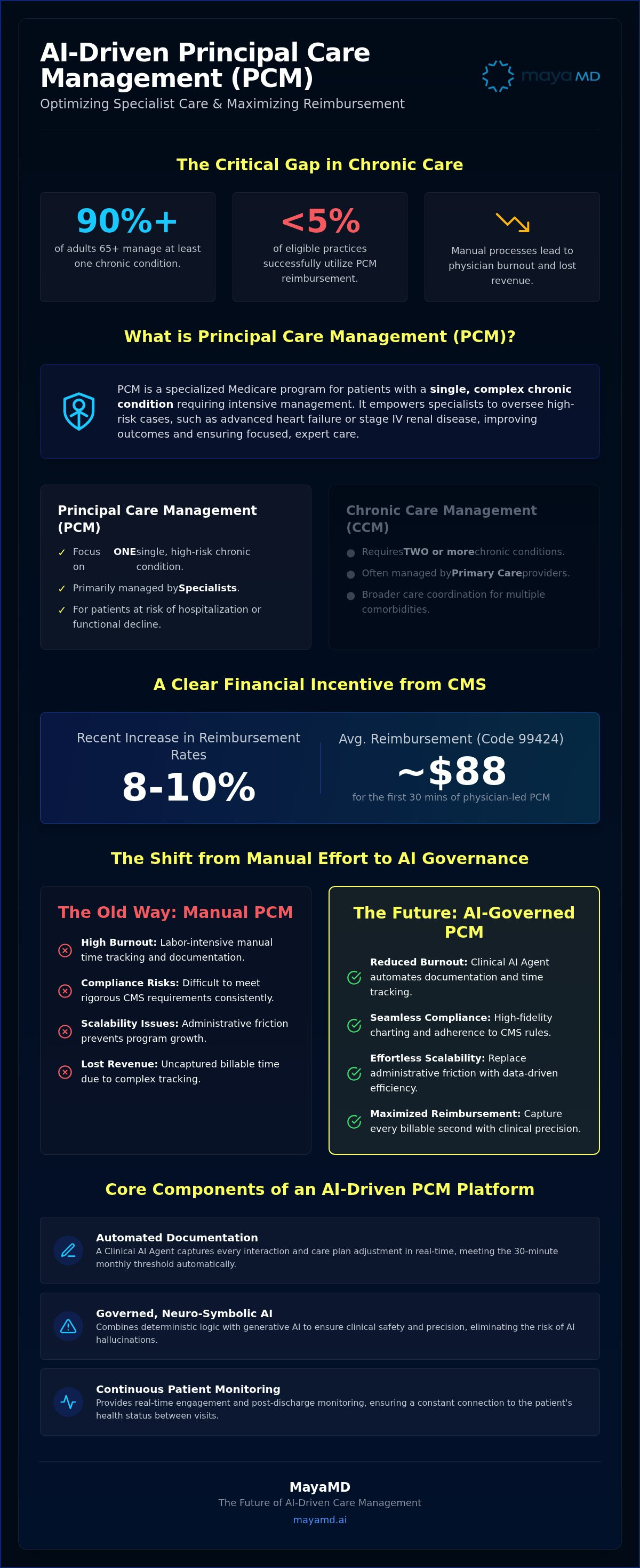
Over 90% of adults aged 65 and older now manage at least one chronic condition, yet barely 5% of eligible practices successfully utilize pcm services for healthcare providers to capture the reimbursement available for this essential longitudinal care. You understand the clinical necessity of specialized oversight for complex, single-condition patients. However, the manual effort required to meet rigorous Medicare requirements often accelerates physician burnout rather than alleviating it. The risk of AI hallucinations in clinical notes and the technical complexity of time tracking have historically made scaling these programs feel like a precarious gamble.
This 2026 guide reveals how to optimize specialist care and maximize Medicare reimbursement using AI-driven platforms. By implementing a governed, neuro-symbolic AI framework, your organization can achieve high-fidelity clinical documentation and seamless regulatory compliance. We will examine the latest CMS billing updates, including the 8-10% increase in reimbursement rates for codes like 99424. You will discover a methodical path to integrating advanced care models that replace administrative friction with precise, data-driven patient outcomes.
Key Takeaways
• Identify the strategic shift toward Principal Care Management (PCM) for high-risk patients requiring specialized oversight for a single chronic condition.
• Discover how a Clinical AI Agent automates documentation and time tracking to optimize pcm services for healthcare providers while significantly reducing specialist burnout.
• Evaluate the clinical and financial advantages of AI-governed models over manual resource allocation to ensure high-fidelity charting and regulatory compliance.
• Implement a seamless transition to digital care using structured risk stratification and HIPAA-compliant patient enrollment portals.
• Leverage the MayaMD ecosystem to integrate deterministic logic with generative AI, ensuring safety and precision in high-risk chronic care management.
What are PCM Services for Healthcare Providers in 2026?
Precision defines the 2026 specialist care environment. Principal Care Management (PCM) represents the structural recognition of specialist expertise in managing high-risk, single-condition patients. While foundational programs like Chronic Care Management (CCM) address patients with multiple comorbidities, PCM is surgically focused. It targets a single, complex chronic condition that places the patient at significant risk of hospitalization, acute exacerbation, or functional decline. These conditions are expected to last between three months and the remainder of the patient's life, requiring the nuanced oversight that only a specialist can provide.
The 2026 landscape has shifted significantly as CMS increased reimbursement rates for all PCM codes by approximately 8-10% in the latest Physician Fee Schedule. This adjustment signals a clear federal investment in longitudinal care. By utilizing pcm services for healthcare providers, specialists can finally capture the cognitive labor involved in care coordination that was previously uncompensated. This model creates a sustainable, recurring revenue stream that stabilizes practice finances while improving the clinical trajectory for the most vulnerable patient populations.
PCM vs. CCM: Choosing the Right Care Model
The distinction between care models is a matter of clinical risk and resource allocation. CCM requires at least two chronic conditions, often making it the domain of primary care. Conversely, PCM is the specialist's tool for intensive, single-disease management. This is distinct from Advanced Primary Care Management (APCM), which often utilizes bundled payments for broader health goals. Specialists should transition patients to PCM when a specific condition, such as advanced heart failure or stage IV renal disease, becomes the primary driver of the patient's clinical risk profile. This transition ensures the provider with the most relevant expertise is leading the care coordination effort.
The Core Elements of a CMS-Compliant PCM Program
Success in PCM requires adherence to a rigorous, logic-based framework. A compliant program must include:
Comprehensive Care Planning
Every patient requires a personalized plan that is periodically reviewed and revised based on real-time data.
Service Thresholds
Providers must meet a 30-minute monthly threshold for codes like 99424 and 99426. The national average reimbursement for the first 30 minutes of physician-led PCM is now approximately $88.
Digital Enrollment
Patient consent must be documented. In 2026, this is best achieved through digital, HIPAA-compliant portals that integrate directly with the EHR.
Deploying pcm services for healthcare providers through a governed platform ensures these requirements are met without increasing the manual burden on clinical staff. By automating the time-tracking and documentation logic, practices can scale their care management efforts while maintaining total regulatory adherence.
The Role of Clinical AI in Modern PCM Services
Clinical AI has transcended basic administrative support. In 2026, the successful deployment of pcm services for healthcare providers relies on Clinical AI Agents that do more than log minutes; they facilitate meaningful patient interactions. According to official Medicare coverage for PCM, these services require intensive management of a single high-risk condition. Manually capturing every interaction, triage event, and care plan adjustment is unsustainable for modern specialist practices. A Clinical AI Agent acts as a bridge, automating documentation in real-time to ensure every billable second is captured with clinical precision. This automation directly addresses specialist burnout by removing the cognitive load of manual charting and allowing physicians to focus on high-level decision-making.
Continuous monitoring is the hallmark of effective chronic care. AI supports patients between specialist visits by providing real-time engagement and automated post-discharge monitoring. By utilizing solutions like Azire, healthcare providers can deploy voice agents that maintain a constant connection to the patient's health status and ensure a seamless transition of care. When a patient leaves the clinic, the AI remains active, tracking adherence to the care plan and identifying subtle shifts in health that might otherwise go unnoticed until the next acute event.
Deterministic Logic vs. Generative AI in Care Management
Unchecked generative AI poses a significant risk in a clinical setting. Hallucinations, where an AI fabricates medical data, are entirely unacceptable when managing complex chronic diseases. MayaMD utilizes a governed approach that combines deterministic logic with advanced clinical AI. This neuro-symbolic framework ensures that every automated patient summary adheres to established medical protocols and clinical truths. By grounding generative capabilities in a logical framework, providers maintain clinical validity while benefiting from the speed of AI-assisted documentation. It's a system built on safety, ensuring that the technology supports rather than complicates the clinical workflow.
Integrating RPM and PCM for Holistic Monitoring
Data is the lifeblood of chronic care. Integrating Remote Patient Monitoring software with PCM workflows creates a proactive care environment. Biometric data from RPM devices feeds directly into the PCM ecosystem, triggering automated alerts if a patient's condition shows signs of acute exacerbation or functional decline. This connectivity allows for immediate intervention, often preventing the hospitalizations that PCM aims to avoid. Specialists who leverage AI-driven patient engagement solutions find they can offer a higher standard of care without increasing their staff's workload, turning disparate data points into a cohesive clinical narrative.
Manual vs. AI-Governed PCM: A Comparative Analysis
Efficiency is the primary differentiator in the modern clinical environment. Traditional pcm services for healthcare providers often collapse under the weight of their own administrative requirements. In a manual model, clinical staff must meticulously track every minute of care coordination across fragmented systems, a process inherently prone to human error and oversight. This staff-heavy approach creates a rigid ceiling for scalability; a practice can only manage as many high-risk patients as their current headcount allows. By contrast, an AI-governed model utilizes a Clinical AI Agent to automate the tracking and synthesis of patient data, transforming a labor-intensive hurdle into a high-margin clinical asset.
While the initial investment in an AI platform may seem substantial, the reduction in administrative overhead is profound. Manual charting is not just slow; it's expensive. Human error in documentation leads to denied claims and significant audit risks. AI-augmented services provide a level of precision that manual systems cannot replicate, ensuring that every interaction is logged accurately and compliantly. This shift allows for a more logical allocation of human resources, where staff focus on high-impact clinical interventions rather than data entry.
The Impact on Physician Burnout
Physician burnout is frequently fueled by "pajama time," the extra hours practitioners spend on clinical documentation after their shift ends. AI agents act as a force multiplier, allowing a single care coordinator to manage a larger patient panel without sacrificing the quality of connection. Clinics in metropolitan hubs like Indianapolis or Houston have reported significant reductions in administrative friction by shifting from manual logs to automated summaries. This transition moves the physician from the role of a data-entry clerk back to that of a clinical visionary, focused entirely on patient outcomes.
Data Security and Regulatory Compliance
Security is a non-negotiable pillar of specialized care. Ensuring HIPAA compliant patient monitoring requires more than just encrypted data; it necessitates a governed framework that provides immutable logs for every AI interaction. This "Authoritative Pioneer" approach to data governance ensures that your practice remains audit-proof. By maintaining a transparent, logic-based trail of care, providers can satisfy both regulatory bodies and clinical standards while protecting the integrity of the patient-provider relationship. Pcm services for healthcare providers must be built on this foundation of stability and security to be viable in the long term.
How to Implement PCM Services in Your Practice
Implementation of pcm services for healthcare providers requires a methodical shift from episodic encounters to a structured, longitudinal oversight model. This transition isn't merely an administrative change; it's a clinical evolution that demands a governed technological framework. To succeed in 2026, specialists must move beyond manual time tracking and embrace a system where data logic and human care intersect seamlessly. The following steps outline the path to a high-performance program.
Step 1: Patient Identification and Risk Stratification.
Utilize EHR data to identify patients with a single, complex chronic condition expected to last at least three months. Advanced risk stratification ensures your resources are focused on patients at the highest risk of acute exacerbation or functional decline.
Step 2: Digital Consent and Enrollment.
Secure patient consent through digital, HIPAA-compliant portals. This ensures that the enrollment process is documented with clinical precision, satisfying a core CMS requirement for participation.
Step 3: Integration of Specialized Technology.
Deploying a Principal Care Management tool allows for the automated aggregation of patient data and interaction tracking. This connectivity is essential for managing the 30-minute monthly threshold required for reimbursement.
Step 4: Establishing Neuro-Symbolic AI Workflows.
Implement an AI-governed documentation process. By using deterministic logic to ground generative AI, you ensure that clinical summaries are accurate, valid, and free from hallucinations.
Step 5: Billing and Quality Reporting.
Submit monthly claims using CPT codes 99424 through 99427. National average reimbursement for the initial 30 minutes of physician-led care is approximately $88, providing a sustainable revenue stream for specialist expertise.
Local Operational Guidance for US Hubs
Specialists in major metropolitan hubs like Las Vegas, Phoenix, and Chicago face unique demographic challenges and regional Medicare Administrative Contractor (MAC) requirements. Scaling pcm services for healthcare providers across multi-city hospital systems requires a unified technological standard that can still adapt to local nuances. For instance, providers in Phoenix must navigate specific Noridian requirements while managing high-acuity populations. A centralized, AI-driven platform ensures consistency in quality reporting and compliance across disparate locations, turning geographic complexity into a manageable clinical asset.
Staff Training and Workflow Integration
Training clinical staff to work alongside AI Agents is a strategic necessity rather than a technical hurdle. Your team must understand how to interpret automated PCM summaries and integrate them into existing EHR workflows. This continuous quality improvement (CQI) approach allows specialists to refine care plans based on real-time data insights. By reducing the manual burden of documentation, your staff can focus on high-impact interventions. Practices ready to modernize their care models should implement AI-driven PCM solutions to achieve these efficiency gains while maintaining the highest standards of patient support.
MayaMD: The Future of AI-Driven PCM Services
Connectivity defines the future of specialized care. MayaMD provides a comprehensive Clinical AI ecosystem designed to transform how specialists deliver pcm services for healthcare providers. By integrating disparate data points into a cohesive clinical narrative, our platform ensures that high-risk patients receive continuous, precise oversight. This is not a disruptive tool; it's a sophisticated partner that understands the nuances of clinical workflows and the gravity of chronic disease management. We bridge the gap between advanced data science and the daily reality of patient management, allowing for a seamless transition from acute care to longitudinal support.
Our governed approach distinguishes MayaMD within the competitive market of top PCM software companies. While others focus primarily on time logging or revenue maximization, we prioritize the clinical validity of every interaction. By deploying Clinical AI Agents that operate within a rigorous framework of medical logic, we empower providers to scale their services without sacrificing the quality of connection or the safety of the patient experience. The result is a measurable improvement in patient engagement and a significant reduction in the administrative friction that typically hinders specialist practices.
The MayaMD Differentiator: Reliable AI
Safety is the non-negotiable foundation of our technology. We utilize neuro-symbolic AI to eliminate the risk of hallucinations in clinical documentation, ensuring that every summary is grounded in deterministic logic. This technical precision translates into high-fidelity charting that satisfies both clinical standards and regulatory audits. Our cloud-based, HIPAA-compliant infrastructure provides the stability and security required for 2026 healthcare environments. This reliable framework allows specialists to trust the automated outputs, facilitating faster decision-making and more accurate care coordination. To see the Clinical AI Agent in action, we invite you to schedule a professional consultation with our team to discuss your specific operational goals.
Building Long-Term Clinical Partnerships
MayaMD views technology as a bridge to human care, not a replacement for it. We adopt a collaborative approach to chronic care, customizing pcm services for healthcare providers to meet the specific requirements of various medical specialties. Whether managing advanced cardiology cases, complex nephrology patients, or intensive psychiatric needs like those handled at pandhealth.com, our platform adapts to your unique clinical protocols and risk stratification models. We value long-term partnerships over fleeting trends, offering a stable foundation for practices to grow their care management programs. This commitment to measurable performance ensures that your practice remains at the forefront of clinical innovation. Join the pioneers of AI-governed continuous care and redefine the standard of excellence for your high-risk patient populations.
Modernizing Specialist Care for a New Era
The transition to AI-governed care models is no longer a futuristic concept; it's a strategic necessity for specialist practices. By adopting pcm services for healthcare providers that leverage deterministic logic, organizations can capture the 8-10% reimbursement increases available in 2026 without overburdening their staff. This evolution ensures that high-risk patients receive the specialized oversight they require while maintaining the highest standards of data integrity and regulatory compliance.
MayaMD stands as the authoritative partner in this evolution, offering specialist-focused chronic care solutions built on a foundation of stability and precision. Our HIPAA-compliant neuro-symbolic AI eliminates clinical hallucinations; meanwhile, the Clinical AI Agent for documentation transforms administrative friction into a streamlined, high-fidelity process. We invite you to move past the limitations of manual care management and embrace a future defined by clinical connectivity and measurable performance. Request a Demo of MayaMD's AI-Driven PCM Services to see how we can support your practice's growth and improve patient outcomes.
Frequently Asked Questions
What are the specific Medicare billing codes for PCM in 2026?
As of 2026, the correct CPT codes are 99424 and 99425 for physician-led services, while 99426 and 99427 are used for services performed by clinical staff under general supervision. These codes replaced older HCPCS G-codes to provide a more granular framework for specialized care. The national average reimbursement for the initial 30 minutes of physician-led care (99424) is approximately $88, reflecting a significant federal investment in longitudinal management.
Can a patient receive both CCM and PCM services simultaneously?
No, a provider cannot bill for both Chronic Care Management (CCM) and Principal Care Management (PCM) for the same patient within the same calendar month. While CCM manages patients with two or more chronic conditions, PCM focuses exclusively on the intensive management of a single, high-risk condition. Choosing the correct model depends on the patient's specific clinical risk profile and the primary driver of their current care needs.
How does AI reduce the administrative burden of PCM documentation?
Clinical AI Agents automate the synthesis of patient interactions and time tracking to ensure every billable minute is captured with clinical precision. By integrating directly with the EHR, these agents generate automated summaries that meet CMS requirements without manual data entry. This governed approach to pcm services for healthcare providers allows staff to focus on high-impact clinical interventions rather than the friction of tedious charting.
Is MayaMD's PCM platform HIPAA compliant for providers in Las Vegas and Houston?
Yes, the MayaMD platform utilizes a fully HIPAA-compliant cloud infrastructure designed to meet the rigorous security standards of providers in Las Vegas, Houston, and across the United States. We employ advanced encryption and immutable logging to protect sensitive patient data at every touchpoint. This secure framework ensures that all remote monitoring and engagement activities remain within total regulatory and clinical adherence.
What qualifies a patient as 'high-risk' for PCM services?
A patient qualifies if they have a single complex chronic condition that is expected to last at least three months or until the end of their life. This condition must place the patient at significant risk of hospitalization, acute exacerbation, functional decline, or death. The specialized nature of these cases requires the nuanced oversight and frequent care plan revisions that define the Principal Care Management model.
Does PCM require the use of Remote Patient Monitoring (RPM) devices?
PCM doesn't strictly require RPM devices, but integrating the two services provides a more comprehensive clinical narrative and proactive care environment. While PCM focuses on the coordination and management of a single condition, RPM provides the real-time biometric data that informs those management decisions. When used together, these services can significantly improve outcomes by allowing for data-driven interventions before an acute event occurs.
How does deterministic logic prevent AI errors in clinical care plans?
Deterministic logic acts as a clinical guardrail by grounding generative AI outputs in established medical truths and logical frameworks. MayaMD utilizes neuro-symbolic AI to eliminate the risk of hallucinations, ensuring that every care plan and documentation summary is clinically valid. This approach prioritizes safety and precision over the unpredictable nature of ungoverned large language models, providing a reliable partner for specialist workflows.
What is the typical ROI for a specialist practice implementing PCM services?
Specialists typically see a positive ROI through the capture of previously uncompensated cognitive labor and the 8-10% increase in 2026 reimbursement rates. By utilizing an AI-governed platform for pcm services for healthcare providers, practices reduce the administrative overhead that often erodes the profitability of manual care models. This shift transforms care coordination from a resource-intensive hurdle into a sustainable, high-margin clinical asset for the practice.




See The MayaMD Difference
Fill the form below
Download Our Apps
MayaMD for patients and MayaPro for physicians - available on iOS and Android.
FOR PATIENTS
MayaMD App
AI-powered symptom assessment, triage, and secure access to your care team.


FOR PHYSICIANS
MayaPro App
MayaPro brings patient vitals, RPM/PCM care plans, and clinical decision support to your pocket.