
Top PCM Software Companies: Evaluating the Best Principal Care Management Platforms in 2026

With the global care management market projected to reach $19 billion in 2026, the search for top pcm software companies has shifted from simple tracking tools to sophisticated clinical AI ecosystems. Specialists understand that managing high-risk, single-condition patients requires more than a digital checklist. It demands a system that bridges the gap between complex care and administrative precision. You've likely experienced the exhaustion of manual documentation and the frustration of reimbursement gaps for CPT codes 99424 through 99427.
This article helps you discover the leading Principal Care Management (PCM) software providers and explains how AI-driven platforms are transforming specialized chronic care. We'll examine how the integration of deterministic logic and generative AI can automate clinical documentation, ensuring every minute of care is captured with clinical accuracy. By the end, you'll understand how to select a platform that maximizes CMS revenue while improving clinical outcomes for your patients through governed, reliable technology.
Key Takeaways
• Distinguish between PCM and CCM to effectively manage high-risk patients with complex, single chronic conditions.
• Evaluate the top pcm software companies through the lens of data liquidity and bilateral EHR integration to ensure seamless clinical workflows.
• Implement AI-governed platforms that utilize deterministic logic to eliminate hallucinations and maintain high-stakes clinical safety.
• Maximize CMS reimbursement for CPT codes 99424-99427 by leveraging automated documentation and precise time-tracking capabilities.
• Utilize Clinical AI Agents to foster continuous patient engagement and remote monitoring between specialist visits.
The Evolution of Specialized Chronic Care: Why PCM Software is Essential in 2026
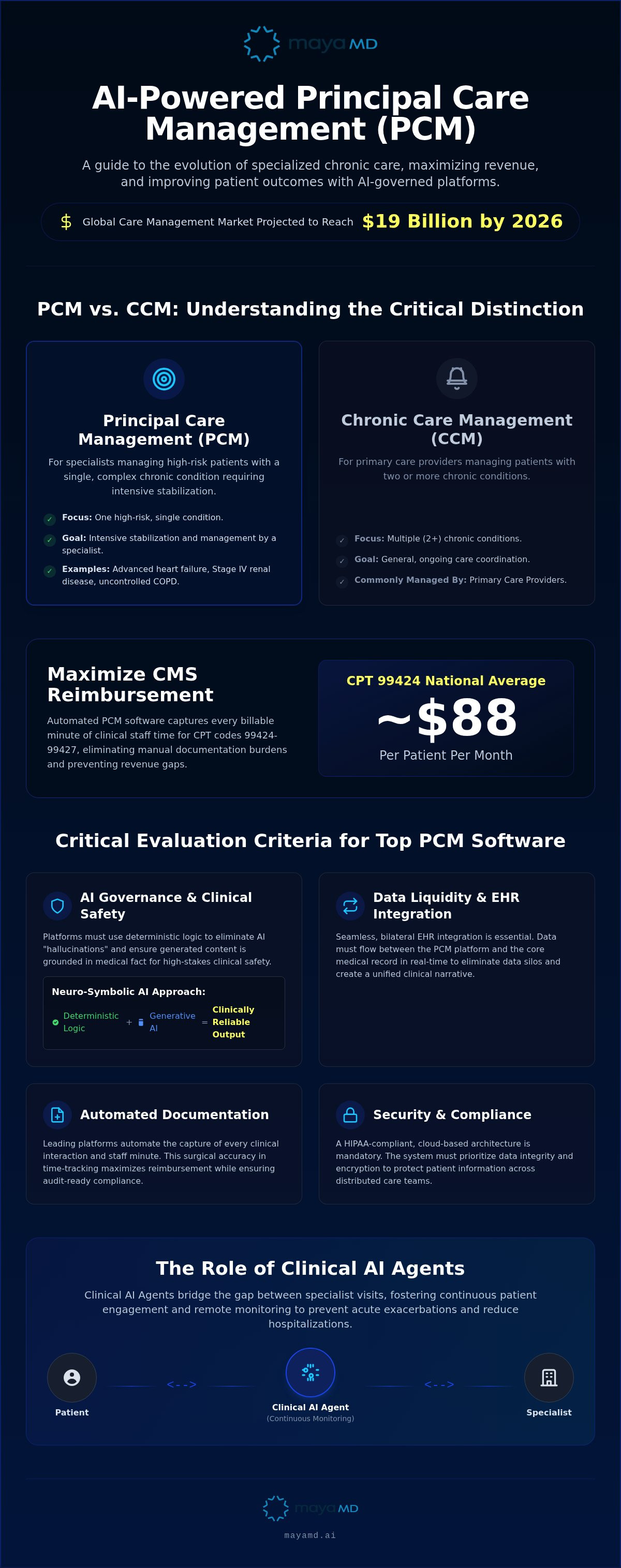
The landscape of chronic disease management has undergone a fundamental shift toward clinical precision. While Chronic Care Management (CCM) addresses patients with multiple comorbidities, Principal Care Management (PCM) focuses on the intensive stabilization of a single, high-risk condition. This distinction is critical for specialists who manage complex cases like advanced heart failure, stage IV renal disease, or uncontrolled COPD. By 2026, CMS has reinforced this focus by increasing reimbursement rates for PCM codes. National averages for CPT 99424 have risen to approximately $88 per month, reflecting a broader regulatory push toward Primary Care Case Management principles adapted for the specialist environment. This shift recognizes that single-condition patients often require more resources and expertise than general primary care can provide.
Specialist practices now face a growing population of high-risk patients who require continuous oversight between office visits. Traditional reactive models are no longer sufficient to prevent acute exacerbations. The economic impact of adopting automated tracking is substantial. By leveraging top pcm software companies, practices can capture every billable minute of clinical staff time without the manual burden that typically leads to physician burnout. Automated systems ensure that CPT codes 99424 through 99427 are tracked with surgical accuracy, maximizing revenue while maintaining the highest standards of patient safety.
The Specialist Gap in Traditional Care
Generic care management software often fails because it lacks the clinical depth required for specialty-specific workflows. A cardiologist requires different data points and logic than an endocrinologist. Generalist CCM tools don't account for the unique diagnostic nuances of pulmonology or the specific monitoring needs of oncology. The most effective PCM platforms distinguish themselves by offering deterministic logic that mirrors specialist decision-making. These tools move beyond simple time-tracking; they provide the infrastructure for continuous monitoring and intervention. This level of specificity ensures that high-risk patients remain stable, reducing the likelihood of hospitalizations through governed, condition-specific care plans.
Regulatory Compliance and HIPAA Standards
Security is the foundation of any clinical platform. In 2026, maintaining hipaa compliant patient monitoring requires a cloud-based architecture that prioritizes data integrity and encryption across distributed care teams. Top PCM software companies must offer audit-ready documentation that captures every interaction and clinical staff minute automatically. This systematic approach eliminates the risk of human error in reimbursement tracking and ensures that the practice remains compliant during CMS reviews. It's about creating a governed ecosystem where data liquidity and patient safety coexist. High-stakes reliability is mandatory when managing the delicate health of chronic patients.
Critical Evaluation Criteria: What Defines a Top PCM Software Provider?
Identifying the top pcm software companies requires looking beyond basic patient lists or simple time-tracking tools. In 2026, data liquidity is the primary benchmark for success. Systems must support bilateral EHR integration, allowing clinical data to flow seamlessly between the care management platform and the core medical record. This connectivity ensures that Principal Care Management Services are documented in real-time, effectively reducing the risk of data silos that compromise patient safety. A truly advanced platform acts as a bridge, connecting disparate data points into a unified, actionable clinical narrative.
AI Governance and Clinical Safety
The 2026 standard for clinical documentation is neuro-symbolic AI. Unlike unmanaged generative models that are prone to "hallucinations," this approach combines the creative potential of AI with the rigid guardrails of symbolic reasoning. This dual-layer architecture is essential for eliminating inaccuracies in patient summaries. By utilizing deterministic logic in clinical ai, software providers ensure that every piece of generated content remains grounded in medical fact. This level of oversight is mandatory for specialists who manage complex conditions where a single error can lead to adverse outcomes. You can explore how these governed systems protect clinical integrity by reviewing the latest clinical AI solutions designed for high-stakes environments.
User Experience and Clinician Burnout
Automation is also the key to capturing reimbursement for CPT codes 99424 through 99427. With national average reimbursements for the first 30 minutes of physician time (99424) reaching approximately $88 in 2026, the financial stakes are high. Top PCM software companies provide the logic-driven frameworks necessary to track these minutes with surgical precision. This systematic approach ensures that every intervention is logged, verified, and ready for audit; it transforms the reimbursement process from a manual burden into a reliable revenue stream for the specialist practice. To further optimize your financial operations, you can check out HPC Healthcare Partners for specialized medical billing services.
Top PCM Software Companies and AI Platforms: 2026 Comparison
Market selection. The landscape of top pcm software companies has bifurcated into established legacy providers and agile, AI-native platforms. Established players like CareCloud have built robust reputations by mastering the complexities of billing and large-scale EHR interoperability. These systems prioritize stability and adherence to the CMS Guidelines on Care Management, providing a reliable foundation for practices transitioning away from traditional fee-for-service models. HealthEC continues to lead in population health analytics, offering deep insights into patient cohorts. However, as the industry moves toward 2026, the demand for real-time engagement has catalyzed the rise of AI-first leaders like MayaMD. These platforms utilize clinical AI agents to maintain a continuous presence in the patient's life, moving beyond the periodic check-ins characteristic of older models.
Vendors typically utilize two primary financial structures: fixed monthly subscriptions or a percentage-of-reimbursement model. Subscription models offer predictable overhead for large-scale operations, while percentage-based pricing aligns vendor incentives with practice revenue. Evaluating these models requires a thorough analysis of internal staff capacity and projected patient enrollment. The ideal partner offers a transparent fee structure that scales alongside the clinical success of the program.
Legacy Systems vs. AI-Native Platforms
Traditional EHR-based tools often treat artificial intelligence as a "bolt-on" feature. This approach frequently results in fragmented workflows and data latency. In contrast, AI-native platforms are designed from the ground up to handle high-velocity data streams. For large medical groups in Chicago, this architectural difference is the key to scalability. A native AI framework supports thousands of concurrent patient interactions without compromising clinical oversight. Vendor stability remains a critical factor; practices must prioritize partners with clear innovation roadmaps that address the evolving regulatory landscape.
Specialist-Specific Feature Sets
Clinical precision requires more than generic templates. Top pcm software companies now provide condition-specific logic for cardiology, nephrology, and other high-stakes specialties. Integration with Remote Patient Monitoring (RPM) hardware is another essential capability. MayaMD bridges the gap between specialized principal care management tools and RPM by unifying device data with AI-governed care plans. This synthesis allows specialists to monitor physiological changes in real-time, intervening before a single chronic condition escalates into an emergency. It's a shift from retrospective data collection to proactive, continuous care coordination.
Strategic Implementation: Deploying PCM Software in Major US Markets
Strategic deployment. Transitioning from the evaluation of top pcm software companies to active clinical operation requires a methodical, three-phase framework: clinical alignment, technical integration, and performance optimization. In markets like Indianapolis and Las Vegas, healthcare systems face distinct workforce dynamics. These regions often manage high patient volumes with specialized needs, making AI-assisted care coordination a necessity rather than a luxury. By deploying a governed platform, practices can bridge staffing gaps and maintain a continuous clinical presence without increasing the physical burden on their teams.
The time-to-value for PCM software investments is often realized within the first 90 days of operation. Rapid ROI is driven by the immediate stabilization of revenue through automated tracking of CPT 99424 and 99426. When the administrative friction of manual documentation is removed, clinical staff can pivot their focus toward high-risk interventions. This shift doesn't just improve the practice's bottom line; it fosters a deeper connection between the specialist and the patient, ensuring that single-condition chronic care remains proactive and precise.
Managing the Cultural Shift to AI
Physician skepticism regarding AI documentation is a reality that leadership must address with transparency. It's vital to demonstrate that AI is a supportive layer designed to enhance clinical judgment, not replace it. Integrating PCM insights into the daily huddle ensures the entire care team stays aligned on patient status and intervention priorities. Many organizations have successfully navigated this transition through advanced primary care management deployments, where governed AI workflows significantly reduced the time spent on manual charting and administrative follow-ups.
Scaling PCM Across Multiple Locations
Consistency is the primary challenge when scaling across multiple sites. For organizations with clinics in both Phoenix and Houston, a centralized care management model often provides the most reliable oversight. This approach allows a core team to monitor high-risk patients using standardized clinical protocols across the entire network. By utilizing clinical workflow automation solutions, multi-site operators can synchronize data across disparate EHR instances and geographic boundaries. This level of connectivity transforms a collection of individual clinics into a unified, high-performing healthcare ecosystem.
Ready to transform your specialist practice with governed technology? Explore how to launch a Clinical AI Agent to support your PCM and RPM programs today.
MayaMD: Redefining Specialist Care with AI-Governed PCM
Clinical authority meets technological ambition. MayaMD distinguishes itself among top pcm software companies by prioritizing safety through the rigorous application of deterministic logic. While many platforms offer basic administrative tools, MayaMD provides a Clinical AI Agent that functions as a sophisticated extension of the specialist's own expertise. By integrating digital healthcare for chronic disease into existing workflows, the platform ensures that patient oversight is never interrupted. This approach transforms the traditional, episodic care model into a continuous, governed narrative that prioritizes the stabilization of high-risk conditions.
The proof of this methodology is found in clinical outcomes. AI-driven PCM has demonstrated a measurable impact on reducing hospital readmissions by identifying subtle physiological shifts before they escalate into acute crises. This proactive intervention logic allows specialists to maintain high-stakes reliability while managing complex patient populations. It's a system built on the cold, hard logic of data science, yet it remains deeply focused on the human impact of chronic care management.
The Clinical AI Agent in Action
The Clinical AI Agent supports patients during the critical intervals between specialist visits. It utilizes real-time escalation logic to identify high-risk clinical events, ensuring that the care team is alerted the moment an intervention is required. In markets like Indianapolis, these governed programs have significantly improved patient adherence to specialized treatment plans. The agent provides the constant connection and support that high-risk patients need to manage their conditions effectively. It's not just a monitoring tool; it's a bridge between disparate data points and meaningful clinical action.
Future-Proofing Your Practice
Scalability is a core requirement for any modern practice. MayaMD allows providers to expand their capabilities from PCM to Advanced Primary Care Management (APCM) and Remote Patient Monitoring (RPM) on a single, unified platform. As the 2026 value-based care landscape continues to evolve, governed AI stands as the only viable path for sustainable specialist care. It provides the systematic framework necessary to meet rigorous compliance standards while maximizing the quality of care. Choosing MayaMD means partnering with a visionary leader that understands the nuances of clinical workflows and the necessity of regulatory adherence.
The evolution of your practice begins with a strategic shift toward governed intelligence. Specialists ready to lead this transition should consider booking a clinical AI strategy session to explore how these advanced frameworks can be tailored to their specific patient populations and revenue goals.
Securing the Future of Specialized Chronic Care
The shift toward specialized chronic care requires a departure from legacy administrative tools in favor of governed, AI-driven ecosystems. As you evaluate the top pcm software companies, the priority must remain on clinical safety and data liquidity. Modern platforms now offer the ability to automate complex documentation while ensuring 100% clinical safety through deterministic logic. This technological evolution allows specialists to focus on high-stakes interventions rather than the exhaustion of manual documentation or inaccurate reimbursement tracking.
MayaMD stands as a sophisticated partner in this transition, offering a HIPAA-compliant AI architecture specifically designed for the nuances of specialist workflows. Our specialized PCM and APCM clinical agents provide the continuous oversight necessary to improve patient outcomes and maximize CMS revenue. It's time to move past experimental technology into proven, reliable application that supports both the provider and the patient. You can take the first step toward a more efficient, patient-centered practice today. Request a Clinical AI Strategy Session with MayaMD to see how governed intelligence can redefine your care delivery model. Your commitment to clinical excellence deserves a platform built for the future of medicine.
Frequently Asked Questions
What is the difference between PCM and CCM software?
Principal Care Management (PCM) software is specifically engineered to manage a single, high-risk chronic condition, whereas Chronic Care Management (CCM) software handles patients with two or more comorbidities. PCM platforms require higher clinical specificity and specialist-driven logic to stabilize complex cases. While CCM tools often focus on general primary care coordination, PCM software provides the deep diagnostic frameworks necessary for specialties like cardiology or nephrology.
How does PCM software help with CMS reimbursement in 2026?
The software automates the precise tracking of clinical staff and physician time required for CPT codes 99424 through 99427. In 2026, national average reimbursement for the initial 30 minutes of physician time has reached approximately $88. By utilizing logic-driven documentation, these platforms ensure every billable minute is captured and verified, effectively eliminating the manual errors that often lead to denied claims or audit failures.
Can PCM software integrate with my existing EHR like Epic or Cerner?
Yes, the most advanced platforms offer bilateral EHR integration to ensure data liquidity across the care continuum. This connectivity allows clinical data to flow seamlessly between your core medical record and the care management system. By maintaining a single source of truth, specialists can provide continuous oversight without the friction of toggling between disparate systems, which significantly reduces administrative burden and clinician burnout.
Is AI safe for clinical documentation in Principal Care Management?
AI is safe and reliable when it utilizes a neuro-symbolic architecture that combines generative capabilities with deterministic logic. This governed approach eliminates the "hallucinations" common in unmanaged models, ensuring that every patient summary is grounded in medical fact. By adhering to strict HIPAA-compliant protocols, these systems provide a secure environment for automated documentation that meets the highest standards of clinical safety and regulatory oversight.
What are the top-rated PCM software companies for specialists?
Top-rated providers in the 2026 market include established names such as CareCloud and HealthEC, which offer robust billing and population health frameworks. MayaMD is frequently cited among top pcm software companies for its unique application of neuro-symbolic AI and clinical agents. Specialists often select their partner based on the platform's ability to provide condition-specific logic rather than generic care management templates.
How much time does it take to implement a new PCM platform?
Implementation typically spans a 30 to 90-day period, depending on the depth of EHR integration and the scale of the practice. The process begins with clinical alignment and moves through technical configuration to staff training. Many practices achieve rapid time-to-value by starting with a pilot group, allowing them to stabilize their workflows and see immediate reimbursement results before scaling the program across multiple locations.
What CPT codes are relevant for Principal Care Management?
The primary codes for PCM are 99424 and 99425 for physician or qualified health professional time, alongside 99426 and 99427 for clinical staff time. Each code represents specific time increments spent managing a patient's single complex condition per calendar month. Top-tier software must track these increments with surgical precision to ensure compliance with CMS guidelines and to maximize the practice's legitimate revenue potential.
Does MayaMD support both RPM and PCM on the same platform?
Yes, MayaMD provides a comprehensive ecosystem that unifies Remote Patient Monitoring (RPM) and Principal Care Management (PCM) within a single interface. This integration allows specialists to monitor real-time physiological data while simultaneously managing the broader care plan. By consolidating these programs, practices can foster stronger patient engagement and achieve better clinical outcomes through a coordinated, AI-governed approach to chronic disease management.




See The MayaMD Difference
Fill the form below
Download Our Apps
MayaMD for patients and MayaPro for physicians - available on iOS and Android.
FOR PATIENTS
MayaMD App
AI-powered symptom assessment, triage, and secure access to your care team.
FOR PHYSICIANS
MayaPro App
MayaPro brings patient vitals, RPM/PCM care plans, and clinical decision support to your pocket.