
HIPAA Compliant Patient Monitoring: The 2026 Checklist for Providers

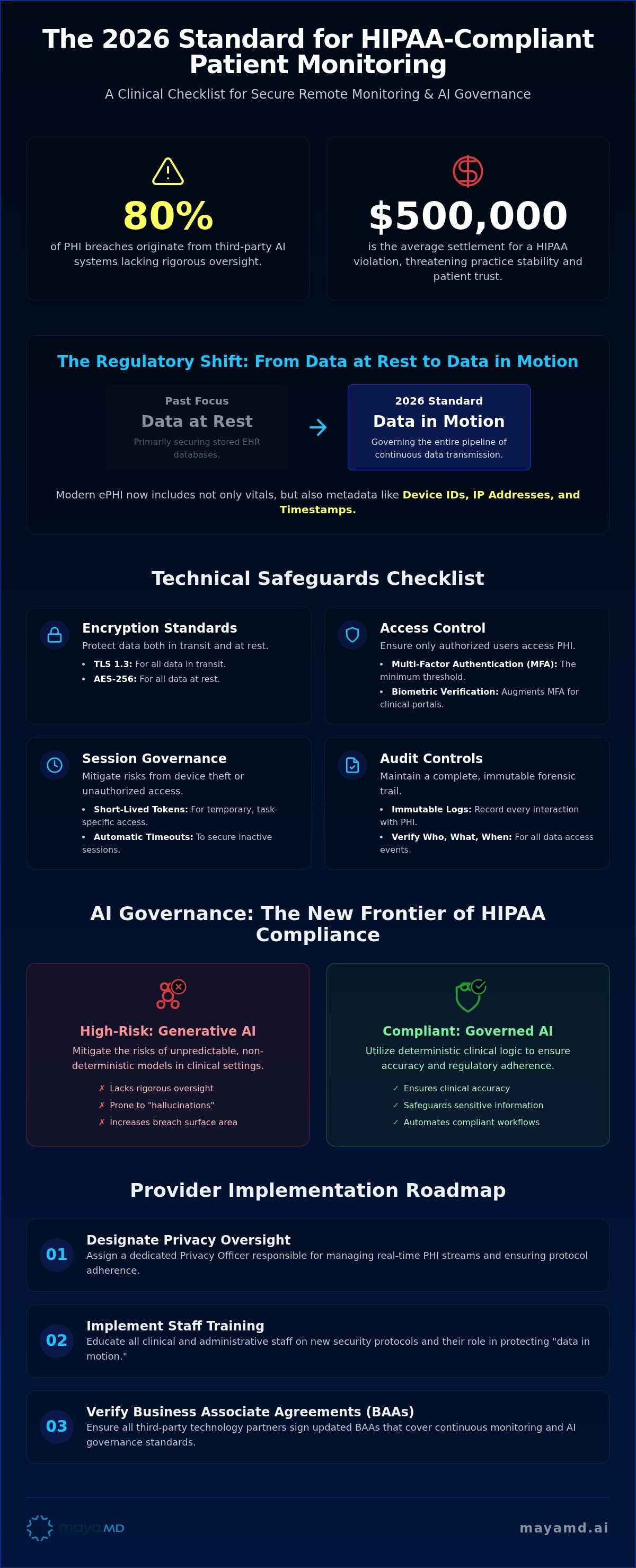
Eighty percent of PHI breaches currently originate from third-party AI systems that lack rigorous oversight. For the modern provider, the integration of remote care technology often feels like a precarious choice between clinical innovation and regulatory catastrophe. You likely recognize that manual oversight is no longer sustainable, yet the complexity of maintaining hipaa compliant patient monitoring in an era of evolving HHS standards can be paralyzing. The fear of a $500,000 settlement is not just a financial concern; it is a direct threat to the stability of your practice and the trust of your patients.
This article provides a comprehensive clinical checklist to evaluate and implement secure remote monitoring systems that protect both data and provider liability. We will move beyond basic encryption to explore the concept of governed AI oversight, where deterministic logic ensures clinical accuracy while safeguarding sensitive information. You will learn how to transition from addressable safeguards to the required protocols of the future, ultimately creating an automated workflow that improves chronic care outcomes without adding to administrative burnout. From universal encryption to the nuances of Business Associate Agreements, this is your roadmap for a resilient, compliant ecosystem.
Key Takeaways
• Understand the transition from addressable safeguards to the mandatory security protocols required for modern continuous monitoring environments.
• Identify the essential technical standards, including TLS 1.3 and biometric authentication, necessary for high-integrity hipaa compliant patient monitoring.
• Learn to mitigate the risks of generative AI by utilizing deterministic clinical logic to ensure documentation accuracy and regulatory adherence.
• Establish a structured administrative roadmap for designating privacy oversight and training staff to manage real-time PHI streams.
• Discover how to leverage clinical AI agents to bridge the gap between raw data collection and secure, value-based care outcomes.
The 2026 Standard for HIPAA Compliant Patient Monitoring
The regulatory landscape for digital health is undergoing a fundamental shift. While the core tenets of the Health Insurance Portability and Accountability Act (HIPAA) remain stable, the interpretation of these rules has matured to meet the demands of high-velocity data. In 2026, the standard for hipaa compliant patient monitoring has transitioned from protecting 'data at rest' to securing 'data in motion.' This evolution responds to the reality that continuous monitoring generates a relentless stream of Electronic Protected Health Information (ePHI) that exists far beyond the traditional EHR. It is no longer enough to encrypt a database; the entire pipeline of data transmission must be governed by rigorous, real-time oversight.
Defining the scope of ePHI in a continuous monitoring environment requires a broader perspective than in traditional clinical settings. It encompasses not only physiological vitals like heart rate or glucose levels but also the metadata associated with the transmission. Device identifiers, IP addresses, and even the timestamps of patient interactions with a monitoring portal are all considered protected information. Health systems in major hubs like Chicago and Houston are currently pivoting toward 'governed' data ecosystems. This shift replaces fragmented, third-party monitoring tools with integrated platforms that treat security as a clinical imperative. In these sophisticated environments, data is not just stored; it is managed through a lifecycle of verified compliance.
Privacy Rule vs. Security Rule in RPM
The Privacy Rule and Security Rule function as the two pillars of a compliant RPM program. The Privacy Rule dictates the permitted uses and disclosures of patient data, which is particularly complex when managing continuous data streams. Central to this is the 'Minimum Necessary' standard. When deploying clinical AI agents for primary care, the platform must ensure that only the specific data required for a clinical decision is processed. This prevents the over-collection of ePHI and reduces the surface area for potential breaches. Compliance requires that patient rights, including the right to access and amend their digital records, are integrated directly into the software interface.
The Cost of Non-Compliance in 2026
The financial implications of a breach are severe. Recent data indicates that the average settlement for a HIPAA violation currently reaches $500,000. For providers in competitive markets like Indianapolis and Las Vegas, the reputational damage often outweighs the immediate fine. Patients today are increasingly aware of data privacy; a single breach can erode years of established trust. Beyond these penalties, compliance is now the non-negotiable prerequisite for maintaining Medicare RPM reimbursement. Without verified technical and administrative safeguards, a monitoring program cannot satisfy the rigorous auditing standards required for federal funding. Security is the foundation of clinical profitability.
Technical Safeguards Checklist: Beyond Basic Encryption
Encryption is no longer a passive layer but an active, multi-dimensional protocol. In the 2026 regulatory environment, hipaa compliant patient monitoring requires a transition to TLS 1.3 for data in transit and AES-256 for data at rest. These standards ensure that even if a packet is intercepted, the underlying PHI remains computationally inaccessible to unauthorized actors. Beyond encryption, access control has evolved. Multi-factor authentication (MFA) is the minimum threshold, often augmented by biometric verification for clinical portals. This dual-layer approach prevents credential harvesting from compromising entire patient populations.
Effective technical management also demands rigorous session governance. Mobile clinical agents must utilize short-lived tokens and automatic session timeouts to mitigate the risk of physical device theft or unauthorized access in shared clinical spaces. These automated barriers ensure that access is temporary and task-specific. Audit controls must be absolute. Every interaction with a patient record must generate an immutable log entry. These logs provide a forensic trail that verifies who accessed what data and when, forming the backbone of your defense during an OCR inquiry. To implement these enterprise-grade safeguards, many organizations rely on specialized cybersecurity firms like OAD Technologies to provide Managed Detection and Response (MDR) and Data Loss Prevention (DLP) solutions.
Data Integrity and Transmission Security
The integrity of a continuous data stream is paramount. When vitals travel over cellular networks, they're vulnerable to man-in-the-middle attacks or data corruption. Implementing signed webhooks and zero-trust architecture ensures that every data packet is verified at the point of entry. This "never trust, always verify" philosophy extends to the 'Edge' where wearable device identifiers themselves are classified as ePHI. By masking these hardware IDs during transmission, providers maintain a higher level of anonymity for the patient's digital footprint.
Cloud Infrastructure and Hosting
The choice of hosting environment directly impacts long-term liability. While public clouds offer scalability, many Chicago-based health systems are opting for private or hybrid cloud environments that provide granular control over data residency. Geographic redundancy is equally critical. For a provider in Indianapolis, utilizing a data center in a geographically distinct region like Phoenix ensures that care continues even during localized infrastructure failures. This physical and logical separation of resources guarantees that your hipaa compliant patient monitoring system remains resilient against both cyber threats and physical disasters.
Ensuring your infrastructure meets these rigorous standards is the first step toward a sustainable digital practice. Providers often find that implementing a governed AI platform simplifies these technical requirements by embedding compliance directly into the software architecture.
AI Governance: The New Frontier of HIPAA Compliance
The logic governing clinical data is now as critical as the encryption protecting it. Traditional generative AI models often prioritize fluid conversation over clinical accuracy, leading to "hallucinations" that can result in incorrect PHI documentation. For hipaa compliant patient monitoring, this lack of precision is a regulatory violation. Providers must ensure that AI outputs are grounded in deterministic logic; every recommendation or note must be traceable to established medical evidence rather than probabilistic guesses. When AI creates a clinical note, its reasoning must be transparent and defensible to satisfy current auditing standards.
Deterministic Frameworks for Patient Safety
Neuro-symbolic AI represents the "governed" approach necessary for modern care. By merging the linguistic capabilities of LLMs with structured clinical frameworks, such as those used in Advanced Primary Care Management (APCM), systems can maintain rigorous safety standards. This hybrid model prevents unauthorized "learning" from patient data. It ensures that PHI never inadvertently trains a public model. This isolation of data is a non-negotiable requirement for a valid Business Associate Agreement (BAA), as it prevents the leak of sensitive identifiers into the broader digital ecosystem.
The Role of the Clinical AI Agent
Clinical AI agents for primary care are transforming how Chicago-based providers manage documentation. These agents must adhere to the "Minimum Necessary" standard, capturing only the relevant clinical data points required for the patient's care plan. In practice, this automation has significantly reduced physician burnout by handling the administrative burden of chronic care management. However, the system must always include human-in-the-loop oversight. Clinicians must verify AI-generated notes before they enter the permanent record to ensure absolute clinical validity and regulatory adherence.
Regulatory bodies now demand transparency in AI decision-making. The "Black Box" problem, where the reasoning behind an AI's output is obscured, creates a liability gap for the provider. A transparent, governed system allows for continuous auditing. It ensures that the hipaa compliant patient monitoring workflow remains visible and defensible during regulatory reviews. When selecting a vendor, providers must verify that the BAA explicitly covers the logic layer. The agreement must define how the AI handles data and what safeguards are in place to prevent logic errors that could compromise patient safety or privacy.
Administrative Safeguards: The Provider Implementation Roadmap
Technical encryption and AI logic are only as effective as the human policies governing them. For a program to maintain hipaa compliant patient monitoring, the provider must establish a rigorous administrative framework that translates regulatory requirements into daily clinical actions. This begins with designating a Privacy Officer specifically tasked with overseeing remote care operations. This individual manages the intersection of clinical workflows and data security, ensuring that the organization's risk profile remains within acceptable bounds. They're responsible for the lifecycle of compliance, from initial risk assessment to the final decommissioning of patient data.
Staff training protocols must address the unique challenges of handling continuous PHI streams. Unlike traditional office visits, RPM requires staff to manage a relentless volume of real-time alerts. Training must emphasize the "Minimum Necessary" standard when sharing data across clinical teams to prevent accidental over-exposure. Periodic risk analysis is also a non-negotiable requirement. Providers must map every data point as it travels from a wearable device through the cloud and into the EHR. This mapping identifies potential vulnerabilities before they result in a breach. To prepare for the unforeseen, health systems should conduct regular tabletop exercises. These simulated incident response plans test the team's ability to detect and mitigate a breach in a remote setting, ensuring that a swift response minimizes both clinical risk and legal liability.
Managing Third-Party Vendors
The security of your program is intrinsically linked to the maturity of your partners. When vetting top pcm software companies, providers must look beyond basic functionality to evaluate security maturity and audit history. A robust Business Associate Agreement (BAA) is essential. This document should include specific clauses regarding data breach notification timelines and subcontractor oversight. It's your responsibility to ensure that your vendor's vendors, such as cloud hosting providers or third-party API services, adhere to the same stringent standards. Oversight is not a one-time event; it's a continuous clinical duty.
Patient Consent and Authorization
Transparency fosters patient trust and ensures legal compliance. Providers in Phoenix and Houston are increasingly utilizing digital signatures and E-Consent tools to streamline the authorization process. Clear authorization must be obtained for continuous data collection, detailing exactly what vitals are monitored and how that data is used. Patients also retain the "Right to be Forgotten" within the limits of medical record retention laws. Your system must have a defined protocol for the revocation of consent, ensuring that data collection ceases immediately upon request. To see how a governed platform manages these complex administrative requirements, you can explore MayaMD's clinical AI solutions.
MayaMD: AI-Governed, HIPAA-Compliant Monitoring
MayaMD functions as the bridge between raw clinical data and secure, actionable outcomes. By integrating deterministic logic directly into the platform architecture, we've created a framework where hipaa compliant patient monitoring is a structural certainty rather than an operational goal. This approach eliminates the variability found in standard generative models; it ensures that every data point and clinical note remains within the strict boundaries of medical accuracy and regulatory adherence. Unlike probabilistic AI that predicts the next word in a sequence, deterministic systems follow pre-defined clinical pathways. This ensures that a patient's hypertensive alert is processed according to established guidelines, leaving no room for the 'hallucinations' that plague consumer-grade technology. Our platform serves as a reliable partner for health systems in Chicago, Phoenix, and beyond, providing the stability required to scale complex care models.
The synergy between remote patient monitoring software and Advanced Primary Care Management (APCM) allows providers to move beyond simple data collection into the realm of predictive, governed care. MayaMD transforms continuous vitals into a structured clinical narrative that fits seamlessly into existing clinical workflows. Leading specialists frequently adopt our principal care management tools because they bridge the gap between high-level data science and the daily reality of specialist care. In the high-stakes environment of Las Vegas healthcare, where patient volume and data velocity are high, our platform provides a stabilizing force that maintains compliance at scale. This automated oversight has improved patient engagement while significantly reducing the risk of data breaches for chronic care populations.
The MayaMD Clinical AI Advantage
Efficiency shouldn't come at the cost of security. MayaMD's Clinical AI Agent utilizes a zero-trust architecture to ensure that EHR integrations are both seamless and impenetrable. By automating the documentation process with verified clinical logic, the platform eliminates the manual transcription errors that often lead to PHI exposure. This allows practices to scale their chronic care programs efficiently. It provides high-touch support without a corresponding increase in administrative documentation or staffing overhead. The result is a clinical environment where the physician is empowered to focus on the patient, while the AI manages the heavy lifting of regulatory compliance and data integrity.
Next Steps for Your Practice
Evaluating a platform's security maturity is a critical step in your implementation roadmap. We invite you to request a comprehensive security audit and a tailored platform demonstration to see how our logic-driven approach aligns with your specific regional patient needs. Whether you're managing complex multi-condition patients in urban Chicago or providing rural care in the Southwest, the foundation must be secure. Our team works closely with your IT and compliance departments to ensure a smooth transition into a governed data ecosystem. Schedule a consultation to secure your RPM workflow and discover how a governed AI ecosystem can protect your practice, your reputation, and your patients.
Securing the Future of Remote Care Logic
Establishing a resilient framework for hipaa compliant patient monitoring requires a shift from reactive security to proactive, governed oversight. We've explored how the 2026 landscape demands technical rigor, from AES-256 encryption to the deployment of deterministic AI that eliminates documentation errors. By aligning administrative safeguards with advanced technical protocols, your practice can bridge the gap between raw patient data and secure clinical outcomes.
MayaMD provides the cloud-based, HIPAA-compliant clinical AI infrastructure necessary to navigate this complex regulatory environment. Trusted by providers in Las Vegas, Chicago, and Houston, our platform utilizes deterministic logic to ensure that every automated entry is clinically valid and legally defensible. This level of precision protects your practice from liability while reducing the administrative burden that leads to physician burnout.
The path toward a secure, automated RPM workflow is clear. You're now equipped with the checklist needed to evaluate your current systems and implement a higher standard of care. Schedule a Demo of MayaMD's HIPAA-Compliant AI Platform to begin your transition toward a more secure and efficient clinical future. Your commitment to data integrity is the foundation of patient trust.
Frequently Asked Questions
What are the core HIPAA requirements for remote patient monitoring in 2026?
Core requirements focus on the transition from addressable safeguards to mandatory technical protocols for data in motion. In 2026, this includes universal encryption of ePHI using AES-256 standards, mandatory multi-factor authentication for all system access, and a defined schedule for vulnerability scans every six months. Providers must maintain continuous risk analysis rather than relying on periodic assessments to ensure the integrity of the monitoring pipeline.
Does a Business Associate Agreement (BAA) cover all liability for providers?
A Business Associate Agreement does not absolve a provider of all legal or clinical liability. While the BAA establishes a contractual obligation for the vendor to safeguard data, the covered entity remains responsible for performing due diligence and monitoring the vendor's ongoing compliance maturity. If a provider utilizes a platform with known security gaps, they may still be held liable for resulting breaches under the "willful neglect" category of enforcement.
How does AI impact HIPAA compliance in patient monitoring?
AI introduces significant risks regarding data training and the accuracy of clinical documentation. To maintain hipaa compliant patient monitoring, AI systems must utilize deterministic logic to prevent "hallucinations" that could result in incorrect PHI entries. Additionally, providers must ensure that patient data is never used to train public large language models, as this would constitute an unauthorized disclosure of sensitive identifiers to a third party.
Is data from consumer wearables considered PHI?
Data from consumer wearables is classified as PHI only when it is transmitted to a covered entity for use in clinical diagnosis or treatment. While a patient’s personal use of a device is not governed by HIPAA, the data becomes protected the moment it is integrated into a provider's RPM workflow. This shift requires that the transmission path from the wearable to the clinical portal meets all federal security standards.
What are the penalties for a HIPAA breach in a remote monitoring program?
Penalties are tiered based on the level of negligence and can reach millions of dollars for systemic failures. Current data shows that the average settlement for a HIPAA violation is approximately $500,000. Beyond these direct financial costs, providers often face mandatory corrective action plans, loss of patient trust, and the potential revocation of Medicare reimbursement privileges for their remote monitoring programs.
How can I ensure my RPM platform is compliant with both federal and state laws in Texas or Illinois?
Compliance in Texas or Illinois requires adhering to federal standards while navigating specific state-level privacy mandates. For example, providers in Illinois must ensure their platforms comply with the Biometric Information Privacy Act (BIPA) when utilizing facial or fingerprint recognition for portal access. A resilient platform must be configured to meet the most stringent requirement between federal and state statutes to ensure multi-jurisdictional adherence. This rigor is also essential for specialized telehealth in Colorado, where patients looking to get medical marijuana card online rely on secure, HIPAA-compliant evaluation processes.
What is the 'Minimum Necessary' rule in the context of AI documentation?
The 'Minimum Necessary' rule requires that clinicians and AI agents only access or disclose the specific information required to accomplish a clinical task. When an AI agent generates a summary of a monitoring session, it must be programmed to filter out extraneous PHI that is not relevant to the specific care plan. This practice limits the surface area of sensitive data and reduces the impact of potential unauthorized access.
Can clinical AI agents be truly HIPAA compliant without human oversight?
Clinical AI agents cannot satisfy HIPAA’s requirement for clinical validity without human-in-the-loop oversight. While the AI can effectively automate the structuring of real-time vitals, a licensed clinician must review and sign off on AI-generated notes before they are committed to the permanent record. This human verification ensures that the documentation is accurate and that the care provided meets the high-stakes reliability expected in a governed clinical environment.




See The MayaMD Difference
Fill the form below
Download Our Apps
MayaMD for patients and MayaPro for physicians - available on iOS and Android.
FOR PATIENTS
MayaMD App
AI-powered symptom assessment, triage, and secure access to your care team.


FOR PHYSICIANS
MayaPro App
MayaPro brings patient vitals, RPM/PCM care plans, and clinical decision support to your pocket.