
The most-proven discharge protocol, delivered to every patient.
Send a patient's discharge summary by secure email, and within minutes Maya turns it into a personalized, multilingual conversation the patient opens from a secure web link. Maya walks them through all 13 steps of Project RED in plain language, at the bedside or once they're home, and confirms understanding with teach-back. Our clinical staff can then support your clinicians through 30 days of follow-up.

Source: Spring Valley Hospital heart-failure pilot, presented at AHA Scientific Sessions 2024, Circulation 2024;150(Suppl 1):4142032.
Patients think they understood. Most didn't.
In studies of older adults, nearly everyone says they understand why they were hospitalized, but far fewer can describe their diagnosis. Few recognize their own gaps, and nurses rarely have time to check.
Everything the patient needs to know. Explained, then checked.
Maya builds each conversation from the patient's own discharge documents, so every explanation is about their stay, their medicines and their plan.
Diagnoses, explained conversationally
Why they were in the hospital and what happened there, in plain language at about a 6th-grade reading level.
Every medication change
Maya explains the reconciled medication list your team prepared: what's new, what changed, what stopped, what stays the same, and why.
Follow-ups and pending results
Upcoming appointments, who they're with and why they matter, plus tests whose results were still pending at discharge.
Home care and warning signs
Diet, activity and self-care instructions, and the specific symptoms that mean call now.
Comprehension, confirmed
Interactive teach-back checks understanding in the patient's own words, and your team sees which topics need another conversation.
Questions and answers, multilingual
Patients and caregivers ask questions in their own language. MayaRED supports 32 languages.
Engagement and clinical escalation
Check-ins, symptom triage and medication reminders for 30 days, with red flags escalated to your clinicians.
How Maya explains a medication change.
Robert is going home after a heart-failure stay. His care team changed four medicines. Maya explains the list his clinicians reconciled; it never changes a medication itself.
- NewDapagliflozin 10 mg, once a dayA new heart medicine that also protects the kidneys. It can make you urinate more.
- ChangedFurosemide: 20 mg → 40 mg every morningYour water pill went up to keep fluid from building up again.
- StoppedIbuprofen (Advil, Motrin)It can make your body hold on to fluid. Ask your care team what to use for pain instead.
- ContinueMetoprolol succinate 50 mg, once a dayNo change. Keep taking it the way you did before.
MAYARobert, your care team made some changes to your medicines. Let's go through them one at a time.
MAYAFirst, you'll stop taking ibuprofen, like Advil or Motrin. It can make your body hold on to fluid, which is hard on your heart.
ROBERTI take Advil for my back. What do I use now?
MAYAGood question. I've flagged it for your care team so they can tell you what's safe for your back pain.
MAYATo make sure I explained it well: in your own words, which medicine are you stopping, and why?
ROBERTNo more Advil, because it makes me keep water.
✓ Teach-back confirmed · question sent to the care team
Illustrative example. The patient and details are fictional; medicines and doses always come from the patient's own discharge documents.
Patients understood. And they want it again.
From the Spring Valley Hospital heart-failure pilot, where MayaRED patients started with higher pro-BNP levels than their matched controls.
- Every surveyed patient preferred Maya over a nurse or doctor for their discharge education.
- Every patient said they would want MayaRED again if they were hospitalized.
- Every patient strongly agreed they understood their medicines and had their questions answered.
- Every patient rated Maya highly for trust, ease of use and confidence, and said they were likely to follow its advice.
“When the nurses do your discharge it always feels rushed but this time it felt controlled and calm. I was able to focus on what the computer was saying.”
“I felt like the education was done at his pace. With the staff it was always rushed and he was afraid to ask questions.”
“I’ve never understood what I am supposed to do about my heart issues, now I feel like I have handle on things.”
Patient comments from the Spring Valley Hospital pilot.
From discharge to day 30, nobody falls through.
- DAY 0Guided dischargeAt the bedside or once the patient is home, Maya explains the diagnosis, medicines and warning signs, with teach-back.
- DAYS 1–2First contactOur staff reaches the patient within two business days, on behalf of your clinicians.
- DAY 7Clinician visitA transitional-care visit with your clinician.
- WEEKS 2–3MonitoringCheck-ins, symptom triage, medication reminders, connected devices, red-flag alerts.
- DAY 30Close and reportProgram closes; comprehension and outcome reports go to your team.
A new symptom at home gets a clinical answer, not a default trip to the ER.
During the 30 days, patients can report a new or worsening symptom by app or text at any time. Maya’s built-in symptom triage asks the follow-up questions a clinician would, recommends the right level of care and writes a note for your team. Emergencies are sent to the ER right away. Everything else is routed to your clinicians or a telemedicine visit, so avoidable ER visits and readmissions stay avoidable.
Deployment figures are from a past virtual-triage program built on the Maya Engine. Study: Delshad S, Dontaraju VS, Chengat V. Cureus 2021;13(8):e16956.
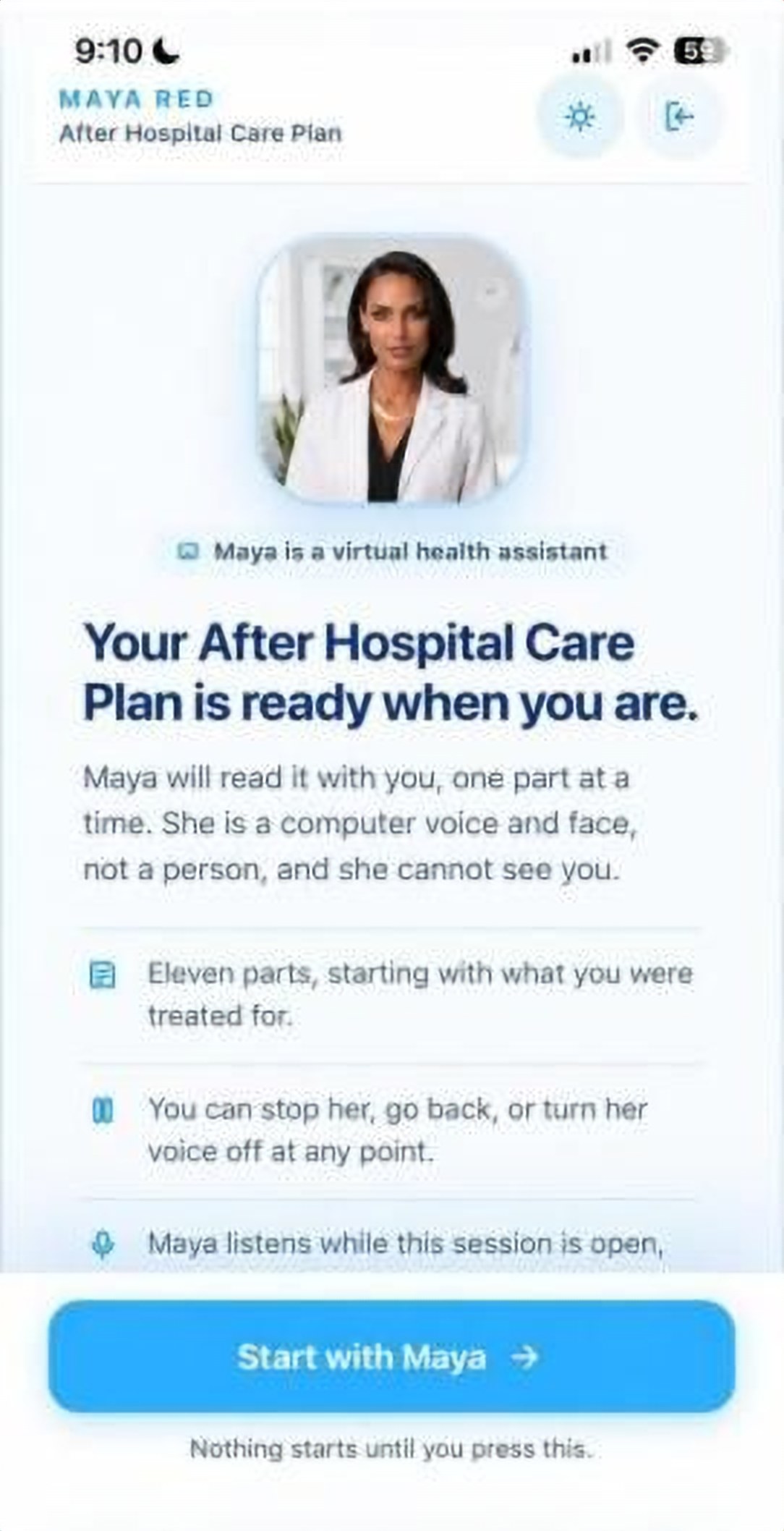
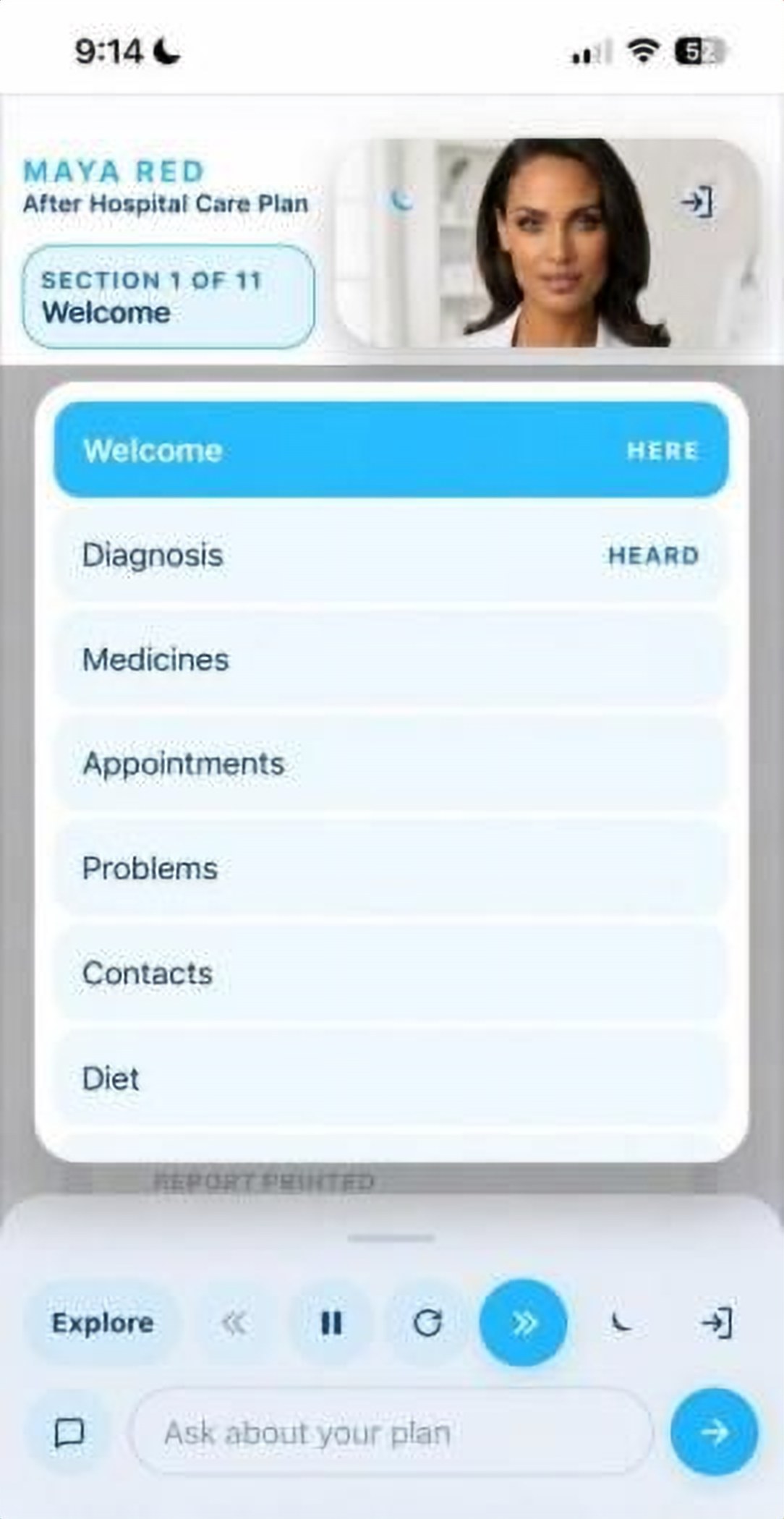
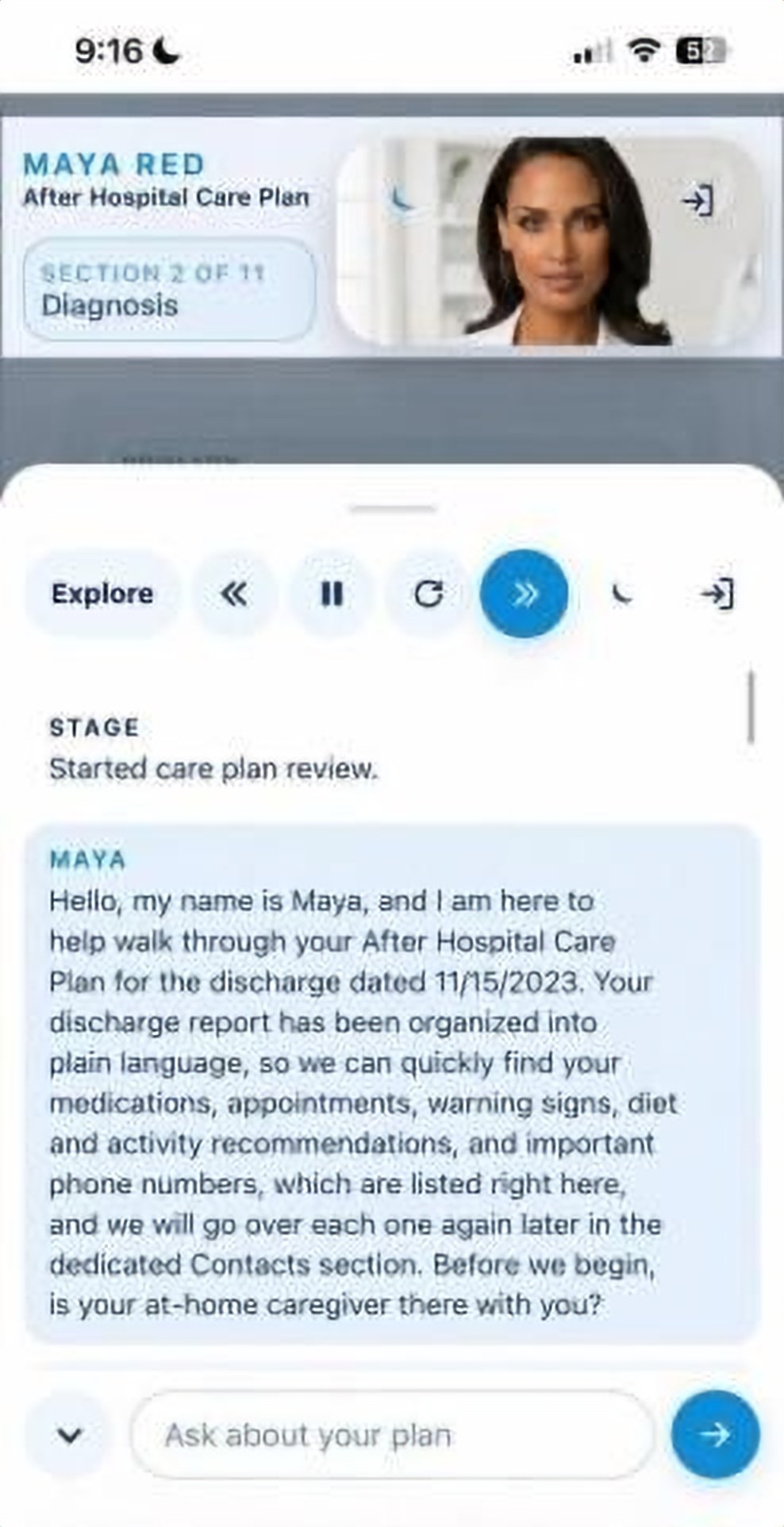

See a MayaRED discharge.
One minute from a real After Hospital Care Plan: Maya explains the diagnosis, every medicine and the warning signs in plain language. Tap a chapter to jump to it.
- 010:00The care planEverything in one place.
- 020:14The diagnosisExplained in plain words.
- 030:43Every medicineWhat it is for and how to take it.
- 040:55Red flagsWhat to watch for at home.
MayaRED patient experience demo (1 minute).
Demo with a fictional patient.
Complements your discharge nurses. Replaces nothing.
MayaRED can start alongside your existing nursing, discharge and RPM workflows, with no replacement platform. Your nurses still discharge and your case managers still coordinate; Maya makes sure every patient understood and tells your team who didn't.
Secure-email workflow
- Discharge summaries sent to Maya by secure email
- Each patient's conversation ready within minutes
- Patients open a secure web link; no app download
- No EHR integration or ADT feed required
- Business associate agreement signed before any patient data is shared
Enterprise integrations
- Automated discharge notifications and document delivery
- Read-only EHR access for our medical assistants
- Comprehension and monthly outcome reports
- Scoped with your IT and security teams; full programs typically go live in 4–6 weeks
Built with the people who wrote the protocol.
The source protocol
Co-developed with Dr. Brian Jack of Boston University, creator of RED. A National Quality Forum Safe Practice and Peter Drucker Award winner.
 Dr. Brian Jack, Boston University
AI that can't go off-script
The protocol decides each step. Notes contain only what the patient said. Patent-pending method for hallucination-free clinical notes.
$0 to you, either way
MayaMD bills TCM by default, so there’s no fee to the health system. Prefer your own clinicians to bill? Our fee comes from the new revenue you capture, never your existing budget.
"I really liked Maya. It was easier to understand than the nurses and doctors."Patient, Spring Valley Hospital pilot
You introduce it. We run it.
No change to your discharge workflow. Your clinicians step in only when a patient needs them.
Your hospital provides
- A point of contact
- Discharge summaries by secure email
- Read-only EHR access for our medical assistants, if you add 30-day follow-up
- Staff who introduce MayaRED at discharge
MayaMD provides
- The platform and staff to support your clinicians
- Connected home devices
- Outreach, consent and EHR documentation
- Comprehension and monthly outcome reports
Questions health systems ask
How is this different from AI calling tools?
MayaRED starts at discharge, delivers the full RED protocol with teach-back, and our staff supports your clinicians for 30 days.
Do patients need to download an app?
No. Patients open their discharge conversation from a secure web link on a phone or computer. Patients in 30-day follow-up can also use the Maya companion app.
How is it paid for?
MayaMD bills transitional care management (TCM) directly, so there’s a $0 fee to your health system. If your own clinicians prefer to bill TCM, our fee is paid from that new revenue, not your current budget. Either way, we handle enrollment, documentation and claims prep.
Do we need an EHR integration?
No. The pilot runs on discharge summaries sent by secure email. Read-only EHR access or a real-time ADT feed can be added later.
Does it replace our discharge nurses or RPM program?
No. Maya complements your nurses, case managers and any existing RPM program, and shows them which patients need another conversation.
Where do we start?
One unit or condition, usually heart failure or another CMS-penalized condition. Results review at 90 days.
Start a 90-day MayaRED pilot, at no cost.
For hospitals, skilled nursing facilities, rehab hospitals, LTACs and value-based care groups. The full RED discharge protocol and 30 days of follow-up support for your clinicians, with no IT integration.
A 20-minute call
A physician on our team walks through the workflow and helps you pick the first patients.
A pilot outline
One page: which unit, which patients, and the measures we agree to track.
Agreement and BAA
A simple pilot agreement and business associate agreement.
Send the first summaries
Name a pilot lead and start sending discharge summaries by secure email. Our staff supports your clinicians with outreach and follow-up for the full 90 days.
The same technology, before and after procedures.
Preprocedure prep, recovery instructions, new diagnoses and new medicines, explained the same way.
Start with one unit. See results at 90 days.
Start with a no-cost 90-day pilot on one unit, using secure email. A 20-minute demo is the first step.