
Remote Monitoring for Chronic Conditions: 2026 AI Guide

The era of passive data collection has ended. Clinicians have long faced a deluge of biometric alerts that offer significant volume but insufficient clinical clarity. You likely recognize the professional exhaustion that stems from managing inconsistent patient compliance alongside the intricate logic of Medicare reimbursement rules. While remote monitoring for chronic conditions promised to bridge the gap between office visits, it often created a new burden of administrative documentation and clinical noise.
This guide demonstrates how AI-governed logic transforms these programs from reactive data streams into proactive clinical interventions. By integrating deterministic frameworks with generative capabilities, the Clinical AI Agent acts as a sophisticated digital assistant that filters noise and streamlines documentation. You'll learn how to secure sustainable revenue through CMS reimbursement while improving outcomes for hypertension and diabetes. We'll explore the transition to a governed, hallucination-free ecosystem that restores the vital connection between provider and patient.
Key Takeaways
• Understand why the shift from episodic check-ins to continuous remote monitoring for chronic conditions is essential for success in modern value-based care models.
• Learn the critical technical distinction between "black box" generative AI and deterministic logic to ensure clinical safety and eliminate hallucinations in patient data management.
• Identify the specific clinical and financial advantages of Remote Patient Monitoring (RPM), Principal Care Management (PCM), and the holistic 2026 Advanced Primary Care Management (APCM) model.
• Discover a strategic framework for operationalizing AI-driven risk stratification to improve patient enrollment and secure sustainable revenue through CMS reimbursement cycles.
• Explore how the Clinical AI Agent serves as a governed digital assistant to streamline documentation and mitigate physician burnout by converting raw biometric noise into actionable insights.
The Evolution of Remote Monitoring for Chronic Conditions in 2026
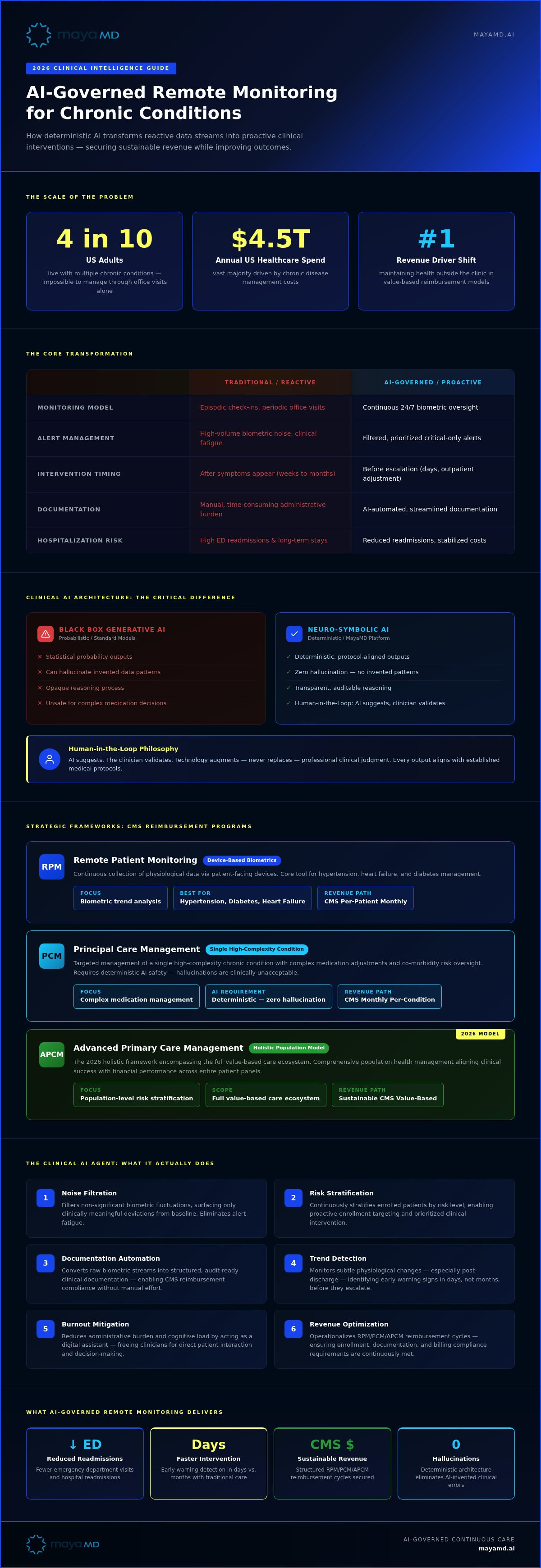
Remote monitoring for chronic conditions has transcended its origins as a peripheral data collection tool. It's no longer a series of episodic check-ins or a simple repository for patient-logged vitals. Instead, the 2026 standard defines it as a rigorous system of continuous clinical oversight. This evolution responds to a critical demographic reality. Roughly 4 in 10 US adults now live with multiple chronic conditions, a statistic that underscores the impossibility of managing high-risk populations through traditional office visits alone. Manual tracking is no longer sufficient; the volume of data requires a systematic, governed approach to remain actionable.
The shift toward digital healthcare for chronic disease represents a fundamental move toward AI-Governed Continuous Care. This framework ensures that patient safety isn't left to chance between appointments. It utilizes deterministic logic to monitor biometric trends, creating a persistent clinical presence that identifies risks before they escalate into emergencies. By establishing this level of oversight, providers move past the experimental phase of telehealth into a proven application of clinical intelligence that prioritizes precision and safety.
The Shift from Reactive to Proactive Care
Traditional care models are often reactive. They wait for the patient to feel symptomatic before an intervention occurs. For patients with hypertension or heart failure, this delay can be catastrophic. Real-time biometric data provides the visibility needed to adjust medications or lifestyle factors in days rather than months. This creates a reliable safety net for high-risk patients, particularly during the vulnerable window following hospital discharge. By capturing subtle physiological changes, clinicians can intervene early. This turns what would have been an acute exacerbation into a manageable outpatient adjustment.
Economic Impact on US Healthcare Systems
The financial stakes are immense. Chronic disease management accounts for the vast majority of the $4.5 trillion annual US healthcare expenditure. Systems that implement remote monitoring for chronic conditions find a direct path to stabilizing these costs by reducing emergency department readmissions and long-term hospitalizations. As the industry moves from fee-for-service models toward value-based reimbursement, the ability to maintain health outside the clinic becomes a primary revenue driver. Organizations that adopt these automated oversight frameworks don't just improve outcomes; they build a sustainable economic foundation by aligning clinical success with financial performance.
Architecting Clinical Intelligence: How AI Governs Remote Data
The sheer volume of data generated by remote monitoring for chronic conditions often exceeds human cognitive capacity. Without a sophisticated layer of governance, biometric alerts become noise rather than clinical insight. This is where a clinical ai agent for primary care becomes indispensable. It serves as a bridge between the raw data stream and the practitioner's decision-making process. By filtering out non-significant fluctuations and highlighting critical trends, the agent ensures that clinicians spend their time on intervention rather than data sorting. You can integrate clinical intelligence into your existing patient workflows to ensure no critical alert goes unnoticed.
A fundamental differentiator in 2026 is the shift from "black box" generative models to neuro-symbolic architectures. While standard AI often relies on statistical probability, clinical settings require absolute reliability. Our platform utilizes deterministic logic to ensure every output aligns with established medical protocols. This structure maintains a "Human-in-the-Loop" philosophy. AI suggests. The clinician validates. This ensures that technology serves as an augmentative tool that supports, rather than replaces, professional clinical judgment.
Eliminating Hallucinations with Deterministic Logic
Probabilistic AI is insufficient for principal care management (PCM) where the stakes involve complex medication adjustments and co-morbidity risks. Clinical safety demands a system that can't "hallucinate" or invent data patterns. Neuro-symbolic AI is the synthesis of logic-based rules and deep learning. By grounding the AI in deterministic rules, the system provides a stable framework for patient oversight. This adherence to clinical protocols ensures that the logic remains transparent, auditable, and, most importantly, safe for high-stakes chronic care.
Streamlining Clinical Documentation Workflows
Clinicians in high-volume regions like Phoenix and Las Vegas are using these tools to reclaim their schedules and combat professional exhaustion. The system automates the conversion of biometric alerts into structured SOAP notes, providing a pre-drafted summary for the provider to review. These clinical workflow automation solutions allow for direct integration into existing EHR systems. This eliminates the friction of manual entry and ensures that remote monitoring for chronic conditions contributes to a sustainable revenue cycle without increasing the administrative load on staff. By reducing the time spent on documentation, providers can focus on the human connectivity that defines high-quality care.
Strategic Frameworks: RPM vs. PCM vs. APCM
Implementing remote monitoring for chronic conditions requires a sophisticated understanding of tiered care models. While Remote Patient Monitoring (RPM) serves as a foundational layer for physiologic data collection, 2026 clinical standards demand more specialized pathways like Principal Care Management (PCM) and Advanced Primary Care Management (APCM). Selecting the correct framework depends entirely on patient acuity and the specific clinical objectives of the practice. MayaMD facilitates this selection by supporting all three models within a single, HIPAA-compliant platform, ensuring that data flows seamlessly into the appropriate billing and care pathways without fragmented documentation.
The choice between these frameworks isn't merely administrative; it's a strategic decision that affects clinical outcomes. RPM is ideal for broad oversight across a patient population. PCM and APCM offer the depth required for high-risk individuals. By aligning the technical capability of the platform with the specific medical needs of the patient, providers can ensure that remote monitoring for chronic conditions remains both clinically effective and financially viable. This structured approach allows for a level of precision that traditional, one-size-fits-all monitoring simply cannot achieve.
Principal Care Management (PCM) for Specialist Providers
PCM is designed for high-complexity cases where a single, unstable condition requires intensive oversight by a specialist. This model is particularly effective for managing severe COPD or advanced CKD, where frequent adjustments to the care plan are necessary. Utilizing principal care management tools, specialists can coordinate interventions that standard Chronic Care Management (CCM) doesn't address. Unlike CCM, which manages multiple conditions over a longitudinal period, PCM focuses on stabilizing a specific disease state through specialized clinical intelligence, reducing the likelihood of acute exacerbations.
The APCM Advantage for Indianapolis and Chicago Clinics
Primary care groups in metropolitan hubs like Indianapolis and Chicago are increasingly adopting advanced primary care management as their holistic 2026 model. APCM integrates behavioral health and social determinants of health (SDOH) directly into the monitoring workflow. This strategy creates a sustainable revenue model by rewarding comprehensive wellness rather than isolated biometric tracking. When evaluating the best chronic care management software, providers must prioritize systems that synthesize these disparate data points into a unified clinical narrative. APCM ensures that social barriers to health don't undermine the efficacy of medical treatments.
Operationalizing Remote Monitoring: Implementation and ROI
Transitioning from a conceptual framework to an active program requires a methodical, phased approach. Successful implementation of remote monitoring for chronic conditions rests on the ability to integrate technology into established clinical workflows without causing disruption. This process begins with AI-driven risk stratification to identify patients who will benefit most from intensive oversight. By analyzing historical data and current acuity, the system ensures that enrollment efforts focus on high-risk individuals who are most likely to experience acute exacerbations. This targeted approach optimizes clinical resources and sets the foundation for measurable ROI.
Operational success follows a structured five-step lifecycle:
Step 1: Patient Identification.
AI-driven risk stratification parses EHR data to prioritize candidates based on clinical necessity and potential for outcome improvement.
Step 3: Workflow Calibration.
Establishing alert hierarchies ensures that critical biometric shifts are routed to the appropriate clinical staff while filtering out non-actionable noise.
Step 4: Reimbursement Management.
Systematic tracking of clinical time and device transmissions secures consistent revenue through Medicare and private payer cycles.
Step 5: Performance Review.
Continuous reporting on clinical outcomes allows for iterative improvements to the care delivery model.
Navigating Reimbursement in 2026
Financial sustainability is anchored in the precise application of CMS billing codes. Providers must master the requirements for CPT 99453 for initial setup, CPT 99454 for monthly device supply, and CPT 99457 for the first 20 minutes of clinical monitoring. Compliance demands rigorous documentation of these 20 minutes of interactive communication per month. Automated tracking software logs every minute of clinical interaction, resulting in audit-proof documentation that secures consistent reimbursement. To maximize your practice's financial health, you can optimize your RPM billing cycles using our governed AI platform.
Patient Engagement and Adherence Strategies
Technical capability is irrelevant if patients don't engage with the hardware. Overcoming the digital divide, particularly among elderly populations, requires a supportive, accessible interface. The Clinical AI Agent addresses this by providing 24/7 patient support, offering reminders and answering queries in natural language. This persistent connectivity fosters a sense of security and accountability. In Phoenix, clinics utilizing these AI-driven engagement tools, often in conjunction with mobile care providers like YA Medical, have reported significant improvements in compliance rates for hypertension management. When technology acts as a bridge rather than a barrier, patient adherence becomes a predictable outcome rather than a clinical challenge.
The MayaMD Ecosystem: AI-Governed Care Delivery
The MayaMD platform represents the culmination of clinical necessity and computational precision. It establishes the definitive standard for remote patient monitoring software by shifting the focus from raw data acquisition to governed clinical intervention. While previous iterations of telehealth relied on passive monitoring, our ecosystem utilizes the Clinical AI Agent to synthesize biometric inputs into actionable intelligence. This transition is vital for modern practitioners who must manage complex patient populations without succumbing to the data fatigue that often leads to professional burnout. It's time to move past simple dashboards into a system that actively supports the clinical mission.
Scalability remains a core requirement for healthcare systems in 2026. Whether supporting independent practices or large-scale hospital networks in Las Vegas and surrounding regions, the platform provides a consistent, reliable framework for remote monitoring for chronic conditions. This adaptability ensures that as your patient volume grows, your clinical oversight remains rigorous and your documentation stays audit-proof. The architecture is designed to grow with your organization, providing the stability needed to maintain high-stakes clinical standards across multiple locations and specialties.
A Partner in Clinical Excellence
MayaMD is built for providers by clinical experts who understand the nuances of the patient-provider relationship. Our HIPAA-compliant, cloud-native architecture ensures that data security is never compromised while providing the flexibility needed for real-time care coordination. This systematic approach allows remote monitoring for chronic conditions to scale across disparate departments, from cardiology to primary care, maintaining a unified clinical narrative. We don't just provide software; we offer a strategic partnership designed to enhance the quality of care through stable, deterministic technology. By prioritizing safety and precision, we help you bridge the gap between technological potential and real-world application.
Next Steps for Your Practice
Transitioning to a governed AI ecosystem is a methodical process. The first step involves a comprehensive clinical workflow assessment to identify how our Clinical AI Agent can best support your specific staff requirements. Integration is seamless, as the platform is designed to interface directly with existing EHR systems including Epic, Cerner, and Athena. This connectivity ensures that your clinical documentation remains centralized and accessible. You won't have to worry about fragmented data or manual entry errors. By adopting a governed approach to chronic care, you can reclaim your time and focus on the high-stakes clinical decisions that define your practice. Request an assessment today to begin transforming your chronic care management into a proactive, revenue-generating clinical engine.
Securing the Future of Continuous Clinical Oversight
The transition from episodic check-ins to continuous care is no longer a theoretical goal; it's a clinical necessity in a landscape defined by rising patient acuity and administrative strain. By implementing remote monitoring for chronic conditions grounded in deterministic logic, you ensure that every alert is actionable and every intervention is safe. This shift protects your staff from data fatigue while securing the patient-provider connectivity that's often lost in traditional care models. You've seen how the integration of AI governance transforms raw biometric noise into a structured, revenue-generating clinical engine.
Sustainable success in 2026 requires a platform that bridges the gap between biometric data and structured documentation. MayaMD provides a HIPAA-compliant clinical AI that utilizes zero-hallucination logic to streamline your workflows and integrate seamlessly with your existing EHR. You don't have to sacrifice clinical safety for technological efficiency. We invite you to Schedule a Demo of MayaMD’s AI-Governed RPM Platform to see how these governed frameworks can stabilize your practice and elevate your standard of care. Your journey toward proactive, precision-based medicine starts with a reliable partner.
Frequently Asked Questions
How does remote monitoring for chronic conditions improve patient outcomes?
Remote monitoring for chronic conditions improves outcomes by facilitating proactive clinical interventions. Continuous oversight identifies physiologic shifts before they escalate into acute exacerbations, allowing for timely medication adjustments and lifestyle modifications. This persistent clinical presence ensures that patients receive support between office visits, resulting in fewer emergency department readmissions and a higher overall quality of life for high-risk populations.
Is remote patient monitoring covered by Medicare in 2026?
Medicare provides robust reimbursement for remote monitoring for chronic conditions through specific CPT codes in 2026. Codes 99453 and 99454 cover initial setup and monthly device supply, while 99457 and 99458 reimburse for the actual clinical monitoring time. Providers must document at least 20 minutes of interactive communication each month to qualify for these payments, ensuring that the technology translates into direct patient engagement.
What is the difference between RPM and Chronic Care Management (CCM)?
RPM focuses on the transmission and analysis of physiologic data via digital devices, such as blood pressure cuffs or pulse oximeters. Chronic Care Management (CCM) is a broader service involving care coordination for patients with two or more chronic conditions. While RPM is data-driven and requires biometric monitoring, CCM is more administrative and emphasizes the longitudinal management of a patient's overall care plan.
How does AI prevent clinical data fatigue for doctors?
AI prevents data fatigue by acting as a digital filter that distinguishes between biometric noise and actionable clinical insights. By utilizing deterministic logic, the system prioritizes critical alerts while suppressing non-significant data points that don't require intervention. This ensures that clinicians spend their limited time on high-stakes decision-making and direct patient care rather than sorting through thousands of stable readings.
Are remote monitoring apps HIPAA-compliant?
Reliable platforms utilize HIPAA-compliant, cloud-native architectures to protect patient data during every stage of the monitoring process. These systems employ end-to-end encryption and rigorous access controls to ensure that sensitive health information remains secure during transmission and storage. Compliance is maintained through systematic frameworks that prioritize regulatory adherence and patient privacy, providing a stable foundation for clinical trust.
What chronic conditions are best suited for remote monitoring?
Hypertension, diabetes, heart failure, and COPD are the conditions most effectively managed within this framework. These diseases provide clear, measurable physiologic markers such as blood pressure, glucose levels, and oxygen saturation. Monitoring these specific metrics allows for precise adjustments that significantly reduce the risk of long-term complications, making them ideal for a program focused on continuous clinical oversight.
How much time does my staff need to dedicate to RPM each month?
Clinical staff must dedicate at least 20 minutes per patient each month to meet the requirements for CPT 99457. This time includes reviewing transmitted data and conducting interactive communications with the patient to discuss their health status. AI-driven automation can significantly streamline this process by pre-drafting documentation and filtering alerts, ensuring that staff time is utilized with maximum clinical efficiency.
Can remote monitoring integrate with my existing EHR system?
Integration with existing EHR systems is a core capability of advanced remote monitoring for chronic conditions platforms. These systems utilize standardized protocols to transmit biometric data and pre-structured SOAP notes directly into records like Epic, Cerner, or Athena. This connectivity eliminates the friction of manual entry and ensures a unified clinical narrative, allowing providers to access patient data without leaving their primary workflow.




See The MayaMD Difference
Fill the form below
Download Our Apps
MayaMD for patients and MayaPro for physicians - available on iOS and Android.
FOR PATIENTS
MayaMD App
AI-powered symptom assessment, triage, and secure access to your care team.
FOR PHYSICIANS
MayaPro App
MayaPro brings patient vitals, RPM/PCM care plans, and clinical decision support to your pocket.