
Integrating APCM with RPM: A Clinical AI Strategy for 2026 Primary Care

What if the relentless administrative burden of chronic care wasn't the inevitable price of clinical excellence, but a solvable logic problem? As we enter 2026, the shift toward value-based care has matured, yet many practitioners remain trapped between fragmented data and complex CMS billing requirements. Successfully integrating APCM with RPM is no longer a luxury for the technologically curious; it's the foundational strategy for any practice aiming to thrive under the current Physician Fee Schedule.
You likely feel the weight of documenting every minute of care while trying to keep your head above a sea of remote physiological data. We understand that physician burnout is often the result of this persistent disconnect between clinical insight and operational execution. This article will show you how to synchronize Advanced Primary Care Management with Remote Patient Monitoring to maximize both patient outcomes and practice revenue through codes like G0556 and G0558. We will explore the technical methodology for creating a clinical AI ecosystem that transforms episodic management into a proactive, continuous care model that prioritizes safety and precision.
Key Takeaways
• Learn how to synchronize Advanced Primary Care Management with real-time physiological data to establish a continuous, proactive care model for 2026.
• Identify the specific clinical and administrative requirements for G0556, G0557, and G0558 to optimize practice revenue and regulatory compliance.
• Explore the technical necessity of deterministic clinical AI in documentation to ensure rigorous oversight and eliminate the risks associated with generative hallucinations.
• Discover how integrating APCM with RPM reduces the administrative burden on providers, directly addressing the root causes of physician burnout.
• Implement a structured implementation workflow that utilizes AI-driven documentation to capture essential service elements without disrupting clinical focus.
The Evolution of Care: Understanding APCM and RPM Synergy
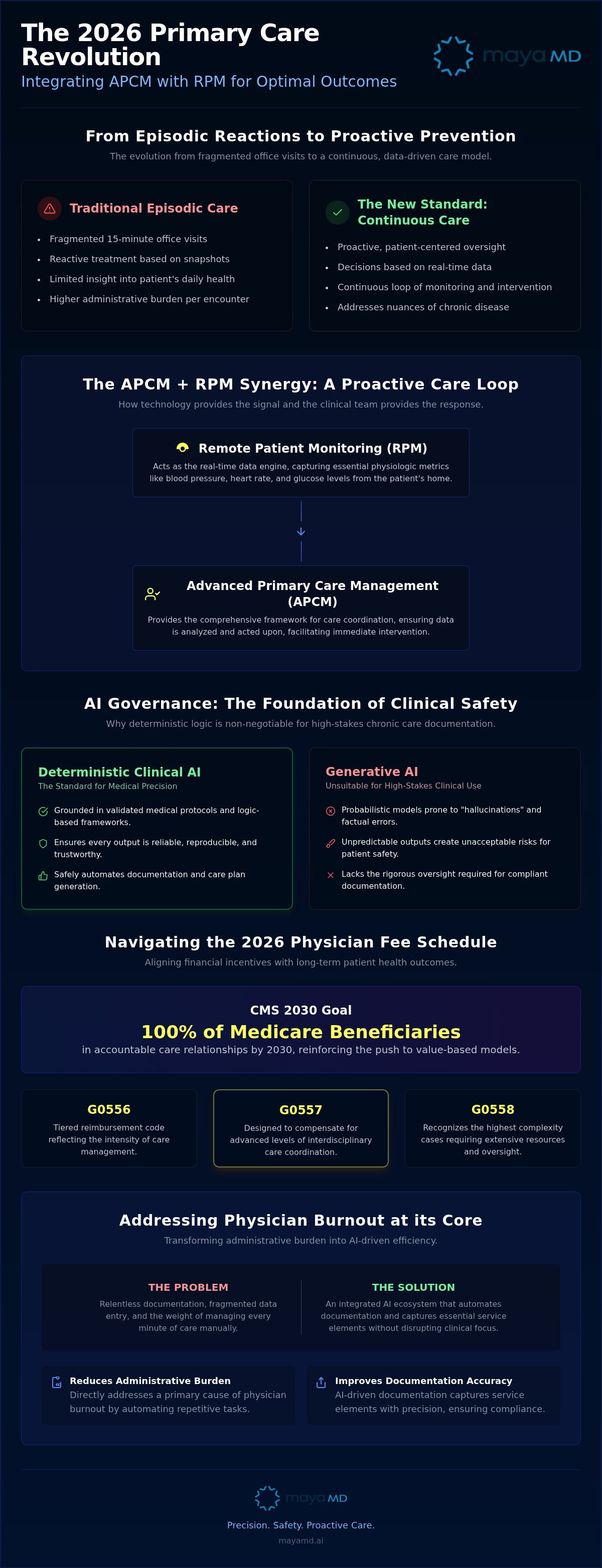
Episodic care models have reached their logical limit. For patients managing complex chronic conditions, the traditional 15-minute office visit provides only a fragmented snapshot of their health status. By 2026, the clinical standard has shifted toward Advanced Primary Care Management (APCM), a model that prioritizes continuous, patient-centered oversight. Integrating APCM with RPM serves as the critical technological bridge between raw physiologic data collection and decisive clinical action. This synergy allows practices to move beyond reactive treatments toward a governed, proactive care strategy that addresses the nuances of chronic disease management with mathematical precision.
APCM vs. RPM: Distinct Strengths, Shared Goals
While the two services are complementary, they fulfill distinct roles within the modern clinical workflow. Remote Patient Monitoring (RPM) acts as the real-time data engine, capturing essential physiologic metrics such as blood pressure, heart rate, and glucose levels from the patient's home environment. This steady stream of data provides the clinical evidence needed for informed decision-making. APCM provides the comprehensive framework for interdisciplinary care coordination, ensuring that these data points aren't just collected, but analyzed and acted upon. This partnership creates a loop of continuous oversight where RPM identifies a concerning trend and APCM facilitates the immediate intervention. It's a relationship where technology provides the signal and the clinical team provides the response.
The 2026 Regulatory Landscape
The Centers for Medicare & Medicaid Services (CMS) has accelerated its push toward value-based models, aiming for 100% of Medicare beneficiaries to be in accountable care relationships by 2030. The introduction of HCPCS codes G0556, G0557, and G0558 in the 2026 Physician Fee Schedule reflects this regulatory priority. These codes offer a tiered reimbursement structure that acknowledges the varying levels of intensity required for managing different patient populations. In major healthcare hubs like Houston and Chicago, primary care leaders are prioritizing integrating APCM with RPM to maintain financial stability while meeting these rigorous new compliance standards. This integration ensures that practices can scale their services without sacrificing the quality of patient connection or documentation precision. By adopting these frameworks, providers align their financial incentives with the long-term health outcomes of their most vulnerable patients.
Technical Framework: AI-Governed Continuous Care
Establishing a robust technical foundation is the first step toward a successful 2026 primary care strategy. A HIPAA-compliant cloud platform serves as the central nervous system for this operation, synthesizing disparate data points into a cohesive clinical narrative. By centralizing patient information within a secure, governed environment, practices create a single source of truth that is essential for complex care synthesis. This infrastructure allows for the seamless flow of information from the patient's home directly into the provider's decision-making loop, ensuring that no critical metric is overlooked.
Deterministic Logic in Chronic Care
Clinical safety remains the paramount concern when deploying artificial intelligence in a medical setting. While generative AI has gained popularity for creative tasks, its tendency to "hallucinate" makes it unsuitable for high-stakes chronic care documentation. Our approach utilizes deterministic logic in clinical ai to ensure that every output is grounded in validated medical protocols and logic-based frameworks. This rigorous oversight eliminates the unpredictability of probabilistic models, providing providers with reliable, reproducible data they can trust.
By prioritizing deterministic frameworks, practices can automate the generation of care plans and documentation without sacrificing precision. The AI agent functions as a disciplined assistant that follows strict clinical rules, ensuring that documentation for complex chronic conditions remains accurate and compliant with CMS standards. This level of governance is what allows for a safe transition from episodic management to a continuous, AI-supported care model.
Real-Time Data as a Clinical Asset
Raw physiologic data is only valuable when it is transformed into actionable clinical insight. Integrating APCM with RPM allows the Clinical AI Agent to process thousands of data points from remote devices, filtering out the "noise" to highlight only the most significant clinical events. This prioritization ensures that APCM staff can focus their energy on high-risk interventions rather than manually reviewing stable readings. The result is a more efficient use of clinical resources and a faster response time for patients experiencing health fluctuations.
Successfully integrating APCM with RPM requires this layer of intelligent filtration to prevent provider fatigue. When the system identifies a blood pressure trend that crosses a specific clinical threshold, it automatically triggers a care coordination workflow, alerting the appropriate team member within the governed platform. Practices looking to enhance their oversight can see how a Clinical AI Agent provides the necessary bridge between real-time data monitoring and meaningful clinical intervention.
Billing and Compliance: Navigating G-Codes and CPTs
CMS has refined the financial architecture of primary care for 2026. The transition from time-based Chronic Care Management (CCM) to the service-element framework of Advanced Primary Care Management (APCM) represents a significant regulatory pivot. This new model prioritizes the availability of thirteen specific service elements over minute-by-minute time tracking. Successfully integrating APCM with RPM requires a meticulous understanding of these requirements to ensure that documentation reflects the high-stakes nature of chronic care oversight. It's a shift that rewards clinical readiness and systematic coordination rather than simple duration.
The APCM Reimbursement Hierarchy
CMS has established a tiered structure to account for the varying complexity of patient populations. Level 1, billed under HCPCS code G0556, focuses on management for patients with one or no chronic conditions. Level 2, G0557, addresses the needs of patients with two or more chronic conditions, reflecting the increased clinical intensity required for complex care coordination. Finally, Level 3, G0558, is reserved for Qualified Medicare Beneficiary (QMB) patients with two or more chronic conditions. This hierarchy ensures that practices are compensated based on the clinical risk and socio-economic complexity of their patient panel. Each level demands rigorous oversight to maintain compliance with the 2026 Physician Fee Schedule.
Overcoming Billing Obstacles
Navigating concurrent billing is often the most challenging aspect of integrating APCM with RPM. It is essential to recognize that CMS prohibits billing APCM alongside CCM, Principal Care Management (PCM), or Transitional Care Management (TCM) for the same patient in the same month. However, Remote Patient Monitoring (RPM) and Remote Therapeutic Monitoring (RTM) remain fully billable in conjunction with the APCM framework. This allows practices to capture the value of real-time data streams while also receiving reimbursement for the broader management of the patient's care.
Utilizing advanced primary care management software is the most reliable method for automating the documentation of the thirteen required service elements. These elements include 24/7 access to care, systematic risk stratification, and the maintenance of a comprehensive electronic care plan. By leveraging AI-driven reporting, providers can audit-proof their claims and reduce the administrative friction that often leads to billing errors. This systematic approach ensures that every clinical action is captured and mapped to the appropriate G-code without the risk of generative hallucinations.
Implementation Workflow: Reducing Physician Burnout
Physician burnout in 2026 is often the byproduct of "documentation debt," where the clinical value of patient care is obscured by the labor of recording it. Successfully integrating APCM with RPM requires a shift from manual oversight to an AI-governed workflow that prioritizes professional sustainability. This process begins with the systematic identification of eligible patients through data-driven risk stratification, followed by the acquisition of informed consent for integrated remote services. By establishing this clear entry point, practices ensure that every participant is aligned with the goals of a continuous, proactive care model.
The second phase involves deploying AI-driven documentation tools to capture the specific service elements required by CMS. Rather than relying on staff to manually synthesize RPM data streams, the Clinical AI Agent automatically maps physiologic readings to the patient's comprehensive care plan. This automated synthesis allows for continuous monitoring and proactive intervention, where the system identifies early warning signs before they escalate into acute events. When you are integrating APCM with RPM, this layer of automation ensures that every clinical action is captured in real time, maintaining rigorous regulatory adherence without increasing the provider's administrative load.
Automating the 13 Service Elements
CMS demands 24/7 access to care and systematic coordination, requirements that can easily overwhelm a traditional primary care staff if managed manually. Utilizing clinical workflow automation solutions allows practices to document these interactions as they occur, ensuring that transitional care and community resource linking are handled with precision. These systems function as a bridge between the clinical team and the patient, managing the logistical complexity of value-based care. Industry data suggests that automating these administrative service elements can save a provider upwards of 10 hours per week, directly mitigating the root causes of professional exhaustion and allowing for a renewed focus on patient connection.
Engaging Patients in the Integrated Model
A governed care model is only effective if the patient remains an active, informed participant. By improving health literacy through AI-driven engagement, providers empower patients to understand the significance of their RPM metrics within the context of their broader APCM care plan. This connectivity fosters a sense of safety, particularly during high-risk periods such as the post-discharge window. Proactive monitoring in this phase has proven essential for reducing hospital readmissions, as the Clinical AI Agent can identify subtle health declines that the patient might otherwise ignore. To see how your practice can deploy these tools to enhance patient safety, discover how our Clinical AI Agent can streamline your current operations.
The MayaMD Advantage: Integrating APCM with RPM
MayaMD represents the convergence of clinical authority and technological ambition. We don't view ourselves as a disruptive outsider but as a sophisticated partner that understands the intricate nuances of clinical workflows. Our platform excels at integrating APCM with RPM by centralizing the disparate data points of chronic disease into a single, HIPAA-compliant clinical narrative. This governed approach ensures that every piece of remote data is processed through a lens of safety and precision, providing a steady, predictable flow of information that builds trust between the provider and the patient. We prioritize long-term partnerships and measurable performance over fleeting technological trends.
Our commitment to safety is reflected in our rigorous AI oversight. By utilizing deterministic logic, our platform eliminates the documentation hallucinations that plague less sophisticated systems, ensuring that practices can bill G0556 through G0558 with absolute confidence. This high formality register in our software design mirrors the clinical process itself. We provide localized support for healthcare systems in Indianapolis, Chicago, and Phoenix, ensuring that our partners have the technical depth and clinical validity required to thrive in a highly regulated environment. The result is a measurable improvement in practice performance, often aligning with industry studies that show RPM adoption can lead to 20% greater revenue for primary care practices compared to non-adopters.
Why MayaMD for APCM Implementation?
Our proprietary Clinical AI Agent is specifically engineered for the high-stakes reality of chronic care management. It functions as a bridge between real-time physiologic data and the human connection of primary care, reducing the administrative bloat that traditionally suffocates clinical teams. By automating the capture of the 13 required CMS service elements, we allow your staff to focus on high-value interventions rather than manual data entry. We invite you to explore our remote patient monitoring software to see how a clinical AI perspective can transform your 2026 practice strategy.
Next Steps for Your Practice
Transitioning to an integrated care model requires a methodical assessment of your current chronic care management infrastructure. We work closely with our partners to identify gaps in data synthesis and documentation workflows, providing a roadmap for successful implementation. Requesting a customized demo allows your team to see how our platform handles the logistical complexity of value-based care in real time. It's time to join the leaders in digital healthcare for chronic disease and experience the shift to an AI-governed continuous care ecosystem that prioritizes both clinical excellence and professional sustainability.
Architecting a Resilient Care Ecosystem for 2026
The transition to Advanced Primary Care Management represents more than a regulatory shift; it's a strategic opportunity to redefine the relationship between technology and chronic care. By successfully integrating APCM with RPM, practices can move away from the fatigue of episodic management and toward an AI-governed model that prioritizes precision and safety. This framework ensures that real-time physiologic data is captured and documented with the rigorous oversight required for G0556, G0557, and G0558 billing without increasing the physician's administrative load.
Our HIPAA-compliant Clinical AI Agent is designed to serve as the bridge between raw data and clinical action, using deterministic logic to ensure every care plan is safe and compliant. This systematic approach reduces documentation burdens by up to 40%, allowing your team to reclaim valuable time for direct patient connection. The future of primary care belongs to those who view data as a clinical asset rather than a liability. We invite you to streamline your chronic care workflow with MayaMD’s Clinical AI platform and lead your practice into a new era of measurable clinical excellence. Your journey toward a more sustainable, high-performance practice starts today.
Frequently Asked Questions
Can I bill APCM (G0557) and RPM (99454) for the same patient in the same month?
Yes, CMS regulations for 2026 permit concurrent billing of APCM and Remote Patient Monitoring (RPM) for the same patient in the same month. While APCM cannot be billed with Chronic Care Management (CCM) or Principal Care Management (PCM), it is specifically designed to work alongside physiologic data collection services. This allows practices to capture the value of real-time monitoring while managing the broader care coordination elements required for complex chronic patients.
What are the 13 required service elements for APCM reimbursement in 2026?
Reimbursement for APCM requires the consistent availability of thirteen specific service elements. These include 24/7 access to care, systematic risk stratification, a comprehensive electronic care plan, and proactive patient outreach. Additionally, practices must provide coordination of care transitions and community resource linking. Successfully integrating APCM with RPM ensures that these elements are informed by real-time data, creating a more robust and compliant care environment that meets the 2026 Physician Fee Schedule standards.
How does a Clinical AI Agent reduce the documentation burden for APCM?
A Clinical AI Agent reduces the documentation burden by automatically synthesizing raw RPM data into the patient's care plan. Instead of staff manually reviewing thousands of data points, the AI identifies significant clinical trends and maps them to the required APCM service elements. This automation can reduce administrative documentation by approximately 40%, allowing providers to focus on clinical decision-making rather than data entry. It ensures that documentation remains rigorous, precise, and audit-ready.
Is APCM billing time-based like Chronic Care Management (CCM)?
No, APCM is not a time-based billing model. Unlike Chronic Care Management (CCM), which requires tracking specific minutes of clinical staff time, APCM focuses on the availability and delivery of thirteen defined service elements. This shift in the 2026 Physician Fee Schedule aims to reduce the administrative friction of minute-by-minute tracking. It rewards practices for establishing a continuous care infrastructure and maintaining a governed ecosystem rather than simply documenting the duration of staff activities.
What is the difference between APCM and Principal Care Management (PCM)?
APCM is a comprehensive primary care model designed for patients with varying chronic needs, ranging from a single condition to complex multi-morbidity. In contrast, Principal Care Management (PCM) focuses exclusively on a single, high-risk, or complex condition that requires specialist-level intervention. While PCM is narrower in scope, APCM provides a holistic framework for the primary care team to coordinate all aspects of a patient's health, often utilizing data from multiple remote sources.
How do integrated RPM and APCM programs affect patient hospital readmission rates?
Integrated RPM and APCM programs significantly reduce hospital readmission rates by facilitating earlier clinical interventions. By monitoring physiologic metrics in real time, the Clinical AI Agent identifies subtle health declines that often precede acute crises. This proactive oversight allows the care team to adjust treatment plans or schedule urgent visits before a patient requires emergency services. A 2025 meta-analysis confirmed that RPM is consistently associated with reduced hospitalizations compared to traditional episodic care models.
Does MayaMD support HIPAA-compliant monitoring for providers in Las Vegas and Phoenix?
Yes, MayaMD provides full support for healthcare systems and private practices in Las Vegas, Phoenix, and across the Southwest. Our platform is a HIPAA-compliant, cloud-based solution that enables providers to manage APCM and RPM workflows within a secure, governed environment. We offer localized expertise to help practices navigate the specific regional challenges of chronic care management while ensuring adherence to federal 2026 Physician Fee Schedule regulations and data security standards.
What happens if a patient does not consent to APCM but wants RPM?
If a patient consents to RPM but declines APCM, the practice may still bill for Remote Patient Monitoring services provided all CPT requirements are met. However, the provider cannot bill any of the APCM G-codes (G0556-G0558) for that patient. Integrating APCM with RPM is most effective when patients understand the synergistic value of both services. Clear communication regarding the benefits of continuous coordination is essential for achieving the high enrollment rates necessary for practice-wide success.




See The MayaMD Difference
Fill the form below
Download Our Apps
MayaMD for patients and MayaPro for physicians - available on iOS and Android.
FOR PATIENTS
MayaMD App
AI-powered symptom assessment, triage, and secure access to your care team.

FOR PHYSICIANS
MayaPro App
MayaPro brings patient vitals, RPM/PCM care plans, and clinical decision support to your pocket.