
Clinical AI Agent: 2026 Hospital Governance & Safety

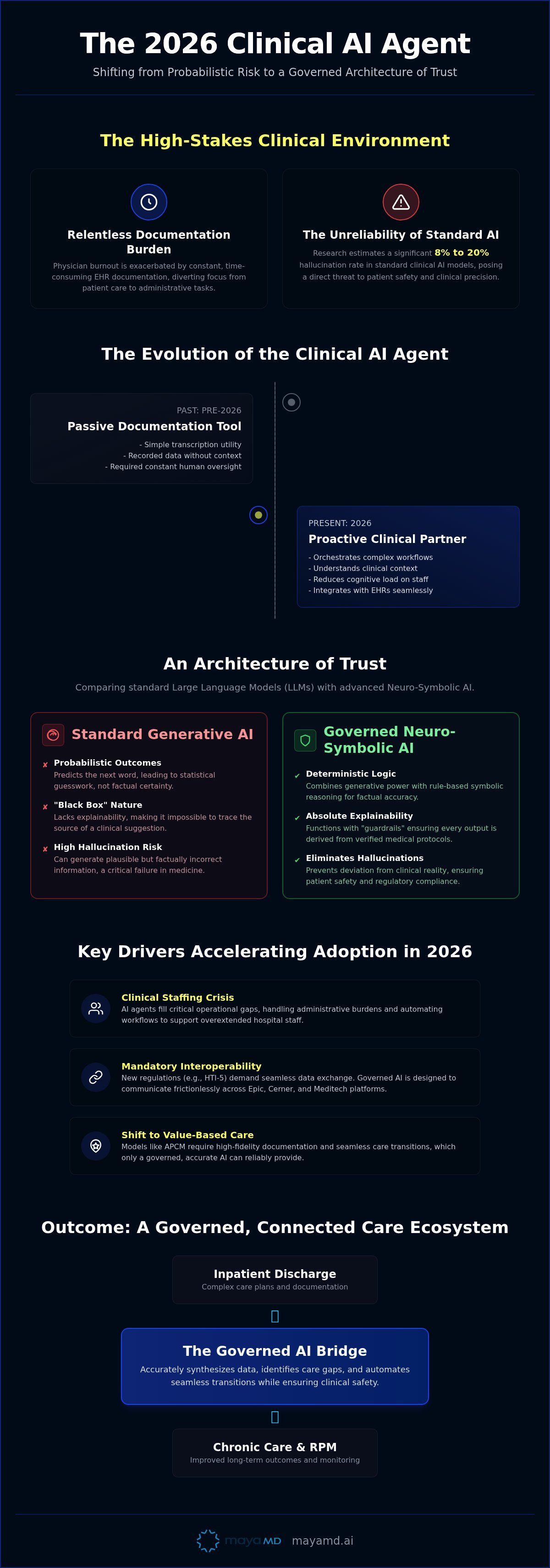
In the high-stakes environment of 2026 healthcare, the value of a clinical ai agent for hospitals is no longer measured by how fast it generates text, but by how rigorously it is governed. You likely feel the exhaustion of physician burnout from relentless EHR documentation and the legitimate fear of hallucinations, which research still estimates at 8% to 20% for standard clinical models. It's a difficult balance between the urgent need for operational efficiency and the non-negotiable requirement for clinical precision.
We understand that fragmented care between inpatient discharge and chronic care management remains a critical vulnerability. This article demonstrates how the shift toward neuro-symbolic AI, combining deterministic logic with generative capabilities, eliminates the risks of standard large language models. You'll discover how these systems provide a sophisticated bridge to Remote Patient Monitoring (RPM), ensuring that documentation is accurate and transitions are seamless. We'll explore a framework where clinical AI agents move past the experimental phase into proven, governed application that prioritizes safety and measurable performance.
Key Takeaways
• Learn how the 2026 clinical ai agent for hospitals has evolved from a simple transcription utility into a proactive partner capable of autonomous workflow orchestration.
• Understand the architecture of trust provided by neuro-symbolic AI, which integrates deterministic logic with generative power to eliminate hallucinations and ensure clinical safety.
• Identify the essential interoperability and validity benchmarks necessary for integrating AI agents with major EHR platforms while adhering to established medical guidelines.
• Discover a strategic, phased approach for deploying AI across high-impact departments to ensure alignment with specific local hospital protocols and safety standards.
• See how a governed AI ecosystem bridges the gap between acute inpatient documentation and long-term remote patient monitoring for improved chronic care outcomes.
The Evolution of Clinical AI Agents in Hospital Ecosystems
The year 2026 marks a decisive shift in how medical facilities deploy artificial intelligence. We've moved past the era of passive transcription tools toward the era of the clinical ai agent for hospitals. These systems no longer simply record data; they orchestrate workflows with a level of precision that mirrors human clinical reasoning. This transition reflects the Evolution of Clinical AI Agents from experimental novelties to governed, essential infrastructure. By integrating deterministic logic with generative capabilities, these agents support the Quintuple Aim by directly reducing physician burnout while improving the accuracy of patient outcomes.
From Documentation Tools to Clinical Partners
Early AI applications in hospitals focused almost exclusively on natural language processing for medical scribing. Today's agents understand clinical context. They don't just transcribe a discharge summary; they identify gaps in the care plan and suggest appropriate follow-up protocols. This shift to a proactive partner model allows the clinical ai agent for hospitals to manage complex tasks across care and operations simultaneously. By automating the synthesis of disparate data points, these systems significantly lower the cognitive load on overextended hospital staff. This capability ensures that clinicians can focus on the patient relationship rather than the mechanics of the electronic health record.
Key Drivers for Hospital Adoption in 2026
Several systemic factors have accelerated the transition to governed AI ecosystems this year. The US continues to face a critical shortage of clinical staff, making autonomous workflow orchestration a necessity rather than a luxury. Additionally, new regulatory frameworks, such as the HTI-5 rule from the HHS, have placed increased pressure on hospitals to ensure data transparency and interoperability. Hospitals are also adapting to state-specific laws, such as Indiana's HB 1271, which prohibits insurers from using AI as the sole basis for downcoding claims, highlighting the need for highly accurate documentation.
Staffing Crisis
: AI agents fill operational gaps by handling administrative burdens that would otherwise require manual intervention.
Interoperability
: Modern agents are designed to communicate across Epic, Cerner, and Meditech platforms without friction.
Value-Based Care
: The transition to models like Advanced Primary Care Management (APCM) requires the high-fidelity documentation that only a governed AI can provide.
As two-thirds of clinicians now utilize AI in their work, according to the American Medical Association, the focus has shifted entirely to safety. Facilities in cities like Las Vegas and Chicago are prioritizing platforms that offer rigorous oversight to prevent the hallucinations common in early generative models. This focus on stability ensures that technology serves as a reliable bridge between acute care and long-term patient management.
Architecture of Trust: Deterministic Logic vs. Generative Hallucinations
Standard large language models (LLMs) operate on probabilistic outcomes, essentially predicting the most likely next word in a sequence. While this is effective for creative tasks, this "black box" nature remains a significant liability in acute clinical settings. A clinical ai agent for hospitals must provide more than linguistic fluency; it requires absolute explainability. When a system suggests a treatment path or summarizes a patient encounter, clinicians must know that the output is derived from established medical facts rather than statistical guesswork.
Neuro-symbolic AI serves as the fundamental solution to this problem. This architecture marries the high-scale statistical power of deep learning with the rigid, rule-based precision of symbolic reasoning. By integrating deterministic logic, the system functions with a set of "guardrails" that prevent it from deviating from clinical reality. This hybrid framework ensures that every clinical suggestion follows verified medical protocols and adheres to the hospital's specific governance standards.
Eliminating Hallucinations in Clinical Notes
Hallucinations occur when a model prioritizes linguistic patterns over factual accuracy, leading to "invented" data points in medical records. In 2026, achieving healthcare ai without hallucinations is possible only through rigorous symbolic grounding. This process requires the AI to cross-reference every generative claim against the patient's verified EHR data before the note is finalized. For example, in complex chronic care scenarios involving multiple comorbidities, the agent won't conflate medications or laboratory results based on common associations; it only documents what is explicitly present in the record.
Governance and HIPAA Compliance in the Cloud
Security is the bedrock of clinical trust. A modern clinical ai agent for hospitals utilizes a HIPAA-compliant data layer that ensures all PHI is encrypted at rest and in transit. Beyond simple encryption, a governed system maintains comprehensive audit trails. These logs provide a transparent record of every instance of AI-driven decision support, which is essential for meeting the transparency requirements of the HTI-5 rule. This level of oversight allows hospital leadership to deploy cloud-based AI with the confidence that every interaction is secure, traceable, and compliant.
Implementing these safeguards allows your facility to scale its digital infrastructure without compromising patient privacy or clinical integrity. You can explore our governed AI solutions to see how we balance high-performance automation with the sober reality of clinical oversight.
Evaluating Clinical AI Performance: Key Criteria for Hospital Leadership
Hospital leadership faces a market saturated with AI solutions that often prioritize interface convenience over clinical depth. Selecting a clinical ai agent for hospitals requires a rigorous evaluation framework that moves beyond the surface level of voice commands and login ease. Executives must demand evidence of high-stakes reliability and technical maturity. The primary objective is to identify a partner that understands the nuances of hospital workflows and the critical nature of regulatory adherence.
The Interoperability Checklist
Seamless data exchange is the cornerstone of any successful AI deployment. A governed AI agent must utilize HL7 and FHIR standards to ensure it can communicate effectively with legacy systems like Epic, Cerner, and Meditech. This requires bi-directional integration where the agent doesn't just pull patient history but also pushes verified documentation back into the EHR in real time. In 2026, interoperability is defined as the seamless, automated movement of high-fidelity clinical data across the entire care continuum without the need for manual entry or secondary verification. This capability ensures that the patient's record remains a single, accurate source of truth throughout their journey from the ER to post-discharge care.
Clinical validity is equally non-negotiable. Leadership must verify that the agent follows established medical guidelines through deterministic logic rather than statistical probability. This ensures that the system’s reasoning is explainable and grounded in peer-reviewed protocols. Furthermore, the agent must demonstrate scalability. A system that succeeds in the intensive environment of the ICU must also be capable of managing the continuous, lower-intensity data streams of Remote Patient Monitoring (RPM). This versatility allows a hospital to consolidate its technology stack under a single, governed ecosystem.
Measuring ROI: Burnout, Documentation, and Reimbursement
The financial and human impact of AI is measurable through specific performance indicators. One of the most critical metrics is the reduction in "pajama time," the hours physicians spend on documentation after their shift ends. By automating the synthesis of clinical notes, a clinical ai agent for hospitals returns valuable time to the provider, directly mitigating the staffing crisis. Additionally, higher documentation accuracy leads to more precise coding, which significantly optimizes the hospital revenue cycle and reduces claim denials.
Implementing clinical workflow automation solutions allows facilities to capture revenue that is often lost to administrative friction. When an AI agent ensures that every screening, such as MIPS 2026 depression or oral health assessments, is documented and billed correctly, the ROI becomes undeniable. This strategic integration fosters a sustainable environment where technological precision supports both the provider's well-being and the hospital's long-term financial health.
Strategic Integration: Deploying AI Agents Across Inpatient and Chronic Care
Successful deployment of a clinical ai agent for hospitals requires a methodical, multi-phase roadmap rather than a simple software installation. This structured approach ensures that the technology aligns with the specific clinical needs and operational realities of the facility. By following a governed implementation strategy, hospital systems can mitigate the risks of disruption while maximizing the immediate benefits of automation.
Phase 1: Departmental Prioritization
. Leadership identifies high-impact departments such as the ER, ICU, and Primary Care where documentation burdens and patient throughput challenges are most acute.
Phase 2: Protocol Customization
. The AI agent is trained on local hospital protocols and clinical guidelines, ensuring that its suggestions are consistent with the facility’s specific standards of care.
Phase 3: Iterative Feedback
. Pilot programs allow for clinician feedback loops, where providers can refine the agent’s interaction patterns to better suit their daily workflows.
Phase 4: Enterprise Expansion
. Full-scale rollout includes deep integration with advanced primary care management (APCM) to support long-term patient health beyond the hospital walls.
Bridging the Gap: From Hospital to Home
The period immediately following inpatient discharge is often a point of significant care fragmentation. A clinical ai agent for hospitals acts as a bridge, facilitating discharge planning and ensuring that critical data reaches the patient's primary care team. By integrating principal care management tools, specialists can maintain oversight of complex cases without manual data re-entry. This continuity is particularly vital for patients in sprawling metropolitan areas like Phoenix and Houston, where the distance between acute care and home-based recovery can lead to lapses in follow-up. The agent maintains the thread of care, ensuring that chronic care management remains proactive rather than reactive.
Local Implementation Support in Major US Hubs
Deploying AI in major healthcare hubs like Indianapolis and Chicago requires a deep understanding of regional dynamics. Each system faces unique challenges, from specific state-level telehealth regulations to the nuances of local payer mixes. Navigating these complexities necessitates the identification of "AI Champions" within the hospital staff; these are clinicians who lead the adoption process and provide peer-to-peer training. This local support ensures that the transition to an AI-augmented workflow is culturally and operationally sustainable. You can schedule a consultation with our implementation experts to discuss a tailored rollout strategy for your facility.
MayaMD: The Governed Clinical AI Agent for US Hospital Systems
MayaMD stands as a sophisticated partner for hospital systems that prioritize clinical safety over technological novelty. By utilizing a neuro-symbolic AI architecture, we provide a clinical ai agent for hospitals that redefines the concept of trust in digital medicine. This approach ensures that every automated action is governed by deterministic logic, effectively eliminating the risk of hallucinations that plague purely generative models. Our commitment to a HIPAA-compliant, cloud-based framework allows for rapid innovation without compromising the rigorous security protocols required by modern healthcare leadership.
We view the hospital encounter not as an isolated event, but as the starting point for a continuous care journey. Our platform facilitates a seamless transition from acute inpatient documentation to remote patient monitoring software, ensuring that the clinical insights captured at the bedside inform the patient's recovery at home. This connectivity empowers hospitals in Las Vegas, Indianapolis, and Chicago with actionable data that bridges the gap between discharge and long-term wellness.
The MayaMD Difference: Logic-Driven Care
The industry benchmark for excellence is no longer just speed; it's the ability to maintain clinical validity across diverse care settings. Our clinical ai agent for primary care serves as the foundational layer for this continuity, providing specialists and general practitioners with a unified view of the patient’s health status. By focusing on digital healthcare for chronic disease, MayaMD helps medical groups manage high-acuity populations with the precision of advanced data science. Our partnership model is built for the long term, offering hospital systems a scalable ecosystem that adapts to evolving regulatory requirements and clinical guidelines.
Stability
: A governed framework that prioritizes precision and regulatory adherence.
Connectivity
: A bridge between disparate data points and human-centered care.
Impact
: Measurable improvements in clinician well-being and patient outcomes.
Next Steps for Hospital Leadership
Transitioning to a governed AI environment requires a clear understanding of your current operational friction points. We invite hospital executives and clinical directors to schedule a comprehensive clinical workflow audit with our specialists. This process identifies high-impact areas where a clinical ai agent for hospitals can immediately reduce administrative burden and improve documentation accuracy. You can also access our reference library for implementation benchmarks to see how similar systems have successfully integrated our solutions. Contact MayaMD today to arrange a localized demonstration in your city and discover how we can support your facility’s mission through reliable, logic-driven AI healthcare.
Securing the Future of Hospital Governance
The transition toward autonomous clinical workflows requires more than just technological adoption; it demands a commitment to rigorous safety and architectural transparency. By prioritizing a neuro-symbolic AI framework, hospital systems can finally eliminate the risks associated with generative hallucinations while ensuring every automated note is grounded in deterministic logic. This approach transforms the clinical ai agent for hospitals from a simple transcription tool into a reliable bridge between acute inpatient care and continuous chronic care management. You've seen how interoperability across EHR platforms and a phased integration strategy can mitigate physician burnout and optimize hospital revenue cycles.
MayaMD remains dedicated to providing a HIPAA-compliant architecture that supports proven 2026 clinical workflows. We invite you to take the next step in your facility's digital evolution by exploring how governed intelligence can foster deeper connections between providers and patients. Request a Demo of MayaMD’s Governed Clinical AI Agent to see our specialized solutions in action. The path to a safer, more efficient hospital ecosystem starts with a partner who values clinical precision as much as you do.
Frequently Asked Questions
What is a clinical AI agent for hospitals?
A clinical AI agent is a sophisticated software system that orchestrates clinical and administrative workflows by synthesizing real-time patient data. Unlike standard chatbots, a clinical ai agent for hospitals utilizes neuro-symbolic AI to provide proactive support, from documenting complex inpatient encounters to facilitating post-discharge care plans. It acts as a digital partner that understands medical context and adheres to governed clinical protocols.
How does a clinical AI agent reduce physician burnout?
These agents mitigate burnout by automating the high-volume documentation tasks that typically consume hours of a clinician's day. By synthesizing EHR notes and drafting discharge summaries with high accuracy, the agent significantly reduces "pajama time." This allows physicians to refocus their cognitive energy on direct patient interaction and complex clinical decision-making rather than administrative data entry.
Can a clinical AI agent integrate with my existing EHR system?
Yes, modern agents are designed for deep interoperability with major platforms such as Epic, Cerner, and Meditech. They utilize HL7 and FHIR standards to enable bi-directional data exchange, allowing the system to pull patient histories and push verified clinical notes back into the record. This ensures that the hospital's existing source of truth remains updated without requiring manual intervention.
Is clinical AI safe for making medical recommendations?
Clinical AI serves as a decision-support tool rather than an autonomous diagnostic entity. When built on a neuro-symbolic framework, the system follows deterministic logic to ensure its suggestions align with established medical guidelines. This provides a human-in-the-loop model where the AI offers evidence-based synthesized data, but the final clinical determination always rests with the licensed healthcare professional.
How do clinical AI agents ensure HIPAA compliance?
Compliance is maintained through a multi-layered security architecture that includes end-to-end encryption for data at rest and in transit. A governed clinical ai agent for hospitals also maintains comprehensive audit trails and access logs, ensuring that all protected health information is handled according to federal standards. These systems are hosted on secure, cloud-based environments specifically designed for healthcare regulatory adherence.
What is the difference between generative AI and deterministic logic in healthcare?
Generative AI uses statistical probability to create text, which can lead to hallucinations if not properly constrained. Deterministic logic follows rigid, rule-based frameworks to ensure accuracy and consistency. Combining these into a neuro-symbolic model allows the system to be both linguistically fluent and clinically precise, ensuring that documentation remains grounded in verifiable patient data rather than statistical guesswork.
How much time can hospitals save on documentation using AI agents?
While individual results vary based on department volume, many facilities report substantial time savings by automating the synthesis of complex notes and screenings. By reducing the time spent on manual data entry for MIPS screenings and discharge summaries, clinicians can redirect those hours toward patient care. This efficiency directly improves throughput and reduces the administrative friction that often delays patient transitions.
What are the implementation costs for hospital-wide clinical AI?
Implementation costs depend on the scale of the deployment, the number of integrated departments, and the complexity of the existing EHR infrastructure. Hospitals should evaluate the investment based on the long-term ROI generated by reduced burnout, optimized revenue cycles, and improved clinical documentation accuracy. Specialized providers typically offer tailored implementation roadmaps to ensure the transition is operationally and financially sustainable.




See The MayaMD Difference
Fill the form below
Download Our Apps
MayaMD for patients and MayaPro for physicians - available on iOS and Android.
FOR PATIENTS
MayaMD App
AI-powered symptom assessment, triage, and secure access to your care team.


FOR PHYSICIANS
MayaPro App
MayaPro brings patient vitals, RPM/PCM care plans, and clinical decision support to your pocket.