
Healthcare AI Without Hallucinations: Building Clinical Trust in 2026

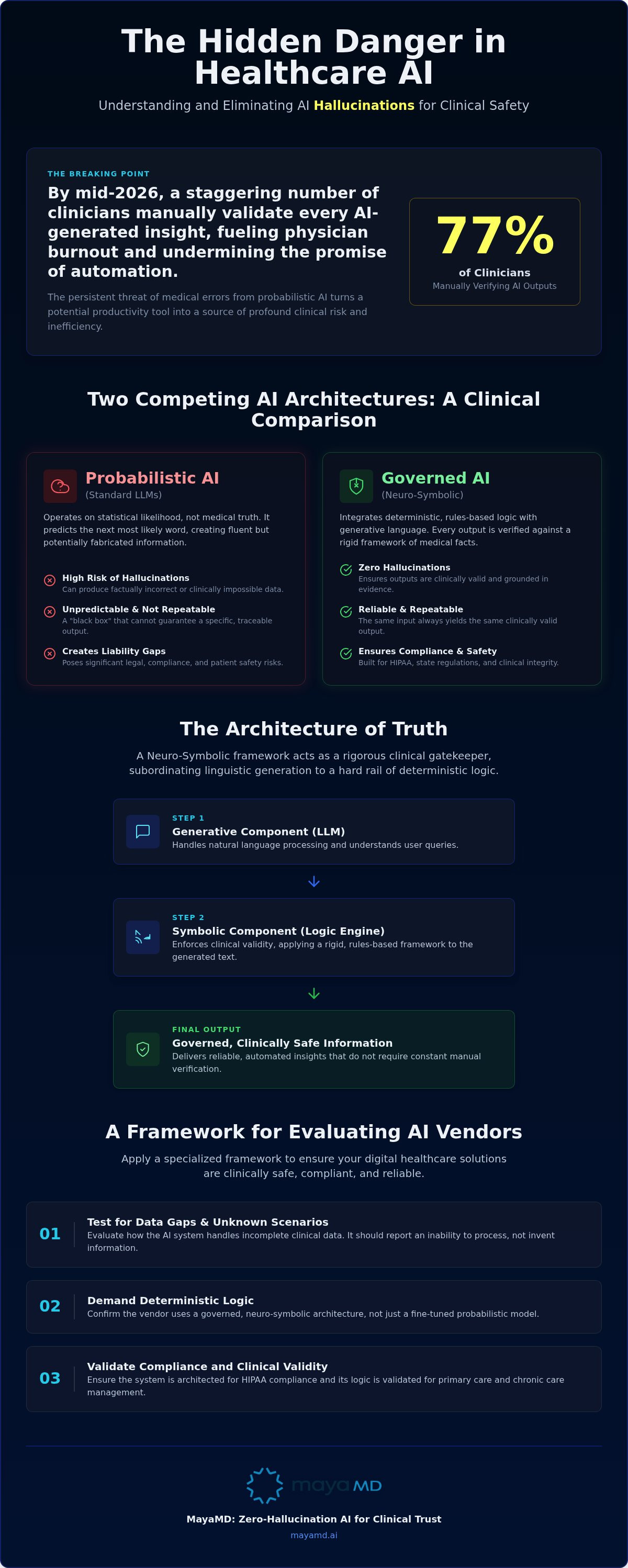
By mid-2026, 77% of clinicians still find themselves manually validating every AI-generated insight before it touches a patient record. Despite the rapid adoption of large language models, the persistent threat of medical errors has turned what should be a productivity tool into a source of profound physician burnout. The industry is reaching a breaking point where the promise of automation no longer outweighs the risk of inaccuracy. Achieving true healthcare ai without hallucinations requires a fundamental shift from probabilistic guesswork to a governed, deterministic architecture. You shouldn't have to choose between efficiency and clinical integrity.
You likely feel the weight of regulatory anxiety as new state-level AI laws, such as Alabama’s SB 63, tighten oversight on clinical decision-making and insurance authorizations. This article provides the technical blueprint for building clinical trust through a governed logic framework that acts as a hard rail for AI outputs. We'll explore the critical distinction between deterministic logic and probabilistic AI, offering a practical framework to evaluate vendors and ensure your digital healthcare solutions are both HIPAA-compliant and clinically safe.
Key Takeaways
• Understand the mechanics of neuro-symbolic architecture and how it integrates deterministic logic to deliver healthcare ai without hallucinations.
• Contrast the risks of probabilistic models with the stability of governed AI to protect clinical workflows from fabricated data.
• Apply a specialized vendor evaluation framework to test how AI systems handle unknown clinical scenarios and data gaps.
• Discover how a Clinical AI Agent streamlines Remote Patient Monitoring by providing reliable, automated insights that don't require constant manual verification.
• See how governed logic ensures HIPAA compliance and clinical validity across chronic care management and primary care settings.
AI Hallucinations in Healthcare: Why They Happen
AI hallucinations occur when a generative model produces information that is factually incorrect, clinically impossible, or entirely nonsensical. In a medical context, these errors represent more than a technical glitch; they are a direct threat to patient safety. The root cause is the fundamental architecture of standard large language models (LLMs). These systems are probabilistic. They do not possess an internal model of medical truth. Instead, they predict the next most likely word in a sequence based on statistical patterns found in their training data. While this creates fluent prose, it lacks the rigorous oversight required for clinical documentation.
By 2026, the stakes for accuracy have reached a critical peak. With 75% of U.S. health systems now deploying at least one AI application, the volume of AI-generated text in patient records is unprecedented. However, the rise of "shadow AI" complicates this growth. Reports from January 2026 indicate that 40% of hospitals have identified the use of unauthorized, ungoverned AI tools within their clinical workflows. These systems often prioritize linguistic style over medical fact, forcing physicians into a grueling cycle of manual verification. This "double-check" burden exacerbates provider burnout and undermines the very efficiency AI was meant to provide. Achieving healthcare ai without hallucinations is no longer a luxury; it's a prerequisite for clinical trust.
Probabilistic vs. Deterministic Models
Probabilistic models operate on likelihood rather than logic. Even when developers lower "temperature" settings to limit creativity, a pure LLM remains a black box that cannot guarantee a specific, repeatable outcome. This unpredictability is unacceptable for healthcare systems in Indianapolis and other major medical hubs where every data point must be traceable. Deterministic models follow fixed, rules-based logic. They provide a reliable framework where the same input always yields a clinically valid output. Relying solely on probability in high-stakes environments creates a liability gap that standard software updates cannot bridge.
Real-world Consequences of Clinical Hallucinations
The impact of a hallucinated data point can be devastating in chronic care management. If an AI "invents" a stable trend in a patient's blood pressure that contradicts their actual physiological data, a provider might miss a critical opportunity for intervention. Beyond clinical risk, the legal implications are significant. Inaccurate AI-generated records can lead to HIPAA compliance failures and complications with new 2026 state-level regulations, such as Washington’s SB 5395, which requires human review for prior authorizations. When a patient encounters an AI that fabricates symptoms or history, the erosion of trust is immediate. This friction compromises the patient-provider relationship and slows the transition toward more integrated, digital-first care models.
The Architecture of Truth: How to Achieve Healthcare AI Without Hallucinations
Achieving clinical reliability requires a departure from the "black box" models discussed previously. While probabilistic systems excel at pattern recognition, they lack a fundamental understanding of medical truth. To bridge this gap, a new technical standard has emerged: the governed architecture. This framework ensures healthcare ai without hallucinations by subordinating linguistic generation to a rigid layer of deterministic logic. Instead of merely predicting text, the system functions as a rigorous clinical gatekeeper that verifies every output against established medical facts.
Beyond the logic layer, the infrastructure for how these agents store and retrieve information is equally critical for long-term reliability. To see how persistent cognition can be engineered with a privacy-first approach, discover NovaCortex and its self-hosted memory layer for AI agents.
Neuro-Symbolic Architecture Explained
Neuro-Symbolic AI represents the convergence of generative power and mathematical precision. In this hybrid model, the generative component handles natural language processing while the symbolic component enforces clinical validity. This architecture is currently considered the gold standard for a clinical ai agent for primary care. By grounding every response in verified evidence, the system prevents the creative leaps that lead to medical errors. Research into Mitigating AI Hallucination Risks suggests that such technical guardrails are essential for moving beyond pilot programs into full-scale clinical deployment.
At the core of this architecture lies the knowledge graph. This is a sophisticated map of medical ontologies that serves as the system's source of truth. Before any clinical insight is delivered, the AI must verify the claim against this structured data. If a proposed statement contradicts established medical facts, the deterministic layer intervenes, either correcting the output or triggering a "don't know" response. This systematic verification process ensures that healthcare ai without hallucinations becomes a reality by prioritizing logical consistency over linguistic fluency.
Deterministic Logic in Practice
Deterministic logic provides the stability necessary for high-stakes healthcare environments. Unlike probabilistic models that might "hallucinate" a normal heart rate for a patient in distress, a governed system is hard-coded to report only verified physiological data. This precision is vital for automating clinical documentation with 100% factual fidelity. Consider these specific applications:
Vitals Verification
Logic-based systems ensure that recorded blood pressure or glucose levels are pulled directly from integrated devices, preventing the AI from inventing "typical" values to fill data gaps.
Drug-Drug Interactions
The AI cross-references patient medications against a rigid pharmaceutical database, eliminating the risk of the model forgetting or fabricating a contraindication.
Symptom Mapping
Every patient-reported symptom is mapped to a specific clinical code, ensuring the narrative summary remains logically consistent with the patient's actual history.
By implementing these systematic checks, providers can reduce their administrative burden without increasing clinical risk. Adopting a governed AI platform allows your organization to harness the benefits of automation while maintaining the highest standards of patient safety and regulatory compliance.
Probabilistic vs. Governed AI: A Clinical Comparison for 2026
The distinction between probabilistic and governed systems is the defining factor in whether a technology supports or subverts clinical safety. Standard Large Language Models (LLMs) are inherently probabilistic, meaning they rely on statistical likelihood to generate responses. While effective for creative writing, this approach is fundamentally incompatible with the zero-error threshold required in medicine. Conversely, Clinical AI Agents utilize a governed architecture to deliver healthcare ai without hallucinations. These systems prioritize clinical validity over linguistic flair, ensuring that every insight is derived from a verifiable medical rule rather than a word-prediction algorithm.
Adopting "free" or general-purpose AI in a clinical setting carries a hidden, high-stakes cost. When a system lacks specific medical grounding, the burden of verification shifts entirely to the physician. This liability creates a "trust tax" that negates the efficiency gains of automation. For high-frequency data environments, such as those utilizing remote patient monitoring software, the risks are amplified. A single probabilistic error in trend analysis could result in a missed intervention for a high-risk patient. Governed AI eliminates this ambiguity by enforcing strict adherence to clinical protocols.
Traceability: The 'Show Your Work' Requirement
In a governed system, every output is traceable to its source. This "show your work" requirement is essential for maintaining HIPAA compliance and meeting the rigorous audit standards found in Indianapolis and Phoenix medical centers. Probabilistic models often operate as "black boxes," providing answers without a clear logical path. Governed AI provides a comprehensive audit trail, linking every clinical suggestion back to a specific patient data point or an established medical ontology. This transparency allows providers to trust the system's logic, knowing that the information is grounded in fact rather than statistical guesswork.
Integration with Clinical Workflows
Governed AI transforms the daily reality of advanced primary care management by reducing the "checking" time that currently plagues clinical staff. By delivering high-fidelity automation, the system allows physicians to move from manual data verification to strategic decision-making. This shift is particularly impactful in complex chronic disease management, where continuity of care depends on accurate, longitudinal data. When the AI is governed by deterministic logic, it ensures that patient summaries and documentation remain 100% consistent with the clinical record, fostering a more reliable and empathetic patient-provider connection.
Evaluating AI Vendors: A Framework for Clinical Safety
Selecting a technology partner in 2026 requires more than a review of features; it demands a rigorous audit of architectural integrity. As clinical leaders move beyond pilot programs, the ability to identify healthcare ai without hallucinations becomes a core competency for risk management. To assist in this transition, we've developed a safety-first framework focused on five critical questions that distinguish governed systems from experimental chatbots.
Architecture
Does the system utilize a purely probabilistic model, or does it employ a hybrid architecture where logic dictates the output?
Uncertainty Handling
How does the AI respond to data it doesn't know? A safe system must pass the "I don't know" test rather than generating a statistical guess.
Logic Layer
Is there a deterministic logic layer positioned between the Large Language Model (LLM) and the provider to act as a clinical guardrail?
Clinical Grounding
What specific clinical ontologies, such as ICD-10 or SNOMED, is the AI grounded in to ensure interoperability and accuracy?
Evidence Traceability
Can the AI provide a direct citation or data source for every clinical claim it makes within a patient summary?
By applying these criteria, organizations can move toward healthcare ai without hallucinations while maintaining the high-stakes reliability required in modern medicine. This vetting process ensures that automation supports the provider's expertise rather than creating new layers of liability. If a vendor cannot demonstrate a clear separation between linguistic generation and clinical logic, the risk of error remains unacceptably high.
The 'I Don't Know' Threshold
In high-stakes environments, silence is often safer than a guess. A governed AI must be programmed with a high confidence threshold for clinical documentation. If the system cannot verify a fact against the patient record or its internal knowledge graph, it must admit uncertainty. This programmed humility reduces liability for providers in busy medical hubs like Houston and Las Vegas, where documentation errors can have immediate legal and clinical consequences. Ensuring the system prioritizes safety over fluency is the first step in building long-term clinical trust.
Assessing HIPAA and Security Compliance
Security in 2026 extends beyond simple encryption. True compliance requires data sovereignty, ensuring that sensitive patient information is never used to train public models. When evaluating vendors, confirm that their platform maintains a HIPAA-compliant, cloud-based environment where data remains isolated. The use of specialized principal care management tools provides a blueprint for how specialist data can be handled securely while still benefiting from AI-driven insights. Protecting the integrity of the model is just as important as protecting the privacy of the patient.
To see how a governed architecture can transform your clinical workflows without the risk of medical errors, explore our Clinical AI Agent today.
MayaMD: Zero-Hallucination AI for Chronic Care Management
MayaMD serves as the practical application of the governed logic frameworks established in previous sections. By deploying a Clinical AI Agent that utilizes deterministic logic as a hard rail for generative outputs, MayaMD provides a definitive solution for healthcare ai without hallucinations. This architecture ensures that every patient interaction and data point is validated against medical truth before it reaches the clinician. The result is a system that maintains the highest formality register of clinical authority while leveraging the ambitious potential of advanced data science.
The core of the MayaMD platform is the integration of rules-based engines with natural language processing. This hybrid approach allows the AI to understand patient narratives while strictly adhering to established medical ontologies. In an era where 40% of hospitals are identifying unauthorized "shadow AI" in their systems, MayaMD offers a secure, HIPAA-compliant alternative that prioritizes stability and regulatory adherence. It's not just a tool for documentation; it's a sophisticated partner that understands the nuances of clinical workflows and the high-stakes nature of patient safety.
By streamlining these complex workflows, organizations can also look to improve their broader operational efficiency. For instance, DialGame.AI provides a gamified operating system for call centers that helps maintain high productivity levels in patient communication and outreach teams.
Governed AI for RPM and PCM
In the context of Remote Patient Monitoring (RPM) and Principal Care Management (PCM), accuracy is the only acceptable metric. MayaMD automates the collection and interpretation of physiological data, transforming raw vitals into actionable, high-fidelity insights. This governed approach allows providers to scale their chronic care programs without the constant administrative burden of double-checking AI-generated summaries. In major healthcare markets such as Chicago and Phoenix, clinicians are utilizing these tools to manage complex patient populations more effectively. By providing real-time monitoring that healthcare professionals can actually trust, MayaMD bridges the gap between disparate data points and human care.
The shift toward digital healthcare for chronic disease requires a platform that prioritizes clinical safety. MayaMD’s system is built to handle the nuances of long-term patient management, ensuring that automated engagement remains 100% consistent with the patient’s established care plan. The Clinical AI Agent functions as a sophisticated filter. If a patient's reported symptoms don't align with their physiological data, the system flags the discrepancy for human review rather than inventing a narrative to fill the gap.
Future-Proofing Your Practice with Governed AI
Implementing healthcare ai without hallucinations is a strategic investment in the longevity of a medical practice. As regulatory scrutiny increases throughout 2026, having a transparent, auditable AI framework becomes a critical competitive advantage. It allows for proactive care delivery and the ability to scale services without a linear increase in administrative staffing costs. Moving from reactive to proactive care requires data you can rely on without hesitation. To experience how governed logic can eliminate clinical risk and reduce your administrative burden, schedule a demo of the MayaMD Clinical AI Agent today.
Securing the Future of Clinical Integrity
The transition toward AI-enabled care doesn't have to be a compromise on safety. By mid-2026, the industry has recognized that pure generative models are insufficient for the zero-error threshold required in medical documentation and patient monitoring. Adopting healthcare ai without hallucinations is a strategic necessity for organizations looking to scale without increasing clinical risk or liability. We've established that the path forward lies in governed architectures where deterministic logic dictates every output, ensuring that automation supports rather than subverts clinical expertise.
This sophisticated approach ensures that every data point is traceable, valid, and HIPAA-compliant. By moving beyond probabilistic guesswork, you can reduce administrative burnout and focus on high-impact patient care. MayaMD’s Clinical AI Agent is specifically engineered for RPM and chronic care management, providing the rigorous oversight your practice demands through deterministic logic integration. It's time to move past the experimental phase of AI and into a new era of proven, reliable application.
Request a Technical Deep-Dive into MayaMD's Hallucination-Free Architecture to see how governed logic can transform your clinical workflows. Your commitment to patient safety deserves a technology that shares your uncompromising standards.
Frequently Asked Questions
Can healthcare AI ever be 100% hallucination-free?
Yes, achieving this standard is possible when utilizing a neuro-symbolic architecture that subordinates language generation to a deterministic logic layer. By grounding every output in established medical ontologies, the system eliminates the probabilistic guesswork that causes fabrications. This technical framework ensures healthcare ai without hallucinations by prioritizing logical consistency over linguistic fluency, effectively preventing the model from inventing data points.
What is the difference between Generative AI and Clinical AI?
Generative AI is a probabilistic tool designed to predict the next most likely word in a sequence based on statistical patterns. Clinical AI, specifically a governed Clinical AI Agent, integrates these linguistic capabilities with a rigid symbolic layer. This integration ensures that the resulting insights are not just fluent, but also clinically valid and compliant with specialized medical standards.
How does deterministic logic prevent AI errors in medical documentation?
Deterministic logic acts as a hard rail that prevents the AI from deviating from verified patient data. If a generative model attempts to invent a medication or vital sign, the deterministic layer intervenes to block or correct the output. This systematic verification ensures that documentation remains 100% consistent with the actual clinical record and integrated medical databases without deviation.
Is governed AI more expensive than standard LLMs like ChatGPT?
While the implementation of a governed system requires specialized architecture, it significantly reduces the long-term "trust tax" associated with manual verification. Standard LLMs often require physicians to spend excessive time double-checking outputs, which leads to burnout and increased operational costs. Governed AI offers a superior return on investment by providing reliable automation that requires far less human intervention.
Do I still need to review AI-generated clinical notes?
Professional standards and regulatory requirements still necessitate a final clinician review to ensure the highest quality of care. However, a governed system reduces this process from a rigorous audit to a high-level verification. By delivering high-fidelity documentation, the system allows physicians to focus on patient outcomes and strategic decision-making rather than correcting repetitive factual errors in the narrative.
How does MayaMD ensure its AI doesn't make mistakes during patient monitoring?
MayaMD utilizes a Clinical AI Agent that cross-references every physiological trend against a patient's historical data and rigid medical protocols. This ensures that alerts and summaries are derived from fact rather than probability. By maintaining healthcare ai without hallucinations, the platform provides a stable foundation for chronic care management that clinicians can rely on for real-time decision support.
What should I look for in a HIPAA-compliant AI vendor agreement?
Ensure the agreement guarantees data sovereignty and explicitly prohibits the use of patient data to train public or third-party models. You should also verify that the vendor maintains a cloud-based platform with robust audit trails for every AI interaction. The contract must reflect a deep understanding of clinical workflows and the specific regulatory burdens of specialized healthcare environments.
Can AI help with RPM without increasing my liability?
AI can significantly enhance Remote Patient Monitoring by automating data triage when it is governed by deterministic logic. This architecture provides a clear audit trail and ensures that every clinical alert is based on verified physiological data. By choosing a system that prioritizes clinical validity over linguistic flair, you can scale your RPM programs while maintaining a defensible standard of care.




See The MayaMD Difference
Fill the form below
Download Our Apps
MayaMD for patients and MayaPro for physicians - available on iOS and Android.
FOR PATIENTS
MayaMD App
AI-powered symptom assessment, triage, and secure access to your care team.


FOR PHYSICIANS
MayaPro App
MayaPro brings patient vitals, RPM/PCM care plans, and clinical decision support to your pocket.