
Virtual Chronic Care: 2026 Guide to AI-Governed Care

What if the primary barrier to effective chronic care isn't the patient's pathology, but the administrative weight of the tools designed to manage it? Most clinicians today feel buried under a mountain of manual documentation and siloed data from disconnected RPM and CCM tools. You've likely experienced the frustration of managing complex patient populations with a virtual chronic care management platform that feels more like a data entry burden than a clinical asset. It's a common struggle to balance high-quality care with the constant fear of AI hallucinations or technical errors in a high-stakes environment.
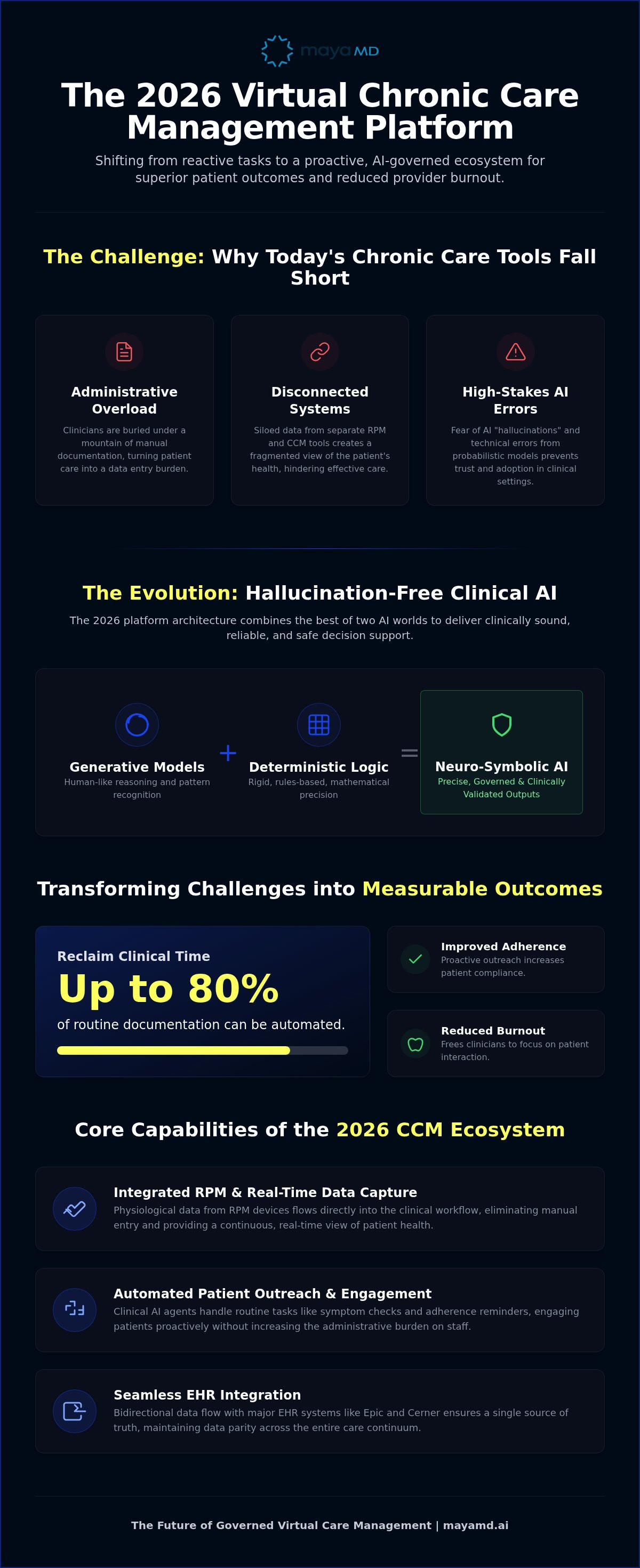
Precision. This guide reveals how the 2026 generation of virtual chronic care management platforms utilizes clinical AI to transform these challenges into streamlined workflows. You'll discover how a neuro-symbolic approach to AI eliminates hallucinations while automating documentation and improving patient adherence between visits. We'll explore the integration of RPM and CCM into a single ecosystem that captures higher reimbursement through better compliance. By the end of this article, you'll understand how to leverage AI-governed care to reduce provider burnout and achieve superior longitudinal patient outcomes.
Key Takeaways
• Understand why the next evolution of the virtual chronic care management platform requires a transition from passive monitoring to a proactive, AI-governed ecosystem.
• Learn how neuro-symbolic AI architectures combine human-like reasoning with deterministic logic to provide precise, hallucination-free clinical decision support.
• Identify the essential "governor" mechanisms that ensure generative AI outputs remain within safe, clinically validated parameters for high-stakes patient care.
• Master the strategic implementation of Advanced Primary Care Management (APCM) workflows to improve patient adherence and streamline reimbursement capture.
• Explore how integrating Remote Patient Monitoring (RPM) with automated documentation creates a unified clinical environment that fosters deeper patient-provider connectivity.
Defining the Virtual Chronic Care Management Platform in 2026
A virtual chronic care management platform is no longer a mere extension of the telephone. It has matured into a sophisticated, integrated digital ecosystem designed for continuous monitoring and clinical intervention. While early iterations of virtual care relied on episodic telehealth visits, the 2026 model prioritizes AI-governed patient engagement and automated documentation. This shift ensures that care isn't just delivered; it's managed through a HIPAA-compliant cloud infrastructure that connects disparate data points into a single, actionable narrative. Precision is the new standard. By utilizing advanced primary care management frameworks, providers can move past the experimental phase of digital health into a era of proven clinical application.
The Shift from Reactive to Proactive Care
Traditional healthcare models often fail chronic patients because they rely on the 15-minute office visit. A modern platform moves beyond these constraints by establishing continuous data streams. Chronic care management in this context means managing hypertension or diabetes through real-time physiological feedback rather than waiting for an emergency. This proactive stance is critical for bridging the gap between hospital discharge and home-based recovery, where the risk of readmission is highest. By maintaining a constant clinical presence, providers can intervene before a minor fluctuation becomes a major crisis. It's a transition from reactive firefighting to steady, governed oversight.
Core Capabilities of a 2026 CCM Ecosystem
To function effectively, these platforms must integrate several high-performance components. It's about more than just software; it's about a systematic framework of care. A reliable remote patient monitoring software serves as the foundation, but the ecosystem requires deeper integration to be effective.
Real-time physiological data capture
Integrated RPM devices feed directly into the clinical workflow, eliminating manual entry errors.
Automated patient outreach
Clinical AI agents handle routine symptom checking and engagement without increasing administrative burden.
EHR integration
Seamless bidirectional data flow with systems like Epic and Cerner ensures clinical data parity across the care continuum.
These capabilities allow for longitudinal data analytics that predict trends rather than just recording history. The goal is a capability-to-outcome flow. When a clinical AI agent identifies a trend in blood glucose levels, it triggers an immediate outreach. This results in improved patient adherence and better clinical stability. This methodical approach builds trust through transparency and measurable performance, ensuring the virtual chronic care management platform remains a bridge between data science and human care.
The Architecture of Continuous Care: AI Agents and Deterministic Logic
Generative AI has captured the public imagination, yet its probabilistic nature makes it insufficient for high-stakes clinical decision support. In a medical context, "close enough" is a failure. The 2026 virtual chronic care management platform requires a more rigorous foundation. This is where neuro-symbolic AI enters the frame. By combining the pattern recognition of generative models with the rigid, mathematical precision of deterministic logic, this architecture ensures every clinical output is governed by medical truth. It's a system designed for reliability, not just conversation.
Implementing clinical workflow automation solutions through this dual-layered logic allows practices to reduce physician burnout significantly. By automating up to 80% of routine documentation, clinicians can reclaim their time for direct patient interaction. This isn't just about efficiency; it's about restoring the human element to medicine through technological precision. You can explore how these systems integrate by reviewing the latest standards for Telehealth in Chronic Care Management. This methodical approach ensures that every automated action is both traceable and clinically valid.
The Clinical AI Agent: Your Digital Care Partner
A clinical ai agent for primary care serves as a tireless extension of the care team. These agents manage critical tasks that previously required manual intervention, allowing for a more scalable care model. Their primary functions include:
Real-time patient triage
Identifying high-risk physiological alerts and escalating them to the correct provider immediately.
Medication adherence checks
Conducting automated follow-ups to ensure patients are following their prescribed regimens.
Health literacy engagement
Delivering personalized educational content that empowers patients to manage their conditions effectively.
This capability-to-outcome flow ensures that patients remain engaged between visits, leading to higher adherence rates and improved long-term health. It's a collaborative expert that never sleeps.
Integrating RPM with Principal Care Management
Specialists often face fragmented data when managing single, high-acuity conditions. By utilizing principal care management tools within a unified virtual chronic care management platform, clinics in Las Vegas and Phoenix can synchronize physiological monitoring with specialized care coordination. This synergy provides a comprehensive view of the patient's status, allowing for data-driven adjustments to treatment plans. Specialists gain the clarity needed to manage complex cases without the typical administrative friction. For providers seeking to modernize their approach, adopting a reliable AI healthcare partner is the first step toward clinical excellence and sustainable practice growth.
Ensuring Clinical Safety: Eliminating AI Hallucinations in Chronic Care
Hallucinations are a catastrophic risk in clinical medicine. Standard Large Language Models operate on probabilistic next-token prediction, which means they're designed for fluency rather than factual accuracy. In a high-stakes clinical setting, a probabilistic "guess" regarding a patient's medication dosage or symptom severity is a liability that no practice can afford. A reliable virtual chronic care management platform must move beyond simple generative text to a system of rigorous, rule-based oversight. Safety isn't an optional feature; it's the core requirement of governed care.
Deterministic logic serves as the essential governor for these systems. While generative AI provides the interface for natural communication, symbolic reasoning ensures the content aligns with established medical truth. This framework ensures clinical validity by anchoring every AI output to evidence-based protocols and expansive medical knowledge graphs. Even with these advanced safeguards, maintaining a "human-in-the-loop" approach is non-negotiable. The AI identifies patterns and drafts documentation, but the clinician always maintains final authority over the care plan. This methodology ensures that technology supports the provider's expertise without overriding their clinical judgment.
The Technical Framework of Governed AI
Providers don't need to be computer scientists to understand why their tools work. Neuro-symbolic AI is the intersection of deep learning and symbolic reasoning. Think of deep learning as the "intuition" that allows the system to understand natural language, while symbolic reasoning is the "rulebook" that enforces medical accuracy. MayaMD utilizes this dual-layered architecture to validate AI-generated documentation against hard clinical logic in real time. If the generative layer suggests an intervention that contradicts a patient's known allergy or a standard care protocol, the symbolic layer blocks the output. This specific application of AI in Healthcare Administration and Clinical Informatics is what transforms a standard chatbot into a sophisticated clinical asset.
Risk Mitigation and HIPAA Compliance
Data security is the foundation of trust in virtual care. In major healthcare hubs like Chicago and Houston, providers require absolute certainty that patient data remains protected. Every data point captured by the virtual chronic care management platform is secured through AES-256 encryption and rigorous multi-factor authentication. Beyond encryption, the system maintains comprehensive audit trails that log every interaction, from an RPM reading to an AI-suggested note. These logs are vital for regulatory compliance and managing liability in an AI-assisted environment. By providing a transparent, governed ecosystem, practices can confidently implement advanced technology while upholding the highest standards of patient privacy and clinical safety.
Strategic Implementation: Transitioning to Advanced Primary Care Management (APCM)
Transitioning to a high-performance virtual chronic care management platform isn't a simple software update. It's a fundamental shift in clinical delivery. Assessing your practice readiness for advanced primary care management is the first step in this evolution. This assessment should focus on technical infrastructure and clinical capacity. Start by selecting specific patient cohorts, such as those with multiple comorbidities or high-risk post-discharge status, to ensure a controlled and measurable initial rollout. This targeted approach allows the care team to master the technology before scaling across the entire patient population.
Success depends on the human element. Clinical staff in regional hubs like Indianapolis and Phoenix require specialized training on AI-augmented workflows to ensure seamless adoption. This training focuses on interpreting AI-driven insights rather than just managing data entry. By optimizing the interaction between the provider and the technology, practices can ensure that the virtual chronic care management platform acts as a force multiplier for the existing care team. This methodical preparation transforms a complex technical migration into a predictable clinical improvement.
Step-by-Step Deployment Roadmap
The roadmap to deployment is methodical. It follows a logical sequence to minimize disruption to existing patient care while establishing a robust foundation for AI-governed monitoring.
Phase 1: EHR integration and data mapping.
This ensures that historical patient records and new virtual data streams exist in a single clinical truth, preventing the data silos that plague traditional RPM tools.
Phase 2: Patient enrollment and RPM device distribution.
This phase establishes the physical connection between the home and the clinic, providing the continuous data streams necessary for proactive intervention.
Phase 3: AI Agent activation for automated monitoring.
Once data flows are secure, the AI begins its role as the continuous care governor, managing routine checks and documentation.
Maximizing Reimbursement and ROI
Financial sustainability is built into the architecture of governed care. The 2026 CMS landscape for virtual care services has evolved to reward longitudinal engagement over episodic interactions. Virtual platforms are uniquely capable of capturing "hidden" billable time. This includes minutes spent on data review and patient outreach that often go unrecorded in traditional models. Beyond immediate billing, the long-term value lies in the reduction of hospital readmissions. Preventing a single acute episode through proactive monitoring provides a measurable return that far exceeds the initial implementation costs. For practices ready to modernize, partnering with MayaMD provides the technical and regulatory framework needed for sustainable success.
MayaMD: The Future of Governed Virtual Care Management
MayaMD isn't a disruptive outsider. It's a sophisticated partner that understands the nuances of clinical workflows and the heavy responsibility of patient outcomes. MayaMD stands as the definitive choice for practices navigating the high-stakes complexities of modern medicine. By serving as a bridge between disparate data points and human care, this virtual chronic care management platform provides the stability required for rigorous clinical oversight. It's the preferred remote patient monitoring software because it moves past experimental hype into proven, governed application. Providers are empowered to deliver high-quality care without the administrative tax that typically accompanies digital transformation. This balance of clinical authority and technological ambition ensures that safety remains the priority as practices scale.
A Unified Ecosystem for Providers
Efficiency. MayaMD consolidates RPM, PCM, and APCM into a single clinical dashboard, eliminating the fragmentation caused by siloed tools. This intuitive interface, designed by clinicians for clinicians, ensures that the most critical physiological data is always at the forefront. MayaMD streamlines clinical documentation and patient engagement simultaneously, allowing the care team to focus on the human impact of their work rather than the mechanics of the software. This holistic approach to digital healthcare for chronic disease ensures that no patient falls through the cracks of a busy practice. By reducing the manual documentation burden, clinicians can spend more time on complex decision-making and direct patient connection.
Join the Authoritative Pioneers in Healthcare
Vision. The journey toward AI-governed care begins with a clear understanding of your practice's unique operational needs. MayaMD offers tailored platform demonstrations that show exactly how these tools integrate into existing workflows without causing disruption. Whether your practice must adhere to specific city-based regulatory needs or general federal standards, the platform is customizable to ensure total compliance and precision. The vision for 2026 is clear: AI serves as a bridge between cold data science and empathetic human care. By adopting a virtual chronic care management platform built on clinical authority, you aren't just buying software; you're entering a long-term partnership focused on measurable performance and superior patient outcomes. This methodical approach ensures your practice remains at the forefront of the industry's evolution while maintaining the highest standards of care.
Advancing the Standard of AI-Governed Care
The transition from reactive monitoring to proactive, AI-governed care is no longer a visionary concept; it's a clinical necessity. By integrating neuro-symbolic AI into your practice, you eliminate the risks of hallucinations while ensuring every patient interaction remains within safe, deterministic boundaries. This methodical approach allows your team to move beyond the constraints of fragmented data and siloed tools. Implementing a sophisticated virtual chronic care management platform provides the connectivity needed to bridge the gap between hospital and home; it ensures superior longitudinal outcomes through constant, reliable oversight.
MayaMD offers a HIPAA-compliant and secure AI architecture that's proven to reduce administrative burden by 80%. This efficiency gain allows providers to focus on high-acuity care while the system handles routine documentation and patient engagement. Our ecosystem supports both APCM and PCM workflows, providing the stability and precision required for modern healthcare delivery. You don't have to choose between technological ambition and clinical safety.
Schedule a Demo of MayaMD’s Virtual Chronic Care Management Platform to see how we can transform your clinical workflows. We're ready to help you lead the next generation of patient care with confidence and clarity.
Frequently Asked Questions
What is the difference between a virtual CCM platform and traditional telehealth?
Traditional telehealth focuses on episodic, video-based visits that mirror standard office consultations. In contrast, a virtual chronic care management platform provides a continuous, integrated digital ecosystem for ongoing monitoring. It moves beyond the 15-minute call by utilizing real-time data streams and AI-governed engagement. This creates a longitudinal care model where interventions happen between visits, rather than waiting for an acute episode to trigger a consultation.
How does the platform ensure AI documentation is clinically accurate?
Accuracy is maintained through a neuro-symbolic AI architecture that combines generative capabilities with deterministic logic. While the generative layer drafts notes, the symbolic layer acts as a governor, validating every statement against established medical knowledge graphs and clinical protocols. This dual-layered approach eliminates the risk of hallucinations. The final documentation always requires a clinician's review, maintaining a human-in-the-loop standard for all high-stakes decisions.
Is MayaMD compliant with HIPAA and other US healthcare regulations?
Yes, MayaMD is fully HIPAA-compliant and adheres to all relevant US healthcare data security standards. The platform utilizes AES-256 encryption and multi-factor authentication to protect sensitive patient information. Beyond basic compliance, it maintains rigorous audit trails for every automated action and data entry. This systematic framework ensures that practices meet regulatory requirements for RPM, APCM, and PCM while protecting against data breaches or liability risks.
Which chronic conditions are best suited for virtual management?
Conditions requiring continuous physiological monitoring and frequent medication adjustments see the most significant benefit. Hypertension, diabetes, and congestive heart failure are primary candidates because they generate actionable data streams like blood pressure and glucose levels. The platform also excels in managing chronic obstructive pulmonary disease and chronic kidney disease. By tracking these metrics remotely, providers can intervene early to prevent costly hospital readmissions or acute exacerbations.
How does a virtual platform help with Medicare reimbursement?
The platform automates the tracking of billable time and patient compliance, which are essential for CCM and RPM CPT codes. By capturing every minute of data review and AI-driven outreach, it identifies hidden billable activities that often go unrecorded in manual systems. This leads to higher reimbursement capture and ensures the practice remains compliant with 2026 CMS documentation requirements. It transforms administrative overhead into a predictable revenue stream for the practice.
Can the platform integrate with my existing EHR system?
MayaMD is designed for seamless bidirectional integration with major EHR systems including Epic, Cerner, and Athenahealth. This connectivity ensures that patient data flows into the virtual chronic care management platform without manual entry, maintaining a single clinical truth across the organization. By synchronizing RPM data and AI-generated notes directly into the patient record, it eliminates data silos and reduces the risk of documentation errors during the transition of care.
What training is required for my clinical staff to use MayaMD?
Training focuses on clinical oversight rather than technical data entry. Staff members learn to interpret AI-governed alerts and manage the automated patient engagement workflows. Because the interface is designed by clinicians, the learning curve is typically short. Training modules cover RPM device management, EHR synchronization, and the use of AI agents for triage. This ensures the team can operate the platform with calm confidence from the initial rollout phase.
How does the platform improve patient engagement in cities like Las Vegas or Houston?
In high-density urban centers like Las Vegas or Houston, patients often face barriers to frequent in-person visits. The platform bridges this gap by providing a constant clinical presence through automated outreach and symptom checking. AI agents deliver personalized health literacy content and medication reminders, which improves adherence between appointments. This steady connection fosters a sense of support and reliability, leading to better long-term patient engagement and improved clinical outcomes.




See The MayaMD Difference
Fill the form below
Download Our Apps
MayaMD for patients and MayaPro for physicians - available on iOS and Android.
FOR PATIENTS
MayaMD App
AI-powered symptom assessment, triage, and secure access to your care team.
FOR PHYSICIANS
MayaPro App
MayaPro brings patient vitals, RPM/PCM care plans, and clinical decision support to your pocket.