
ROI for Enterprise RPM Platforms: 2026 Strategic Guide

In 2026, the true value of a remote patient monitoring program is no longer found in the volume of data collected, but in the precision of the clinical response that data triggers. You likely understand the frustration of seeing your clinical teams buried under a mountain of alerts while you struggle to navigate the evolving complexity of Medicare reimbursement codes. It's a high-stakes environment where the fear of AI hallucinations in documentation can stall even the most ambitious digital health initiatives. You need a model that proves financial viability without sacrificing clinical integrity.
This strategic guide provides the multi-dimensional framework necessary for calculating ROI for enterprise RPM platforms, moving beyond simple fee-for-service metrics to include operational and clinical outcomes. We will explore how a Clinical AI Agent utilizing deterministic logic can streamline workflows, reduce hospital readmissions, and secure the board approval you need for sustainable growth. By the end of this article, you will master a governed approach to RPM that transforms disparate data points into measurable performance and enhanced human connection.
Key Takeaways
• Adopt a multi-dimensional framework that moves beyond fee-for-service metrics to include cost avoidance, workforce retention, and value-based care accountability.
• Master the 2026 reimbursement landscape by analyzing the specific revenue potential of CPT codes 99453 through 99458 and the additive value of Principal Care Management.
• Simplify the process of calculating ROI for enterprise RPM platforms by quantifying the reduction in physician burnout and alert fatigue through automated triage.
• Protect your organization from liability by utilizing a Clinical AI Agent built on deterministic logic, which eliminates the financial risks associated with AI hallucinations.
• Follow a proven 2026 implementation roadmap to integrate governed AI into existing EMR infrastructures for scalable and sustainable financial returns.
The 2026 RPM ROI Framework: Beyond Fee-for-Service
Strategic success in the current healthcare market requires a shift from viewing Remote patient monitoring (RPM) as a standalone revenue stream to recognizing it as a foundational pillar of value-based care. When calculating ROI for enterprise RPM platforms, leaders must integrate three distinct dimensions: direct financial reimbursement, operational cost avoidance, and workforce retention. This composite approach reflects the 2026 shift toward total cost of care accountability, where performance bonuses under MIPS and ACO models often outweigh traditional fee-for-service billings.
Enterprise organizations are moving away from passive monitoring tools that simply transmit data. These legacy systems create "dashboard medicine," a phenomenon where providers are overwhelmed by noise without actionable insights. In contrast, an active clinical AI agent for primary care functions as a force multiplier. It processes incoming physiological data through deterministic logic to ensure that only clinically significant anomalies reach the care team, transforming a potential cost sink into a streamlined clinical asset.
The Evolution of Digital Care Economics
The 2026 Medicare Final Rule has provided much-needed stability for RPM and PCM reimbursement paths. This regulatory clarity allows health systems to build sustainable long-term financial models. Specifically, the integration of Advanced Primary Care Management (APCM) has redefined the economic landscape. By aligning RPM with APCM workflows, organizations can secure recurring monthly revenue while simultaneously addressing the continuous care needs of chronic disease populations. Automated AI intervention is the key to this sustainability; it replaces manual data oversight with governed logic, ensuring that clinical resources are allocated to the highest-risk patients.
Key Performance Indicators (KPIs) for Enterprise Health Systems
To provide a clear ROI model for board approval, executives must track metrics that reflect both clinical excellence and fiscal responsibility. Effective calculating ROI for enterprise RPM platforms involves monitoring specific KPIs:
Reduction in ED High-Utilizer Costs
Measure the decrease in emergency department visits among patients enrolled in continuous monitoring programs.
Time-to-Intervention
Track the duration between a physiological alert and a documented clinical response, which serves as a leading indicator of clinical safety.
Patient Retention and Engagement
Quantify how automated post-discharge communication maintains patient connection and prevents leakage to competing networks.
By focusing on these metrics, health systems move past the experimental phase and into proven, scalable application. This methodical approach ensures that technology serves the human element of care rather than complicating it.
Financial ROI: Maximizing Reimbursement and Revenue Streams
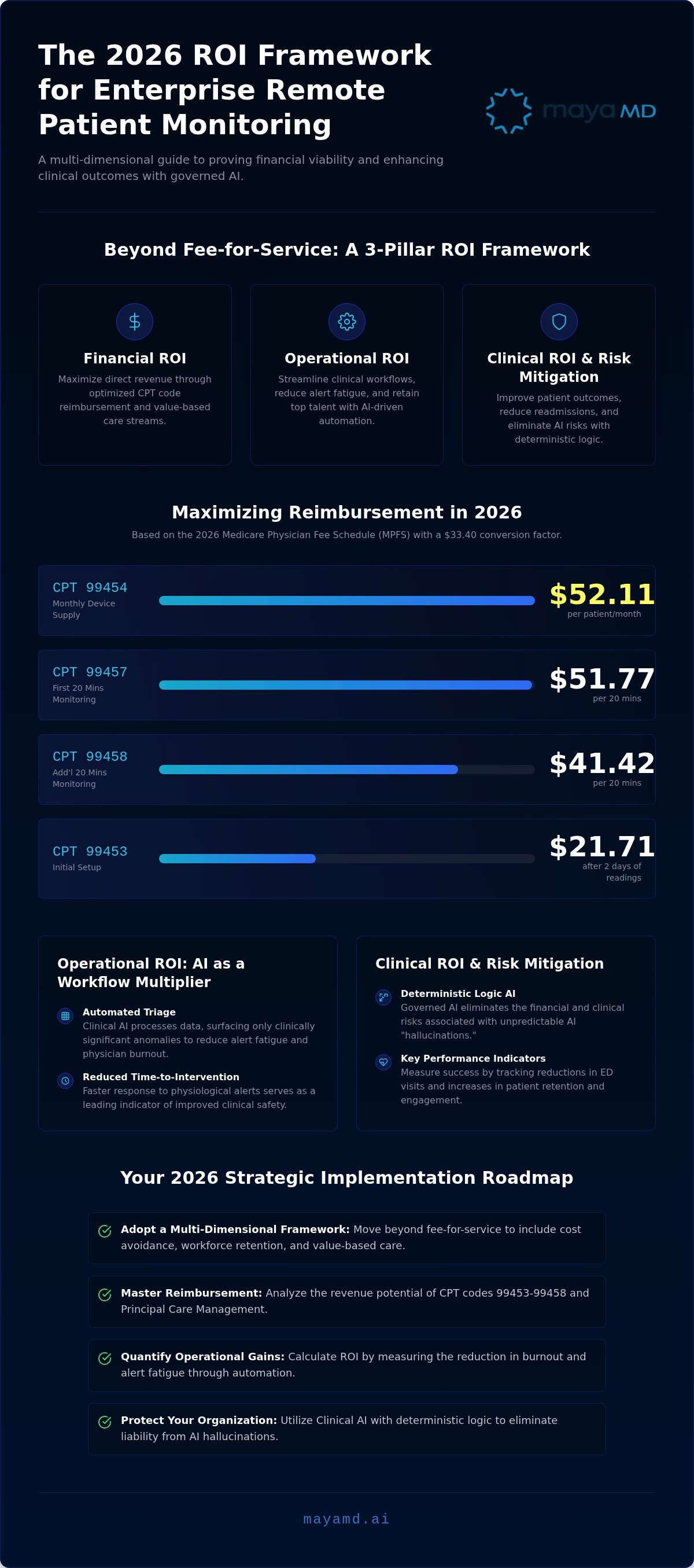
Direct revenue in 2026 is anchored by a sophisticated regulatory environment that rewards continuous, high-quality data transmission. Calculating ROI for enterprise RPM platforms requires a granular understanding of the 2026 Medicare Physician Fee Schedule (MPFS), which utilizes a conversion factor of $33.40. The financial foundation of any program rests on the proper utilization of CPT codes 99453 and 99454. Notably, 99453, which covers initial setup and patient education, now allows for reimbursement of $21.71 after only two days of readings. This reduction from the previous 16-day requirement significantly accelerates the time-to-revenue for new enrollments. Monthly device supply and data transmission under 99454 remain a primary driver at $52.11 per patient, provided the 16-day transmission threshold is met.
Beyond hardware, the 2026 framework emphasizes the value of clinical time. CPT 99457 provides $51.77 for the first 20 minutes of clinical monitoring, while 99458 offers an additional $41.42 for subsequent 20-minute increments. For health systems, the goal is to move toward advanced primary care management (APCM) models. This reimbursement structure creates a predictable revenue floor, allowing organizations to manage "transition economics" by maintaining margins as they shift from volume-based to value-based care. Integrating these streams ensures that the average payback period for an RPM investment remains between two and three months.
The Compounding Effect of PCM and CCM
Specialist groups in metropolitan areas like Chicago and Phoenix are increasingly leveraging principal care management tools to capture revenue for single-organ system management. When combined with Chronic Care Management (CCM), a single patient can generate approximately $1,991 per year. The key to maximizing this compounding ROI is AI-assisted documentation. A Clinical AI Agent ensures that every billable minute is accurately captured and cross-referenced with deterministic clinical logic, effectively preventing revenue leakage that often plagues manual tracking systems. Organizations can further optimize these complex workflows by exploring Clinical AI Agent solutions that automate the documentation of monitoring minutes.
Incentive Programs and Payer Contracting
The operational success of a digital health initiative is measured by its ability to reduce the cognitive load on clinical staff while maintaining high standards of oversight. When calculating ROI for enterprise RPM platforms, the most significant operational gain is the mitigation of "alert fatigue" through deterministic triage. Unlike generative models that may produce unreliable outputs, a Clinical AI Agent utilizes governed logic to filter incoming physiological data. This ensures that clinicians only interact with alerts that require immediate human intervention, effectively separating clinical signals from the noise of continuous data streams.
The financial impact of this efficiency is profound, particularly regarding physician burnout and staff turnover. High-performing health systems recognize that the cost of replacing a single physician or specialized nurse often reaches hundreds of thousands of dollars in recruitment and lost productivity. By deploying clinical workflow automation solutions, organizations can protect their most valuable assets: their people. This shift from human-only monitoring to AI-augmented documentation allows providers to focus on complex clinical decision-making rather than administrative data entry.
Eliminating the Documentation Burden
Clinical AI Agents automate the charting of patient-reported data directly into the EMR, a process that traditionally consumes hours of provider time. In large networks, such as those operating in Las Vegas, this automation significantly reduces "pajama time," the hours clinicians spend on documentation after their shift ends. Furthermore, the ROI of an automated post-discharge solution is realized through the prevention of 30-day readmissions. By maintaining a continuous, AI-governed connection with patients during the critical transition from hospital to home, health systems avoid the heavy penalties associated with preventable acute events.
Scaling Without Linear Headcount Growth
Clinical ROI and Risk Mitigation: The AI Safety Factor
In 2026, the clinical component of calculating ROI for enterprise RPM platforms must include a rigorous assessment of risk mitigation and liability protection. While traditional models focus on surface-level outcomes, a "governed" approach to artificial intelligence introduces deterministic logic as a financial safeguard. This neuro-symbolic architecture ensures that every clinical recommendation is grounded in established medical protocols, effectively eliminating the liability risks inherent in "black box" or generative AI models. By prioritizing safety, health systems avoid the hidden costs of clinical errors and protect their institutional reputation.
Proactive digital healthcare for chronic disease management allows for the early detection of physiological decompensation, enabling interventions before a patient requires hospitalization. This shift toward AI-governed continuous care also addresses medication adherence and health literacy. When patient engagement is driven by reliable, evidence-based insights rather than unpredictable generative responses, the clinical outcomes become both predictable and scalable.
Reducing Readmission Penalties
Avoided acute events represent a significant portion of cost avoidance in the enterprise landscape. For many organizations, the logic is straightforward: a 5% reduction in readmissions can often cover the entire operational cost of the platform. This is particularly relevant when considering the savings from avoided CMS Hospital Readmissions Reduction Program (HRRP) penalties, which can otherwise erode thin margins. Continuous monitoring provides the high-fidelity data needed to stabilize patients in their homes, turning reactive care into a proactive clinical strategy that prevents costly 30-day readmissions.
The Value of Data Accuracy and Safety
The "Hallucination Tax" is a real financial burden for organizations that deploy non-deterministic AI models. This tax represents the cumulative cost of clinical errors, increased administrative oversight, and the potential for malpractice litigation resulting from AI-generated misinformation. MayaMD’s deterministic approach ensures that data accuracy is non-negotiable, supporting HIPAA compliance and data security in high-stakes environments. Beyond the numbers, this reliability builds patient trust. When patients receive consistent, AI-supported communication regarding their symptom management, engagement rates climb. This virtuous cycle of trust and accuracy is essential for long-term clinical success. To see how a governed approach can secure your clinical workflows, explore our Clinical AI Agent solutions.
Implementing MayaMD for Enterprise-Grade Returns
Successful deployment of an AI-governed platform requires a methodical transition from legacy monitoring to active clinical intervention. In 2026, the complexity of calculating ROI for enterprise RPM platforms demands an implementation roadmap that prioritizes technical interoperability and clinical safety. For health systems in Phoenix, Chicago, and other major metropolitan hubs, this process is not merely a software installation; it's a strategic realignment of chronic care workflows. To manage the underlying business complexity of such large-scale deployments, enterprises often look to specialized partners; for instance, NaviWorld (Thailand) Co., Ltd. helps organizations optimize their Microsoft Dynamics 365 finance and supply chain systems for maximum operational efficiency. By integrating our Clinical AI Agent with existing infrastructures, organizations can secure the financial, operational, and clinical returns detailed throughout this guide.
We've standardized a three-step deployment model to ensure rapid time-to-value for large-scale health networks. The first phase involves clinical workflow mapping and the configuration of deterministic logic. During this stage, we align the AI’s triage protocols with your institution’s specific medical guidelines. This ensures that the system remains a "governed" asset that protects against liability. The second phase focuses on deep integration with Epic, Cerner, or proprietary health system APIs. This connectivity allows for the automated charting of patient data, eliminating the administrative burden on providers. Finally, we execute staff training and patient enrollment protocols. This step is critical for maintaining high engagement rates and ensuring that clinical teams feel supported rather than overwhelmed by new technology.
Partnering for Long-Term Performance
Enterprise success isn't a static achievement. It's a process of continuous optimization. Our Clinical AI Agent refines its performance over time by learning from system interactions while remaining strictly within the bounds of deterministic logic. This ensures that your ROI grows as the program scales. We provide dedicated enterprise support models tailored for large-scale deployments in cities like Chicago and Phoenix, where population health needs are diverse and high-stakes. This localized expertise helps health systems navigate regional payer nuances and maintain compliance with evolving 2026 regulations.
Our platform provides native support for Advanced Primary Care Management (APCM) and Principal Care Management (PCM), ensuring that your organization captures every available revenue stream while stabilizing patient outcomes. Ultimately, ROI in 2026 is a measure of clinical agility and patient safety. It's time to transition from passive monitoring to AI-governed care excellence.
Securing the Future of AI-Governed Care
The transition from passive data collection to active, AI-governed intervention is the defining shift for healthcare leaders in 2026. We've explored how a multi-dimensional framework allows for accurately calculating ROI for enterprise RPM platforms by integrating direct reimbursement with operational cost avoidance and clinical risk mitigation. By leveraging the stabilized 2026 Medicare Physician Fee Schedule and aligning with APCM workflows, your organization can ensure long-term financial sustainability while reducing the administrative burden on clinical teams.
MayaMD provides the necessary infrastructure through a HIPAA-compliant AI architecture and deterministic logic to eliminate hallucinations; this ensures that your digital health initiatives remain safe and deeply integrated with your existing enterprise EMRs. It's time to move past experimental pilots into proven, scalable applications that prioritize both measurable performance and the human impact of care. Schedule a Strategic ROI Consultation with MayaMD to begin your transition toward clinical excellence. We're ready to help you navigate this sophisticated landscape with confidence.
Frequently Asked Questions
What is the typical ROI timeframe for an enterprise RPM platform?
The typical ROI timeframe for an enterprise RPM platform is between two and three months. This rapid payback period is driven by the immediate capture of CPT code reimbursements and the reduction of operational inefficiencies. For health systems in cities like Phoenix and Chicago, the initial setup costs are often offset by the recurring monthly revenue generated from device supply and clinical monitoring within the first quarter of deployment.
How does Medicare reimburse for RPM and APCM in 2026?
In 2026, Medicare reimburses for RPM through a structured set of CPT codes, including 99453 for initial setup and 99454 for monthly data transmission. Clinical monitoring minutes are captured under codes 99457 and 99458. The 2026 Medicare Physician Fee Schedule utilizes a conversion factor of $33.40, providing a stable revenue floor. Integrating these with Advanced Primary Care Management (APCM) allows organizations in Houston and Indianapolis to secure consistent monthly payments for continuous chronic care.
Can Clinical AI Agents really reduce physician burnout?
Yes, a Clinical AI Agent significantly reduces physician burnout by automating the triage of incoming physiological data and streamlining clinical documentation. By filtering out non-critical alerts through deterministic logic, the platform ensures that clinicians only spend time on high-acuity interventions. This reduction in administrative "pajama time" is essential for large-scale networks in Las Vegas and Chicago, where workforce retention is a critical component of calculating ROI for enterprise RPM platforms. To further support these retention goals, elli offers workforce intelligence that helps organizations improve employee engagement and wellbeing.
What is the difference between Generative AI and Deterministic Logic in healthcare?
Generative AI creates content based on probabilistic patterns, which can lead to clinical "hallucinations" or errors. In contrast, deterministic logic follows a structured, rule-based framework that yields consistent and predictable outcomes every time. MayaMD utilizes this governed approach to ensure that clinical recommendations are always grounded in established medical protocols. This eliminates the liability risks associated with unpredictable AI models, providing a reliable bridge between data points and human care.
How does RPM ROI differ between health systems and independent practices?
Health systems typically find ROI in cost avoidance, such as preventing CMS readmission penalties and optimizing large-scale clinical workflows. Independent practices often focus more on the direct revenue generated from fee-for-service reimbursements. For an enterprise in Phoenix or Houston, the ROI is a composite of direct revenue and the ability to scale care management for thousands of patients without a linear increase in clinical headcount, thanks to AI-driven automation.
Does the MayaMD platform integrate with existing EMR systems?
The MayaMD platform is designed for seamless integration with major EMR systems, including Epic and Cerner, through robust health system APIs. This connectivity allows the Clinical AI Agent to automate the charting of patient-reported data directly into the clinical record. By eliminating manual data entry, the platform ensures that clinical workflows remain efficient and that all billable monitoring minutes are accurately captured for health systems in Indianapolis and beyond.
What are the most profitable chronic conditions to monitor with RPM?
Conditions that require frequent physiological monitoring and carry high risks of acute decompensation offer the highest ROI. This includes heart failure, COPD, hypertension, and diabetes. Managing these chronic diseases through continuous monitoring allows health systems in Chicago and Houston to prevent costly emergency department visits. The resulting financial gain is a combination of monthly RPM reimbursements and the significant cost avoidance achieved by stabilizing high-risk patient populations in their homes.
How do you calculate the cost avoidance of prevented ED visits?
Cost avoidance is calculated by comparing the historical emergency department utilization rates of a patient cohort with their utilization rates after enrolling in an RPM program. Organizations multiply the reduction in ED visits by the average internal cost of an acute encounter. For health systems in Las Vegas and Phoenix, preventing even a small percentage of preventable ED visits can generate millions in annual savings, which is a vital metric when calculating ROI for enterprise RPM platforms.




See The MayaMD Difference
Fill the form below
Download Our Apps
MayaMD for patients and MayaPro for physicians - available on iOS and Android.
FOR PATIENTS
MayaMD App
AI-powered symptom assessment, triage, and secure access to your care team.


FOR PHYSICIANS
MayaPro App
MayaPro brings patient vitals, RPM/PCM care plans, and clinical decision support to your pocket.