
Principal Care Management Solutions in Phoenix: The 2026 Clinical AI Guide

What if the thirty minutes required for monthly Principal Care Management documentation could be reclaimed without sacrificing clinical precision or risking a single generative hallucination? For many Phoenix providers, the administrative friction of managing high-risk chronic cases often eclipses the actual patient interaction. You're likely familiar with the struggle to meet strict CMS requirements for CPT 99424 through 99427 while attempting to maintain meaningful patient engagement between visits.
This guide demonstrates how the next generation of principal care management solutions Phoenix clinicians are deploying utilizes a governed, neuro-symbolic AI architecture to bridge the gap between disparate data and human care. We'll explore the transition from manual advocacy to an AI-governed continuous care model that ensures better clinical outcomes and streamlined reimbursement. You'll discover how a Clinical AI Agent can automate documentation and improve adherence to care plans, allowing your practice to scale the management of complex cases with calm confidence and clinical validity.
Key Takeaways
• Understand why Phoenix specialists are shifting to PCM models to provide focused, high-stakes care for patients with single, high-risk chronic conditions.
• Learn how autonomous Clinical AI Agents facilitate continuous patient engagement between office visits, far exceeding the capabilities of traditional chatbots.
• Evaluate the economic and clinical advantages of principal care management solutions Phoenix practices are using to lower cost-per-patient while improving data accuracy.
• Secure your practice against 2026 MAC audits by utilizing neuro-symbolic AI architectures that eliminate hallucinations and ensure rigorous HIPAA compliance.
• Discover the methodology for integrating a Clinical AI Agent into your existing clinic workflow to automate documentation and maximize reimbursement for CPT 99424-99427.
Understanding Principal Care Management (PCM) for Phoenix Healthcare Providers
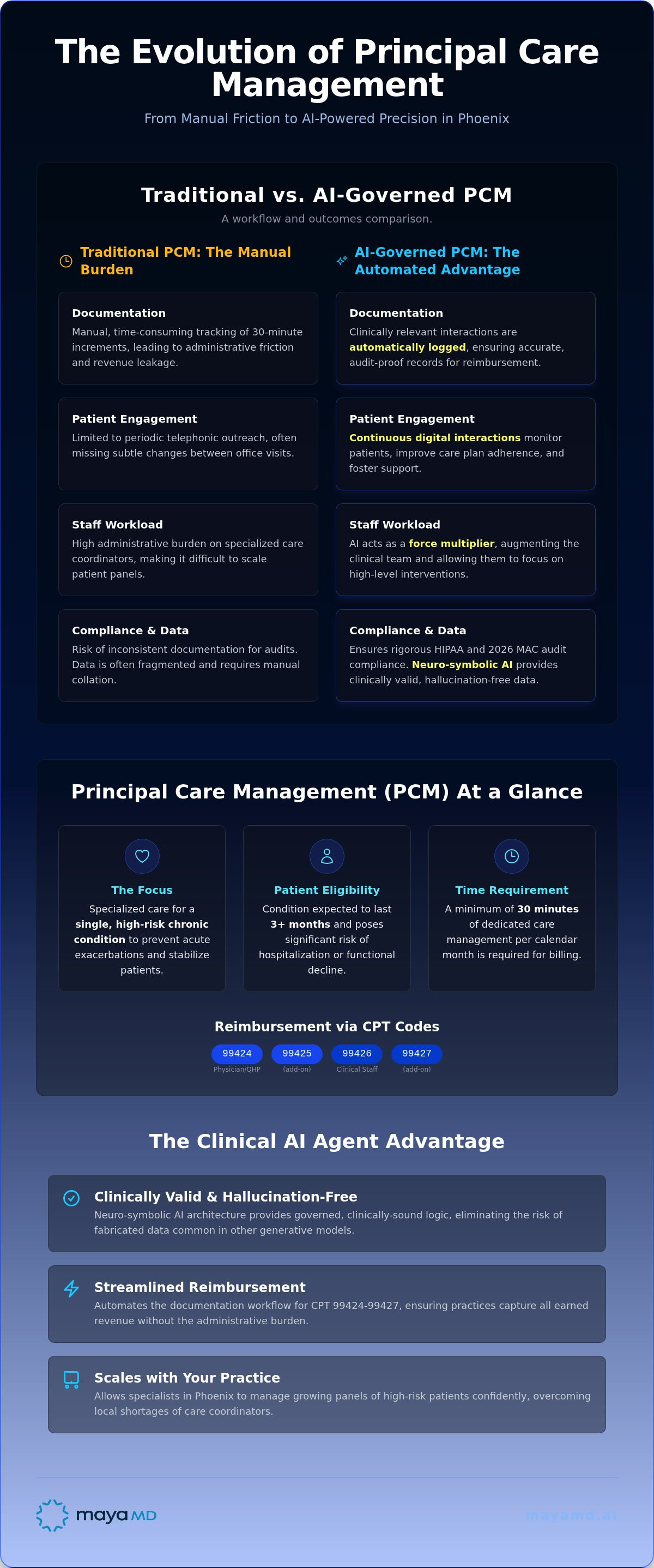
Principal Care Management (PCM) represents a specialized tier of clinical oversight designed for patients with a single, high-risk chronic condition. In 2026, the CMS definition remains focused on stabilizing patients whose conditions are complex enough to require specialist-level intervention. While Primary Care Case Management (PCCM) historically addressed broad coordination, PCM empowers Phoenix specialists in cardiology, endocrinology, and nephrology to apply concentrated clinical logic to specific pathologies. This model differs fundamentally from Chronic Care Management (CCM), which necessitates the management of at least two chronic conditions. By focusing on a single, unstable condition, providers can deliver the intensive monitoring required to prevent acute exacerbations.
The Arizona market is currently experiencing an unprecedented demand for sophisticated principal care management tools. This surge isn't merely a reaction to regulatory shifts; it's a strategic necessity. By implementing principal care management solutions Phoenix clinicians can maintain rigorous oversight without taxing their existing human resources. These systems act as a bridge between disparate data points and the human care team, ensuring that no critical physiological change goes unnoticed.
PCM Eligibility and CPT Codes 99424-99427
Clinical eligibility for PCM in 2026 requires a patient to have one complex chronic condition expected to last at least three months. This condition must place the patient at significant risk of hospitalization or functional decline. Documentation is the cornerstone of reimbursement, requiring at least thirty minutes of dedicated care management per calendar month. CPT 99424 and 99425 are utilized for physician or qualified healthcare professional time, while 99426 and 99427 govern clinical staff time. Every Phoenix enrollment must be preceded by an initiating visit, which serves as the foundation for the specialized care plan and establishes patient consent for digital coordination.
The Phoenix Healthcare Landscape in 2026
Maricopa County has emerged as a leader in value-based care transitions, yet local practices face unique scaling challenges. A persistent shortage of specialized care coordinators in the Phoenix metro area has made manual care management increasingly untenable. For mid-sized practices, the administrative burden of tracking thirty-minute increments across a growing patient panel often leads to significant revenue leakage. Adopting principal care management solutions Phoenix specialists can rely on allows for the automation of documentation workflows. This technological integration ensures that local practices remain compliant with 2026 audit standards while providing the continuous support that complex chronic patients require.
While clinical tools handle patient management, growing a practice in the competitive Phoenix market often requires a robust digital strategy; to explore how local marketing experts can help your business thrive, you can discover Marqueting Madness LLC.
The Role of Clinical AI Agents in Scaling PCM Services
The evolution of principal care management solutions Phoenix providers utilize has moved beyond traditional telephonic outreach toward autonomous clinical support. A Clinical AI Agent is not a simple chatbot designed for basic scheduling or triaging; it's a sophisticated software entity capable of performing high-level clinical tasks within a governed framework. These agents facilitate continuous patient engagement by initiating meaningful digital interactions between scheduled Phoenix office visits, ensuring that patients with complex conditions feel supported and monitored throughout their care journey. Adhering to CMS guidelines on Principal Care Management requires a level of rigor that manual systems often struggle to maintain, particularly when documenting the thirty-minute monthly threshold for billing. By applying clinical ai agent for primary care logic to specialized PCM workflows, specialists can ensure that every digital interaction is clinically relevant, patient-specific, and automatically logged for reimbursement purposes.
Augmenting Clinical Staff, Not Replacing Them
AI serves as a force multiplier for the existing clinical team. By automating routine documentation and initial data collection, the Clinical AI Agent significantly reduces physician burnout, allowing specialists to focus on high-complexity decision making rather than administrative minutiae. Phoenix care coordinators can effectively manage three times their typical patient load when supported by AI oversight, as the system filters out stable data and highlights only the cases requiring immediate human intervention. This shift moves the practice from a reactive stance to a proactive one, where real-time alerts for clinical deterioration allow for early intervention. Practices looking to modernize their chronic care delivery can explore our Clinical AI Agent to see these efficiencies in action.
Neuro-Symbolic AI: The Standard for Clinical Safety
Clinical safety in 2026 demands a departure from standard generative AI models that are prone to unpredictable outputs. The standard for principal care management solutions Phoenix clinicians trust is neuro-symbolic AI. This architecture combines the pattern recognition of generative AI with the deterministic logic of symbolic AI, creating a system that is essentially hallucination-free. Because the AI operates within a predefined set of clinical rules and medical knowledge bases, it ensures one hundred percent factual accuracy in every patient interaction. MayaMD utilizes this governed approach to manage complex chronic diseases, providing a reliable bridge between advanced data science and the delicate reality of patient management. This methodical integration of technology ensures that clinical ambition never compromises patient safety or regulatory adherence.
Comparing Traditional vs. AI-Driven Principal Care Management Solutions
The economic disparity between human-only care models and AI-hybrid frameworks has become impossible for Phoenix practices to ignore. Traditional PCM relies on manual, nurse-led outreach, a method that inherently limits the number of patients a single coordinator can effectively manage. By contrast, the principal care management solutions Phoenix specialists are adopting utilize AI to handle high-frequency, low-acuity tasks. This shift significantly lowers the cost-per-patient while maintaining the high-stakes reliability required for chronic condition management. Patients benefit from 24/7 access to a Clinical AI Agent that provides immediate support, a level of availability that traditional human-staffed models cannot match without prohibitive overhead.
Data integrity remains the primary vulnerability in manual systems. Manual logs often suffer from gaps in documentation, leading to audit risks and missed reimbursement opportunities. As detailed in the GAO report on AI in Health Care, the integration of automated systems can mitigate these risks by providing a consistent, verifiable trail of clinical activity. This transition reflects a broader movement toward digital healthcare for chronic disease, where the focus moves from episodic check-ins to continuous, governed oversight. By eliminating the reliance on subjective manual entry, clinics ensure that their clinical documentation is as precise as the care they provide.
Manual Advocacy vs. Systematic Monitoring
Relying on a single monthly phone call to manage a high-risk patient is a reactive strategy that often fails to catch physiological shifts before they escalate. Modern principal care management solutions Phoenix providers implement leverage automated Remote Patient Monitoring (RPM) data to feed directly into the PCM care plan. This integration ensures that the clinical AI agent can detect subtle trends in real time. Instead of waiting for a patient to report a symptom, the system alerts the clinical team to intervene proactively. It's a systematic approach that allows Phoenix clinics to scale their services without sacrificing the quality of the patient experience.
Implementation Timelines and EHR Integration
Many clinical administrators fear that adopting advanced AI requires a disruptive "rip and replace" of their existing infrastructure. In 2026, the reality is far more streamlined. Leading platforms prioritize seamless, cloud-based integration that works alongside existing Electronic Health Records (EHR) rather than competing with them. Local Phoenix providers value these HIPAA-compliant, interoperable platforms because they minimize downtime and ensure data security from day one. The common misconception that AI rollouts take months has been replaced by agile deployment models that can go live in as little as two to four weeks. This rapid integration allows practices to begin capturing higher reimbursement and improving patient outcomes almost immediately.
Navigating Regulatory Compliance and Reimbursement in Arizona
Regulatory adherence in Maricopa County requires a precise understanding of both federal CMS mandates and local payer behavior. For 2026, Arizona Medicare Administrative Contractors (MACs) have increased their scrutiny of substantive communication within digital platforms, necessitating a more rigorous approach to documentation. It's no longer sufficient to simply log time; clinicians must demonstrate that digital interactions directly advanced the patient's care plan. By utilizing principal care management solutions Phoenix providers can ensure every automated touchpoint is clinically valid and documented with the granularity required for CPT 99424 through 99427. This level of rigor is especially critical when adopting advanced primary care management frameworks, which rely on high-fidelity data to justify reimbursement in complex chronic cases.
Arizona-Specific Payer Trends for 2026
The local landscape is uniquely favorable for remote care delivery due to Arizona's robust telehealth parity laws. Private insurers in the Phoenix metro area have largely aligned their reimbursement schedules with the 2026 Medicare Physician Fee Schedule, which established a national conversion factor of $33.40. National averages for PCM codes, such as $88.00 for CPT 99424 and $68.00 for CPT 99426, serve as the baseline, though Arizona's Work GPCI of 1.000 suggests local rates remain highly competitive. Additionally, the state's Medicaid program, AHCCCS, continues to cover medically necessary telehealth services across both rural and metropolitan sectors. This regulatory stability allows specialists to maximize value-based bonuses by consistently reporting improved clinical outcomes through automated engagement and standardized data collection.
Audit-Proofing Your PCM Workflow
Surviving a clinical audit in 2026 hinges on maintaining a single, immutable source of truth for every chronic care plan. Manual entry is a significant liability. It often lacks the time-tracking precision required to prove the thirty-minute monthly threshold, leading to potential revenue clawbacks. MayaMD’s platform addresses this by generating audit-ready reports that capture every interaction, from automated physiological monitoring to direct Clinical AI Agent conversations. These systems ensure that your documentation is not just present, but defensive. To secure your practice's revenue cycle against increased MAC oversight, you should evaluate our HIPAA-compliant reporting architecture to ensure every billable minute is backed by verifiable clinical activity.
Implementing MayaMD: A Locally-Optimized PCM Solution for Phoenix
MayaMD stands as the sophisticated partner for Phoenix specialists managing complex chronic care, offering a platform specifically engineered to handle the nuances of Maricopa County’s clinical workflows. Our technology acts as a bridge between disparate data points and human care, ensuring that clinical ambition is matched by rigorous oversight. By implementing these principal care management solutions Phoenix providers can customize care protocols for prevalent regional conditions such as type 2 diabetes and hypertensive heart disease. These tailored plans utilize clinical workflow automation solutions to eliminate the administrative bottlenecks that typically hinder specialist practices. This systematic approach allows for the scalable management of complex cases while maintaining the cold, hard logic of advanced data science.
The MayaMD Onboarding Process
The integration process is characterized by a methodical, top-down approach that prioritizes clinical safety and operational continuity. It begins with a rigorous clinical logic mapping phase where we align the Clinical AI Agent's deterministic rules with your practice’s unique protocols. This ensures that the software functions as a precise extension of your medical expertise rather than a generic tool. Following this, we provide targeted training for your Phoenix-based clinical staff, empowering care coordinators to transition from manual data entry to AI-assisted oversight roles. The process concludes with the deployment of the patient-facing Clinical AI Agent. This provides 24/7 support and connectivity, ensuring that high-risk patients remain within a governed care ecosystem between scheduled office visits. This steady, predictable flow builds trust through transparency and technical depth.
Measurable Outcomes for Phoenix Practices
Adopting a governed AI model yields quantifiable improvements in clinical safety and practice profitability. Practices utilizing our principal care management solutions Phoenix infrastructure frequently observe a significant reduction in emergency department visits for their PCM cohorts. This outcome is the direct result of the Clinical AI Agent's ability to identify subtle physiological shifts and trigger proactive interventions before they escalate into acute crises. Operationally, the ROI is driven by the automation of documentation for CPT codes 99424 through 99427, which maximizes reimbursement capture while optimizing staff time. By joining the network of forward-thinking providers in Phoenix, Indianapolis, and Chicago, your practice adopts the persona of an authoritative pioneer. This collaborative expert status ensures long-term success in a highly regulated industry that values measurable performance and clinical validity.
Securing the Future of Specialized Chronic Care
The transition from episodic check-ins to a continuous, AI-governed care model represents the new standard for chronic disease management. By adopting sophisticated principal care management solutions Phoenix specialists can bridge the gap between complex data and empathetic patient support. This evolution ensures that documentation for CPT 99424 through 99427 is both clinically accurate and audit-ready; it effectively eliminates the administrative friction that traditionally limits practice growth.
MayaMD provides a HIPAA-compliant, neuro-symbolic AI architecture that serves major healthcare hubs including Phoenix, Houston, and Chicago. Our platform delivers clinical-grade documentation automation, allowing your team to focus on high-stakes medical decision-making rather than manual logging. It's time to move past the experimental phase into proven application. Schedule a clinical AI consultation for your Phoenix practice today to optimize your clinical outcomes and reimbursement strategy. We're ready to partner with you in advancing the quality of care across the Southwest.
Frequently Asked Questions
What exactly is Principal Care Management (PCM) for specialists?
Principal Care Management is a Medicare-reimbursed program designed specifically for specialists managing a single, high-risk chronic condition expected to last at least three months. Unlike Chronic Care Management, which covers multiple diseases, PCM allows cardiologists, endocrinologists, and other specialists to bill for the intensive coordination required to stabilize a patient's primary condition. This model focuses on preventing hospitalizations through continuous monitoring and specialized care planning rather than general wellness advocacy.
How do PCM solutions in Phoenix differ from general geriatric care management?
PCM is a clinical service focused on managing a specific high-risk condition, while geriatric care management typically addresses broader lifestyle and residential needs. For families in Phoenix seeking assisted living placement or in-home care, wecareaz.com provides the necessary support to complement a clinical PCM plan.
Yes, MayaMD’s Clinical AI Agent is fully HIPAA-compliant and operates within a secure, cloud-based infrastructure designed for the Phoenix market. The platform utilizes advanced encryption and rigorous access controls to protect sensitive patient health information during every digital interaction. This governed approach ensures that specialists can deploy AI-driven engagement solutions without compromising regulatory adherence or patient privacy, meeting the high security standards expected by Arizona's medical community.
Can AI really manage complex chronic patients without 'hallucinating' data?
MayaMD eliminates the risk of AI hallucinations by utilizing a neuro-symbolic AI architecture that combines generative capabilities with deterministic clinical logic. This framework ensures that every interaction is grounded in established medical knowledge bases and practice-specific protocols. By operating within these governed boundaries, the Clinical AI Agent provides one hundred percent factual accuracy, which is a non-negotiable requirement for managing complex chronic patients in a high-stakes clinical setting.
What are the specific CPT codes for PCM reimbursement in 2026?
The primary CPT codes for PCM reimbursement in 2026 are 99424 through 99427. Codes 99424 and 99425 cover physician or qualified healthcare professional time, with 99424 representing the first thirty minutes of monthly service. Codes 99426 and 99427 apply to clinical staff time. National average rates for the initial thirty minutes are approximately $88.00 for physicians and $68.00 for clinical staff, though Arizona rates are adjusted by local GPCI factors.
How long does it take to implement a PCM software solution in a Phoenix practice?
Implementing modern principal care management solutions Phoenix practices can rely on typically takes between two and four weeks. MayaMD utilizes an agile, cloud-based deployment model that avoids the "rip and replace" complexity of legacy systems. This timeline includes initial clinical logic mapping, staff training on AI-assisted coordination, and the launch of the patient-facing Clinical AI Agent, allowing practices to begin capturing reimbursement and improving outcomes with minimal disruption to daily workflows.
Does PCM require the patient to have multiple chronic conditions?
No, PCM is specifically designed for patients with only one complex chronic condition. This is the primary distinction between PCM and Chronic Care Management (CCM), which requires two or more conditions. To qualify for PCM, the single condition must be high-risk and expected to last at least three months. This allows specialists to focus their clinical resources on stabilizing a single, unstable pathology that requires intensive, specialist-level oversight.
How does MayaMD integrate with my existing EHR system?
MayaMD integrates with your existing EHR system through a seamless, interoperable platform that prioritizes data connectivity without requiring a total infrastructure overhaul. The system functions as a digital bridge, pulling relevant patient data to inform the Clinical AI Agent while pushing interaction logs and documentation back to the EHR. This ensures a single source of truth for every care plan, streamlining clinical documentation workflows and reducing the administrative burden on your staff.




See The MayaMD Difference
Fill the form below
Download Our Apps
MayaMD for patients and MayaPro for physicians - available on iOS and Android.
FOR PATIENTS
MayaMD App
AI-powered symptom assessment, triage, and secure access to your care team.


FOR PHYSICIANS
MayaPro App
MayaPro brings patient vitals, RPM/PCM care plans, and clinical decision support to your pocket.