
Primary Care Management Technology: The 2026 Guide to AI-Driven APCM and RPM

What if your primary care management technology could transition from a passive data repository into a proactive clinical partner? Most providers are currently buried under a mountain of documentation fatigue and the fragmented noise of disconnected monitoring tools. You understand that the promise of digital health often feels like just another administrative burden rather than a solution for patient care. It's frustrating to navigate the rigid requirements of Medicare reimbursement for APCM and RPM while fearing the potential for AI hallucinations in clinical decision support.
This guide demonstrates how advanced, AI-governed technology is transforming primary care management from simple monitoring into proactive, clinical-grade intervention. We'll examine how deterministic logic and clinical AI agents streamline documentation and improve outcomes for chronic conditions. You'll discover how to fully utilize CMS reimbursement codes with minimal manual effort, ensuring your practice remains both profitable and patient-centered in 2026. By the end of this article, you'll see how a governed approach to AI creates a seamless bridge between data points and human care. We'll explore the shift from reactive dashboards to active, clinical-grade agents that manage the "in-between" care gap with precision.
Key Takeaways
• Understand how the transition to continuous care models requires a robust digital infrastructure to support longitudinal patient-clinician relationships.
• Learn how modern primary care management technology utilizes deterministic logic to ensure clinical safety while serving as a scalable digital extension of your care team.
• Discover why effective chronic disease management requires the integration of real-time health data with advanced AI governance to bridge the gap between traditional office visits.
• Identify the essential criteria for selecting care management platforms, including HIPAA compliance and rigorous safety protocols that prevent AI hallucinations in clinical decision support.
• Evaluate the financial impact of automating documentation workflows to reduce physician burnout and maximize practice ROI through optimized APCM and RPM reimbursement.
The Evolution of Primary Care Management Technology in 2026
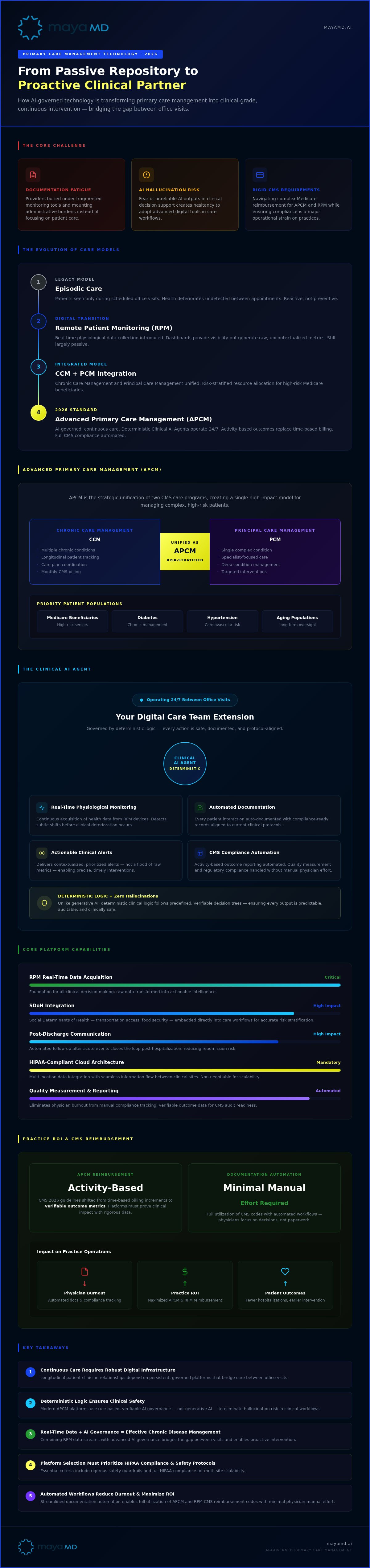
Primary care management technology serves as the essential digital infrastructure supporting longitudinal patient-clinician relationships. It facilitates a critical transition from the legacy model of episodic care to a "continuous care" framework mandated by modern value-based initiatives. This evolution recognizes that patient health doesn't pause between office visits. Instead, it requires a persistent, governed presence that monitors physiological trends and intervenes before clinical deterioration occurs. By 2026, CMS guidelines have matured to prioritize activity-based outcomes over simple time-based billing increments. This shift demands platforms capable of proving clinical impact through rigorous, verifiable data. Ultimately, APCM technology acts as the bridge between disparate data points and high-stakes clinical oversight.
The Rise of Advanced Primary Care Management (APCM)
APCM represents a strategic integration of Chronic Care Management (CCM) and Principal Care Management (PCM), creating a unified approach to high-risk patient populations. This model prioritizes risk-stratified care management for Medicare beneficiaries, ensuring that resources are directed precisely where they're most needed. Technology plays a decisive role in this ecosystem by automating the complex quality measurement and reporting requirements that often lead to physician burnout. Through the deployment of a Clinical AI Agent, practices can maintain a digital extension of their care team that operates with deterministic logic. This ensures every patient interaction is safe, documented, and aligned with the latest clinical protocols. By automating these workflows, providers can focus on high-level decision-making while the software handles the meticulous requirements of regulatory compliance.
Digital Transformation in Local Healthcare Hubs
Regional healthcare trends are driving specific adoption patterns for primary care management technology across the United States. In cities like Chicago and Indianapolis, clinical leaders are leveraging these platforms to manage the complexities of aging populations that require intensive, long-term oversight. These tools allow for the early detection of subtle health shifts in seniors, preventing unnecessary hospitalizations. Meanwhile, providers in Phoenix and Houston are utilizing digital tools to address significant challenges in healthcare accessibility and the high prevalence of chronic conditions such as diabetes and hypertension. For multi-location practices in these regions, cloud-based, HIPAA-compliant platforms are mandatory. These systems ensure patient data remains integrated and accessible, allowing for a seamless flow of information between different clinical sites. This connectivity is the foundation of a stable, scalable care management strategy that prioritizes both patient safety and operational efficiency.
Core Capabilities of Modern Care Management Platforms
Effective primary care management technology in 2026 requires a shift from passive data collection to active clinical governance. At the center of this transition is the deployment of remote patient monitoring software, which provides the real-time health data acquisition necessary for high-stakes decision-making. However, raw data alone doesn't improve outcomes. True digital healthcare for chronic disease necessitates an intelligent layer that interprets physiological signals within a safe, deterministic framework. This active oversight ensures that clinical teams receive actionable alerts rather than a flood of uncontextualized metrics, allowing for precise interventions that prevent clinical deterioration.
Modern platforms must also integrate Social Determinants of Health (SDoH) data directly into the primary care workflow. Understanding a patient's transportation access or food security provides the context required for effective longitudinal care and more accurate risk stratification. Additionally, the inclusion of automated post-discharge communication solutions is vital for closing the loop after acute events. By maintaining a continuous connection with patients immediately following hospital stays, practices can significantly reduce readmission rates and identify potential complications before they escalate into emergencies.
Remote Patient Monitoring and Principal Care Management
While Remote Patient Monitoring (RPM) focuses on broad physiological data across a population, principal care management tools are designed for the intensive oversight of single, high-complexity chronic conditions. In 2026, the technical requirements for these tools include the use of cellular-connected devices. These devices ensure data continuity for complex patients who may lack reliable internet access, providing a stable stream of information to the care team regardless of the patient's technical environment. This distinction allows specialists and primary care providers to collaborate within a unified platform, ensuring that even the most vulnerable patients remain under rigorous supervision through a digital extension of the care team.
Interoperability and Clinical Workflow Integration
Siloed software remains a significant barrier to clinical efficiency and patient safety. When data is trapped in disconnected tools, the result is fragmented care and increased administrative burden for already overextended staff. Advanced clinical workflow automation solutions solve this by eliminating manual data entry and synchronizing information across the entire care ecosystem. Utilizing FHIR standards and seamless EMR/EHR integration ensures that every stakeholder has access to the same clinical truth. This connectivity allows providers to spend less time on clerical tasks and more time on high-impact patient interactions. To see how these integrations function in a live clinical setting, you can explore the clinical AI solutions currently used by leading health systems.
The Clinical AI Agent: A New Standard for Care Governance
While legacy systems focus on the administrative "what" of billing, modern primary care management technology must address the clinical "how" of execution. The introduction of a clinical ai agent for primary care marks a shift from simple software to a digital extension of the care team. This agent doesn't just store data; it governs the "in-between" care gap by triaging patient needs before they ever reach a human clinician. By utilizing neuro-symbolic AI, the system merges the pattern recognition of neural networks with the rigorous logic of symbolic reasoning, effectively eliminating hallucinations in clinical documentation. This ensures that every entry in the patient record is both medically accurate and contextually relevant, providing a level of reliability that pure generative models can't match.
Deterministic Logic vs. Generative AI in Healthcare
Safety is the primary differentiator in clinical AI. Pure generative AI, while impressive in its conversational flexibility, is insufficient for healthcare because it lacks the predictability required for clinical safety. It can produce "hallucinations" or incorrect medical advice that poses significant risk. The MayaMD approach utilizes deterministic logic as a set of rigorous guardrails to ensure medical accuracy. This rule-based safety framework ensures that the AI's outputs are always grounded in established clinical protocols. By offloading the initial data synthesis to these governed agents, practices see a significant reduction in physician cognitive load. Doctors don't have to sift through raw data; instead, they receive structured, high-fidelity summaries that allow them to make faster, safer decisions.
Automating Patient Engagement and Post-Discharge Care
Consistency is the foundation of chronic care management. AI agents conduct automated check-ins, ensuring that patients with multiple chronic conditions remain engaged with their care plans without requiring constant human intervention. These agents also serve as an educational resource, answering patient questions about their conditions between office visits with pre-verified clinical information. When a patient reports a physiological shift, real-time AI triage identifies the severity of the event. For clinicians in Las Vegas or Phoenix managing high-risk populations, these alerts provide a critical early warning system. The agent identifies high-risk events and escalates them immediately, ensuring that the human care team can intervene exactly when and where they're needed most. This creates a scalable model of care that maintains high-stakes reliability across large patient panels.
Evaluating Primary Care Management Software for Implementation
Selecting primary care management technology is a high-stakes decision that requires a move beyond basic feature lists toward a framework of clinical governance. For healthcare executives, the priority is no longer just "can it bill," but rather "how does it safeguard the clinical workflow." A robust evaluation must center on three pillars: rigorous AI safety protocols, seamless scalability, and absolute regulatory adherence. In regions like Indianapolis and Houston, the "vendor-as-a-partner" model has become essential. Practices shouldn't settle for static software providers. Instead, they require a sophisticated partner that understands the nuances of multi-location operations and provides the clinical depth necessary for long-term performance.
The essential 2026 primary care tech stack requires deep integration between the EHR, remote monitoring tools, and the governing AI agent. This connectivity ensures that data flows without friction, allowing the Clinical AI Agent to provide real-time oversight without manual intervention. To ensure your practice is equipped for the future, you can schedule a consultation for AI-driven care management to evaluate your current infrastructure.
The APCM Technology Selection Checklist
Implementing advanced primary care management requires a checklist that addresses both financial and technical viability. Consider the following requirements:
Reimbursement Support
Does the platform inherently support the documentation requirements for HCPCS codes G0556, G0557, and G0558?
Logic Framework
Is the clinical agent governed by deterministic medical logic, or does it rely on purely probabilistic models that risk hallucinations?
Implementation Velocity
What is the realistic timeline for deployment? For a mid-sized clinic in a metro area like Chicago, a modular approach often allows for full integration within 60 to 90 days.
Security, Compliance, and Data Governance
Security is the foundation of patient trust. In a cloud-based environment, SOC2 Type II and HIPAA compliance are non-negotiable standards that ensure data is handled with the highest level of professional oversight. Beyond basic compliance, practices must maintain clear data ownership and patient privacy protocols. MayaMD ensures data integrity across multi-state clinical operations by utilizing a centralized, governed logic framework. This approach prevents the fragmentation that often occurs when scaling across different regulatory environments. By prioritizing stability and security, providers can focus on the human impact of care while the technology manages the cold, hard logic of data protection.
Maximizing Clinical Outcomes and Practice ROI
Financial sustainability in modern medicine requires more than just meeting billing quotas. It demands a fundamental optimization of clinical time. Primary care management technology achieves this by automating the data synthesis that previously required hours of manual labor. By streamlining these workflows, practices can capture the full value of risk-stratified reimbursement without increasing staff overhead. For physicians in Las Vegas and Phoenix, the burden of documentation fatigue is a primary driver of burnout. AI-driven documentation solutions handle the administrative load, effectively reducing "pajama time" and allowing clinicians to reclaim their personal lives. Clinical data indicates that continuous monitoring leads to a measurable reduction in emergency department visits. By identifying physiological shifts early, the care team can intervene before a manageable condition becomes an acute crisis. MayaMD acts as the catalyst for this transformation, ensuring that clinical excellence and financial sustainability work in harmony.
Restoring the Patient-Provider Connection
Technology's highest purpose is to remove administrative barriers, not create new ones. When a Clinical AI Agent manages the routine tasks of data collection and triage, physicians are liberated to focus on high-acuity decision-making. This shift preserves the human element of medicine. It's about returning the provider's gaze to the patient rather than the screen. Consistent, governed communication between office visits fosters a deeper sense of patient trust. Patients feel supported by a persistent clinical presence, which improves adherence and longitudinal outcomes. This connectivity ensures that the patient-provider relationship remains the center of the care experience.
Future-Proofing Your Practice for 2026 and Beyond
The healthcare landscape is moving rapidly toward "hospital-at-home" models. These frameworks rely heavily on the digital infrastructure provided by advanced primary care management technology. In crowded markets like Houston, early adoption of Clinical AI Agents offers a distinct competitive advantage. It allows practices to manage larger, more complex patient panels with greater precision and lower costs. By integrating these systems now, you position your practice as a leader in the next era of medicine. This proactive approach ensures you're prepared for the shifting regulatory and clinical demands of the future. Partner with MayaMD to revolutionize your primary care management.
Leading the Transition to Continuous Care
The shift toward value-based care in 2026 necessitates a move beyond static data collection. By adopting advanced primary care management technology, your practice can bridge the gap between office visits with clinical-grade precision. We've explored how deterministic AI logic eliminates the risks of generative hallucinations while providing a stable, digital extension of your care team. This governed approach doesn't just improve longitudinal patient outcomes; it restores the provider-patient connection by removing the administrative weight of documentation and complex compliance requirements.
Integrating these capabilities ensures your practice remains competitive and financially sustainable in a rapidly evolving landscape. MayaMD provides the HIPAA-compliant cloud architecture and comprehensive support for APCM, RPM, and PCM required for this level of rigorous oversight. Request a Demo of the MayaMD Clinical AI Agent to see how we can optimize your clinical workflows and maximize practice ROI. The future of primary care is proactive, precise, and profoundly human. You're ready to lead that transformation with confidence.
Frequently Asked Questions
What is the difference between APCM and traditional Chronic Care Management (CCM)?
APCM is a consolidated model for primary care that integrates elements of CCM and PCM into a longitudinal, risk-stratified framework. While CCM focuses specifically on patients with two or more chronic conditions, APCM provides a more holistic structure for advanced primary care management. It emphasizes continuous clinical oversight rather than episodic billing increments. This allows practices to manage complex populations through a unified digital infrastructure that supports the entire patient-clinician relationship.
How does Clinical AI technology reduce physician burnout in primary care?
AI technology reduces burnout by automating the high-volume administrative tasks that lead to documentation fatigue. By deploying a Clinical AI Agent, primary care management technology can synthesize patient data and generate structured clinical summaries without human intervention. This shift allows physicians to focus on high-acuity decision-making rather than clerical data entry. It effectively eliminates "pajama time" by closing the gap between patient monitoring and record completion through intelligent automation.
Is primary care management technology HIPAA compliant?
Yes, advanced care management platforms are designed with HIPAA-compliant, cloud-based architectures to ensure the security of protected health information. These systems utilize encrypted data transmission and rigorous access controls to maintain regulatory adherence. Beyond basic compliance, established leaders often pursue SOC2 Type II certification to provide high-stakes reliability for multi-state clinical operations. This ensures that patient privacy remains protected while facilitating seamless data connectivity across the entire care ecosystem.
Can Clinical AI Agents prevent hallucinations in medical documentation?
Clinical AI Agents prevent hallucinations by utilizing deterministic logic and neuro-symbolic frameworks instead of relying solely on probabilistic generative models. This governed approach ensures that every output is grounded in established medical protocols and rule-based safety guardrails. By merging pattern recognition with symbolic reasoning, the system maintains clinical validity. It provides a level of precision that is mandatory for high-stakes medical documentation and clinical decision support in regulated environments.
What are the 2026 Medicare reimbursement codes for Advanced Primary Care Management?
The 2026 Medicare reimbursement structure for Advanced Primary Care Management typically utilizes HCPCS codes G0556, G0557, and G0558. These codes are risk-stratified to account for the varying complexity of patient populations. G0556 generally covers basic care management, while G0557 and G0558 address moderate to high-complexity needs. Practices should verify current 2026 CMS reimbursement rates for GPCM codes to ensure accurate financial projections and full utilization of available value-based incentives.
How does Remote Patient Monitoring (RPM) integrate with APCM platforms?
Remote Patient Monitoring integrates with APCM platforms by serving as the primary source of real-time physiological data. This connectivity allows the primary care management technology to ingest metrics like blood pressure or glucose levels directly into the clinical workflow. When a physiological shift is detected, the AI agent triages the data and alerts the care team. This creates a seamless flow from data acquisition to clinical intervention, ensuring continuous oversight for chronic patients.
What technical infrastructure is required to deploy an AI-driven care management tool?
Deploying an AI-driven care management tool requires a cloud-based infrastructure capable of integrating with existing Electronic Health Records through FHIR standards. This connectivity is essential for ensuring data integrity and eliminating siloes. Practices also need stable internet access for the platform and cellular-connected devices for patients to ensure data continuity. The implementation process typically involves mapping clinical workflows to the AI agent's logic to ensure a seamless digital extension of the care team.
How do primary care management tools improve outcomes for chronic disease patients?
These tools improve outcomes by facilitating continuous monitoring and proactive intervention for chronic disease patients. By closing the "in-between" care gap, the technology identifies subtle health deteriorations before they escalate into acute events. This model reduces emergency department visits and hospital readmissions through consistent patient engagement and education. Ultimately, the integration of AI governance ensures that patients receive clinical-grade support that is both scalable and highly personalized to their specific chronic needs.




See The MayaMD Difference
Fill the form below
Download Our Apps
MayaMD for patients and MayaPro for physicians - available on iOS and Android.
FOR PATIENTS
MayaMD App
AI-powered symptom assessment, triage, and secure access to your care team.
FOR PHYSICIANS
MayaPro App
MayaPro brings patient vitals, RPM/PCM care plans, and clinical decision support to your pocket.