
Physician Chronic Care Platform: 2026 AI-Governed Guide

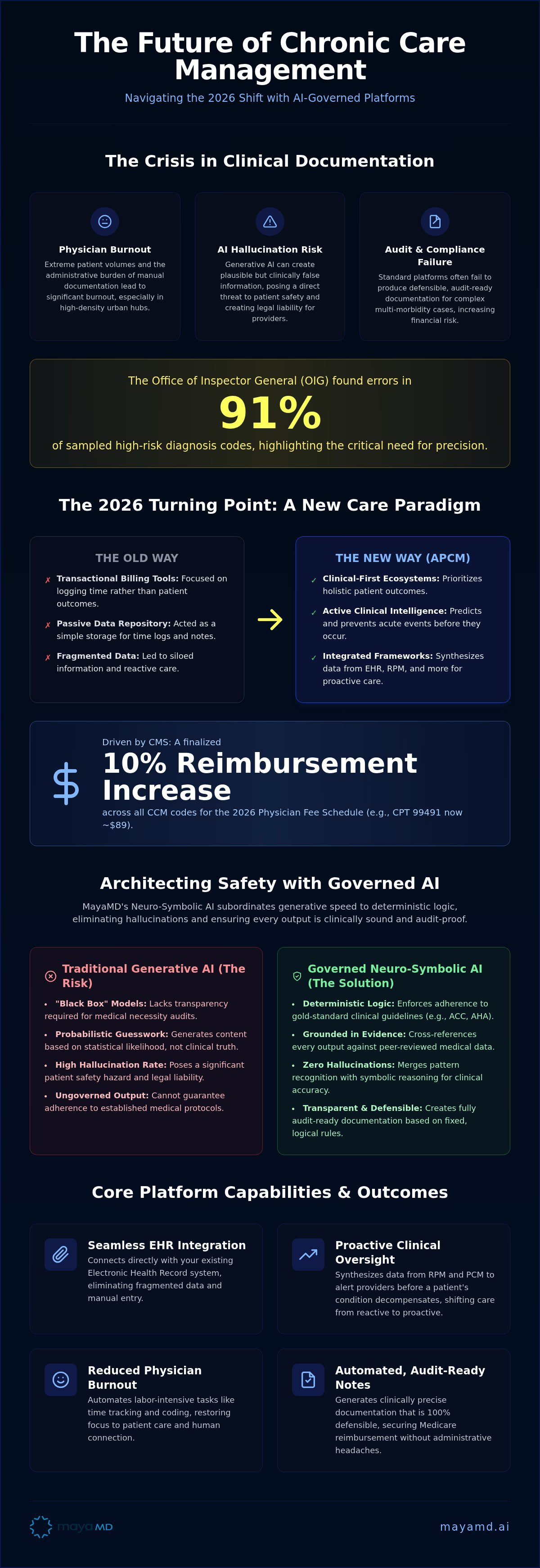
What if the clinical documentation that currently consumes hours of your day could be generated with zero risk of "hallucinations" or audit failures? Most practitioners recognize that a standard chronic care management platform for physicians often falls short when it encounters the nuance of complex multi-morbidity cases. You're likely exhausted by the manual burden of time tracking and the persistent fear that an AI-generated note might misrepresent a patient's history; an error that the OIG recently found in 91% of sampled high-risk diagnosis codes.
It's time to move past the experimental phase of digital health into an era of rigorous oversight. This guide demonstrates how AI-governed systems are revolutionizing physician workflows by combining generative speed with deterministic logic to ensure HIPAA compliance and clinical precision. You'll discover how to leverage the 10% increase in 2026 Medicare reimbursement rates through automated, audit-ready documentation that integrates seamlessly with your existing EHR. We'll examine the transition from passive tracking to active clinical agents that eliminate fragmented data and foster genuine patient connectivity.
Key Takeaways
• Understand the 2026 evolution from transactional billing tools to integrated Advanced Primary Care Management (APCM) clinical ecosystems.
• Learn how a sophisticated chronic care management platform for physicians leverages neuro-symbolic AI to eliminate documentation hallucinations and maintain rigorous clinical safety.
• Discover the mechanism behind automated, audit-ready documentation that secures Medicare reimbursement while mitigating physician burnout through reduced manual entry.
• Explore the strategic integration of Remote Patient Monitoring (RPM) and Principal Care Management (PCM) to facilitate continuous, data-driven patient oversight.
• Access a structured implementation roadmap for deploying clinical AI agents that bridge the gap between complex data points and human-centered care.
The 2026 Landscape of Chronic Care Management Platforms for Physicians
The year 2026 marks a definitive shift in how healthcare organizations perceive longitudinal support. A modern chronic care management platform for physicians must function as a clinical-first ecosystem rather than a mere billing utility. This evolution is driven by the transition from traditional CCM to Advanced Primary Care Management (APCM), a model that prioritizes holistic patient outcomes over fragmented service delivery. As the industry moves toward these integrated frameworks, the focus has shifted from simple activity tracking to rigorous clinical oversight.
Regulatory changes have solidified this path. On October 31, 2025, CMS finalized a 10% increase in reimbursement across all CCM codes for the 2026 Physician Fee Schedule. For example, the reimbursement for CPT code 99491 is now approximately $89 for the first 30 minutes of physician time. This financial incentive reflects a clear commitment to expanding care, yet it arrives alongside increased scrutiny. With the Office of Inspector General (OIG) reporting high error rates in diagnosis codes, physicians in high-density areas like Chicago are moving toward AI-governed platforms to ensure defensible, audit-ready documentation. These platforms provide the systematic framework necessary to navigate complex Medicare reimbursement rules without increasing the provider's administrative load.
From Passive Tracking to Active Clinical Intelligence
Historically, CCM software operated as a passive repository for time logs. The current generation of platforms leverages neuro-symbolic AI to act as a predictive clinical engine. These systems move beyond the foundational Chronic Care Model by providing real-time data that helps prevent acute decompensation. This is particularly vital for patients with multi-morbidity profiles. When managing a patient with both diabetes and hypertension, the platform synthesizes disparate data points from Remote Patient Monitoring (RPM) and clinical notes to alert the provider before a crisis occurs. This shift from reactive to proactive care is what defines a truly modern ecosystem.
Addressing the Physician Burnout Crisis in Urban Hubs
Providers in high-density markets like Houston and Phoenix face unique pressures due to extreme patient volumes and fragmented data across multiple systems. The administrative burden of manual documentation often leads to significant physician burnout. By implementing an AI-governed platform, practices can automate labor-intensive tasks such as time tracking and encounter-linked coding. This "sober" approach to AI focuses on practical utility rather than speculative hype. It provides a sense of calm confidence to clinical staff who value technical depth and clinical validity. Automation doesn't just save time; it restores the provider's ability to focus on the human impact of care through long-term partnerships and measurable performance.
Architecting Safety: How Neuro-Symbolic AI Eliminates Hallucinations
Traditional generative AI poses a significant risk in medical settings due to "hallucinations," where the model creates plausible but clinically false information. For a chronic care management platform for physicians, this is not just a technical glitch; it's a patient safety hazard and a legal liability. MayaMD addresses this by utilizing a "governed" approach that subordinates generative capabilities to deterministic clinical logic. Every output from the Clinical AI Agent is cross-referenced against established medical protocols, ensuring that documentation remains grounded in peer-reviewed evidence rather than probabilistic guesswork. This rigorous oversight transforms AI from an experimental tool into a reliable clinical partner.
Deterministic Logic vs. Generative Hype
Physicians in markets such as Indianapolis recognize that "black box" AI models lack the transparency required for medical necessity audits. Deterministic logic enforces adherence to gold-standard clinical guidelines, such as those from the ACC or AHA, by following fixed, logical rules that cannot be bypassed. Neuro-symbolic AI serves as the vital bridge between raw patient data and clinical truth by merging the pattern recognition of neural networks with the rigorous reasoning of symbolic logic. This architecture ensures that when Chronic Care Management services are documented, every claim is backed by traceable, deterministic medical evidence. This approach eliminates the "black box" problem, providing physicians with a clear audit trail for every clinical decision support recommendation.
Ensuring HIPAA Compliance and Data Integrity
By 2026, the standard for cloud-based monitoring has moved beyond basic encryption toward a comprehensive security framework that prioritizes data sovereignty. Data integrity is maintained through a HIPAA-compliant, cloud-based architecture that protects sensitive patient information while facilitating seamless integration across disparate EHR systems. This level of security is essential for maintaining the shift to AI-governed continuous care, where data flows constantly from home-based RPM devices to the clinic. Protecting this pipeline is a prerequisite for clinical trust and long-term partnership. If you are ready to implement a system that prioritizes precision over hype, you can explore our clinical AI solutions to see how we maintain this high-stakes reliability.
Core Capabilities: Evaluating CCM Platform Features for 2026
High-stakes reliability in 2026 requires more than basic digital connectivity. A robust chronic care management platform for physicians must provide automated time tracking that translates clinical activity into audit-ready documentation. With the OIG revealing a 91% error rate in high-risk diagnosis coding, manual entry is no longer a viable strategy for defensible billing. Modern platforms solve this by linking every minute of clinical staff time to specific, evidenced encounters, ensuring that the 10% increase in 2026 Medicare reimbursement is captured without increasing audit risk.
Integration of Remote Patient Monitoring (RPM) and Principal Care Management (PCM) allows for continuous physiological oversight. This modular approach ensures that data from wearable devices flows directly into the clinical workflow, enabling predictive analytics to identify risks before they escalate into hospitalizations. By stratifying patients based on real-time data rather than historical claims, providers can intervene exactly when a patient’s status begins to deviate from the baseline.
Seamless EHR Integration and Workflow Automation
Connecting advanced AI with established systems like Epic, Cerner, or Athena requires a bidirectional data flow that eliminates redundant entry. In Indianapolis clinics, this integration transforms raw data into actionable insights without forcing providers to toggle between disparate interfaces. This capability-to-outcome structure ensures that as data enters the EHR, the AI-governed system automatically updates the patient’s risk profile, resulting in a more responsive care environment. For a deeper analysis of how these systems stack up, consult our guide on the Best Chronic Care Management Software of 2026: An AI-Governed Comparison.
Comprehensive Care Plan Management
Effective management relies on structured, patient-specific care plans that update dynamically based on real-time health status changes. A chronic care management platform for physicians should facilitate medication reconciliation and adherence tracking within a unified digital ecosystem. Clinical AI Agents assist with complex tasks by:
• Automating medication reconciliation to prevent adverse drug events during care transitions.
• Tracking adherence through patient engagement modules that foster connectivity without staff burden.
• Coordinating post-discharge care to target the 31% reduction in hospital readmissions reported by MayaMD.
These capabilities foster a sense of continuous support between the patient and the care team. By automating the administrative overhead, the platform allows clinical staff to focus on high-impact interventions rather than data entry. This methodical approach ensures that care plans are not static documents but living protocols that adapt to the patient's evolving clinical needs.
Implementation Strategy: Scaling Quality Care in Major Markets
Scaling a chronic care management platform for physicians requires a transition from fragmented pilot programs to a unified, AI-governed roadmap. The deployment starts with a rigorous EHR connectivity audit to ensure that the Clinical AI Agent can ingest longitudinal data without manual intervention. Following this, practices must map their workflow for specialist referrals, a critical step in high-growth markets like Las Vegas and Phoenix where care coordination across disparate networks is essential. This systematic approach ensures that the platform functions as a reliable extension of the clinical team rather than a standalone software package.
Financial modeling is the cornerstone of sustainable scaling. Within the first 12 months, practices can achieve a significant return on investment by leveraging the 10% increase in 2026 Medicare reimbursement rates. For instance, a practice managing 200 Medicare patients under the base non-complex CCM code (99490) can generate approximately $158,400 per year. When layered with Remote Patient Monitoring (RPM), the revenue potential scales alongside the quality of care, providing the capital necessary to reinvest in further clinical innovation. If you're ready to evaluate the financial impact for your organization, you can request a custom ROI analysis from our team.
The Local Advantage: Regional Implementation Nuances
Success in Houston’s diverse healthcare market depends on the platform’s ability to handle complex patient demographics and multi-lingual engagement. In contrast, implementation in the Phoenix area requires heavy optimization for Medicare Advantage plans, which often have specific reporting requirements that differ from traditional fee-for-service models. Local compliance knowledge remains a non-negotiable requirement for 2026 billing to ensure that regional variances in Medicare Advantage adjudication don't disrupt cash flow. By tailoring the Clinical AI Agent to these regional nuances, providers ensure that their care delivery remains both culturally competent and regulatory compliant.
Overcoming Staff Resistance to AI Adoption
Physicians and clinical staff often view new technology with skepticism, fearing it will increase their administrative burden or replace human judgment. To mitigate this, the AI agent must be positioned as a "Clinical Partner" that handles the cognitive load of data synthesis and documentation. Practical training should focus on how the platform reclaims hours previously lost to manual time tracking. Transitioning to an AI-governed model is a methodical process that rewards transparency. For a deeper look at managing this shift in clinical oversight, see our Remote Monitoring for Chronic Conditions: 2026 AI Guide. By focusing on the human impact—specifically how technology fosters deeper patient connection—practices can transform staff from reluctant users into sophisticated partners in care.
The MayaMD Advantage: Leading the Future of AI-Governed Care
MayaMD stands as the definitive partner for organizations seeking a chronic care management platform for physicians that prioritizes clinical safety over speculative speed. Our neuro-symbolic architecture serves as the gold standard for 2026, ensuring that every clinical insight is governed by deterministic logic. This systematic framework prevents the inaccuracies common in standard generative models, providing a foundation of high-stakes reliability for providers in Las Vegas and across the nation. By bridging the gap between advanced data science and the daily reality of patient care, we offer an ecosystem that values long-term performance and measurable outcomes.
Specialized Tools for PCM and APCM
Specialist physicians require a level of precision that traditional CCM software cannot provide. MayaMD’s Principal Care Management (PCM) tools are engineered to support single-condition focus with the same rigorous oversight applied to complex primary care. This capability allows specialists to manage high-risk patients with granular accuracy, resulting in improved adherence and reduced complications. The shift toward holistic, AI-governed care is further realized through our integrated Advanced Primary Care Management (APCM) solutions. For a comprehensive analysis of these emerging frameworks, consult our Advanced Primary Care Management (APCM): The 2026 Definitive Guide. This transition ensures that primary care and specialist workflows operate in harmony, reinforcing a comprehensive patient management ecosystem.
Next Steps for Your Practice
Transforming your clinical workflow begins with a clear understanding of your current documentation and compliance risks. We invite you to request a clinical AI audit to identify inefficiencies in your existing CCM processes and evaluate your readiness for the 2026 regulatory environment. By joining our network of AI-enabled providers in major US cities, you position your practice as an authoritative pioneer in digital health. Our collaborative approach ensures that your transition to an AI-governed model is seamless, methodical, and focused on the human impact of care. Secure your practice’s future by prioritizing clinical authority and patient safety through a partnership built on proven application and intellectual depth.
Advancing Toward a Governed Clinical Future
The 2026 landscape demands a move beyond basic digital tracking toward a comprehensive, clinical-first ecosystem. By integrating neuro-symbolic logic into your workflow, you eliminate the risk of administrative hallucinations while securing the 10% increase in Medicare reimbursement rates. Adopting a sophisticated chronic care management platform for physicians allows your practice to transition seamlessly into Advanced Primary Care Management (APCM), ensuring that every patient encounter is backed by deterministic medical evidence.
MayaMD provides the HIPAA-compliant, deterministic clinical AI agent required to navigate this high-stakes environment. Trusted by leading providers in Chicago, Houston, and Phoenix, our platform functions as a reliable partner that reduces physician burnout through automated, audit-ready documentation. It's time to reclaim your clinical focus and foster deeper patient connectivity through rigorous technological oversight. You can Request a Demo of MayaMD's AI-Governed CCM Platform to witness how our authoritative pioneer technology transforms care delivery. We look forward to supporting your journey toward scalable, safe, and high-performance chronic care.
Frequently Asked Questions
What is the difference between CCM and APCM in 2026?
APCM represents a strategic evolution toward a unified, primary-care-first model that integrates multiple management services into a single, comprehensive framework. While traditional CCM focuses on specific monthly care increments, APCM encourages holistic patient oversight and long-term connectivity through a structured clinical ecosystem. This shift allows for more flexible care delivery that prioritizes the patient’s overall health status rather than fragmented, code-specific interventions.
How does neuro-symbolic AI prevent hallucinations in clinical documentation?
This technology eliminates hallucinations by subordinating probabilistic generative patterns to deterministic clinical logic and peer-reviewed protocols. The "governed" architecture ensures that every clinical recommendation is validated against a symbolic reasoning framework, providing a level of precision that standard generative models cannot achieve. This hybrid approach ensures that all documentation remains grounded in medical truth rather than statistical guesswork.
Is MayaMD's chronic care management platform HIPAA-compliant?
MayaMD’s chronic care management platform for physicians is built on a HIPAA-compliant, cloud-based architecture that prioritizes data sovereignty and rigorous security protocols. The platform utilizes advanced encryption and systematic frameworks to protect sensitive health information while facilitating the seamless flow of data between patients and providers. This ensures that all remote monitoring and engagement activities meet the highest standards of regulatory adherence.
Can this platform integrate with my existing EHR system like Epic or Athena?
The platform facilitates bidirectional data flow with established systems such as Epic, Cerner, and Athena to eliminate manual entry and fragmented records. This integration ensures that clinical data captured through the AI-governed system is automatically reflected within your existing EHR, maintaining a single source of truth for every patient. By reducing software friction, the platform allows for more efficient clinical workflows across the entire organization.
What are the 2026 Medicare requirements for chronic care management billing?
CMS finalized a 10% increase in reimbursement rates across all CCM codes for the 2026 Physician Fee Schedule, reflecting a continued commitment to longitudinal care. Providers must maintain audit-ready documentation and encounter-linked coding to mitigate the risk of OIG audits, which have recently highlighted high error rates in diagnosis reporting. Meticulous time tracking and clear evidence of medical necessity remain foundational requirements for defensible billing.
How does a Clinical AI Agent help reduce physician burnout?
A Clinical AI Agent reduces burnout by automating labor-intensive tasks such as documentation, time tracking, and medication reconciliation. By reclaiming hours previously spent on administrative overhead, the agent allows practitioners to focus on high-impact clinical interventions and the human connection of care. This reduction in cognitive load fosters a more sustainable practice environment where providers can operate at the top of their license.
What is the ROI for a physician practice implementing CCM software in Houston?
Practices in Houston can achieve a substantial return on investment by leveraging the 10% reimbursement hike and the increased efficiency of automated scaling. Managing a cohort of 200 Medicare patients under base non-complex codes can generate approximately $158,400 in annual revenue from CCM alone. This revenue provides the capital necessary to expand clinical services and improve patient outcomes without requiring a proportional increase in administrative staff.
Does the platform support Principal Care Management (PCM) for specialists?
MayaMD includes specialized Principal Care Management (PCM) tools designed for the specialist-level precision required to manage a single, high-risk chronic condition. These features allow specialists to provide continuous oversight and data-driven interventions, ensuring that their specific clinical expertise is supported by advanced monitoring. This modular approach allows the chronic care management platform for physicians to adapt to the unique needs of both primary care and specialty practices.




See The MayaMD Difference
Fill the form below
Download Our Apps
MayaMD for patients and MayaPro for physicians - available on iOS and Android.
FOR PATIENTS
MayaMD App
AI-powered symptom assessment, triage, and secure access to your care team.
FOR PHYSICIANS
MayaPro App
MayaPro brings patient vitals, RPM/PCM care plans, and clinical decision support to your pocket.