
Deterministic Logic in Clinical AI: Busting Myths

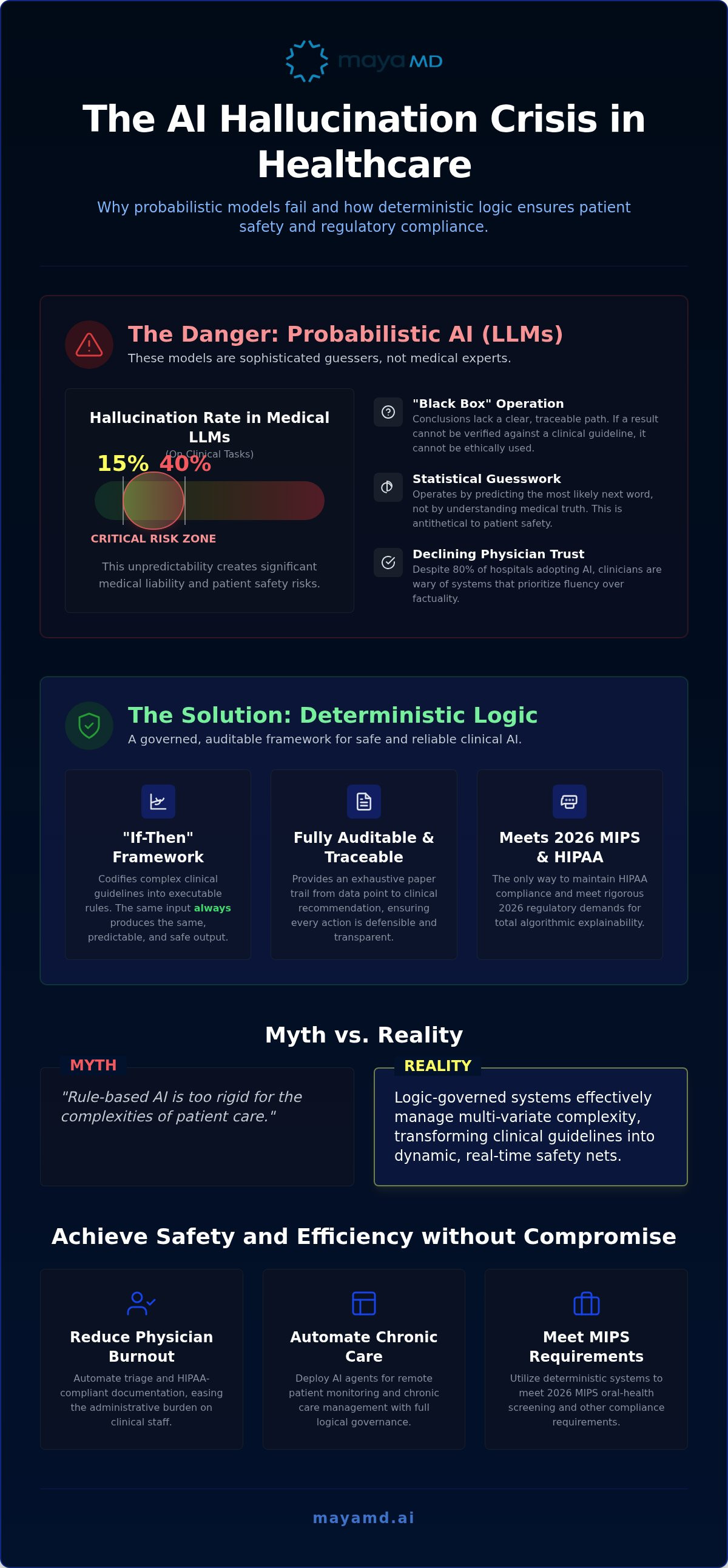
The most dangerous myth in modern healthcare is the belief that scale alone can solve the AI hallucination problem. While large language models are impressive, they remain probabilistic by nature; even advanced medical LLMs show hallucination rates between 15% and 40% on clinical tasks. You've likely felt the tension between the promise of automation and the fear of a critical medical error. Safety isn't an emergent property of bigger datasets. It requires the rigorous implementation of deterministic logic in clinical ai. This structural governance ensures every output is predictable, auditable, and grounded in medical fact rather than statistical probability.
You don't have to choose between reducing physician burnout and maintaining patient safety. By integrating rule-based frameworks with intelligent automation, you can achieve HIPAA-compliant documentation and remote patient monitoring without risking lives. This article will dismantle the common misconceptions surrounding medical AI and provide a clear framework for evaluating safety. We'll also demonstrate how deterministic systems help you meet 2026 MIPS oral-health screening requirements while finally easing the administrative burden on your clinical staff.
Key Takeaways
• Understand why probabilistic models alone are insufficient for healthcare and how to eliminate hallucination risks through structured governance.
• Learn to codify clinical guidelines into an auditable "If-Then" framework using deterministic logic in clinical ai for consistent, repeatable patient outcomes.
• Discover how logic-governed systems manage multi-variate complexity more effectively than human oversight, debunking the myth that rule-based AI is too rigid for patient care.
• Explore how the MayaMD Clinical AI Agent automates triage and documentation for chronic care management, significantly reducing physician burnout while maintaining HIPAA compliance.
The Clinical AI Hallucination Crisis: Why Probabilistic Models Alone Fail
Probabilistic AI is effectively a sophisticated form of autocomplete. It operates by predicting the most likely next word or data point based on massive statistical patterns rather than an underlying understanding of medical truth. While these models excel at natural language synthesis, they are inherently unreliable for clinical decision-making. The core of the issue lies in "temperature" settings. In the world of Large Language Models (LLMs), temperature controls the level of randomness in the output. While a higher temperature fosters creativity in marketing copy, it's antithetical to patient safety. You cannot have a "creative" interpretation of a drug-drug interaction or a critical lab value. Clinical care requires the precision of a deterministic algorithm, where a specific input always yields the same, predictable output.
The cost of ignoring this distinction is high. Hallucination rates in medical LLMs remained as high as 40% in some clinical tasks through 2025, leading to significant medical liability and patient safety risks. This unpredictability is why physician trust is declining despite the fact that 80% of hospitals have adopted some form of AI. Clinicians are rightfully wary of systems that prioritize fluency over factuality. To restore this trust, the industry must pivot toward deterministic logic in clinical ai, ensuring that every automated insight is governed by rigorous medical rules rather than statistical guesswork.
The 'Black Box' Problem in Modern Medicine
Deep learning models often function as a "black box," offering no clear traceability for their conclusions. If a clinician cannot verify a result by tracing it back to a specific clinical guideline or a concrete patient data point, they cannot ethically act on that information. This lack of transparency compromises clinical documentation and billing accuracy. When an AI generates a summary containing fabricated symptoms, it puts the provider at risk for both audit failures and malpractice claims. Reliable systems must move beyond hidden layers to provide a transparent, logical path from data to diagnosis.
Regulatory Pressures and HIPAA Compliance in 2026
By 2026, regulatory standards have evolved to demand total explainability in clinical decision support. It's no longer enough for an AI to be "usually right"; it must be auditable. Deterministic frameworks are the only way to maintain HIPAA compliance while scaling automation, as they allow for precise control over how sensitive data triggers specific clinical actions. Algorithmic accountability in the 2026 regulatory landscape refers to the mandatory requirement for healthcare entities to provide a clear, auditable trail explaining how an AI system reached a specific clinical conclusion. Without deterministic logic in clinical ai, meeting these rigorous transparency standards is functionally impossible.
Decoding Deterministic Logic: The Auditable Core of Modern Medicine
Reliability is the cornerstone of clinical practice. Deterministic logic in clinical ai functions as a rigid, mathematical architecture where a specific set of inputs reliably produces the same output every time. It's a consistency that mirrors the cognitive process of a board-certified physician who applies evidence-based protocols to patient data. Unlike probabilistic systems that gamble on statistical likelihoods, deterministic frameworks utilize an "If-Then" structure to codify complex clinical guidelines into executable rules. This ensures that the software operates within the strict boundaries of established medical science, providing a level of predictability that is non-negotiable in a high-stakes environment.
The adoption of deterministic logic in clinical ai transforms these guidelines from static documents into dynamic, real-time safety nets. By removing the ambiguity inherent in large-scale data modeling, healthcare providers can ensure that their digital tools don't deviate from the standard of care. This approach doesn't just improve performance; it establishes a "governed" environment where every automated action is a direct reflection of clinical authority.
Traceability: From Data Point to Clinical Recommendation
Every clinical recommendation must be defensible. Deterministic systems provide an exhaustive paper trail, allowing providers to trace an AI’s conclusion back to the specific data point or peer-reviewed protocol that triggered it. This transparency is central to achieving healthcare AI without hallucinations, as it replaces the opaque "black box" with a visible logic map.
When an AI agent cites specific journals or internal hospital protocols, it reinforces the clinician’s confidence and simplifies the path to regulatory compliance. This level of oversight is why governing bodies increasingly favor logic-based systems over unstructured neural networks. Providers can finally verify results through direct evidence rather than blind trust.
Reliability in High-Stakes Decision Support
In high-stakes scenarios like medication dosing or allergy cross-referencing, the margin for error is zero. Deterministic logic is essential here because it eliminates the "creative" errors found in probabilistic models. By applying precise, logic-driven filters, these systems also solve the pervasive issue of alert fatigue. Instead of a flood of low-relevance warnings, clinicians receive targeted notifications based on exact clinical thresholds.
Research suggests that deterministic error rates in these structured environments are negligible compared to the 15% to 40% hallucination rates seen in unsupervised LLMs. For organizations seeking to implement a Reliable Clinical AI Agent, prioritizing this auditable core is the only way to ensure patient safety remains uncompromised. This systematic approach allows for a reduction in administrative burden without introducing new, unpredictable risks into the clinical workflow.
Myth vs. Reality: Is Deterministic Logic Too Rigid for Complex Patient Care?
The primary criticism leveled against deterministic systems is their perceived lack of nuance. Critics often argue that human health is too complex for binary "if-then" structures. However, this is a fundamental misunderstanding of how deterministic logic in clinical ai operates. Rigidity isn't a limitation; it's a safety feature. While a human clinician can realistically track only four or five clinical variables simultaneously before cognitive load begins to impact decision quality, a logic-governed system can process thousands of multi-variate data points without fatigue or degradation. It doesn't ignore the "grey areas" of medicine. Instead, it ensures that those complexities are navigated through defined, evidence-based pathways rather than statistical guesses.
Clinical governance provides the necessary mechanism for updating these logic trees as medical science evolves. This architecture allows for a "governed" approach to care where rules are transparent and easily modified by medical boards. By codifying these updates into the system's core, healthcare organizations ensure that the standard of care is applied consistently across every patient interaction. This systematic reliability is exactly what's required to move past the experimental phase of AI into proven, high-stakes application.
Busting the 'Limited Scope' Misconception
Many practitioners believe deterministic AI is restricted to simple triage or basic flowcharts. In reality, modern logic engines are highly modular and allow for massive scalability across disparate specialties. We've transitioned from static decision trees to dynamic engines that synthesize real-time patient data against a vast library of clinical rules. Governed flexibility represents the 2026 gold standard, where rigid safety guardrails coexist with modular logic to address the nuanced realities of individual patient health. This adaptability ensures that the system remains precise without being narrow, supporting everything from oncology to chronic disease management.
The Human-in-the-Loop Fallacy
The industry often suggests that physicians can simply "verify" probabilistic AI outputs to mitigate risk. This approach is a direct contributor to physician burnout. Expecting a clinician to act as a human debugger for a machine that might hallucinate 15% to 40% of the time is an unsustainable administrative burden. Deterministic logic acts as the first-line safety net. When a clinical ai agent for primary care operates on deterministic principles, it only presents information that has been verified against clinical protocols. This allows clinicians to focus on care delivery rather than fact-checking the software's predictions.
Strategic Integration: How Logic-Governed AI Transforms Remote Patient Monitoring
The integration of deterministic logic in clinical ai is particularly transformative within the context of high-volume data streams. Remote patient monitoring generates a continuous influx of physiological markers from wearable devices, creating a signal-to-noise ratio that often overwhelms traditional clinical workflows. By applying logic-governed filters, systems can automatically triage chronic conditions like hypertension and diabetes. For instance, if a blood pressure cuff transmits a reading exceeding 180/120 mmHg, the system immediately triggers an emergency protocol. This precision identifies legitimate "red flags" without the burden of false positives, which significantly enhances the overall utility of remote patient monitoring software.
Logic-based triage ensures that clinicians only intervene when clinically necessary. This systematic approach preserves resources and prevents the "alert fatigue" that frequently leads to missed critical events. By codifying medical necessity into the software's architecture, healthcare organizations can maintain a high standard of care while scaling their monitoring programs to thousands of patients. The result is a more responsive, reliable, and efficient ecosystem that prioritizes patient safety through rigorous technical oversight.
Neuro-Symbolic AI: The Best of Both Worlds
Effective clinical AI doesn't require a binary choice between generative power and logical rigor. MayaMD utilizes a neuro-symbolic approach, where generative AI provides an empathetic interface for patient engagement while deterministic logic "bounds" the Clinical AI Agent's medical outputs. Consider a patient managing both stage 3 chronic kidney disease and congestive heart failure. The hybrid model allows the AI to converse naturally about daily symptoms, yet it relies on a hard-coded deterministic core to ensure that any dietary or medication guidance remains strictly within the patient's specific clinical protocol. This architecture eliminates the risk of probabilistic errors in high-stakes chronic care.
Streamlining Advanced Primary Care Management (APCM)
Logic-driven workflows are essential for successfully scaling advanced primary care management. By automating the capture and categorization of patient data, these systems ensure a seamless continuity of care between on-site clinics, such as those in Las Vegas, and their remote patient populations. Deployments of these tools have been reported to reduce physician documentation time by 40% to 45% (Uvik Software, July 2026). This reduction in administrative overhead allows providers to reclaim their time for direct patient interaction. To see how these governed frameworks can optimize your practice, explore our Digital AI healthcare solutions for providers and hospitals.
The MayaMD Approach: Deploying Deterministic AI Agents in Las Vegas and Beyond
MayaMD has moved past the experimental phase of artificial intelligence into proven, high-stakes application. The MayaMD Clinical AI Agent is built on a foundation of deterministic logic in clinical ai, ensuring that every patient interaction remains within the bounds of clinical validity. This isn't a disruptive outsider's tool. It's a sophisticated partner designed to navigate the complexities of modern healthcare. By codifying clinical wisdom into a governed digital framework, MayaMD enables specialists to utilize advanced principal care management tools without the typical risks of probabilistic "black box" systems.
The transition toward digital healthcare for chronic disease requires a bridge between disparate data points and human care. MayaMD serves as that bridge. Whether managing complex kidney patients in Las Vegas or supporting primary care initiatives in Indianapolis, Phoenix, and Houston, the platform provides a reliable, collaborative expert presence. This connectivity ensures that chronic care management remains continuous and precise, rather than episodic and reactive. By focusing on the human impact of technology, MayaMD fosters a deeper connection between the provider and the patient.
Why Las Vegas and Chicago Providers Choose MayaMD
Providers in major metro areas like Las Vegas and Chicago face unique demographic challenges and high-volume clinical demands. MayaMD allows these organizations to customize logic trees to align with local clinical protocols and specific patient populations. This level of customization is paired with seamless integration into existing EHR systems, ensuring that deterministic logic in clinical ai enhances rather than disrupts the established workflow. By supporting local Remote Patient Monitoring (RPM) initiatives, MayaMD helps clinics maintain regulatory adherence while expanding their reach to remote patients through a HIPAA-compliant cloud platform.
Getting Started with Governed AI
Implementing a Clinical AI Agent in a primary care setting is a methodical process. It begins with identifying specific administrative bottlenecks, such as documentation burnout, and deploying logic-driven modules to address them. Organizations typically see a significant return on investment, with industry analyses reporting an average ROI for healthcare AI of 3.2 to 1 and payback periods of 12 to 18 months (Uvik Software, July 2026). These measurable performance gains are achieved alongside improved patient outcomes and reduced clinician stress. To experience the stability and precision of a governed system, request a demo of MayaMD's logic-governed Clinical AI Agent today.
Securing the Future of Clinical Governance
The transition from experimental AI to proven clinical application requires more than just processing power. It demands a fundamental shift toward systems that prioritize auditability and medical truth over statistical probability. By implementing deterministic logic in clinical ai, you eliminate the structural risks of hallucinations while ensuring that every automated triage or documentation task follows established clinical guidelines. This approach transforms AI from a source of liability into a high-stakes safety net that supports your most critical workflows.
MayaMD provides a HIPAA-compliant, cloud-based platform designed specifically for the rigors of modern healthcare. Our specialized Clinical AI Agent for RPM and PCM is already helping US providers reduce their administrative burden without compromising the quality of care. You can finally move past the fear of medical errors and embrace a future where technology fosters deeper patient connections through precise, governed automation. The path to safer, more efficient healthcare is built on logic, and we invite you to lead this evolution with confidence.
Empower your practice with hallucination-free Clinical AI; See MayaMD in action
Frequently Asked Questions
What is the difference between deterministic and probabilistic AI in healthcare?
Deterministic AI follows a fixed mathematical path where a specific input always results in the same, predictable output. Probabilistic AI uses statistical patterns to predict the most likely response, which introduces a margin for error. This distinction is critical in healthcare because medical protocols require absolute consistency rather than sophisticated guesses. While probabilistic models excel at language synthesis, they lack the structural rigor needed for reliable clinical decision support.
Can deterministic AI really prevent hallucinations in clinical documentation?
Yes, deterministic systems eliminate hallucinations by restricting the AI’s output to a predefined set of clinical rules. Unlike Large Language Models that can fabricate data based on statistical probability, deterministic logic in clinical ai ensures that every recommendation is grounded in verified medical evidence. By removing the randomness inherent in probabilistic models, providers can trust that the software will not generate plausible but incorrect symptoms or diagnoses.
Is MayaMD's Clinical AI Agent HIPAA-compliant for providers in Chicago?
MayaMD’s Clinical AI Agent is fully HIPAA-compliant and secure for healthcare providers in Chicago and across the United States. Our cloud-based platform utilizes advanced encryption and rigorous data governance frameworks to ensure that all patient information is protected according to federal standards. This infrastructure allows large health systems to scale their digital initiatives while maintaining the highest level of regulatory adherence and data integrity.
How does deterministic logic improve Remote Patient Monitoring (RPM) outcomes?
Deterministic logic improves Remote Patient Monitoring outcomes by providing precise, automated triage of physiological data. By applying hard-coded thresholds to continuous data streams, the system identifies critical red flags without the burden of false positives. This systematic reliability ensures that clinicians only receive alerts for medically necessary interventions. It allows for more timely care for patients with chronic conditions while reducing the cognitive load on clinical staff.
Why is deterministic logic preferred for Advanced Primary Care Management (APCM)?
Deterministic logic is preferred for Advanced Primary Care Management because it provides an auditable trail for every automated clinical action. This transparency is essential for meeting 2026 Medicare reimbursement requirements and maintaining algorithmic accountability. Additionally, these systems reduce documentation time by 40% to 45%. This allows primary care teams to focus on patient connection rather than spending hours on administrative fact-checking and manual data entry.
What happens if clinical guidelines change? How is the AI updated?
When clinical guidelines change, the system's logic trees are updated through a centralized governance process. Unlike probabilistic models that require massive retraining on new datasets, deterministic logic in clinical ai can be modified instantly by medical boards. This modular architecture allows healthcare organizations to remain current with the latest evidence-based protocols. It ensures the AI’s behavior always reflects the most recent standard of care without unpredictable deviations.
Does deterministic AI work for patients with multiple chronic conditions?
Deterministic AI is exceptionally well-suited for patients with multiple chronic conditions because it can process thousands of multi-variate data points simultaneously. While human cognitive load is limited, logic-governed systems evaluate complex medication interactions and conflicting symptoms across various specialties. This ensures that a patient with comorbid conditions receives care that is coordinated through a unified, evidence-based logic engine rather than fragmented statistical predictions.
How can I implement deterministic AI in my Las Vegas medical practice?
Implementing deterministic AI in a Las Vegas medical practice begins with a consultation to identify your specific workflow bottlenecks. MayaMD’s team assists with integrating the Clinical AI Agent into your existing EHR system to ensure a seamless transition for your staff. By starting with a focused deployment in Remote Patient Monitoring or chronic care management, your practice can quickly realize measurable gains in both administrative efficiency and patient engagement.




See The MayaMD Difference
Fill the form below
Download Our Apps
MayaMD for patients and MayaPro for physicians - available on iOS and Android.
FOR PATIENTS
MayaMD App
AI-powered symptom assessment, triage, and secure access to your care team.


FOR PHYSICIANS
MayaPro App
MayaPro brings patient vitals, RPM/PCM care plans, and clinical decision support to your pocket.