
Clinical Documentation Automation Software: The 2026 Guide to AI-Governed Care

The era of the digital scribe is over; we've entered the age of the clinical governor. While first-generation tools focused on simple transcription, the integration of generative AI for clinical documentation now demands a more rigorous, logic-based framework to protect patient safety. Most practitioners recognize that "pajama time" is a symptom of a systemic failure in administrative design, yet the fear of AI-generated hallucinations in clinical records remains a valid barrier to adoption. You need a solution that functions as a sophisticated workflow partner rather than a passive listener.
This guide explores how AI-governed automation reduces physician burnout and ensures clinical accuracy within complex chronic care environments. By merging deterministic logic with generative power, these systems produce HIPAA-compliant, defensible documentation that creates a seamless link between patient monitoring and clinical notes. We will detail the technical shift toward neuro-symbolic AI and provide a framework for evaluating 2026's leading documentation platforms for RPM and PCM programs.
Key Takeaways
• Understand the critical transition from passive speech-to-text tools to active Clinical AI Agents that prioritize governance and safety in 2026 healthcare.
• Learn how the strategic use of generative AI for clinical documentation, when anchored by neuro-symbolic logic, eliminates the risk of medical hallucinations.
• Discover methods to mitigate physician burnout by automating the link between patient monitoring data and defensible, HIPAA-compliant clinical notes.
• Identify the specific implementation steps required to audit EMR compatibility and establish rigorous governance rules for automated chronic care workflows.
• Explore how a sophisticated Clinical AI Agent serves as a workflow partner to support complex primary care management and specialized reimbursement requirements.
Defining Clinical Documentation Automation in 2026
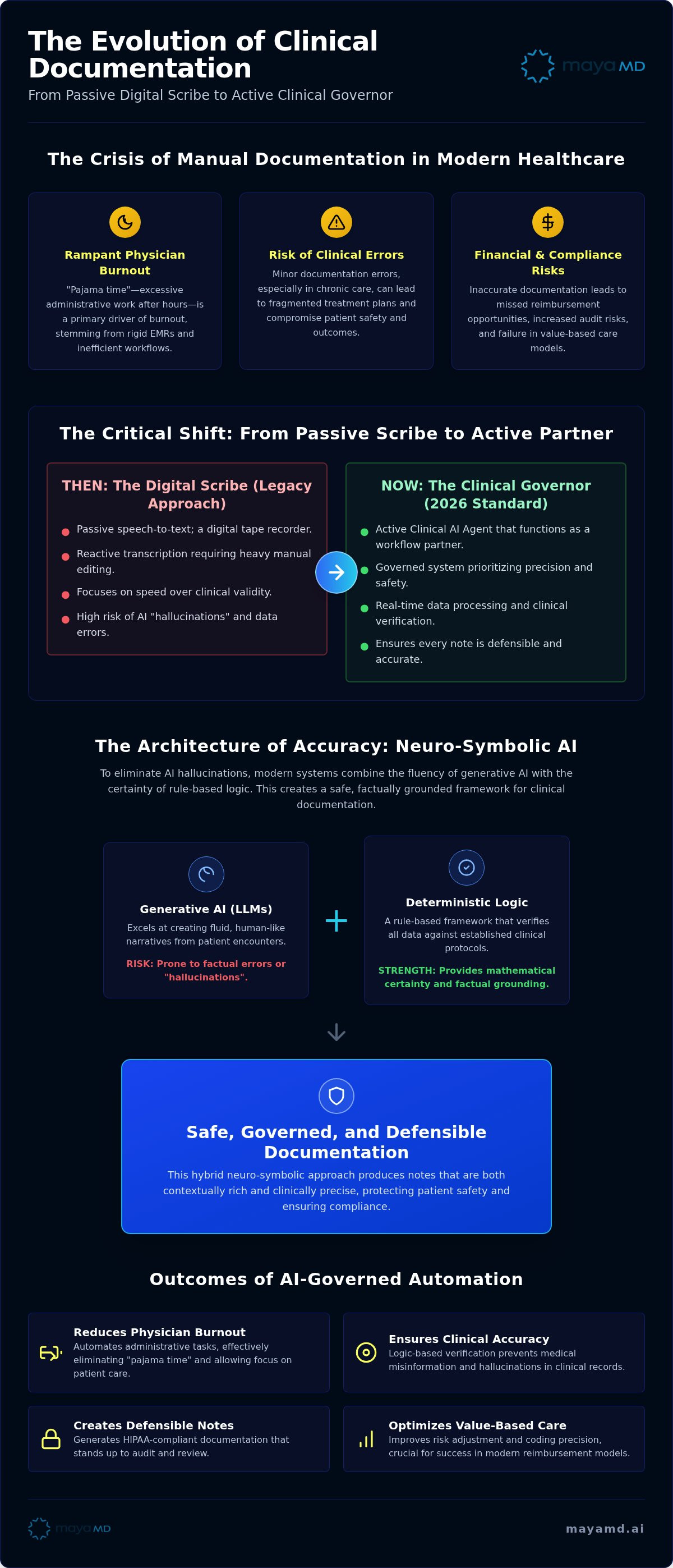
The transition from passive speech-to-text to active Clinical AI Agents marks a fundamental shift in medical technology. In previous years, automation was largely reactive, serving as a digital tape recorder that required heavy manual editing. By 2026, the industry has pivoted toward governed systems that prioritize precision over mere speed. This evolution is driven by the necessity for clinical validity in high-stakes environments like chronic disease management. Generative AI for clinical documentation has moved beyond the experimental phase; it now operates within a framework of deterministic logic to ensure that every note is defensible and accurate.
Intelligent automation directly addresses the "pajama time" crisis by processing data in real-time during the encounter. This capability reduces the administrative burden that traditionally follows a physician home. Beyond provider wellness, these systems play a critical role in risk adjustment. Precise documentation ensures that patient complexity is accurately reflected, which is essential for success in value-based care models. By shifting the focus from manual entry to oversight, health systems can finally align their administrative workflows with their clinical goals.
The Burden of Manual Documentation
Administrative tasks remain a primary driver of provider burnout in major US hubs like Chicago and Houston. Legacy EMR templates often fail to meet 2026 clinical standards because they are rigid and disconnected from the fluid nature of patient interactions. In chronic care, even minor documentation errors can lead to fragmented treatment plans or missed reimbursement opportunities. The hidden costs of these inaccuracies include increased audit risks and compromised patient outcomes. Without a systematic approach to automation, clinicians spend more time managing data than managing health.
Core Capabilities of Modern Automation
Modern systems leverage ambient AI capture to convert patient encounters into structured clinical data without interrupting the provider-patient bond. This technology is a significant component of the broader evolution of Artificial intelligence in healthcare, facilitating a more natural workflow. Real-time clinical verification identifies documentation gaps before the record is finalized, ensuring that all necessary data points are captured. Automated coding then maps findings to CPT and ICD-10 codes with mathematical precision. By integrating generative AI for clinical documentation with rigorous oversight, health systems can maintain high standards of revenue integrity and clinical excellence.
The Architecture of Accuracy: Generative AI vs. Deterministic Logic
The reliance on pure Large Language Models (LLMs) presents a significant risk in the medical field. While LLMs excel at narrative generation, they are prone to "hallucinations," which is the creation of plausible but factually incorrect information. In chronic care, a single data point error can jeopardize patient safety. This is why the industry is shifting toward a neuro-symbolic approach. By integrating generative AI for clinical documentation with deterministic logic, systems can produce notes that are both fluid and factually grounded. This hybrid architecture ensures that the reasoning capabilities of AI are checked by mathematical certainty.
Deterministic frameworks ensure that AI adheres to established clinical protocols without deviation. Unlike standard chatbots, these systems use mathematical logic to verify every claim against a known medical truth. Deterministic logic prevents medical misinformation by forcing AI outputs to align with immutable clinical protocols and verified medical knowledge bases. This structured oversight is emphasized in the U.S. GAO on Generative AI in Health Care report, which highlights the need for rigorous standards in clinical applications. It's about moving from probabilistic guesses to clinical certainties.
MayaMD: Eliminating AI Hallucinations
MayaMD utilizes a sophisticated interplay between deterministic logic and generative output to maintain clinical validity. This architecture ensures that the generative AI for clinical documentation doesn't just predict the next word but verifies it against clinical guidelines. By linking documentation to deterministic logic in clinical ai, the platform provides a level of precision that pure ambient scribes cannot match. This "governed" approach transforms the AI from a simple transcriber into a reliable workflow partner. It's a commitment to accuracy that supports long-term provider trust.
Safety Protocols in Clinical AI Agents
Precision in high-stakes healthcare requires layered verification. Clinical AI Agents audit their own output against recognized clinical guidelines in real time. This process creates a defensible record that stands up to regulatory scrutiny while maintaining HIPAA compliance within a secure cloud-based ecosystem. We approach this with the mindset of an Authoritative Pioneer, understanding that technology must serve the rigors of medicine. It's a method that prioritizes the patient's long-term health over short-term administrative speed. To see how this architecture supports your practice, you can explore our clinical AI solutions.
Software Evaluation by Care Setting: Ambulatory to Chronic
Documentation requirements are not uniform; they vary significantly based on the care setting and the complexity of the patient population. Enterprise health systems in major hubs like Chicago and Houston prioritize deep EMR integration to maintain data integrity across thousands of providers. For these organizations, generative AI for clinical documentation must function as a background utility that seamlessly feeds into systems like Epic or Cerner without disrupting established governance protocols. The goal is a unified record that supports both clinical care and high-level administrative oversight.
In contrast, ambulatory clinics in Las Vegas and Phoenix often focus on narrative encounter speed to manage high patient volumes effectively. These practices require tools that can rapidly synthesize a conversation into a coherent SOAP note. However, chronic care management in Indianapolis presents a different challenge entirely. It demands longitudinal data tracking to monitor disease progression over months or years. Specialized workflows in these settings require principal care management tools that can handle high-acuity data points while maintaining a clear, historical narrative of the patient's journey.
Structured Assessments vs. Narrative Notes
The choice between ambient scribing and structured data capture depends on the specific clinical outcome desired. Ambient scribes are ideal for narrative physician-patient encounters where the human element is paramount. They capture the nuances of the conversation, allowing the provider to remain fully present. Conversely, structured data is essential for regulatory assessments such as OASIS-E2 and HOPE. These frameworks require specific, discrete data points that are mandatory for reimbursement and quality reporting. A sophisticated Clinical AI Agent bridges this gap by extracting structured findings from narrative speech, ensuring that documentation formats align with both clinical needs and financial requirements.
Automation for Remote Patient Monitoring (RPM)
Bridging the gap between physiological device data and clinical narratives is a primary challenge for modern healthcare providers. Streamlining records for remote patient monitoring software ensures that readings from blood pressure cuffs or glucose monitors don't exist in a vacuum. By using generative AI for clinical documentation, these disparate data points are automatically contextualized within a formal clinical note. This creates automated RPM summaries that provide a comprehensive view of patient health between visits. It's a systematic approach that ensures continuity of care across platforms while reducing the manual effort required to reconcile device logs with the medical record.
Implementation and Compliance: Integrating Automation into Clinical Workflows
Successful deployment of automated systems requires a methodical, five-step framework that prioritizes clinical safety and operational continuity. Integrating generative AI for clinical documentation isn't merely a technical upgrade; it's a fundamental shift in how data moves through a health system. Organizations must first audit EMR compatibility to identify clinical data silos that prevent a unified patient view. Once silos are mapped, establishing rigorous governance rules for AI-generated clinical documentation ensures that every note aligns with institutional standards and medical protocols. This structured approach prevents the fragmented records often seen with ungoverned tools.
The transition typically begins with pilot programs in specialized environments, such as hypertension clinics in Phoenix, to refine the AI's interaction with specific patient populations. Full-scale deployment then follows in major healthcare hubs like Indianapolis, supported by comprehensive provider training to ensure high adoption rates. The final stage involves monitoring documentation accuracy and measuring administrative ROI through reduced "pajama time" and improved billing precision. By following this clinical roadmap, health systems can transition from manual entry to a governed, oversight-based model without compromising care quality.
EMR Integration and Data Connectivity
Interoperability is the cornerstone of any modern clinical environment. We maintain an Authoritative Pioneer view on seamless connectivity, recognizing that data must be fluid to support complex chronic care. Overcoming legacy EMR hurdles is essential to ensure that automated records don't become another administrative burden. Utilizing clinical workflow automation solutions allows providers to synchronize narrative notes with structured data fields automatically. This connectivity ensures that technology enhances rather than hinders the daily practice of medicine, allowing clinicians to focus on the human impact of their work.
Regulatory Adherence and Defensible Documentation
Maintaining cloud-based data integrity under 2026 HIPAA standards is a non-negotiable requirement for any enterprise solution. Every record produced by generative AI for clinical documentation must be backed by a clear audit trail to ensure it's defensible for reimbursement and regulatory review. This is particularly vital for providers in Las Vegas and Chicago, where local data privacy considerations and state-level mandates add layers of complexity to federal requirements. A governed system ensures that every note is not only accurate but also fully compliant with the evolving legal landscape of health technology. To begin modernizing your clinical records, you can schedule a consultation with our AI integration experts.
MayaMD: Elevating Documentation Through a Clinical AI Agent
The MayaMD Clinical AI Agent represents the next phase of medical documentation, moving far beyond the capabilities of a standard ambient scribe. It functions as a sophisticated care support system that integrates seamlessly into the provider's workflow. By utilizing generative AI for clinical documentation within a governed framework, our platform empowers teams to deliver advanced primary care management with unprecedented precision. This technology doesn't just record data; it contextualizes it to improve patient engagement and longitudinal care outcomes. It's the bridge between high-volume data capture and the human element of medicine.
The shift toward digital healthcare for chronic disease requires a transition from reactive notes to proactive, governed records. Our platform ensures that every piece of documentation serves a clinical purpose, whether it's supporting a complex RPM program or clarifying a patient's post-discharge instructions. This level of oversight is what distinguishes a true Clinical AI Agent from a general-purpose language model. It's about building a defensible, accurate clinical record that supports the provider's expertise rather than replacing it.
A Partner in Clinical Excellence
Connectivity is more than a technical requirement; it's a clinical necessity. MayaMD bridges the gap between disparate data points and empathetic human care by ensuring that clinicians have the right information at the right time. We leverage deterministic logic to ensure that automated post-discharge communication is both accurate and personalized. This approach results in measurable performance gains, as AI-powered scribes have been shown to reduce documentation time for clinicians by up to 40%. By automating the most tedious aspects of the record-keeping process, we allow providers to rediscover the joy of practice while maintaining the highest standards of clinical validity.
Getting Started with MayaMD in Your Clinic
Our solutions are fully customizable to meet the specific needs of healthcare providers in diverse markets like Houston and Phoenix. Whether you're managing a large enterprise system or a specialized ambulatory clinic, the roadmap to implementing a Clinical AI Agent is designed for minimal disruption and maximum impact. We focus on aligning our generative AI for clinical documentation with your existing clinical protocols to ensure a smooth transition. This is the moment for healthcare leaders to embrace a partner that values precision and reliability as much as they do. To experience how governed AI can transform your practice, contact us for a tailored demonstration of our Clinical AI Agent.
Advancing Toward a Governed Documentation Ecosystem
The landscape of 2026 demands a departure from passive scribing tools toward active, governed systems that prioritize clinical validity. By anchoring generative AI for clinical documentation within a neuro-symbolic architecture, providers can finally eliminate the risk of hallucinations while reclaiming significant time for patient care. This evolution ensures that every note is not only a record of an encounter but a defensible, logic-based asset that supports complex chronic care programs like RPM, APCM, and PCM.
Healthcare leaders who prioritize precision and regulatory adherence are already transitioning to these sophisticated frameworks. Integrating a system designed for high-stakes reliability is no longer an experiment; it's a clinical necessity. Our HIPAA-compliant cloud platform utilizes deterministic logic to bridge the gap between disparate data and empathetic care. Request a Demo of MayaMD’s Clinical AI Agent today to discover how our specialized architecture can reduce your administrative burden. We're ready to help you navigate this new era of intelligent, governed care with confidence.
Frequently Asked Questions
What is clinical documentation automation software?
It's a technological framework that uses artificial intelligence to capture, process, and record clinical interactions into structured medical records. Unlike legacy systems, modern software utilizes generative AI for clinical documentation to synthesize patient encounters into defensible notes. This technology functions as a workflow partner that translates ambient conversations and physiological data into HIPAA-compliant records, ensuring that the final output aligns with rigorous clinical standards and institutional requirements.
How does AI reduce physician burnout in 2026?
AI reduces burnout by automating the most labor-intensive administrative tasks, specifically eliminating "pajama time" spent on after-hours charting. By using ambient listening and real-time data synthesis, these systems allow clinicians to focus entirely on the patient during the visit. Research shows that AI-powered scribes can reduce documentation time by up to 40%. This shift from manual entry to oversight restores the provider-patient bond while maintaining high levels of clinical precision.
Is AI-generated clinical documentation HIPAA compliant?
Yes, provided the software is built on a HIPAA-compliant cloud architecture with rigorous data encryption and access controls. Modern systems ensure compliance by maintaining strict Business Associate Agreements and utilizing secure, private servers that don't use patient data to train public models. Every automated note must be part of a defensible audit trail, ensuring that patient privacy is protected while meeting the high-stakes reliability requirements of a regulated healthcare environment.
Can clinical AI agents integrate with my existing EMR?
Seamless interoperability with major EMR platforms like Epic and Cerner is a standard feature of enterprise-grade clinical AI agents. These agents are designed to bridge the gap between narrative encounters and structured data fields, ensuring that information flows fluidly without creating new data silos. By using advanced connectivity protocols, the software enhances existing workflows, allowing providers to finalize and push notes directly into the patient's permanent record with minimal manual intervention.
How does deterministic logic prevent AI hallucinations in medical notes?
Deterministic logic prevents hallucinations by forcing AI outputs to conform to established clinical protocols and verified medical knowledge. While generative AI for clinical documentation provides the narrative fluidity, the deterministic layer acts as a mathematical filter that verifies every clinical claim. This neuro-symbolic approach ensures that the software doesn't "guess" medical facts. Instead, it audits its own reasoning against rigorous logic frameworks to maintain absolute clinical validity and safety.
What is the difference between an AI scribe and a Clinical AI Agent?
An AI scribe is a reactive tool that primarily focuses on transcribing and summarizing conversations. In contrast, a Clinical AI Agent is an active workflow partner that understands clinical logic and provides intelligent care support. While a scribe merely records what was said, a Clinical AI Agent identifies documentation gaps, maps findings to ICD-10 codes, and links patient monitoring data to the clinical narrative, offering a much higher level of governance and precision.
How do I measure the ROI of documentation automation software?
Measuring ROI involves tracking a combination of time savings, revenue integrity, and provider retention metrics. Key indicators include the reduction in hours spent on documentation per shift and the decrease in claim denials due to improved coding accuracy. Additionally, health systems should monitor the impact on provider burnout scores and patient throughput. When documentation is defensible and accurate, the financial benefits extend beyond administrative efficiency to include optimized risk adjustment and value-based care performance.
What role does automation play in Remote Patient Monitoring (RPM) documentation?
Automation serves as the essential link between continuous physiological data and the official clinical record. It synthesizes readings from monitoring devices into concise, contextualized summaries that are automatically integrated into the patient's longitudinal narrative. This process ensures that RPM data doesn't remain isolated in disparate platforms. By automating the reconciliation of device logs with clinical notes, the software maintains continuity of care and provides a comprehensive view of patient health between office visits.




See The MayaMD Difference
Fill the form below
Download Our Apps
MayaMD for patients and MayaPro for physicians - available on iOS and Android.
FOR PATIENTS
MayaMD App
AI-powered symptom assessment, triage, and secure access to your care team.

FOR PHYSICIANS
MayaPro App
MayaPro brings patient vitals, RPM/PCM care plans, and clinical decision support to your pocket.