
Chronic Care Management Software in Chicago: The 2026 AI Implementation Guide

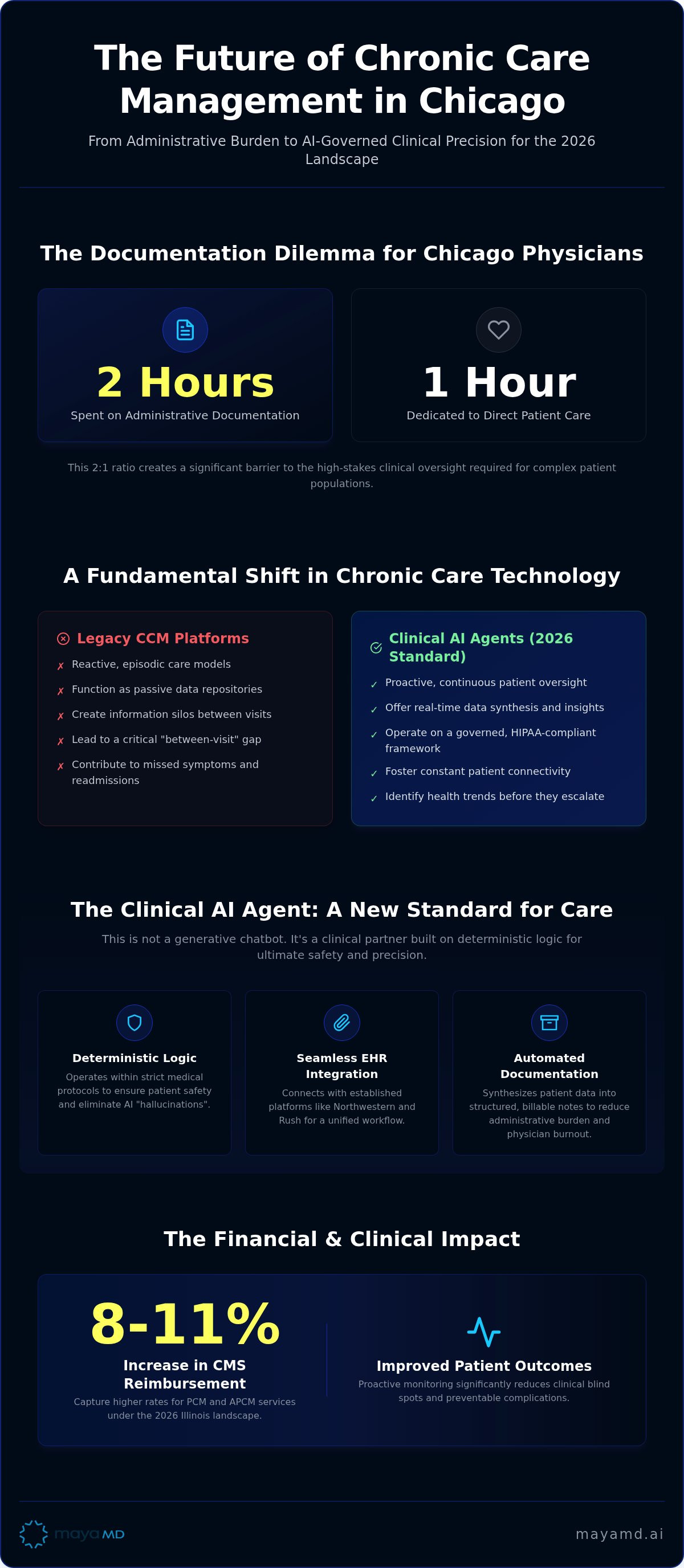
Chicago physicians currently spend two hours on administrative documentation for every one hour of patient care. This ratio isn't just a symptom of inefficiency; it's a barrier to the high-stakes clinical oversight required for complex patient populations. You've likely felt the weight of this imbalance as you navigate the intricacies of Illinois-specific Medicare compliance and the shifting requirements for 2026. Finding the right chronic care management software Chicago medical groups can trust means moving beyond basic tracking tools toward governed, intelligent systems.
We understand that the transition to Advanced Primary Care Management (APCM) and Principal Care Management (PCM) requires a partner that values clinical precision over technological hype. This guide provides a comprehensive roadmap for implementing a Clinical AI Agent that automates documentation while maintaining strict deterministic logic. By the end of this article, you'll discover how to capture the recent 8 to 11 percent increase in CMS reimbursement rates while simultaneously improving patient outcomes and reducing provider burnout through a sophisticated, AI-governed framework. We will examine the specific technical integrations and regulatory safeguards necessary to transform your chronic care workflows into a seamless, high-performance ecosystem.
Key Takeaways
• Understand the strategic shift from reactive documentation portals to proactive Clinical AI Agents that prioritize patient safety and clinical precision.
• Learn how to navigate the 2026 Illinois reimbursement landscape to capture increased Medicare rates for PCM and APCM services.
• Identify the core capabilities of chronic care management software Chicago healthcare systems require to eliminate administrative documentation burdens.
• Discover a methodical implementation framework for integrating sophisticated AI logic with established EHR platforms such as Northwestern and Rush.
• Explore how neuro-symbolic AI architectures foster reliable patient connectivity while maintaining the highest standards of clinical governance.
The Evolution of Chronic Care Management Software in Chicago (2026)
Chicago's healthcare landscape is undergoing a fundamental transformation. The high-density clinical environments of urban Illinois demand a transition from reactive, episodic care to proactive, continuous oversight. To understand the stakes of this shift, one must first establish a baseline: What is Chronic Care Management? It is the systematic coordination of care for patients with two or more chronic conditions. In 2026, the standard for chronic care management software Chicago providers utilize has evolved beyond the static portals of the previous decade. Modern systems now function as comprehensive, cloud-based ecosystems that prioritize connectivity and regulatory adherence over simple data entry.
Chicago healthcare systems are moving away from traditional CCM platforms that act as passive repositories. These legacy tools often create silos where information remains stagnant until the next scheduled visit. Instead, providers are prioritizing Clinical AI Agents that offer rigorous oversight and real-time data synthesis. This transition is driven by the need for a HIPAA-compliant infrastructure that ensures continuity of care across disparate urban networks. By establishing a secure, governed framework, medical groups can maintain the high-stakes reliability required to manage complex patient populations effectively.
From Documentation to Intelligent Engagement
Traditional CCM software frequently fails to address the critical "between-visit" gap. This lack of engagement often leads to missed symptoms and preventable complications, which directly impact Chicago's hospital readmission rates. Modern digital healthcare for chronic disease has shifted toward AI-governed models that foster constant patient connection. These systems utilize automated triggers to identify health trends before they escalate into emergencies. This proactive methodology transforms the patient experience from a series of disconnected appointments into a cohesive journey of support. When software actively monitors patient status, clinical teams can focus their energy on the patients who require the most immediate intervention.
The Clinical AI Agent: A New Standard for Chicago Providers
The core of the 2026 care management ecosystem is the Clinical AI Agent. Defining the role of a clinical ai agent for primary care requires a focus on safety and precision. Unlike standard generative models that may produce "hallucinations" or unreliable data, these agents utilize deterministic logic to ensure every interaction remains within established medical protocols. This technology represents a transition from software-as-a-tool to software-as-a-clinical-partner. By integrating advanced data science with the daily reality of patient management, these agents reduce the administrative documentation burden that often leads to physician burnout. They provide a bridge between disparate data points and human care, ensuring that every clinical decision is supported by a systematic, logical framework.
Core Capabilities: Beyond Basic Monitoring to AI-Governed Care
High-volume clinical environments in Chicago require a technical infrastructure that transcends simple data collection. The integration of Remote Patient Monitoring (RPM) with Principal Care Management (PCM) represents a strategic shift toward specialized, evidence-based oversight. By establishing a unified data stream, providers can move beyond episodic snapshots of patient health. This technical synergy ensures that specialized care plans for chronic conditions remain dynamic and responsive to real-time physiological changes. When these systems are integrated into the chronic care management software Chicago healthcare systems deploy, the result is a significant reduction in clinical blind spots between office visits.
Physician burnout remains a systemic challenge across urban Illinois, driven largely by the weight of administrative documentation. Clinical AI Agents address this by automating the synthesis of patient data into structured, billable notes. This capability allows practitioners to reclaim time for high-level clinical decision-making. Additionally, an automated post discharge solution serves as both a safety mechanism and a revenue driver. These systems facilitate systematic follow-up for patients transitioning from acute care to home settings, ensuring stability and reducing the risk of costly readmissions. This methodical approach to connectivity reinforces the provider-patient bond while securing recurring revenue through PCM and APCM billing frameworks.
Remote Patient Monitoring and Principal Care Management Integration
The specialized nature of PCM demands a granular level of data that traditional portals cannot provide. Utilizing sophisticated remote patient monitoring software allows specialists to synchronize real-time physiological metrics directly with their care management workflows. This capability-to-outcome structure enables immediate intervention when data deviates from established baselines. In high-volume Chicago clinics, this synchronization has proven vital in reducing exacerbations for patients with complex cardiac or respiratory profiles. Real-time data transparency ensures that every adjustment to a care plan is supported by objective, longitudinal evidence.
Safety First: Eliminating AI Hallucinations in Care Plans
Clinical validity is the foundation of any successful AI implementation. While probabilistic models and standard Large Language Models (LLMs) have gained popularity, they introduce the risk of "hallucinations" that can compromise patient safety. The standard for chronic care management software Chicago clinics utilize must instead rely on neuro-symbolic AI. This architecture combines the linguistic flexibility of generative AI with the rigid, deterministic logic of medical protocols. By enforcing these logical guardrails, the system ensures that automated patient communications and care plan suggestions remain strictly within verified clinical boundaries. This level of rigorous governance is why Chicago's top health systems prioritize a governed Clinical AI Agent over unregulated, experimental tools.
Navigating Illinois Reimbursement and Regulatory Requirements
Success in the Chicago market requires a granular understanding of National Government Services (NGS), the Medicare Administrative Contractor (MAC) for Illinois. Regulatory adherence isn't just about compliance; it's about clinical and financial stability. By 2026, CMS has increased reimbursement rates by 8 to 11 percent, marking the most significant single-year growth in five years. To capture these gains, chronic care management software Chicago providers implement must move beyond manual time tracking toward automated, audit-proof validation. This systematic approach, which can be further strengthened by the data optimization tools of FrontRunnerHC, Inc., ensures that every billable minute is backed by documented clinical necessity.
The 2026 landscape rewards practitioners who transition from transactional volume to value-based oversight. With the Office of Inspector General (OIG) adding Chronic Care Management to its 2026 Work Plan, the risk of recoupment for insufficient documentation has never been higher. Sophisticated platforms provide a transparent, chronological record of every patient interaction and data point. This level of transparency protects your practice while establishing your clinic as a leader in Illinois's evolving healthcare economy.
Navigating local MAC requirements demands a methodical approach to documentation. For non-complex CCM (CPT 99490), the 2026 non-facility reimbursement sits at $66.13 per month, while complex CCM (CPT 99487) reaches $144.29. AI automation ensures that the mandatory 20-minute monthly engagement threshold is met with clinical precision. This deterministic logic eliminates the risk of under-reporting or "rounding up," which are common triggers for federal audits. In Illinois, Medicaid requirements for CCM and RPM often mirror these federal standards but demand specific documentation of informed consent and established provider-patient relationships before billing begins.
Advanced Primary Care Management (APCM) Strategy
The introduction of advanced primary care management codes has redefined the revenue gold standard for urban primary care settings. APCM bundles, such as G0558 for patients with social complexity and chronic conditions, offer a monthly reimbursement of $117.24. This shift rewards proactive care for the most vulnerable populations in Chicago. Leveraging a Clinical AI Agent allows clinics to identify and enroll eligible patients automatically by scanning EHR data for specific chronic condition markers. This capability-to-outcome structure ensures that no eligible patient is overlooked, maximizing recurring revenue while maintaining the highest standards of clinical governance.
Implementation Strategy for Chicago Healthcare Systems
Transitioning to an AI-governed care model requires a methodical assessment of existing clinical infrastructures. Chicago healthcare systems, ranging from independent practices to massive networks like Northwestern Medicine and Rush University Medical Center, often struggle with fragmented data silos. Implementing chronic care management software Chicago clinics can trust involves more than a simple software installation. It requires a strategic alignment of technical capabilities with human workflows. Providers must first identify where manual documentation creates the most friction before deploying a Clinical AI Agent to bridge those gaps. This readiness assessment ensures that the technology serves as a partner in care rather than an additional administrative burden.
The integration process focuses on achieving seamless interoperability with legacy EHR systems. A Clinical AI Agent functions as a sophisticated layer that synthesizes disparate data points into actionable insights without requiring a complete overhaul of existing records. Scaling these programs from a single clinic to an enterprise health network demands a modular approach. This allows for the gradual expansion of PCM and APCM services while maintaining the highest standards of clinical governance. By prioritizing stability and precision during the initial rollout, Chicago providers can establish a scalable foundation for long-term patient engagement and financial growth.
Workflow Automation and Burnout Reduction
Identifying bottlenecks in traditional chronic care models is the first step toward clinical efficiency. Many Chicago providers find that manual data entry for monthly CCM requirements consumes valuable time that should be dedicated to patient interaction. Deploying clinical workflow automation solutions allows for the systematic capture of engagement metrics and physiological data. This "Authoritative Pioneer" approach to change management focuses on empowering clinical staff. By reducing the documentation load, practitioners can shift their focus back to high-level clinical decision-making. Training staff to oversee AI-augmented care delivery ensures that the human element remains at the center of the clinical process.
Data Connectivity and Interoperability
Bridging the gap between disparate data points is essential for a cohesive Chicago health ecosystem. HIPAA-compliant data exchange across care teams ensures that specialists and primary care providers remain synchronized on a patient's status. Cloud-based infrastructures play a vital role here; they support mobile patient engagement and real-time data transmission from remote monitoring devices. This connectivity allows for a continuous flow of information that is both secure and accessible. To begin modernizing your clinical operations, you can request a technical integration audit to see how a Clinical AI Agent fits within your current EHR framework.
The MayaMD Advantage: A Clinical AI Agent for Chicago Providers
MayaMD stands as a sophisticated partner for Chicago's complex clinical workflows. Our Clinical AI Agent utilizes a neuro-symbolic architecture that blends the fluid communication of generative AI with the rigid, deterministic logic of medical science. This dual-layered approach ensures that every interaction remains clinically valid and safe. For providers seeking reliable chronic care management software Chicago health systems can trust, this governance is essential. It eliminates the risks of hallucination while providing the high-stakes reliability that urban health systems demand. By establishing this logical framework, MayaMD transforms patient engagement from a series of manual tasks into a systematic, data-driven conversation.
The impact of this technology extends beyond simple data collection. Our Clinical AI Agent significantly improves patient engagement metrics by providing consistent, governed support between office visits. In the high-volume environment of Chicago healthcare, this level of connectivity is vital for maintaining the provider-patient bond. By bridging the gap between disparate data points, we create a cohesive ecosystem that supports both clinical outcomes and financial stability. This is not just software; it's a clinical partnership designed to navigate the complexities of 2026 healthcare.
Why MayaMD for Chicago Clinics?
We understand the specific pressures of the Illinois healthcare market. From managing the nuances of local MAC requirements to addressing the high-volume needs of clinics across the city, our platform is built for urban precision. MayaMD provides specialized modules for APCM and PCM that integrate directly with your clinical documentation. This capability-to-outcome structure has shown measurable success in reducing physician burnout. By automating the capture of engagement minutes and physiological trends, we allow practitioners to focus on the human impact of care. Our commitment to rigorous oversight ensures your practice remains audit-ready while capturing the increased 2026 reimbursement rates.
Getting Started with Governed Clinical AI
Modernizing your practice begins with a thorough evaluation of your current operations. We offer a comprehensive clinical workflow audit to identify bottlenecks in your existing CCM or RPM programs. This process allows us to tailor the Clinical AI Agent to your specific EHR environment, ensuring a seamless bridge between disparate data points. Once integrated, onboarding your patients to our AI patient engagement solutions is a methodical, guided process. This transition empowers your care team with real-time insights and an automated post discharge solution that prevents readmissions. Transforming your clinic into a 2026 leader requires a shift toward authoritative AI partnerships that value precision over fleeting technological trends.
Empowering the Future of Chicago's Chronic Care Ecosystem
The transition from reactive documentation to proactive, AI-governed oversight represents the next frontier for urban healthcare. Effective navigation of the 2026 Illinois reimbursement landscape requires a systematic framework that ensures every minute of engagement is both audit-proof and clinically valid. Selecting the most sophisticated chronic care management software Chicago providers can deploy is no longer just a technical choice. It's a strategic commitment to physician well-being and patient safety. By integrating deterministic logic with generative connectivity, clinics can finally bridge the gap between disparate data points and meaningful human care.
Modernizing your clinical workflows doesn't have to be a disruptive burden. Our HIPAA-Compliant Platform utilizes deterministic logic for patient safety while providing specialized APCM support to help you capture the recent 8 to 11 percent increase in CMS reimbursement rates. Streamline your Chicago clinic's chronic care workflows with MayaMD's Clinical AI Agent. We're ready to partner with your practice to foster deeper connections and more precise clinical outcomes. The future of care management in Chicago is governed, intelligent, and focused on the quality of the patient experience.
Frequently Asked Questions
What is the best chronic care management software for Chicago-based clinics in 2026?
MayaMD’s Clinical AI Agent represents the premier choice for Chicago-based clinics in 2026 because it moves beyond passive tracking. It utilizes a neuro-symbolic architecture that prioritizes clinical precision and safety. This software is specifically designed to handle the high-volume needs of urban Illinois providers while supporting complex billing codes like APCM and PCM. By choosing this chronic care management software Chicago medical groups can ensure their workflows are both efficient and fully compliant with local MAC guidelines.
How does AI improve chronic care management billing and reimbursement?
Artificial intelligence improves reimbursement by systematically capturing engagement minutes that are often missed in manual workflows. It ensures that the mandatory 20-minute threshold for non-complex CCM is met and documented with clinical accuracy. Additionally, AI agents scan EHR data to identify and enroll eligible patients for higher-reimbursement programs like APCM. This automated validation creates an audit-proof trail that protects revenue against OIG scrutiny while maximizing the capture of 2026 CMS rate increases.
Is MayaMD's Clinical AI Agent HIPAA-compliant for Chicago hospitals?
Yes, MayaMD’s Clinical AI Agent is a fully HIPAA-compliant cloud platform designed for high-stakes clinical environments. It meets the rigorous security standards required by major Chicago health systems and hospitals. The platform ensures that all patient data exchange and remote monitoring streams are encrypted and protected. This level of security is essential for maintaining trust and regulatory adherence when managing sensitive health information across disparate urban care networks and mobile patient engagement solutions.
Can CCM software integrate with my existing EHR system in Illinois?
MayaMD’s chronic care management software Chicago clinics use is built for seamless interoperability with legacy EHR systems such as Epic or Cerner. The platform functions as a sophisticated integration layer that synthesizes data without requiring a complete system overhaul. This connectivity allows for a unified view of patient health across the Chicago healthcare ecosystem. By bridging the gap between disparate data points, the software ensures that care teams remain synchronized on patient status and clinical documentation requirements.
What is the difference between PCM and CCM in a clinical AI context?
The primary difference lies in the patient's clinical profile and the provider's focus. CCM manages patients with two or more chronic conditions, typically in a primary care setting. PCM focuses on a single complex or high-risk condition, making it the preferred model for Chicago specialists. Within a clinical AI context, specialized modules manage these distinct requirements by applying specific deterministic logic to each care plan. This ensures that both primary and specialized oversight remain precise and evidence-based.
How does deterministic logic prevent AI hallucinations in healthcare software?
Deterministic logic prevents hallucinations by enforcing a rigid framework of established medical protocols that the AI cannot override. Unlike standard probabilistic models that guess the next word, neuro-symbolic AI uses hard logic to validate every automated patient communication. This ensures that the software remains within clinical boundaries at all times. For Chicago providers, this architecture provides the high-stakes reliability needed to manage complex care without the safety risks associated with unregulated generative AI tools.
What are the Medicare reimbursement requirements for RPM in Chicago?
Medicare requirements for RPM in Illinois include the collection of at least 16 days of physiological data within a 30-day period. Providers must establish a legitimate clinical relationship and obtain documented informed consent before billing. In 2026, NGS, the local MAC, requires that these services be part of a comprehensive care plan. Utilizing a Clinical AI Agent automates the tracking of these data points, ensuring that clinics meet the strict technical thresholds required for successful reimbursement and compliance.
How can AI-driven CCM software reduce physician burnout?
AI-driven software reduces burnout by automating the administrative tasks that currently consume two hours for every one hour of patient care. A Clinical AI Agent synthesizes patient data into structured, billable notes, which eliminates the need for manual data entry. This reduction in documentation burden allows Chicago physicians to focus on high-level clinical decision-making. By streamlining workflows and managing routine patient engagement between visits, the technology restores the balance between clinical practice and administrative oversight.



See The MayaMD Difference
Fill the form below
Download Our Apps
MayaMD for patients and MayaPro for physicians - available on iOS and Android.
FOR PATIENTS
MayaMD App
AI-powered symptom assessment, triage, and secure access to your care team.
FOR PHYSICIANS
MayaPro App
MayaPro brings patient vitals, RPM/PCM care plans, and clinical decision support to your pocket.