
Chronic Care Management Software Houston: AI-Driven Solutions for 2026

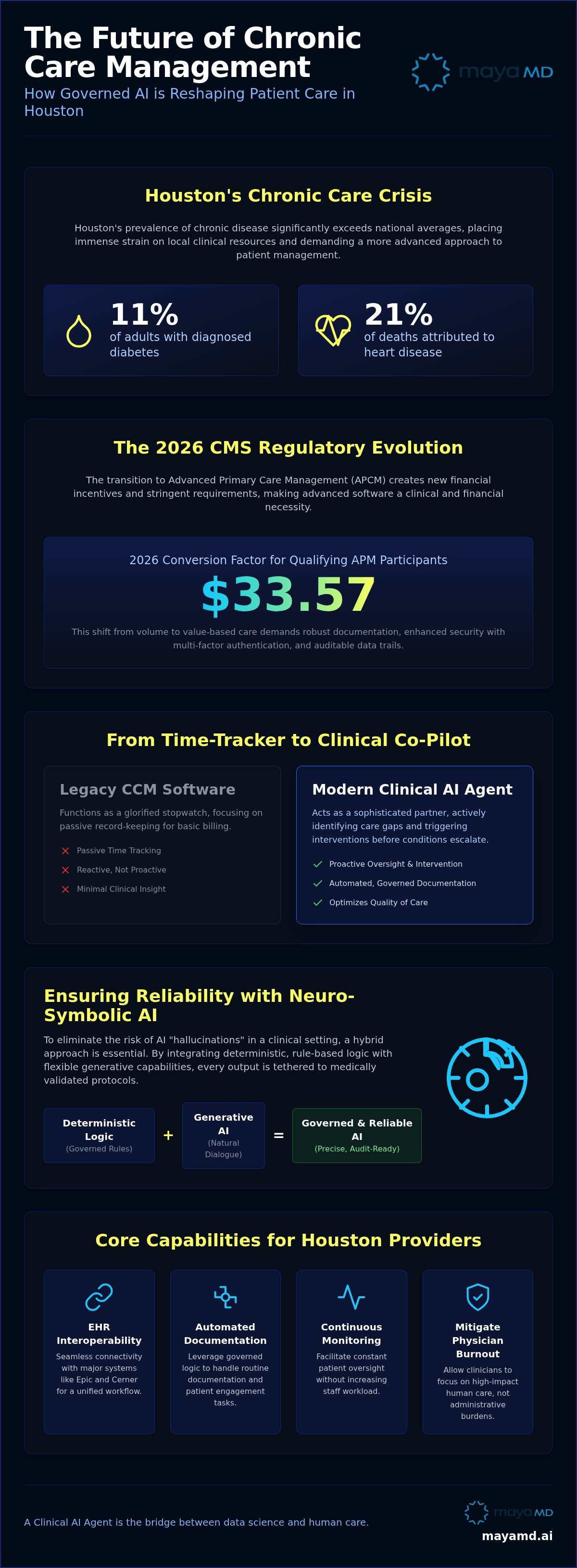
In Houston, approximately 11% of adults aged 20 and older are currently navigating diagnosed diabetes, a prevalence rate that significantly exceeds the national average and places an immense strain on local clinical resources. You likely feel the weight of this demand every day as your team struggles to balance high-quality patient interactions with the rigorous, manual documentation required for CMS compliance. The search for reliable chronic care management software Houston providers can trust has moved beyond simple time-tracking toward a need for sophisticated, automated clinical support that doesn't compromise on safety.
We understand that the fear of AI hallucinations and the complexity of 2026 APCM reimbursement requirements can make technological adoption feel like a high-stakes gamble. This article demonstrates how integrating advanced Clinical AI and governed logic into your workflow can automate administrative burdens while securing maximum reimbursement. We will examine the shift toward neuro-symbolic AI to eliminate documentation errors and explore the updated 2026 Medicare Physician Fee Schedule, which now offers a conversion factor of $33.57 for qualifying APM participants. You'll discover how a bridge between data science and human care can finally mitigate physician burnout and deliver the continuous monitoring your patients deserve.
Key Takeaways
• Understand how 2026 CMS reimbursement updates and localized health trends are shaping the selection of chronic care management software Houston clinics need to remain competitive.
• Discover the role of neuro-symbolic AI in eliminating clinical hallucinations, ensuring that automated documentation remains precise, governed, and audit-ready.
• Learn how a Clinical AI Agent serves as a sophisticated bridge between patient data and human care, facilitating continuous monitoring without increasing staff workload.
• Explore the technical requirements for interoperability with major EHR systems like Epic and Cerner to ensure seamless connectivity across the Houston healthcare landscape.
• Identify strategies to mitigate physician burnout by leveraging governed logic to automate patient engagement and routine documentation tasks.
Navigating the 2026 Chronic Care Landscape in Houston
Houston's healthcare ecosystem, anchored by the Texas Medical Center, represents one of the most complex clinical environments in the nation. As we enter 2026, chronic care management (CCM) has evolved from a discretionary billing activity into a core operational pillar for local providers. This transformation is driven by a shift toward value-based care, where the success of a practice is measured by its ability to manage longitudinal patient health rather than individual visit volume. Utilizing a robust Chronic Care Model allows Houston clinicians to bridge the gap between episodic encounters and continuous wellness, ensuring that patients don't fall through the cracks of a fragmented system.
Local health data necessitates this rigorous approach. With heart disease accounting for 21% of deaths in the three-county Houston area and diabetes prevalence reaching 11% among adults, the demand for precise chronic care management software Houston solutions has reached a critical threshold. Providers in the suburbs and the city center alike must now navigate a landscape where high-risk patient populations require constant oversight to prevent avoidable hospitalizations. This requires a level of connectivity and data integration that traditional, siloed systems simply cannot provide.
The Houston Healthcare Challenge
Houston's high-density market forces hospital systems to prioritize patient retention through superior clinical outcomes. Implementing digital healthcare for chronic disease isn't just about convenience; it's a strategic mechanism for maintaining patient stickiness in a competitive field where patients have numerous choices for specialized care. Large-scale Houston hospital systems face unique administrative pressures, requiring platforms that integrate seamlessly with existing workflows to manage thousands of complex patients. By automating the documentation process, these systems allow clinicians to focus on the human impact of care rather than the mechanics of the software.
Why 2026 Demands Advanced CCM Solutions
The regulatory environment in 2026 has fundamentally changed. The transition from traditional CCM to advanced primary care management (APCM) reflects a move toward more comprehensive, outcome-based reimbursement models. With 2026 CMS policy updates setting the conversion factor at $33.57 for qualifying APM participants, the financial viability of a practice depends on its ability to meet stringent documentation and security standards. This includes mandatory multi-factor authentication and enhanced data encryption for protected health information. Modern CCM software serves as a fundamental clinical necessity that bridges the gap between data and human care, rather than a mere administrative luxury for time tracking.
Beyond Time Tracking: The Evolution of Clinical AI in CCM Software
Legacy CCM software often functions as little more than a glorified stopwatch. While these "timers" were sufficient for basic billing in previous years, the 2026 Houston healthcare market demands a more proactive oversight mechanism. Modern chronic care management software Houston clinics deploy must transition from passive record-keeping to active clinical participation. This is where the Clinical AI Agent enters the workflow, acting as a sophisticated partner that identifies care gaps and triggers interventions before a patient's condition escalates. It's no longer just about tracking minutes; it's about optimizing the quality of every second spent on patient care.
The core of this evolution lies in the distinction between general-purpose models and "governed" AI. MayaMD utilizes a neuro-symbolic approach, which integrates deterministic logic with generative capabilities. This hybrid framework ensures that while the system can engage in natural dialogue, every output is tethered to medically validated protocols. It's a system designed for high-stakes reliability, providing a stable bridge between disparate data points and actionable human care. By synthesizing complex information into concise summaries, it allows providers to maintain clinical authority without being buried under a mountain of raw data.
Governed AI vs. General Purpose Models
Clinical safety is non-negotiable. General-purpose AI models are notoriously prone to "hallucinations," where they fabricate medical data that can lead to catastrophic errors in a patient's record. By prioritizing a clinical ai agent for primary care that operates within a governed logic framework, Houston providers can eliminate these risks. This architecture maintains HIPAA compliance by ensuring data encryption and multi-factor authentication are baked into the logic. The result is a secure environment where technology supports, rather than complicates, the clinical decision-making process.
Automating the Documentation Burden
Burnout remains a primary threat to physician longevity in high-pressure environments like the Texas Medical Center. Manual documentation of chronic care notes and post-discharge communication consumes hours that should be spent on direct patient care. By implementing clinical workflow automation solutions, practices can synthesize real-time data for Principal Care Management (PCM) specialists automatically. This reduces the cognitive load on staff and ensures that every interaction is captured for audit-ready billing. Transitioning to a model of continuous, AI-assisted monitoring allows for better patient outcomes and higher staff satisfaction. If you're ready to explore how these technologies integrate into your specific practice, learning more about MayaMD's governed solutions is the logical next step.
Essential Features for Houston Healthcare Providers: Compliance and Connectivity
In a clinical environment as dense and competitive as the Texas Medical Center, connectivity is the lifeblood of operational efficiency. Houston providers require a technological framework that integrates seamlessly with existing infrastructures, particularly major EHR systems like Epic and Cerner. The ideal chronic care management software Houston clinics deploy must act as a bridge between disparate data points, ensuring that patient information flows securely across the entire care continuum. Without high-level interoperability, CCM programs risk becoming siloed, leading to fragmented care and missed opportunities for early intervention in high-risk populations.
The financial viability of CCM in 2026 relies on a sophisticated billing engine capable of navigating the latest CMS updates. With the Medicare Physician Fee Schedule conversion factor set at $33.57 for qualifying APM participants, precision in coding is paramount. Software must automate the tracking and documentation for CPT 99490 and 99439 while simultaneously supporting the transition to Advanced Primary Care Management (APCM) codes. This level of automated oversight ensures that practices maximize their reimbursement potential while remaining strictly compliant with the increased scrutiny from the Office of Inspector General.
The Unified Care Management Dashboard
A unified dashboard is the command center for modern chronic care, synthesizing data from CCM, PCM, and remote patient monitoring software into a single, actionable view. This integration allows for the concurrent billing of multiple virtual care services, a key trend for 2026 that drives significant revenue growth. By utilizing deterministic alerts, the system can trigger immediate interventions when patient vitals deviate from established protocols. Customizable care plan templates further enhance this by allowing Houston specialists to address specific regional health clusters, such as the high prevalence of diabetes and cardiovascular disease.
Security and Regulatory Oversight
Security standards in 2026 have moved from addressable safeguards to mandatory requirements. Proposed HIPAA updates now necessitate multi-factor authentication for all access points to electronic Protected Health Information and compulsory encryption for data both at rest and in transit. A HIPAA-compliant cloud architecture provides the stability and security required to navigate these rigorous standards. By maintaining audit-ready documentation across the principal care management tools ecosystem, providers can confidently face payer reviews. This systematic approach to data integrity protects the practice from legal risks while fostering long-term trust with the patient population.
Strategic Implementation: Integrating CCM Software into Houston Workflows
Transitioning from manual oversight to an AI-governed model requires a tactical roadmap that respects the high-volume nature of Houston's clinical environments. Successful deployment of chronic care management software Houston providers rely on isn't merely a technical installation; it's a strategic alignment of technology with existing clinical workflows. This process ensures that the transition enhances rather than disrupts the delivery of care, allowing staff to reclaim time for direct patient interaction. By following a structured implementation plan, practices can secure the benefits of automated documentation while maintaining the highest standards of clinical safety.
Step 1: Identifying eligible chronic care populations.
Utilize data analytics to filter your Houston patient base for those with two or more chronic conditions, such as the 11% of local adults diagnosed with diabetes.
Step 2: EHR integration and Clinical AI Agent configuration.
Connect the platform to your primary EHR, whether Epic, Cerner, or a specialized system, and calibrate the Clinical AI Agent to follow your specific practice protocols.
Step 3: Staff training and workflow optimization.
Educate your team on AI-assisted documentation to ensure they understand how the system captures time and generates compliant clinical notes automatically.
Step 4: Continuous monitoring and care plan adjustments.
Use real-time data feeds to adjust care plans dynamically, ensuring that interventions remain relevant to the patient's evolving health status.
Overcoming the Integration Hurdle
Busy Houston clinics cannot afford prolonged operational downtime. Minimizing disruption requires a system built on deterministic logic, which allows for the precise mapping of existing clinical protocols into the AI framework. This governed approach ensures that the technology acts as a reliable extension of the provider's intent. By leveraging AI for rapid patient enrollment and automated consent management, practices can bypass the traditional administrative bottlenecks that often stall CCM adoption. If you're ready to modernize your practice, explore our implementation roadmap to see how we streamline this transition.
Measuring CCM Program Success
Success in 2026 is defined by a trifecta of clinical outcomes, maximized reimbursement, and staff satisfaction. Using AI-driven analytics, providers can identify care gaps in real-time, allowing for immediate corrective action before complications arise. These KPIs provide a clear picture of the program's ROI, demonstrating how automated oversight reduces physician burnout while increasing the practice's financial health. Scaling these solutions from a single-site clinic to a multi-site Houston healthcare system becomes a seamless process when the underlying logic remains consistent and governed across the entire ecosystem.
MayaMD: Elevating Houston’s Chronic Care with Governed Clinical AI
MayaMD positions itself as more than a vendor; it functions as a sophisticated partner for Houston’s healthcare executives who value clinical precision over technological hype. In a city where the Texas Medical Center sets global benchmarks, your chronic care management software Houston partner must meet an equally rigorous standard of reliability. We provide a bridge between disparate data points and human care, ensuring that every technological intervention supports the provider-patient connection. Our Clinical AI Agent doesn't just automate tasks. It fosters a sense of continuous support that drives patient retention and engagement across diverse populations, moving your practice past the experimental phase into proven application.
The Neuro-Symbolic Advantage
The primary differentiator of the MayaMD platform is our commitment to a "governed" AI approach that prioritizes safety and precision. While general-purpose models are notorious for clinical hallucinations, our neuro-symbolic architecture integrates deterministic logic with generative capabilities to ensure absolute accuracy in medical records. This logic-based framework ends the era of manual documentation by providing governed automation that adheres to strict clinical protocols. By prioritizing stability and regulatory adherence, we help practices future-proof their operations for the next decade of digital healthcare. This systematic approach significantly reduces the administrative load on staff, directly addressing the high physician burnout rates prevalent in busy metropolitan clinics while maintaining a sober, reliable oversight of patient health.
Partnering for Success in Houston
We understand that Houston healthcare providers face unique competitive and regulatory pressures that require more than a generic software solution. Our implementation strategies are tailored to the local landscape, providing seamless connectivity with major EHR systems and specialized access to APCM and PCM modules. This local support ensures that your practice can navigate the complexities of 2026 CMS reimbursement requirements with minimal staff intervention and maximum confidence. Our platform is designed to be a reliable, collaborative expert that values measurable performance and long-term partnerships over fleeting trends. If you're ready to transition from passive time-tracking to active, AI-governed clinical support, schedule a demo with MayaMD to transform your chronic care management and reclaim your clinical workflow.
Securing the Future of Houston’s Clinical Excellence
The evolution of healthcare in 2026 demands a shift from passive administration to active, AI-governed oversight. Houston providers are uniquely positioned to lead this transformation by adopting technologies that prioritize clinical safety and operational precision. By leveraging neuro-symbolic AI that eliminates clinical hallucinations, your practice can secure its documentation process while significantly reducing the administrative burnout that often hinders local clinical teams.
Selecting the right chronic care management software Houston platform ensures your organization remains compliant with the latest HIPAA security mandates and CMS reimbursement protocols. A secure, HIPAA-compliant cloud architecture provides the necessary foundation for scalable growth and enhanced patient connectivity through continuous monitoring. It's time to move beyond legacy systems and embrace a future where advanced data science strengthens the human impact of care.
Request a Clinical AI Demo for Your Houston Practice to see how our governed logic can transform your clinical workflow. We look forward to partnering with you to elevate the standard of chronic care in Texas.
Frequently Asked Questions
What is the difference between CCM and RPM software in 2026?
CCM focuses on non-face-to-face care coordination for patients with multiple chronic conditions, while RPM involves the physiological data collection via connected devices. In 2026, the primary difference lies in the layering of these services; CCM manages the longitudinal care plan, whereas RPM provides the real-time data synthesis required for immediate intervention. MayaMD integrates both into a unified dashboard to maximize reimbursement and clinical oversight for Houston providers.
How does Clinical AI reduce physician burnout in Houston practices?
Clinical AI reduces burnout by automating the documentation of chronic care notes and post-discharge communications. Instead of manual data entry, the Clinical AI Agent synthesizes patient interactions into audit-ready records. This allows Houston providers to focus on high-stakes clinical decision-making rather than administrative tasks. By reclaiming hours of provider time, the software mitigates the cognitive load associated with managing complex patient populations in the Texas Medical Center.
Is MayaMD’s CCM software fully HIPAA compliant?
Yes, MayaMD utilizes a HIPAA-compliant cloud architecture specifically designed for protected health information. Our platform incorporates mandatory multi-factor authentication and enhanced data encryption for information both at rest and in transit. These security protocols align with the 2026 HIPAA Security Rule updates. We prioritize regulatory adherence and data integrity to ensure that every patient interaction is secure, providing Houston healthcare executives with the reliability required for large-scale operations.
Can CCM software integrate with my existing EHR system?
Connectivity is a core feature of the MayaMD platform, allowing for seamless integration with major EHR systems like Epic and Cerner. Our software acts as a bridge between disparate data points, ensuring that chronic care management software Houston clinics use doesn't create new data silos. This interoperability is essential for maintaining a unified patient record and ensuring that all clinical workflow automation solutions function in harmony with your existing infrastructure.
What are the Medicare reimbursement requirements for CCM in Houston?
Medicare requires documented patient consent and an initiating face-to-face visit for new patients before billing begins. For 2026, the conversion factor is $33.57 for qualifying APM participants. Providers must track at least 20 minutes of non-complex CCM or 60 minutes of complex CCM per calendar month. Our platform automates this time-tracking and documentation to ensure all claims meet the stringent audit requirements of CMS and the Office of Inspector General.
How does neuro-symbolic AI prevent hallucinations in clinical notes?
Neuro-symbolic AI prevents hallucinations by combining generative AI with deterministic logic. While generative models can fabricate data, our governed approach tethers all outputs to medically validated protocols and systematic frameworks. This ensures that clinical notes are accurate and safe, eliminating the risks associated with general-purpose AI. By using this logic-based structure, MayaMD provides a stable environment for clinical documentation that maintains the highest formality and precision standards.
What chronic conditions are eligible for CCM software management?
Eligibility requires two or more chronic conditions expected to last at least 12 months or until the end of the patient's life. Common conditions managed in Houston include:
• Diabetes, which affects approximately 11% of local adults
• Heart disease and cardiovascular conditions
• Cancer and chronic respiratory diseases
• Alzheimer’s disease and dementia
• Arthritis and clinical depression
Our platform provides customizable care plan templates for these specific condition clusters.
How long does it take to implement MayaMD’s CCM platform?
Implementation typically follows a structured roadmap designed to minimize disruption to daily operations. While the timeline varies based on the size of the practice and EHR complexity, our team focuses on rapid configuration of the Clinical AI Agent and staff training. We utilize deterministic logic to map existing clinical protocols quickly, allowing Houston practices to begin identifying eligible populations and capturing consent within a matter of weeks rather than months.




See The MayaMD Difference
Fill the form below
Download Our Apps
MayaMD for patients and MayaPro for physicians - available on iOS and Android.
FOR PATIENTS
MayaMD App
AI-powered symptom assessment, triage, and secure access to your care team.


FOR PHYSICIANS
MayaPro App
MayaPro brings patient vitals, RPM/PCM care plans, and clinical decision support to your pocket.