
Chicago Medicare AI: Efficient Chronic Care Management

Clinical documentation should be the natural byproduct of patient care, yet for most Chicago practitioners, it has become a primary driver of professional burnout. You likely recognize the frustration of tracking clinical staff time to meet the 20-minute threshold for CPT 99490, only to find that manual errors or poor tracking have compromised your reimbursement. The integration of governed AI for medicare chronic care management represents a fundamental shift from reactive administration to proactive, clinical oversight. By utilizing deterministic logic alongside generative capabilities, providers can finally eliminate the threat of AI hallucinations while ensuring every billable second is captured with precision.
It's understandable to feel skeptical about automated tools when patient safety and CMS compliance are on the line. This article demonstrates how a sophisticated Clinical AI Agent streamlines CCM and APCM workflows to ensure 100% regulatory adherence without increasing your team's workload. We'll explore the technical frameworks that facilitate seamless patient engagement between visits and examine how these systems secure the latest 2026 Medicare reimbursement rates. You'll learn to transition your practice into a high-performance environment where technology serves as a reliable bridge between data points and human care.
Key Takeaways
• Learn how "governed" AI architecture eliminates clinical hallucinations by combining deterministic medical logic with advanced generative capabilities.
• Discover how implementing AI for medicare chronic care management automates the tracking of clinical staff time to ensure 100% CMS compliance for 2026 billing.
• Compare the efficiency of AI-generated clinical summaries against traditional manual care coordination to significantly reduce physician documentation burden.
• Understand the latest 2026 regulatory updates for RPM and APCM codes to optimize your practice's reimbursement strategy and operational stability.
• Explore how a Clinical AI Agent fosters continuous patient engagement between visits, leading to improved outcomes and higher-stakes reliability in care delivery.
Understanding Medicare Chronic Care Management (CCM) in the AI Era
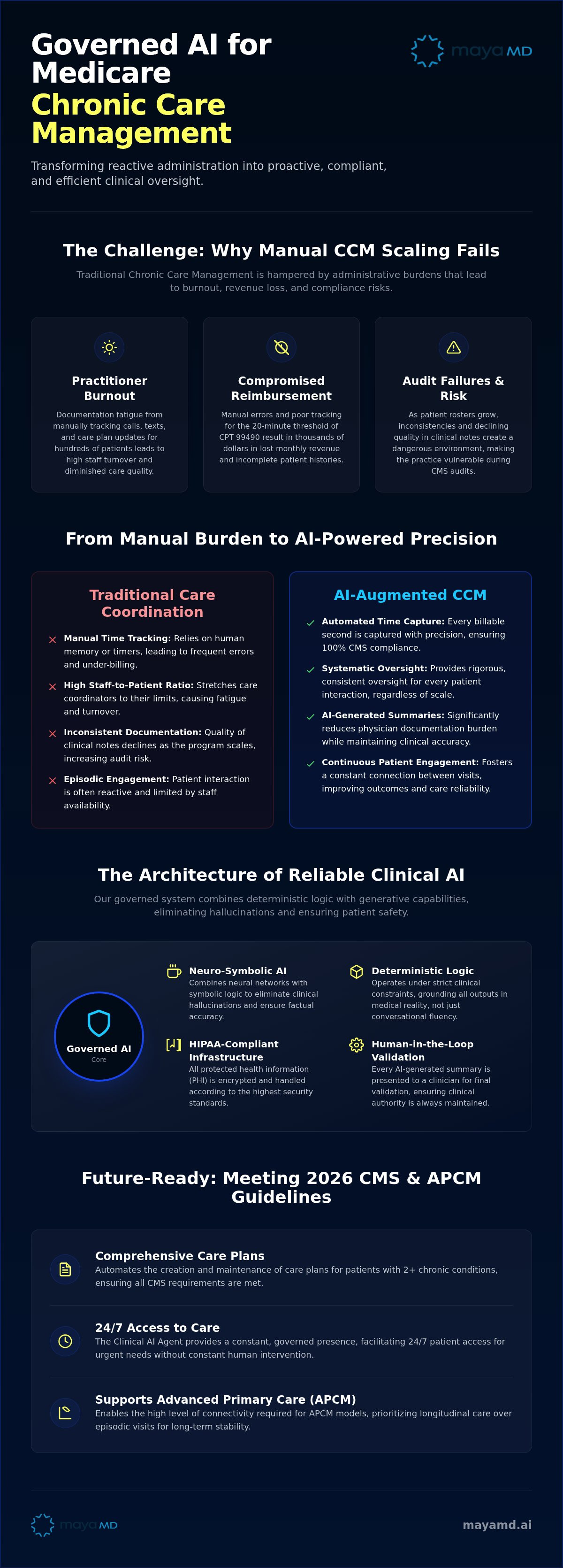
Medicare defines Chronic Care Management as a comprehensive service designed for patients living with two or more chronic conditions expected to last at least 12 months. For years, the gold standard for non-complex CCM billing has been CPT 99490, which requires at least 20 minutes of clinical staff time per month. While the clinical intent is sound, the operational reality is often characterized by a significant documentation gap. Providers frequently deliver high-quality care that goes unrecorded, resulting in thousands of dollars in lost monthly revenue and incomplete patient histories. This is where the implementation of governed AI for medicare chronic care management becomes essential; it acts as a silent partner that captures every interaction with clinical precision.
The 2026 CCM Landscape: CMS Requirements and Billing
The regulatory framework for 2026 maintains strict eligibility criteria. Patients must have multiple conditions that put them at significant risk of death, acute exacerbation, or functional decline. To bill successfully, practices must establish a comprehensive care plan and ensure patients have 24/7 access to care for urgent needs. CMS has also introduced a clear shift toward advanced primary care management (APCM) models, which prioritize longitudinal care over episodic visits. These models require a high level of connectivity that manual systems simply can't sustain. A Clinical AI Agent bridges this divide by maintaining a constant, governed presence in the patient's care journey, ensuring all requirements for comprehensive care are met without constant human intervention.
The Administrative Burden: Why Manual CCM Scaling Fails
Traditional care coordination models typically rely on a high ratio of care coordinators to patients, often stretching staff to a breaking point. In major healthcare hubs like Indianapolis and Phoenix, documentation fatigue has become a leading cause of staff turnover. When a coordinator is tasked with manually tracking every phone call, text, and care plan update for hundreds of patients, errors are inevitable. These inconsistencies create a dangerous environment for audit failures. Scaling a CCM program manually often leads to diminishing returns; as the patient roster grows, the quality of clinical notes tends to decline. Relying on human memory or manual timers for CPT code compliance is no longer a viable strategy for practices aiming for long-term stability. By contrast, a systematic AI framework provides the rigorous oversight needed to ensure every patient interaction is compliant, secure, and medically valid.
The Architecture of Reliable Clinical AI: Beyond Generative Chatbots
Stability. Precision. Reliability. These aren't just buzzwords; they're the architectural pillars of a Clinical AI Agent. Unlike generic "black box" generative models that prioritize fluid conversation over factual accuracy, a governed system operates under strict clinical constraints. In the context of Medicare's Chronic Care Management Services, there's zero margin for error. By deploying AI for medicare chronic care management that prioritizes deterministic logic, providers ensure that patient data remains grounded in medical reality. This approach moves beyond the experimental phase into proven application, where technology serves as a reliable bridge between disparate data points and human care.
Operating within a HIPAA-compliant cloud infrastructure, the platform ensures that all protected health information is encrypted and handled according to the highest security standards. The system is intentionally designed with a human-in-the-loop requirement. This means every AI-generated summary or care plan update is presented to a clinician for final validation. It's a collaborative expert model that values clinical authority over complete automation, ensuring that the final decision always rests with the practitioner. This methodical rhythm mirrors a clinical process, building trust through transparency and measurable performance.
Neuro-Symbolic AI: Eliminating Clinical Hallucinations
Neuro-symbolic AI represents the sophisticated fusion of neural networks, which excel at pattern recognition, and symbolic logic, which adheres to fixed rules. This dual-layered approach creates a system where every generative output is cross-referenced against a knowledge base of established medical facts. By combining these two methodologies, the framework prevents the AI from fabricating patient symptoms or diagnostic data during the documentation process. This architecture is the foundation for healthcare ai without hallucinations, providing a level of safety that standard large language models simply cannot match.
Integration with Existing Clinical Workflows
An effective Clinical AI Agent functions as a seamless extension of the care team. It "listens" to patient interactions and automates documentation in real-time, preserving the vital patient-provider bond without the distraction of manual data entry. Data portability is maintained through robust EHR integration, ensuring that chronic care records remain synchronized across the continuum of care. Integrating AI for medicare chronic care management into your current workflow also facilitates robotic process automation in healthcare for billing, where specific interactions are automatically mapped to CMS-compliant G-codes. If you're looking to upgrade your practice's technological infrastructure, exploring a Clinical AI Agent can provide the rigorous oversight your patients deserve.
Comparing AI-Augmented CCM to Traditional Care Coordination
Traditional care coordination often operates under the physical constraints of human staff, where documentation consumes more time than actual patient interaction. In a manual setup, a coordinator might spend fifteen minutes reviewing a patient's history just to prepare for a five-minute check-in call. Utilizing AI for medicare chronic care management transforms this ratio by delivering structured clinical insights instantly. This systemic efficiency allows the clinical team to focus on high-acuity interventions rather than the administrative friction of chart review. By automating the generation of clinical summaries, the platform ensures that the provider's focus remains on the human element of care delivery.
Compliance accuracy is another area where manual systems struggle. Human-tracked minutes are prone to estimation errors or simple forgetfulness, leading to missed billing opportunities or audit risks. A Clinical AI Agent provides automated time-stamping with millisecond precision, creating an immutable log of all care activities. This level of rigor is especially critical in high-demand markets like Houston and Las Vegas, where the volume of patients with complex needs can quickly overwhelm traditional staffing models. Scaling your program with AI for medicare chronic care management ensures that these high-demand regions maintain a high standard of care without sacrificing operational stability.
Efficiency and ROI: The Provider Perspective
Profitability in chronic care depends on the ability to manage larger patient panels without increasing overhead. In traditional models, a single care coordinator has a limited capacity before the quality of documentation begins to suffer. AI-augmented systems can significantly increase this capacity by handling the repetitive tasks of data collection and initial outreach. This reduction in "unbilled time" through automated activity logs ensures that every interaction is captured and coded correctly. Adopting digital healthcare for chronic disease allows practices to move away from episodic billing toward a more sustainable, continuous revenue model.
Clinical Outcomes and Patient Retention
Continuous monitoring is the key to preventing the acute exacerbations that lead to hospital readmissions and emergency room visits. The CMS Artificial Intelligence Strategy emphasizes the importance of using advanced data science to improve health outcomes, and a Clinical AI Agent fulfills this by identifying "at-risk" patients before a crisis occurs. If a patient's vitals or self-reported symptoms deviate from their baseline, the system alerts the provider immediately. This proactive engagement doesn't just improve clinical metrics; it also boosts patient satisfaction scores (HCAHPS). Patients feel more connected and supported when their care team is aware of their status in real-time, which naturally leads to higher retention rates and better long-term health results.
Navigating 2026 CMS Guidelines for AI-Enhanced Care Management
CMS is increasingly prioritizing outcomes over activity volume. In 2026, the regulatory framework for Remote Patient Monitoring (RPM) and Principal Care Management (PCM) has matured to favor integrated technology. Utilizing AI for medicare chronic care management ensures that your practice meets the rigorous Digital Health mandate, aligning clinical workflows with specific CMS quality measures. These measures now place heavy emphasis on data interoperability and real-time intervention, making manual tracking obsolete. This systemic shift requires a governed approach to data science to ensure that clinical precision is never sacrificed for administrative speed.
Providers in urban centers like Chicago and Phoenix must also contend with diverse Medicare Advantage plan requirements. While traditional Medicare provides a baseline, these private plans often demand higher levels of patient engagement and more granular reporting. A governed AI for medicare chronic care management system adapts to these regional variations, ensuring that documentation remains compliant regardless of the specific payer's nuances. This adaptability is the hallmark of a sophisticated partner that understands the complexities of a highly regulated industry.
APCM and PCM: Beyond Basic Chronic Care
The transition from fee-for-service CCM to value-based advanced primary care management (APCM) reflects a broader industry shift toward longitudinal health governance. While CCM focuses on multiple conditions, PCM targets a single, high-risk condition requiring intensive management. AI facilitates the Continuous Care requirement of PCM by maintaining a persistent connection with the patient through automated check-ins and symptom tracking. To successfully transition to these advanced codes, clinics should follow this structured checklist:
• Validate the existence of a single high-risk condition for PCM eligibility.
• Implement a HIPAA-compliant platform capable of longitudinal data aggregation.
• Ensure the Clinical AI Agent is mapped to generate the specific G-codes required for APCM.
• Review internal protocols to allow AI-generated clinical summaries to be verified by staff.
Compliance and Audit Readiness in 2026
Audits are a clinical reality, yet they don't have to be a source of anxiety. A governed AI creates an audit-proof trail by recording every patient interaction and time-stamping clinical staff activity with verifiable metadata. This level of transparency is vital in the Midwest, particularly as Indiana and Illinois refine their specific telehealth and remote care regulations. Best practices for documentation now dictate that AI-assisted notes must clearly identify the clinician's review and approval. By establishing this rigorous oversight, you protect your practice from the financial risks associated with inconsistent record-keeping. To secure your practice's future, consider how a Clinical AI Agent can stabilize your compliance framework.
MayaMD: Governing the Future of Medicare Chronic Care
MayaMD has established its position as the Authoritative Pioneer in the clinical AI space by focusing on safety, precision, and regulatory adherence. The Clinical AI Agent isn't just an auxiliary tool; it's the core engine for 2026 CCM success. By fusing sophisticated remote patient monitoring software with governed chronic care logic, the platform ensures that every clinical interaction is medically valid and compliant. The strategic deployment of AI for medicare chronic care management requires a partner that understands both the computer science and the nuances of clinical workflows. This transition from experimental technology to proven application provides the stability healthcare executives need to scale their programs with confidence.
The MayaMD Clinical AI Agent Advantage
The platform utilizes an "Agentic" approach to care, meaning the AI proactively manages tasks rather than simply responding to static prompts. It identifies physiological trends in patients with complex conditions like Hypertension, Diabetes, and COPD, then prepares actionable summaries for the care team. This proactive capability-to-outcome structure ensures that clinicians can spend more time on high-value patient interactions and less time on administrative data entry. It's a human-centric design specifically engineered to reduce physician burnout. By automating the tracking and documentation of clinical time, the system alleviates the cognitive load on staff, allowing them to focus on the human impact of their work. This systematic framework fosters deeper connection and support, turning technology into a bridge rather than a barrier.
Implementation Support in Your Region
Scaling a CCM program across diverse markets requires a nuanced understanding of regional healthcare dynamics. MayaMD provides localized implementation support for providers in cities such as Las Vegas, Indianapolis, and Houston, ensuring that local regulatory requirements are met with precision. The onboarding process is designed to be seamless for both large health systems and independent clinics, integrating directly with existing EHRs to maintain data portability. By leveraging AI for medicare chronic care management, organizations can finally move past the limitations of manual coordination to achieve measurable performance gains. We invite you to a strategic consultation to discuss your program's specific needs. Scheduling a demo and workflow audit is the first step toward securing a more efficient, audit-proof future for your practice.
Securing Your Clinical Legacy through Governed Innovation
The landscape of Medicare reimbursement has reached a critical inflection point where manual coordination can no longer sustain the demands of complex patient populations. By integrating AI for medicare chronic care management, your practice moves beyond the limitations of human documentation to achieve rigorous billing accuracy and enhanced patient engagement. This transition doesn't just improve your operational efficiency; it restores the focus to high-stakes patient care by removing the administrative friction that leads to physician burnout. Our Neuro-Symbolic AI architecture provides a governed framework that eliminates clinical hallucinations while maintaining strict HIPAA compliance throughout the care journey.
Trusted by providers in Chicago, Houston, and Phoenix, MayaMD stands as a sophisticated partner in navigating the complexities of 2026 CMS guidelines. It's time to transform your chronic care workflows into a model of systematic precision and clinical excellence. Request a Clinical AI Strategy Consultation with MayaMD to begin your practice's evolution toward automated, compliant care management. Embracing these advanced frameworks today ensures your practice remains a leader in the future of value-based medicine.
Frequently Asked Questions
Does Medicare allow the use of AI for Chronic Care Management billing?
Medicare supports the use of technology to facilitate CCM as long as clinical staff requirements are met. The AI doesn't bill independently; it acts as a tool to track the 20-minute monthly threshold for non-complex CCM. Using AI for medicare chronic care management ensures that time-stamping is precise and verifiable during audits. The final clinical review must always be performed by a qualified practitioner to maintain compliance.
How does AI prevent medical errors in CCM documentation?
AI prevents errors by utilizing Neuro-Symbolic architecture, which cross-references generative outputs with a deterministic medical knowledge base. This dual-layered approach eliminates hallucinations where the system might otherwise invent patient data or symptoms. By automating the transcription of patient interactions into structured clinical notes, the system reduces the risk of manual data entry errors. This level of rigor ensures that every record remains grounded in medical reality and preserves patient safety.
What is the difference between CCM and Advanced Primary Care Management (APCM)?
While Chronic Care Management (CCM) centers on patients with two or more conditions, Advanced Primary Care Management (APCM) is a newer, value-based model launched in 2025. APCM codes, such as G0556 and G0558, prioritize longitudinal care outcomes rather than strict minute-tracking. AI facilitates this transition by providing the continuous connectivity required for APCM. This shift allows practices to move away from episodic billing toward a more holistic, outcome-aligned payment structure.
Can AI help with Remote Patient Monitoring (RPM) reimbursement?
Yes, AI is instrumental in capturing the monitoring and communication time required for RPM codes like CPT 99457. The Clinical AI Agent automatically logs patient physiological data and records the time spent by clinical staff reviewing these metrics. This ensures that the 20-minute monthly requirement for monitoring is documented with verifiable accuracy. By integrating AI for medicare chronic care management, practices can maximize their RPM revenue while maintaining a secure, immutable audit trail for CMS.
How much time can AI save a care coordinator each month?
Care coordinators can save significant time by automating the generation of clinical summaries and patient outreach tasks. While specific time savings vary by practice volume, the system eliminates the clerical burden of manual chart review and activity logging. This efficiency allows coordinators to manage larger patient panels without increasing their daily workload. By reducing unbilled time, the platform ensures that staff can focus on high-acuity interventions that require human empathy and professional clinical judgment.
Is MayaMD’s clinical AI HIPAA compliant?
Yes, MayaMD operates within a strictly HIPAA-compliant, cloud-based infrastructure. All protected health information is encrypted during transmission and at rest, adhering to the highest industry security standards. The platform follows the CARIN Alliance Code of Conduct to ensure data privacy and interoperability. This secure framework provides healthcare executives with the peace of mind that their digital health solutions meet all federal regulatory requirements for patient data protection.
What happens if the AI makes a mistake in a patient’s care plan?
The system is designed with a mandatory human-in-the-loop requirement to prevent errors from reaching the patient. Every AI-generated care plan or clinical note is presented as a draft that must be reviewed, edited, and approved by a licensed clinician. This governed approach ensures that clinical authority remains with the provider. The platform functions as a collaborative expert that enhances human decision-making rather than a replacement for professional clinical oversight or judgment.
How does AI integration work with my existing EHR like Epic or Cerner?
Integration is achieved through robust API connectivity and data portability standards that allow for seamless synchronization with major EHRs. The Clinical AI Agent documents within your existing workflow, pushing structured data directly into the patient record. This eliminates the need for duplicate data entry and ensures that chronic care records remain consistent across the continuum of care. The onboarding process is methodical, ensuring that technical integration doesn't disrupt clinical productivity or the vital patient-provider bond.




See The MayaMD Difference
Fill the form below
Download Our Apps
MayaMD for patients and MayaPro for physicians - available on iOS and Android.
FOR PATIENTS
MayaMD App
AI-powered symptom assessment, triage, and secure access to your care team.

FOR PHYSICIANS
MayaPro App
MayaPro brings patient vitals, RPM/PCM care plans, and clinical decision support to your pocket.