
Benefits of Chronic Care Management for Providers: A 2026 AI-Driven Perspective

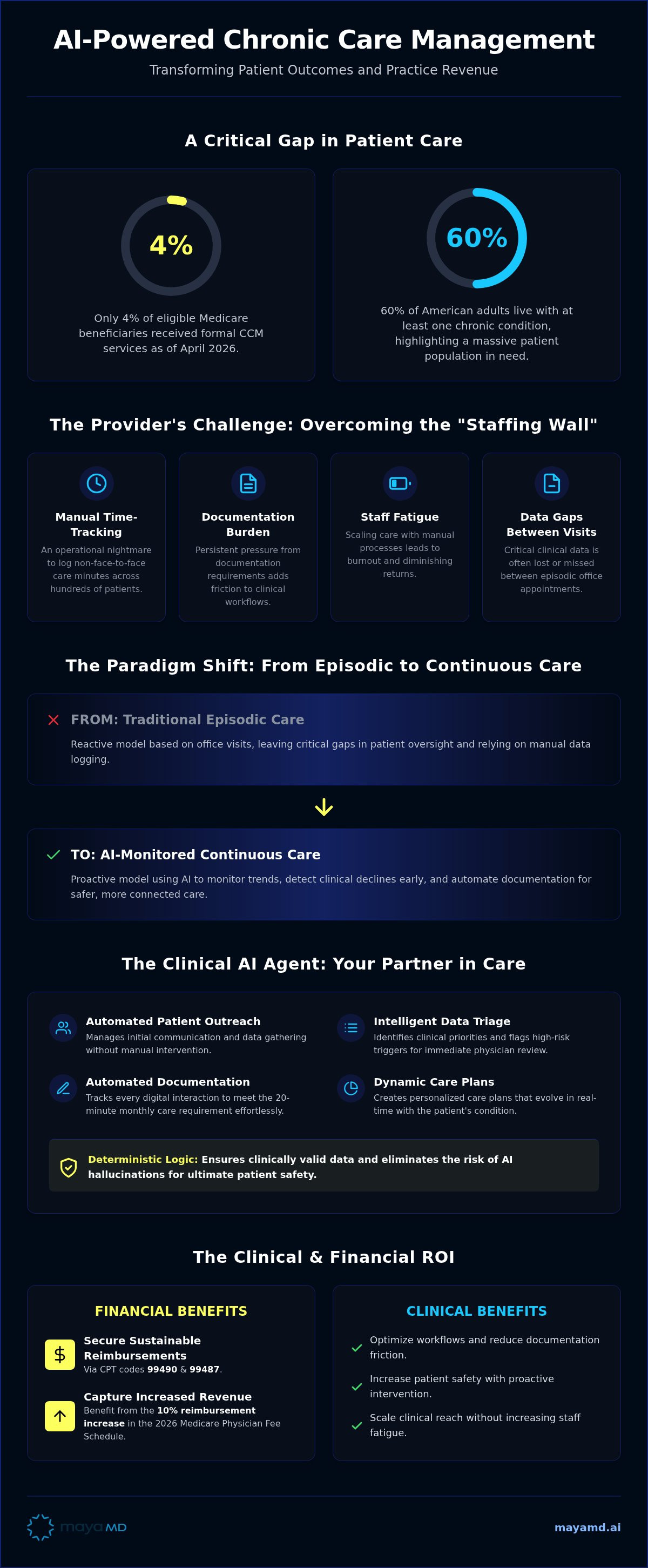
As of April 2026, only 4% of eligible Medicare beneficiaries have received formal Chronic Care Management services. This statistic highlights a massive disconnect between patient needs and provider capacity. One of the primary benefits of chronic care management for providers is the opportunity to bridge this gap through technology that scales clinical reach without increasing staff fatigue. You likely feel the persistent pressure of documentation requirements and the risk of clinical data slipping through the cracks between office visits.
It's time to move past the era of manual time-tracking. This article explores how AI-governed CCM platforms transform these challenges into a streamlined, high-revenue clinical workflow. You'll learn how deterministic logic eliminates the risk of AI hallucinations while securing sustainable reimbursements via CPT codes 99490 and 99487. We'll preview the 2026 Medicare Physician Fee Schedule updates and demonstrate how a sophisticated AI agent can act as a reliable partner in your practice's long-term success.
Key Takeaways
• Understand the fundamental shift from episodic office visits to continuous, AI-monitored care models that prioritize patient safety and clinical connectivity.
• Learn how Clinical AI Agents overcome the traditional "staffing wall" by automating complex patient outreach and data triage without increasing administrative burden.
• Discover the specific financial and clinical benefits of chronic care management for providers, including optimized workflows and maximized revenue via 2026 CPT code updates.
• Follow a systematic implementation framework to audit patient eligibility and integrate sophisticated AI-governed platforms into your existing EHR infrastructure.
• Identify the role of deterministic logic in eliminating clinical hallucinations, ensuring your practice remains compliant and secure in a highly regulated environment.
The Evolving Landscape of Chronic Care Management for Healthcare Providers
The healthcare industry has moved beyond the era of reactive medicine. In 2026, Chronic care management (CCM) isn't a peripheral service; it's a core clinical strategy for managing the 60% of American adults living with at least one chronic condition. CCM functions as a bridge between disparate data points and human care. One of the primary benefits of chronic care management for providers is the ability to maintain clinical oversight without the constraints of physical office walls. This systematic approach transforms fragmented patient data into a cohesive care narrative, ensuring that complex cases receive the attention they require. As patient complexity increases, the transition from episodic office visits to continuous, AI-monitored care becomes a necessity for clinical safety and practice longevity.
The Shift from Passive to Proactive Care Models
Traditional care models rely on episodic office visits, which often leave critical gaps in patient oversight. Transitioning to a continuous, AI-monitored model allows for the detection of subtle clinical declines before they escalate into acute events. For practitioners in high-density medical hubs like Chicago and Houston, this proactive intervention is essential for managing large, complex patient populations. By utilizing clinical AI to monitor physiological trends, providers can identify high-risk triggers that human observation might miss. This capability-to-outcome framework ensures that intervention occurs precisely when it's needed most. It effectively reduces the likelihood of emergency department visits and hospital readmissions by providing a safety net for patients between their scheduled appointments.
Regulatory Foundations and 2026 Compliance Standards
Navigating the 2026 regulatory environment requires rigorous adherence to documentation and security protocols. Medicare reimbursement for CCM now demands HIPAA-compliant, cloud-based integration to ensure data integrity and patient privacy. The 2026 Medicare Physician Fee Schedule has introduced a 10% increase in reimbursement for CCM codes, signaling a federal commitment to this care model. To maximize these incentives, practices are increasingly integrating CCM with Advanced Primary Care Management (APCM). This integration creates a unified workflow that satisfies compliance standards while capturing unrealized revenue. Systematic documentation isn't just a regulatory hurdle; it's the foundation of a sustainable, data-driven practice that prioritizes both clinical precision and financial health.
Transitioning from Manual Tracking to AI-Governed CCM Platforms
Manual care coordination often hits a "staffing wall" where the cost of human labor exceeds the reimbursement potential. This inefficiency is a primary reason why many provider experiences with CCM have historically been characterized by administrative frustration. Transitioning to an AI-governed platform solves this by deploying a Clinical AI Agent to manage initial patient outreach and data triage. This agent doesn't just send messages; it identifies clinical priorities and prepares the data for physician review. By utilizing neuro-symbolic frameworks, the platform eliminates "AI hallucinations" that plague standard generative models. This ensures that every piece of documented data is clinically valid and safe for patient care. It creates a seamless flow where technology handles the volume and humans handle the high-stakes decisions.
Automating the 20-Minute Monthly Requirement
The core of CCM reimbursement lies in documenting at least 20 minutes of non-face-to-face care per month. For clinics in Indianapolis and Phoenix, manually logging these minutes across hundreds of patients is an operational nightmare. AI-governed platforms automate this process by tracking every digital interaction, care plan update, and triage event in real-time. This technology creates dynamic, personalized care plans that evolve with the patient's condition. One of the significant benefits of chronic care management for providers is this reduction in documentation friction, allowing clinical staff to focus on high-risk interventions rather than clerical tasks. You can explore how these AI patient engagement solutions scale your practice without adding headcount.
Deterministic Logic vs. Generative AI in Care Safety
High-stakes chronic care requires more than just conversational fluency; it demands clinical precision. Generative AI is capable of producing sophisticated prose, but it lacks the guardrails necessary for medical decision support. Governed AI utilizes deterministic logic to ensure that every automated patient response adheres to established clinical protocols. MayaMD’s platform integrates these two technological pillars, using generative AI for empathetic engagement and deterministic logic for clinical validity. This hybrid approach provides the safety of a rules-based system with the scalability of modern artificial intelligence. It's a fundamental component in realizing the full benefits of chronic care management for providers, ensuring that patient support is both scalable and medically sound. This rigorous oversight protects the practice from compliance risks while improving the overall quality of care for complex cases.
Clinical and Financial ROI: Why CCM is Essential for Modern Practices
The clinical value of Chronic Care Management (CCM) is increasingly measured by its ability to prevent acute exacerbations before they require inpatient intervention. By maintaining a continuous digital tether to patients, practices can significantly reduce hospital readmission rates, particularly for those managing complex comorbidities. One of the central benefits of chronic care management for providers is the stabilization of patient health through persistent monitoring, which directly influences "Quality of Care" metrics essential for value-based payment models. Through AI-governed automation, CCM transforms what was once a resource-heavy cost center into a predictable, clinical revenue driver. This shift is supported by the 2026 Medicare Physician Fee Schedule, which offers approximately $62 to $66 for CPT code 99490. When combined with Remote Patient Monitoring (RPM), a single enrolled patient can generate roughly $1,991 in annual revenue, providing the capital necessary to sustain high-quality primary care.
Reducing Provider Burnout Through Workflow Automation
Physician burnout often stems from the psychological weight of "unseen" patients between office visits. AI-governed CCM alleviates this burden by ensuring that every patient is monitored 24/7, with clinical alerts prioritized by deterministic logic. The integration of robotic process automation in healthcare assists CCM by handling the repetitive data entry and logging required for compliance. This technical capability leads to a critical outcome: clinicians are freed from administrative minutiae to focus on high-acuity, complex decision-making. It restores the provider's role as a healer rather than a data clerk, fostering a more sustainable and rewarding professional environment.
Enhanced Patient Engagement and Retention
Frequent, high-quality touchpoints are the foundation of long-term patient loyalty. In competitive markets like Las Vegas, addressing the unique engagement needs of a diverse patient population requires more than just occasional phone calls. AI-driven CCM provides consistent, empathetic interactions that keep patients tethered to their care plan. This level of engagement has shown documented success in improving outcomes for hypertension and diabetes management by identifying subtle physiological shifts early. These regular interactions reinforce the provider-patient bond, ensuring that individuals feel supported throughout their health journey. When patients see measurable improvements in their daily wellness, they're more likely to remain committed to the practice, securing both clinical outcomes and practice stability. This holistic approach is a cornerstone of the benefits of chronic care management for providers who prioritize long-term clinical excellence.
Strategic Implementation: Overcoming Staffing and Documentation Barriers
Implementation of a sophisticated care model requires a methodical, top-down strategy. It is not merely a software installation; it's a structural realignment of clinical priorities. To realize the full benefits of chronic care management for providers, practices must follow a structured path that mitigates traditional staffing barriers. This process begins with an audit of your current patient population using deterministic logic to identify beneficiaries with two or more chronic conditions. Once eligible patients are identified, selecting a platform that offers bi-directional EHR integration is critical to prevent data fragmentation. Clinical staff must then be trained on an "AI-governed" workflow, where their role shifts from manual outreach to high-level oversight of the Clinical AI Agent. Finally, practices must capture and document patient consent efficiently; in 2026, this remains a one-time requirement that must be recorded in the patient's medical record to satisfy compliance standards.
Integrating CCM with Remote Patient Monitoring (RPM)
Clinical success in the modern era depends on the synergy between subjective patient reports and objective biometric data. When remote patient monitoring software feeds real-time data into the CCM engine, it creates a holistic digital healthcare ecosystem. This connectivity allows the Clinical AI Agent to trigger alerts based on actual physiological changes, such as a sudden spike in glucose or blood pressure. This capability-to-outcome structure ensures that care plan adjustments are based on precise data rather than anecdotal evidence. It's the most effective way to manage complex cases while maximizing the financial benefits of chronic care management for providers through the concurrent billing of CCM and RPM codes, which can generate approximately $1,991 per patient annually.
Managing Compliance in Local Markets
Practices operating in major markets like Illinois and Texas must navigate specific regulatory nuances while maintaining national standards. Secure, HIPAA-compliant messaging is the cornerstone of safe patient interaction, ensuring that all data remains protected within a systematic framework. Documentation best practices involve logging every minute of care coordination automatically to survive rigorous Medicare audits. By utilizing a platform that prioritizes regulatory adherence, you protect your practice from the increased scrutiny of the Office of Inspector General. You can partner with MayaMD to deploy a Clinical AI Agent that automates these compliance workflows and secures your practice's future.
Future-Proofing Your Practice with MayaMD’s Clinical AI Ecosystem
MayaMD stands as the authoritative pioneer for practices navigating the complexities of modern chronic care. Our platform isn't a standalone tool; it's a comprehensive ecosystem designed to bridge the gap between disparate data points and human-centric care. The unique value of the Clinical AI Agent is most evident in post-discharge scenarios where the risk of readmission is highest. By maintaining a governed digital presence, the agent ensures that patients follow their care plans during the critical transition from hospital to home. For specialists, our Principal Care Management tools complement existing CCM efforts by focusing on single, high-complexity conditions. This integration is one of the key benefits of chronic care management for providers who seek to provide holistic, continuous oversight for their most vulnerable populations.
A Vision for Governed AI in Clinical Workflows
We've moved beyond the experimental phase of artificial intelligence into a period of proven, reliable application. MayaMD utilizes neuro-symbolic AI to eliminate the risks of clinical hallucinations, ensuring that every automated summary and patient interaction meets the highest standards of accuracy. This technical framework provides a specific outcome: documentation that is both comprehensive and audit-ready. Sophisticated healthcare leaders choose this governed approach because it prioritizes patient safety while maximizing the benefits of chronic care management for providers. It's a commitment to precision that reflects the gravity of clinical decision-making. By applying deterministic logic to patient data, we provide a stable foundation for long-term clinical success.
Scalability for Multi-City Provider Networks
Managing care quality across large-scale deployments requires a platform that can standardize clinical workflows without sacrificing local autonomy. Whether your network operates in Indianapolis, Phoenix, or across multiple states, MayaMD ensures consistent care delivery at every touchpoint. This scalability allows multi-city organizations to maintain a unified clinical standard, protecting the practice's reputation and financial stability. Our infrastructure is designed for long-term partnerships, providing the logic and connectivity needed to thrive in a highly regulated industry. We invite you to transform your practice through a clinical consultation to explore how our digital healthcare solutions align with your specific goals. Schedule a demo of MayaMD’s Clinical AI Agent today to see how our ecosystem supports your clinical and financial objectives.
Advancing Clinical Excellence Through Governed AI Integration
The healthcare landscape in 2026 demands a departure from the manual inefficiencies of the past. By integrating deterministic logic and neuro-symbolic frameworks, your practice can bridge the gap between fragmented data and human care. The benefits of chronic care management for providers are realized through a systematic reduction in administrative burnout and the capture of significant, recurring revenue via optimized CPT coding. It's about moving from episodic visits to a continuous digital tether that protects both your patients and your practice's longevity.
MayaMD provides the high-stakes reliability needed for this transition. Our HIPAA-compliant Clinical AI platform offers rigorous oversight for RPM, PCM, and APCM workflows, ensuring that clinical safety is never compromised by technological hallucinations. You have the opportunity to lead this shift toward a more connected, data-driven medical ecosystem that prioritizes measurable performance over fleeting trends. This sophisticated approach ensures that every patient interaction is medically sound and operationally efficient.
Empower your clinical team with MayaMD’s AI-governed CCM solutions to secure your practice's future. Together, we can foster deeper patient support through the cold, hard logic of advanced data science. The path to a more sustainable and impactful practice starts with the right technological partner.
Frequently Asked Questions
How does Chronic Care Management benefit healthcare providers financially?
CCM generates recurring monthly revenue through non-face-to-face care coordination, providing a predictable income stream that stabilizes practice cash flow. In 2026, the Medicare Physician Fee Schedule conversion factor is $33.40, and a combined RPM and CCM enrollment can generate approximately $1,991 per patient annually. This model reduces overhead costs associated with uncompensated care and emergency interventions, effectively transforming a practice into a high-retention, value-based clinical environment.
What are the staffing requirements for a successful CCM program in 2026?
Successful CCM programs now utilize a hybrid model that combines clinical oversight with AI-governed agents. While a designated clinician must manage the care plan, the Clinical AI Agent handles the high-volume tasks of patient outreach and data triage. This structure overcomes the traditional "staffing wall" by allowing existing staff to monitor larger patient panels. You don't need to hire extensive new teams; instead, technology scales your current clinical reach.
Can AI really handle CCM documentation without human error?
Standard generative AI is prone to hallucinations, but MayaMD utilizes deterministic logic and neuro-symbolic frameworks to ensure absolute documentation accuracy. This "governed" approach applies established medical rules to every data point, eliminating the risk of fabricated clinical notes. While a physician remains the final authority, the AI agent provides a rigorous, error-free foundation of logs and summaries. This systematic oversight is one of the primary benefits of chronic care management for providers seeking regulatory security.
What is the difference between CCM and Remote Patient Monitoring (RPM)?
CCM focuses on the coordination of care for patients with two or more chronic conditions, primarily involving monthly care plan updates and engagement. RPM involves the collection and analysis of physiological data, such as blood pressure or glucose levels, via digital devices. While CCM is service-oriented and RPM is data-oriented, they are highly synergistic. Most practices bill both concurrently to provide a comprehensive continuous care model that improves clinical precision and practice revenue.
How does CCM improve patient outcomes for those with multiple chronic conditions?
CCM improves outcomes by closing care gaps that occur between traditional office visits. For patients with multiple chronic conditions, this continuous oversight ensures early detection of clinical declines and better medication adherence. Proactive intervention reduces the frequency of acute exacerbations and hospital readmissions. By providing a constant digital tether, the practice offers the high-stakes reliability necessary to manage complex comorbidities effectively while significantly improving the patient’s overall quality of life.
Is MayaMD’s CCM platform HIPAA-compliant and secure?
MayaMD’s platform is fully HIPAA-compliant and utilizes cloud-based, secure integration to protect sensitive patient information. We employ advanced encryption and rigorous access controls to ensure data integrity across all clinical workflows. Our systematic framework meets the strict security standards required for 2026 Medicare reimbursements. This commitment to security provides healthcare executives with the confidence that their data is protected against cybersecurity threats while maintaining absolute regulatory adherence.
What CPT codes are used for billing Chronic Care Management services?
Providers bill for non-complex CCM using CPT code 99490 for the initial 20 minutes and 99439 for subsequent increments. For complex cases requiring 60 minutes of clinical staff time, CPT code 99487 is utilized. Physicians performing services directly may use CPT code 99491. Understanding these codes is essential for maximizing the benefits of chronic care management for providers, as it ensures that all non-face-to-face coordination time is captured and reimbursed.
How do I identify which patients in my practice qualify for CCM?
Eligible patients are those with two or more chronic conditions expected to last at least 12 months or until the end of life. These conditions must place the patient at significant risk of death, acute exacerbation, or functional decline. Practices identify these individuals by auditing EHR data for ICD-10 codes related to conditions like hypertension, diabetes, or COPD. Once identified, the provider must obtain and document patient consent before initiating the CCM service.




See The MayaMD Difference
Fill the form below
Download Our Apps
MayaMD for patients and MayaPro for physicians - available on iOS and Android.
FOR PATIENTS
MayaMD App
AI-powered symptom assessment, triage, and secure access to your care team.
FOR PHYSICIANS
MayaPro App
MayaPro brings patient vitals, RPM/PCM care plans, and clinical decision support to your pocket.