
AI Solutions for Primary Care: 2026 Clinical Leader Guide

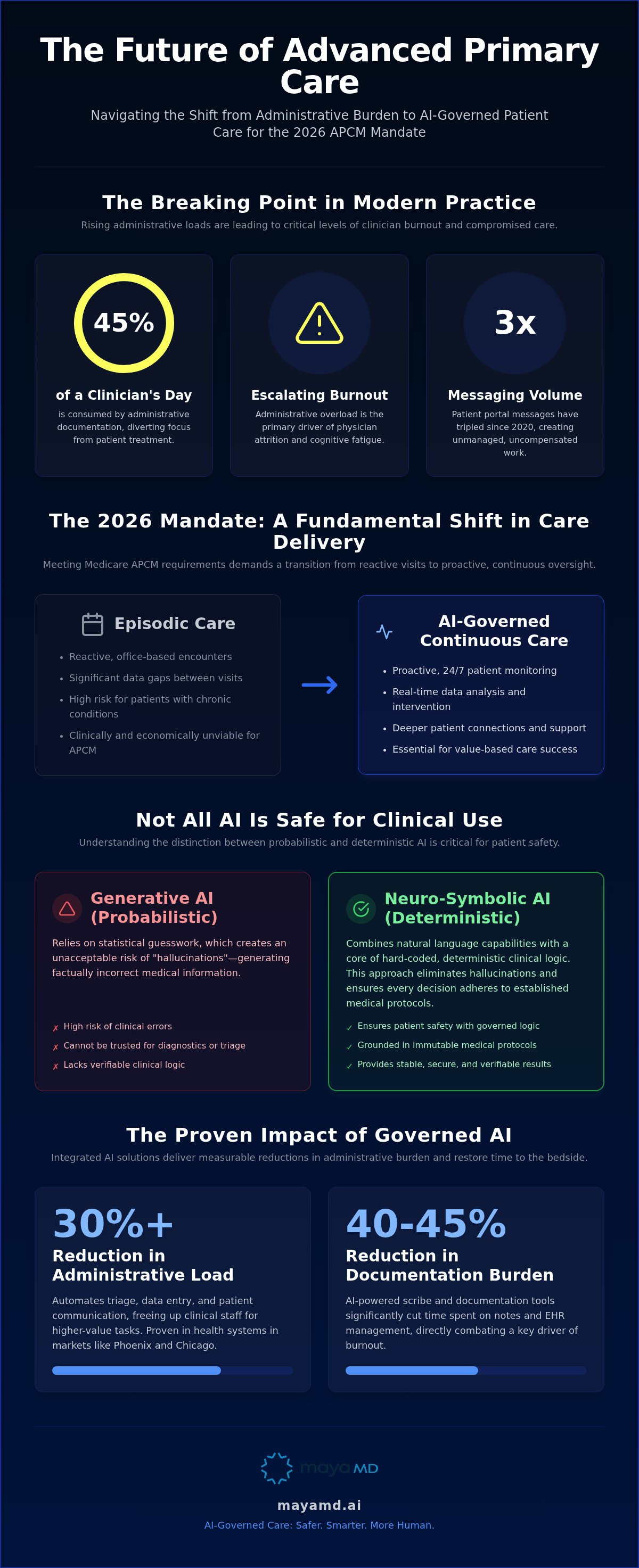
Could your practice survive another year where clinicians spend 45% of their day wrestling with documentation instead of treating patients? As we move through 2026, the pressure on clinical leaders has reached a critical inflection point. You're likely managing the friction between fragmented chronic care data and the rigorous Medicare APCM requirements. It's a heavy burden that often leads to clinician burnout and compromised patient outcomes.
This guide reveals how AI solutions for advanced primary care, built on deterministic logic, can reduce your administrative load by 30% or more while improving adherence in RPM programs. We'll detail the transition from experimental tools to proven neuro-symbolic systems that eliminate the risk of AI hallucinations. You'll discover a methodical framework for integrating APCM and PCM modules into a seamless clinical ecosystem that prioritizes both safety and measurable performance. By moving past the hype and into governed application, your organization can foster deeper patient connections without the technical fatigue of the past.
Key Takeaways
• Learn why the transition from episodic visits to continuous, AI-governed monitoring is essential for meeting 2026 Medicare APCM requirements.
• Understand the critical role of neuro-symbolic AI in combining deterministic logic with natural language to eliminate the risk of clinical hallucinations.
• Evaluate how integrated AI solutions for advanced primary care outperform siloed EHR tools by centralizing chronic care data and reducing administrative burden.
• Discover a phased roadmap for deploying clinical AI agents, beginning with workflow bottleneck assessments and pilot programs for high-risk populations.
• Gain insights into how established health systems in markets like Phoenix and Chicago are leveraging governed AI to achieve a 30% reduction in administrative tasks.
The Evolution of Advanced Primary Care: Why AI is Mandatory in 2026
2026 marks a definitive shift in the structural expectations of primary care. Advanced Primary Care Management (APCM) has evolved from a theoretical framework into a rigorous, data-driven mandate for clinical leaders. Relying on episodic, office-based encounters is no longer clinically or economically viable. Success now depends on AI solutions for advanced primary care that bridge the gap between patient visits. These systems don't just record data; they govern the flow of care. For organizations operating under value-based care models, the economic necessity is clear. Medicare's APCM reimbursement structures now reward organizations that maintain continuous connectivity and proactive intervention, making governed AI an essential component of financial stability.
The Crisis of Clinician Burnout in Primary Care
Burnout isn't a new phenomenon, but its current scale threatens the very foundation of primary care delivery. Administrative documentation remains the primary driver of physician attrition. Recent studies show that AI-powered scribe and documentation tools can reduce this burden by 40% to 45%, providing immediate relief to overextended staff. The pressure is compounded by the fact that patient portal messaging volume has tripled since 2020. This influx of digital communication often goes uncompensated and unmanaged, leading to cognitive overload. By integrating Artificial intelligence in healthcare, practices can automate the triaging of these messages. This returns "time to the bedside," allowing clinicians to focus on complex diagnostic work rather than data entry. It's about restoring the human element of medicine through technical precision.
Moving Toward Continuous Care Models
The transition from reactive to proactive patient management is the hallmark of modern clinical leadership. Traditional care models often leave high-risk patients in a vacuum between quarterly appointments. Effectively managing digital healthcare for chronic disease requires 24/7 oversight that human staff cannot provide alone. Care is now continuous. Deterministic AI agents act as a bridge, monitoring patient vitals and symptoms in real time through automated protocols. When AI solutions for advanced primary care are deployed correctly, they ensure that clinical logic is applied to every data point. This shift from episodic visits to continuous, AI-governed monitoring allows for immediate intervention. It transforms the patient experience from one of isolation to one of constant, reliable support, ensuring that no critical physiological change goes unnoticed.
Beyond Generative AI: The Role of Deterministic Logic and Clinical Agents
Generative AI has captured public imagination, but for clinical leaders, its probabilistic nature presents a significant risk. Hallucinations, the generation of factually incorrect medical information, are unacceptable in a primary care setting where patient safety is the primary metric. Effective AI solutions for advanced primary care must move beyond simple word prediction. They require a neuro-symbolic architecture that marries the flexibility of large language models with the rigid safety of deterministic logic. This hybrid approach ensures that while the AI can communicate naturally, its underlying clinical decisions are grounded in immutable medical protocols. As clinical leaders evaluate AI's role in population health, the focus has shifted from "can it talk" to "can it be trusted."
Deterministic Logic vs. Probabilistic Guesswork
Clinical protocols must be hard-coded into the software's core to ensure that every patient interaction adheres to established medical standards. This "governed" approach to AI maintains clinical authority by preventing the system from improvising during critical diagnostic or triage steps. MayaMD integrates these deterministic frameworks with large language models to provide a stable, secure environment for patient data. By prioritizing logic over probability, providers can deploy automated systems that don't just guess at a patient's needs; they follow a verified clinical path. This level of precision is mandatory for organizations seeking to maintain compliance with the 2026 OCR HIPAA enforcement standards, which now explicitly include automated decision systems.
The Rise of the Clinical AI Agent
The 2026 landscape has seen the emergence of the clinical ai agent for primary care as a vital member of the care team. These agents excel in post-discharge care and chronic management by providing 24/7 engagement that human staff cannot replicate. They automate clinical documentation without sacrificing the nuance required for complex cases. Because the agent's interactions are rooted in deterministic logic, they improve patient engagement through empathetic yet strictly logical interaction. This ensures that patients feel supported while clinicians receive accurate, structured data that is ready for immediate review. Transitioning to a clinical AI platform that utilizes these agents allows practices to scale their chronic care programs without increasing their headcount. It's a strategic move that addresses the administrative burden while simultaneously closing gaps in the patient care journey.
Evaluating AI-Driven APCM Platforms vs. Traditional EHR Tools
Traditional Electronic Health Records (EHR) were designed primarily as digital filing cabinets, optimized for billing and historical documentation rather than active care coordination. While these systems are essential for compliance, they often lack the dynamic responsiveness required for modern 2026 clinical standards. Specialized AI solutions for advanced primary care function as a proactive layer above the EHR, converting passive data into actionable clinical insights. These platforms don't just store information; they actively govern patient journeys by identifying risks before they escalate into acute events.
When managing 50,000+ patients across multiple health systems, scalability is not just a feature; it is a clinical necessity. Siloed tools often force clinicians to toggle between disparate interfaces, which exacerbates the very burnout these technologies are meant to solve. A unified ecosystem ensures that AI solutions for advanced primary care reduce administrative friction rather than adding to it. By centralizing documentation and patient engagement within a single, governed framework, clinical leaders can ensure a consistent standard of care across diverse populations and geographic regions.
APCM and RPM Synergy
The efficacy of an advanced primary care management platform depends on its ability to ingest and interpret real-time physiological data. Comprehensive remote patient monitoring software serves as the sensory input for the APCM engine, providing the continuous stream of vitals required for proactive intervention. This synergy allows for a closed-loop system where data points are automatically triaged by deterministic AI agents. The system filters these inputs to prevent notification fatigue, ensuring that alerts only reach the clinician when they require immediate medical action. This methodical approach transforms raw data into a strategic asset for chronic disease management.
Software Selection Criteria for 2026
Successful AI integration in primary care requires a platform that prioritizes interoperability with existing health system infrastructures. Leaders should prioritize solutions that support Principal Care Management (PCM) alongside APCM, allowing for the management of complex, single-specialty cases within the same ecosystem. Financial ROI is another critical pillar. The software must track reimbursement eligibility in real time, ensuring that the administrative savings of AI are matched by maximized revenue through 2026 Medicare codes. By selecting a platform that balances technical depth with clinical validity, organizations can achieve a 25% reduction in administrative costs within the first year of implementation.
Implementation Roadmap: Deploying AI Solutions in Primary Care
Successful deployment of AI solutions for advanced primary care isn't a matter of simple software installation. It's a methodical clinical evolution. Organizations must move through a structured roadmap to ensure that technical capabilities translate into measurable provider relief and patient safety. By following a phased approach, clinical leaders can mitigate the risks of "pilot purgatory" and achieve a governed, enterprise-wide rollout that aligns with 2026 regulatory standards.
Phase 1: Readiness Assessment.
Audit existing clinical workflows to identify specific documentation bottlenecks and data silos. Ensure your data architecture is HIPAA-compliant and ready for integration.
Phase 2: Targeted Pilot Programs.
Deploy AI agents for a specific high-risk cohort, such as patients with uncontrolled hypertension or Type 2 diabetes, to test deterministic logic in a controlled environment.
Phase 3: Workflow Integration.
Implement clinical workflow automation solutions to handle repetitive administrative tasks, such as patient outreach and scheduling.
Phase 4: Governance and Training.
Establish "human-in-the-loop" protocols where clinicians act as the final authority on AI-generated insights. Train staff on how to use AI as a clinical assistant rather than a replacement.
Phase 5: Performance Benchmarking.
Evaluate the system against initial KPIs, focusing on documentation time reduction and patient adherence rates before scaling to the full population.
Overcoming Staff Resistance to AI
Clinician buy-in is the most significant hurdle in any digital transformation. Resistance often stems from a fear of increased workload or the perceived "black box" nature of artificial intelligence. To counter this, position AI as a dedicated partner that eats the paperwork. Focus on immediate wins, such as the 40% reduction in documentation time often seen with AI-powered tools. When clinicians see that the system gives them back their "pajama time," the hours spent charting at home, adoption happens naturally. Involving your medical staff in the governance process ensures the tool reflects their actual clinical needs, fostering a sense of ownership rather than imposition.
Measuring Success in APCM
Clinical leaders must move beyond vague metrics to quantify the impact of AI solutions for advanced primary care. Key performance indicators should include patient adherence to RPM protocols and the percentage of gaps in care closed through automated outreach. Financial success is measured by the accuracy of APCM and PCM reimbursement tracking, ensuring no revenue is left on the table due to documentation errors. Ultimately, the most telling KPI is the stabilization of staff retention rates. If you're ready to see how these metrics transform your practice, schedule a clinical AI assessment to identify your highest-impact automation opportunities.
Optimizing Care in Local Markets: The MayaMD Advantage
Healthcare is inherently local, even as technology becomes increasingly globalized. Clinical leaders in specific markets face distinct demographic challenges and payer requirements that a one-size-fits-all software solution cannot address. AI solutions for advanced primary care must be adaptable to these regional nuances to be truly effective. In Phoenix and Las Vegas, for instance, the high concentration of retiree populations necessitates a robust approach to chronic care management. MayaMD's platform provides the stability required to manage these complex cohorts, ensuring that clinicians can maintain high standards of oversight without succumbing to administrative fatigue.
In the Midwest, health systems in Indianapolis and Chicago are rapidly adopting AI-governed care to meet the demands of value-based contracts. These organizations require a partner that understands the intricacies of regional Medicare Advantage plans and local payer landscapes. By integrating deterministic logic into daily workflows, these systems can automate the documentation required for APCM reimbursement while maintaining a high degree of clinical precision. This methodical application of technology ensures that providers remain compliant with local regulations while delivering superior patient outcomes.
Regional Case Study: Scaling in Major Metros
Urban centers like Chicago and Houston present unique challenges, including significant health disparities and high-volume patient loads. Deploying principal care management tools in Houston allows specialists to coordinate closely with primary care teams, ensuring that patients with single-specialty chronic conditions don't fall through the cracks. AI-driven engagement helps bridge the gap for underserved populations by providing 24/7 access to clinical guidance that is both culturally and medically relevant. This scalable model allows health systems to manage thousands of patients simultaneously while adhering to local clinical documentation standards that vary by state and payer. It's a strategic necessity for maintaining quality scores in high-competition markets.
Partnering with MayaMD for 2026 and Beyond
Choosing a technology partner requires more than just evaluating software features; it requires finding an authoritative pioneer that understands the nuances of the US healthcare system. MayaMD offers tailored implementation for US-based primary care groups, focusing on the specific operational realities of your local market. Our neuro-symbolic AI architecture is designed to future-proof your practice against evolving care models and regulatory shifts. By prioritizing safety, precision, and long-term performance, we help you transition from a reactive model to a proactive, AI-governed ecosystem. This partnership ensures that your organization remains at the forefront of clinical innovation while staying grounded in the core mission of patient care. We don't just provide AI solutions for advanced primary care; we provide a foundation for clinical excellence in a digital-first era.
Securing the Future of Primary Care through Governed AI
The transition toward continuous, AI-governed monitoring is no longer a choice but a clinical mandate for 2026. By adopting AI solutions for advanced primary care, organizations can effectively bridge the gap between patient visits while significantly reducing the administrative burden that leads to clinician burnout. We've explored how neuro-symbolic AI architecture eliminates the risk of hallucinations, providing a stable foundation for chronic care management that traditional EHR tools simply can't match.
Whether you're managing complex populations in Las Vegas, Indianapolis, Chicago, Phoenix, or Houston, a HIPAA-compliant, governed approach is essential for long-term scalability. MayaMD offers the precise clinical logic and specialized support needed to navigate evolving Medicare APCM requirements without sacrificing care quality. It's time to move past experimental tools and into a proven, integrated ecosystem that prioritizes both provider well-being and patient adherence.
Schedule a consultation to see how MayaMD streamlines your APCM workflow and secures your practice's future in the era of automated care. Your clinicians deserve the time to focus on what matters most: the human connection at the heart of medicine.
Frequently Asked Questions
What is the difference between APCM and standard Chronic Care Management?
APCM represents a more comprehensive, team-based model compared to standard Chronic Care Management. While CCM focuses specifically on patients with two or more chronic conditions, APCM provides a holistic framework for a broader population. It emphasizes continuous monitoring and proactive intervention rather than episodic encounters. This model requires sophisticated AI solutions for advanced primary care to manage the increased data flow and meet 2026 Medicare integration standards.
How does MayaMD ensure its AI doesn't hallucinate clinical data?
MayaMD utilizes a Neuro-Symbolic AI architecture that combines large language models with a rigid, deterministic logic engine. This governed approach ensures every clinical decision is grounded in established medical protocols rather than probabilistic guesswork. By hard-coding clinical logic into the system's core, we eliminate the risk of hallucinations. This architecture provides clinical leaders with the high-stakes reliability required for safe patient management in a highly regulated environment.
Is MayaMD's platform compatible with major EHRs like Epic or Cerner?
Yes, the platform is designed for seamless interoperability with major EHR systems, including Epic and Cerner. We prioritize connectivity to ensure our software acts as a functional layer above your existing infrastructure rather than a siloed tool. This integration allows for real-time data exchange, which reduces manual entry and ensures clinicians have a unified view of patient health within their familiar, daily clinical workflows.
Can AI solutions for primary care help with Medicare reimbursement?
AI solutions significantly streamline the tracking and documentation required for Medicare reimbursement under APCM and PCM codes. The platform automatically logs patient engagement time and monitoring data, ensuring all billing requirements are met with clinical precision. By reducing documentation errors and identifying eligible patients in real time, practices can maximize revenue while minimizing the administrative burden. This financial clarity is essential for organizations transitioning to value-based models.
What is a Clinical AI Agent and how does it interact with patients?
A Clinical AI Agent is a digital assistant that provides 24/7 engagement through natural language interaction. Unlike simple chatbots, these agents use deterministic logic to triage symptoms and monitor vitals according to specific clinical protocols. They interact with patients via mobile apps, providing immediate support and escalating critical changes to the care team. This constant connectivity fosters patient support while automating routine data collection for the clinical provider.
How long does it take to implement an AI solution in a primary care clinic?
Implementation typically follows a phased approach spanning four to twelve weeks depending on your health system's infrastructure. The process begins with a workflow bottleneck assessment and data readiness audit, followed by a controlled pilot program for high-risk populations. This methodical timeline ensures staff are properly trained and that human-in-the-loop oversight protocols are firmly established. This deliberate pace builds trust and ensures a stable, long-term application of the technology.
Does MayaMD offer solutions for specialist Principal Care Management (PCM)?
MayaMD offers specialized modules for Principal Care Management tailored to the needs of specialists managing complex, single-condition patients. These AI solutions for advanced primary care provide the same level of deterministic oversight and automated monitoring found in our primary care modules. By facilitating better coordination between primary care and specialists, our PCM tools ensure high-risk patients receive integrated care in major markets like Houston and Chicago.
Is the MayaMD platform fully HIPAA-compliant for remote monitoring?
The platform is built on a fully HIPAA-compliant cloud architecture, ensuring the security and privacy of all protected health information. We operate as a business associate and provide comprehensive Business Associate Agreements to our partners. Our remote patient monitoring features include end-to-end encryption and rigorous access controls. This level of regulatory adherence is mandatory for clinical leaders navigating the expanded 2026 HIPAA enforcement standards for automated decision systems.




See The MayaMD Difference
Fill the form below
Download Our Apps
MayaMD for patients and MayaPro for physicians - available on iOS and Android.
FOR PATIENTS
MayaMD App
AI-powered symptom assessment, triage, and secure access to your care team.


FOR PHYSICIANS
MayaPro App
MayaPro brings patient vitals, RPM/PCM care plans, and clinical decision support to your pocket.