
AI-Powered Patient Support for Chronic Conditions: A 2026 Clinical Framework

By the end of 2026, the success of chronic care management will no longer be measured by the frequency of office visits, but by the precision of the digital oversight that occurs between them. As six in ten adults in the United States now manage at least one chronic illness, the demand for AI-powered patient support for chronic conditions has evolved from a technological luxury into a clinical necessity. You likely recognize the mounting pressure of this shift; it's visible in the exhaustion of manual documentation and the persistent anxiety that a patient’s condition might deteriorate the moment they leave your sight.
We believe that technology must serve as a bridge, not a barrier, to human connection. This article details a governed clinical framework that bridges the gap between provider oversight and patient self-management. You'll discover how a dual-engine approach, combining generative engagement with deterministic logic, ensures clinical safety while driving measurable outcomes. We will explore how integrating remote patient monitoring with advanced primary care management creates a seamless, hallucination-free ecosystem that supports both the practitioner’s workflow and the patient’s health journey.
Key Takeaways
• Transition from reactive models to proactive, governed care loops that maintain clinical oversight outside the traditional office setting.
• Discover why deterministic logic is the essential safeguard for AI-powered patient support for chronic conditions, effectively eliminating the risk of generative hallucinations.
• Distinguish between RPM, APCM, and PCM frameworks to optimize reimbursement and streamline documentation through integrated clinical AI agents.
• Navigate the complex 2026 regulatory environment by understanding state-specific mandates that require licensed professional review for AI-assisted decisions.
• Implement a sophisticated digital ecosystem that enhances patient compliance and reduces administrative burden through high-stakes reliability and rigorous oversight.
The Evolution of AI-Powered Patient Support for Chronic Conditions
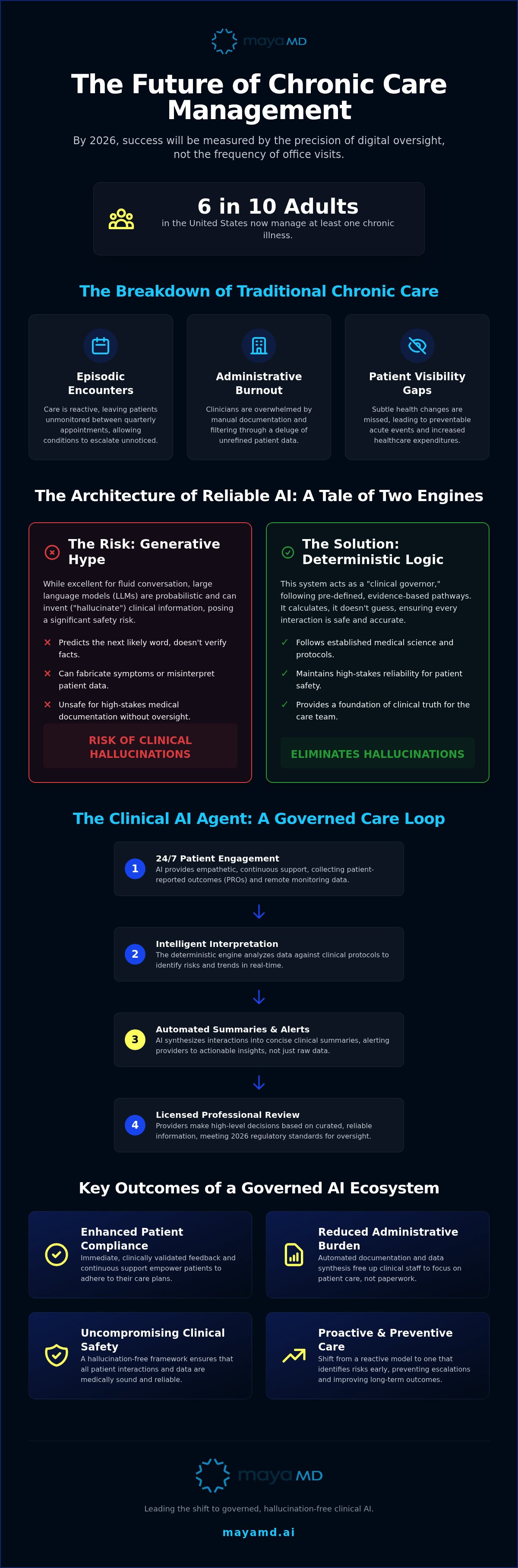
The paradigm of chronic disease management has undergone a fundamental transformation. Historically, care was a sequence of episodic encounters, leaving patients to navigate the complexities of their conditions alone between quarterly appointments. Today, AI-powered patient support for chronic conditions has matured into a continuous, governed care loop. This system serves as the connective tissue between clinical oversight and patient self-management. The shift from reactive intervention to proactive, AI-monitored care is no longer optional. In 2026, simply collecting data through Remote Patient Monitoring (RPM) is insufficient. Raw data without intelligent interpretation and immediate patient guidance remains an administrative burden rather than a clinical asset.
Why Traditional Chronic Care Management is Failing
The limitations of conventional care models have reached a critical breaking point. Clinical staff are increasingly overwhelmed by the manual documentation required for 24/7 monitoring. This administrative load contributes significantly to physician burnout, as practitioners struggle to filter actionable insights from a deluge of unrefined data. There is also a dangerous gap in patient visibility. When data only reaches the provider during quarterly office visits, subtle physiological shifts often go unnoticed until they escalate into acute events. These unmanaged escalations drive the rising expenditures seen in Medicare and Medicaid programs. Effective management requires a system that identifies risks in real-time, closing the window of vulnerability that exists between traditional check-ups.
The Role of a Clinical AI Agent in 2026
The emergence of the Clinical AI Agent represents the next phase of Artificial intelligence in healthcare. These systems aren't mere chatbots; they are sophisticated clinical assistants integrated directly into the provider's workflow. By utilizing deterministic logic, these agents facilitate digital healthcare for chronic disease through 24/7 empathetic engagement that mirrors human care while adhering to strict protocols. This level of support is vital for patient adherence. When a patient receives immediate, clinically validated feedback regarding their medication or symptoms, compliance rates improve. These agents also streamline the documentation process by automatically synthesizing patient interactions into concise clinical summaries. This capability allows providers to focus on high-level decision-making rather than data entry. AI-powered patient support for chronic conditions ensures that the patient feels supported and the clinician stays informed, creating a synergistic environment where outcomes match the complexity of the care being delivered.
The Architecture of Reliable AI: Deterministic Logic vs. Generative Hype
The rush to implement large language models (LLMs) in clinical settings has exposed a significant safety paradox. While generative AI excels at fluid conversation, its inherent tendency to "hallucinate" facts makes it dangerous for medical documentation without rigorous oversight. Reliability isn't a byproduct of more data; it's the result of architectural intent. AI-powered patient support for chronic conditions requires a foundation that prioritizes clinical truth over conversational probability. We believe in a governed approach that treats AI as a precise instrument rather than a creative experiment.
Deterministic logic serves as the essential clinical governor within this framework. Unlike probabilistic models that predict the next likely word in a sentence, deterministic systems follow pre-defined clinical pathways and evidence-based protocols. It doesn't guess. It calculates based on established medical science to ensure every patient interaction remains within safe parameters. This systematic rigidity is what allows a platform to maintain high-stakes reliability in a 2026 healthcare environment. By ensuring all data flows through a HIPAA-compliant cloud infrastructure, we protect the integrity of the patient record while enabling seamless connectivity across the care team.
Eliminating Hallucinations in Clinical Documentation
Unregulated AI can inadvertently fabricate symptoms or misinterpret patient-reported outcomes (PROs), leading to skewed clinical narratives. A governed system verifies these outcomes against known clinical benchmarks before they ever reach the provider's dashboard. Neuro-symbolic AI acts as the functional bridge between the structural rigor of symbolic logic and the communicative fluidity of generative models. This dual-engine approach ensures that AI-powered patient support for chronic conditions remains accurate. Research into AI in chronic disease self-management confirms that precision is the primary driver of patient safety and long-term adherence.
Integrating Deterministic Logic for Care Safety
A "clinical first" philosophy dictates that technology must adapt to the physician’s existing workflow. Maintaining high-stakes reliability is particularly critical when deploying a clinical ai agent for primary care. By using evidence-based logic as the foundation for chronic care protocols, providers can trust that the digital assistant is acting as a faithful extension of their own expertise. This eliminates the anxiety of unauthorized medical advice and ensures that every intervention is grounded in peer-reviewed logic. Organizations seeking a clinically validated AI platform find that this methodical approach is the only way to scale chronic care without increasing administrative risk.
Optimizing RPM, APCM, and PCM with AI-Driven Tools
Precision in chronic care requires a clear distinction between monitoring and management. Remote Patient Monitoring (RPM) serves as the physiological data engine, capturing vital signs in real-time. Principal Care Management (PCM) focuses that data on a single, high-risk condition that requires specialized clinical attention. AI-powered patient support for chronic conditions acts as the unifying layer between these services. It transforms raw data into actionable clinical insights. By implementing a governed AI framework, providers can transition from managing data streams to managing patient health. This shift is critical as RPM adoption is projected to reach 26.2% of the US population by the end of 2025. Without intelligent automation, this volume of data would overwhelm traditional clinical workflows.
AI for Remote Patient Monitoring (RPM)
Effective RPM relies on the ability to distinguish between clinical emergencies and benign data fluctuations. AI-driven triage systems analyze incoming readings to reduce false alerts, which directly mitigates clinician alarm fatigue. When a device setup (CPT 99453) is initiated, the AI agent begins establishing a baseline for that specific patient. This capability leads to better outcomes by ensuring that only significant deviations trigger a manual review. Linking this data to sophisticated remote patient monitoring software allows for longitudinal analysis. Clinicians can then view trends over months rather than isolated days, providing a more accurate picture of disease progression and treatment efficacy.
Advanced Primary Care Management (APCM) Integration
The launch of Advanced Primary Care Management (APCM) in 2025 introduced a bundled monthly payment model that rewards comprehensive care. In 2026, reimbursement rates for APCM have increased by approximately 10%, ranging from $16 to $117 per patient per month based on complexity. Capturing this value requires meticulous documentation that often drains clinical resources. AI streamlines advanced primary care management by automating the synthesis of patient interactions into the EHR. This doesn't just save time; it ensures that every care touchpoint is logged for compliance and billing accuracy. Integrating clinical workflow automation solutions into the primary care setting allows staff to focus on high-touch patient needs. It's a "capability-to-outcome" flow where technical integration leads directly to reduced provider burnout and higher quality of care. AI-powered patient support for chronic conditions ensures that value-based care models remain financially viable and clinically effective.
Strategic Implementation for Providers in Key US Markets
Deploying AI-powered patient support for chronic conditions requires a localized approach that respects the unique regulatory and demographic profiles of specific American cities. In Houston and Phoenix, the challenge isn't just the volume of patients, but the geographical sprawl that often leads to fragmented care. A governed clinical framework ensures that data from Remote Patient Monitoring (RPM) doesn't exist in a vacuum. By integrating deterministic logic into these urban markets, providers can maintain high-stakes oversight as patients move between specialized clinics and primary care settings. This connectivity is vital for ensuring that the transition from acute hospital care to home-based management is seamless and safe.
Market Focus: Chicago and Indianapolis
Midwest urban centers like Chicago and Indianapolis are currently navigating a complex legislative environment regarding artificial intelligence. In Illinois, providers are preparing for the long-term impact of SB 3114, which targets the use of AI in healthcare claims to prevent automated downcoding without human review. This makes a "human-in-the-loop" system a strategic necessity for maintaining billing integrity. In Indianapolis, collaboration with primary care networks is essential for a successful Advanced Primary Care Management (APCM) rollout. By automating documentation through a Clinical AI Agent, these networks can manage the high prevalence of chronic disease in the region without overextending their clinical staff. This methodical integration ensures that practitioners can deliver proactive care while adhering to evolving state-level transparency requirements.
Scaling AI Support in Phoenix and Las Vegas
The Southwest demographics, particularly in Phoenix and Las Vegas, are defined by a significant elderly population managing multiple comorbidities. These patients often require intensive coordination that can overwhelm local specialty clinics. Leveraging AI to facilitate principal care management tools allows specialists to maintain 24/7 engagement without increasing their daily administrative load. In Las Vegas, hospital systems are using these tools to manage post-discharge adherence, ensuring that patients understand their medication protocols immediately upon returning home. This capability-to-outcome flow results in fewer readmissions and higher patient satisfaction scores. As the regulatory landscape shifts, maintaining a HIPAA-compliant, clinically validated presence in these markets provides a competitive edge for health systems seeking to future-proof their chronic care strategies. To explore how these frameworks can be tailored to your specific city, visit MayaMD.
MayaMD: Leading the Shift to Governed Clinical AI
As healthcare systems navigate the complexities of 2026, the need for a stable, clinically validated partner has never been more acute. MayaMD represents the convergence of medical expertise and advanced data science. We provide a HIPAA-compliant ecosystem designed specifically for high-stakes environments where precision is mandatory. Unlike platforms that rely on the unpredictability of pure generative models, our framework uses deterministic logic to ensure that AI-powered patient support for chronic conditions remains safe and effective. This commitment to rigorous oversight allows providers to scale their operations without compromising the quality of care or risking regulatory non-compliance.
Our platform operates as an "Authoritative Pioneer" in the space, having moved past the experimental phase into proven clinical application. We view technology as a bridge that fosters deeper connection between the practitioner and the patient. By prioritizing stability and security, we help organizations transition from fragmented data collection to a unified, governed care loop. This methodical approach builds trust through transparency, ensuring that every digital intervention is grounded in established medical protocols.
The Clinical AI Agent Experience
The success of any digital health initiative depends entirely on patient adoption and sustained interaction. Our Clinical AI Agent utilizes sophisticated, user-friendly interfaces that drive engagement rates exceeding 90% among active users. This high level of interaction provides a continuous stream of patient-reported outcomes that the system automatically synthesizes into structured summaries. By mirroring clinical reasoning, these summaries significantly reduce the administrative burden of manual documentation. The platform offers seamless integration with existing RPM and PCM hardware, ensuring that data flows directly into the clinician's existing workflow. This connectivity transforms the patient’s home into a proactive care environment where AI-powered patient support for chronic conditions is available 24/7.
Partnering for Future-Proof Chronic Care
Choosing a technology partner is a strategic decision that impacts long-term clinical outcomes and financial viability. Sophisticated healthcare leaders value MayaMD because we prioritize measurable performance over fleeting technological trends. We understand the nuances of clinical workflows and the necessity of maintaining a "human-in-the-loop" for all critical medical decisions. Our platform isn't a disruptive outsider; it's a collaborative expert that strengthens the bond between the provider and the patient. Integrating MayaMD into your 2026 care strategy ensures your organization remains at the forefront of the shift toward governed, continuous care. We invite you to schedule a demo of MayaMD's Clinical AI Agent to see how our framework can optimize your chronic care management.
The Future of Governed Chronic Care Management
The transition toward continuous oversight requires a framework that balances technological ambition with clinical safety. We've explored how deterministic logic serves as the essential governor for AI-powered patient support for chronic conditions, ensuring that every interaction remains grounded in evidence-based protocols. By integrating these tools across RPM, APCM, and PCM services, providers can finally bridge the gap between office visits while significantly reducing the burden of manual documentation.
MayaMD offers a HIPAA-compliant, cloud-based platform that utilizes specialized deterministic logic to ensure zero hallucinations. This rigorous approach allows healthcare leaders to confidently scale their digital infrastructure without compromising the integrity of clinical outcomes. By fostering deeper connectivity and maintaining a human-in-the-loop, you can transform the patient experience while securing the financial viability of your practice in the 2026 landscape.
Explore MayaMD's Clinical AI Agent for Chronic Care
It's time to move past the experimental phase and embrace a proven application that prioritizes both provider efficiency and long-term patient health.
Frequently Asked Questions
Is AI-powered patient support HIPAA-compliant?
Yes, MayaMD operates as a HIPAA-compliant, cloud-based platform designed with rigorous security protocols. We prioritize data integrity by ensuring all patient-reported outcomes and physiological data are encrypted and stored within a secure infrastructure. This governed approach protects sensitive health information while enabling the seamless connectivity required for effective chronic care management. Our system undergoes regular audits to maintain regulatory adherence and high-stakes reliability for all clinical partners.
How does MayaMD prevent AI hallucinations in chronic care?
We eliminate the risk of hallucinations by utilizing a neuro-symbolic architecture that prioritizes deterministic logic over probabilistic guessing. While generative models handle conversational fluidity, the deterministic engine acts as a clinical governor that restricts responses to established medical protocols. This ensures the Clinical AI Agent doesn't fabricate symptoms or provide unauthorized advice. It's a "clinical-first" framework that guarantees every interaction is grounded in verified, evidence-based science.
What is the difference between APCM and PCM in 2026?
Advanced Primary Care Management (APCM) is a bundled payment model launched in 2025 that focuses on comprehensive, value-based primary care. Principal Care Management (PCM) is more specialized, targeting a single high-risk chronic condition that requires intensive oversight. In 2026, APCM reimbursement rates have increased by approximately 10%. Both models utilize AI-powered patient support for chronic conditions to automate the documentation and monitoring necessary to capture these complex Medicare reimbursements.
Can AI-powered support reduce physician burnout in Chicago clinics?
AI-powered patient support for chronic conditions significantly reduces burnout by automating the synthesis of raw data into concise clinical summaries. In Chicago, where clinics must navigate Illinois SB 3114 requirements for human review, our platform streamlines the documentation process to save hours of manual entry. By triaging alerts and filtering out false positives, the system allows practitioners to focus on high-level decision-making rather than administrative data management.
How does deterministic logic improve patient safety in Las Vegas healthcare?
Deterministic logic improves safety by ensuring that AI interventions follow a fixed, logical path that mirrors professional clinical reasoning. In Las Vegas hospital systems, this systematic rigidity prevents the AI from deviating from prescribed care plans. It provides a reliable safety net that identifies critical physiological shifts in real-time. This approach maintains a "human-in-the-loop" philosophy, where the AI supports, but never replaces, the ultimate authority of the licensed healthcare professional.
What are the reimbursement requirements for AI-driven RPM in Indianapolis?
Reimbursement for RPM in Indianapolis follows standard 2026 Medicare CPT codes, requiring at least 16 days of device readings for codes like CPT 99454. Providers must also document at least 20 minutes of clinical staff time per month for CPT 99457. Our platform automates the tracking of these interactions to ensure audit-ready compliance. This level of precision is essential for maximizing revenue while adhering to the rigorous documentation standards required by CMS.
How does MayaMD integrate with existing EHR systems in Phoenix?
Our platform features seamless integration capabilities with major EHR systems through standardized APIs and secure cloud connectivity. In the Phoenix market, this allows for a unified care loop where AI-generated summaries and RPM data flow directly into the patient's existing longitudinal record. This eliminates data silos and ensures that the entire care team has access to real-time insights. The integration process is designed to be non-disruptive to existing clinical workflows.
Does AI patient support require patients to have advanced technical skills?
No, the system is designed with a user-friendly interface that prioritizes accessibility for patients of all technical levels. Our Clinical AI Agent drives engagement rates exceeding 90% by utilizing intuitive, conversational pathways that feel natural rather than technical. Patients don't need to manage complex software; they simply interact with the agent as they would a clinical assistant. This simplicity is vital for ensuring long-term adherence among elderly populations with multiple comorbidities.




See The MayaMD Difference
Fill the form below
Download Our Apps
MayaMD for patients and MayaPro for physicians - available on iOS and Android.
FOR PATIENTS
MayaMD App
AI-powered symptom assessment, triage, and secure access to your care team.

FOR PHYSICIANS
MayaPro App
MayaPro brings patient vitals, RPM/PCM care plans, and clinical decision support to your pocket.