
AI Platform for Remote Patient Monitoring: 2026 Guide

In 2026, the success of a chronic care program is no longer measured by the volume of data collected but by the precision of the logic governing it. Integrating a sophisticated AI platform for remote patient monitoring has become essential for clinical teams overwhelmed by raw physiological streams and the persistent alert fatigue that follows. You're likely navigating the strain of staff shortages while trying to satisfy complex Medicare reimbursement requirements, such as the new CPT codes 99445 and 99470, which demand more than just passive oversight.
This guide demonstrates how AI-governed remote patient monitoring platforms are transforming chronic care from passive data collection into proactive clinical intervention. By utilizing Neuro-Symbolic AI to ensure deterministic outcomes, these systems reduce the risk of hallucinations while automating the documentation necessary for compliance. We'll examine the latest FDA guidance on clinical decision support and the specific frameworks required to scale your practice without compromising clinical validity or patient safety.
Key Takeaways
• Understand why the 2026 standard for an AI platform for remote patient monitoring shifts from passive data storage to a centralized intelligence hub that interprets physiological streams in real time.
• Discover how "Governed AI" and Neuro-Symbolic frameworks eliminate the risk of clinical hallucinations, providing the deterministic reliability required for high-stakes medical environments.
• Evaluate critical platform features, specifically focusing on how deep EHR integration converts disparate data points into actionable clinical documentation and intervention.
• Learn a methodical implementation strategy that maps clinical workflows to AI capabilities, ensuring your staff can scale chronic care management without increasing their administrative burden.
• Identify the advantages of clinician-led ecosystems that prioritize regulatory adherence and seamless connectivity to maximize performance across APCM and PCM programs.
What is an AI Platform for Remote Patient Monitoring?
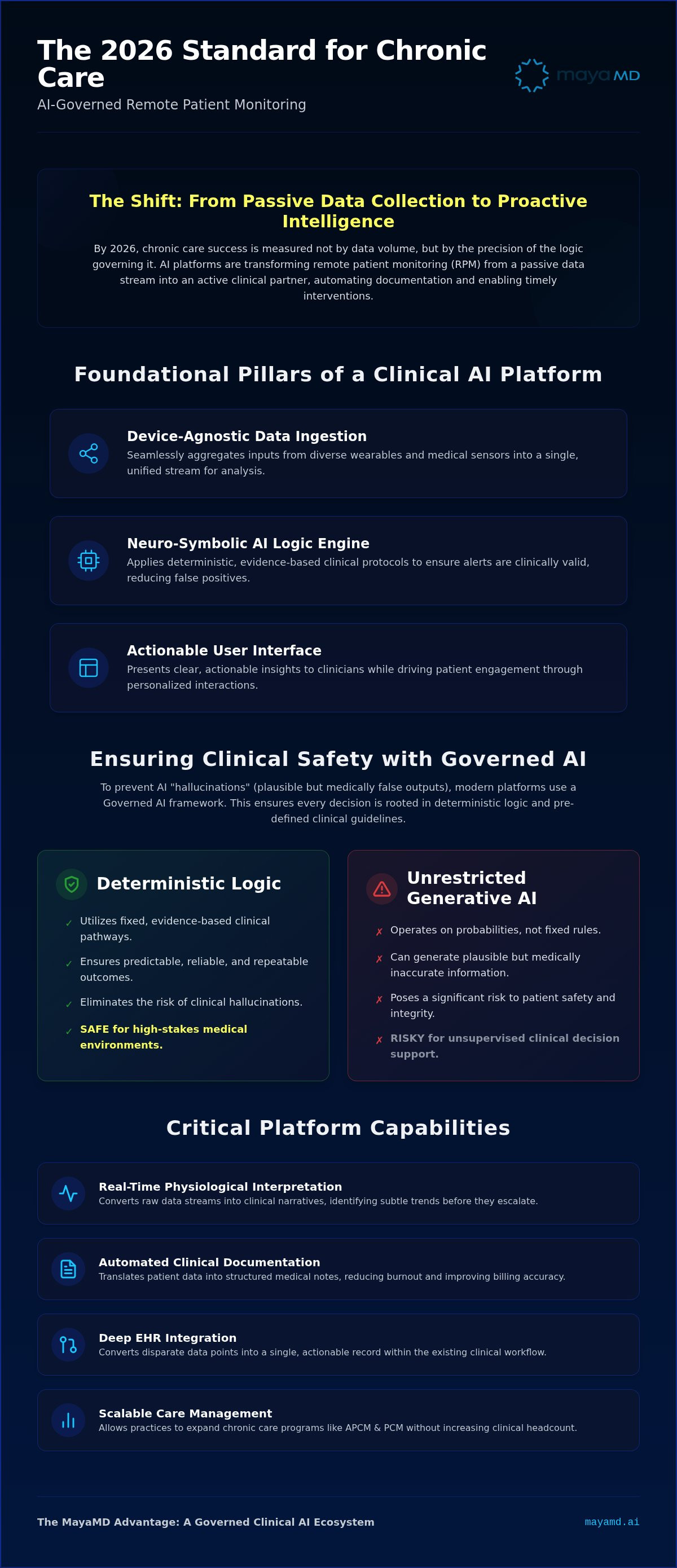
The 2026 landscape of healthcare delivery defines an AI platform for remote patient monitoring as a centralized intelligence hub rather than a mere repository for physiological data. Historically, Remote patient monitoring served as a digital conduit, transmitting blood pressure or glucose readings from a patient's home to a provider's portal. This model often resulted in data silos that required manual review, leading to clinician burnout and delayed interventions. Today, the transition to "Remote Intelligence" means the platform acts as an active clinical partner. It interprets data in real time, identifying subtle physiological trends in chronic conditions like hypertension or diabetes before they escalate into acute events. By converting raw numbers into clinical narratives, the platform ensures that providers spend their time on intervention rather than data entry.
The Core Components of a Clinical AI Platform
A sophisticated platform relies on three foundational pillars to ensure clinical validity and operational efficiency. First, data ingestion must be device-agnostic, seamlessly aggregating inputs from diverse wearables and medical-grade sensors into a unified stream. This connectivity is the bridge between the patient's home and the clinical workflow. Second, the logic engine moves beyond simplistic "if-then" thresholds that often trigger false positives. By utilizing Neuro-Symbolic AI, the platform applies deterministic logic to generative capabilities, ensuring that alerts are rooted in established clinical protocols. Finally, the user interface must prioritize "capability-to-outcome" design. It presents actionable insights to the physician while maintaining high patient engagement through personalized, AI-driven interactions that foster a sense of continuous support.
Why 2026 is the Tipping Point for AI in RPM
The convergence of rising chronic disease prevalence and a systemic shift toward value-based care has made advanced technology a necessity. With the global AI in RPM market projected to reach $2.1 billion in 2026, the industry is moving toward models like Advanced Primary Care Management (APCM). These frameworks prioritize continuous oversight over episodic visits. It's now clear that digital healthcare for chronic disease has moved from an optional efficiency tool to an essential requirement for providers managing complex patient populations. The ability to automate documentation and clinical intervention through a robust AI platform for remote patient monitoring allows practices to scale their care delivery without expanding their clinical headcount. This transition reflects a move toward a more sustainable, data-driven healthcare ecosystem where precision and empathy coexist.
How Clinical AI Agents Eliminate Hallucinations and Ensure Safety
Safety is the primary concern for any clinician evaluating an AI platform for remote patient monitoring. The fear of "hallucinations," where an AI generates plausible but medically inaccurate information, is a significant risk to patient safety and clinical integrity. To mitigate this risk, the industry has shifted toward "Governed AI." This framework ensures that the intelligence layer operates within strict, pre-defined clinical guidelines. By implementing a clinical ai agent for primary care, practices create a reliable bridge between raw patient data and the provider's decision-making process. This agent doesn't replace the physician's judgment; it augments it with verified insights.
The capability to automate clinical documentation is a prime example of this technology in action. When the system captures physiological changes and patient reported outcomes, it translates them into structured medical notes. This capability leads to higher billing accuracy and a substantial reduction in physician burnout. Clinicians seeking to implement these safety frameworks can explore how a governed clinical AI ecosystem integrates with existing workflows to improve care delivery.
Deterministic Logic vs. Generative AI
Deterministic logic utilizes fixed, evidence-based clinical pathways that are immutable. This ensures that the AI's response to a specific medical scenario is always consistent and safe. Generative AI provides the flexible, empathetic interface necessary for meaningful patient communication. A robust AI platform for remote patient monitoring utilizes Neuro-Symbolic AI, a hybrid model that combines these two strengths. This architecture adheres to the Trustworthy AI in Health Care Principles, ensuring that while the tone is accessible, the underlying medical logic remains strictly governed by clinical truth.
Ensuring HIPAA Compliance and Data Security
Security is non-negotiable in remote care. A cloud-based, HIPAA-compliant architecture ensures that sensitive Protected Health Information (PHI) is encrypted both at rest and in transit. Beyond basic encryption, the platform must maintain comprehensive audit trails. These trails provide a transparent record of how every piece of clinical documentation was generated and accessed. This level of oversight is essential for regulatory adherence and protects the practice during reimbursement audits. By prioritizing these systematic frameworks, healthcare organizations can scale their chronic care programs with total confidence in their data's security and precision.
Key Features to Evaluate in an RPM Platform
Selecting the right AI platform for remote patient monitoring involves evaluating the software's capacity to act as a seamless extension of the clinical team. It's not enough to collect data; the platform must provide bidirectional EHR integration. This connectivity ensures that remote physiological data is immediately accessible within the provider's primary workflow, eliminating the need for manual data entry. Additionally, the Clinical AI Agent must be designed with patient-centricity in mind. High engagement rates depend on an interface that feels supportive rather than intrusive, fostering the long-term adherence necessary for chronic care success.
Comprehensive reporting is a non-negotiable feature for financial sustainability. The platform must automatically aggregate the documentation required for CMS reimbursement, specifically tracking clinical staff time for CPT codes 99457 and 99458. With the introduction of new 2026 codes like 99445 for shorter data transmission periods and 99470 for brief clinical staff engagements, the platform's ability to precisely log these interactions directly impacts the practice's revenue. Accurate, automated logging transforms reimbursement from a manual burden into a systematic outcome of the care process.
Automation and Workflow Optimization
Providers face an influx of data that can lead to significant burnout. Implementing clinical workflow automation solutions allows the platform to triage alerts based on clinical severity. This systematic logic ensures that physicians only see the most critical outliers, while the AI handles routine post-discharge follow-ups and standard documentation. By automating these repetitive administrative tasks, the platform restores time for high-value clinical interventions. This capability-to-outcome structure moves the focus from managing software to managing patient health.
Support for APCM and PCM Models
The shift toward value-based care requires tools that support advanced primary care management (APCM) and Principal Care Management (PCM). A high-performance AI platform for remote patient monitoring manages complex, multi-condition patients within a single interface. Whether a specialist is managing a single high-risk condition via PCM or a primary care physician is overseeing a holistic APCM program, the platform provides the modularity needed to tailor care plans. This flexibility allows healthcare organizations to scale their chronic care programs without the need for additional clinical staff, maintaining a high standard of care for diverse patient populations.
Implementation Strategy: From Las Vegas to Houston
Implementing an AI platform for remote patient monitoring requires a methodical approach to ensure clinical safety and operational continuity. Successful integration moves past technical setup into a structured alignment with the practice's unique care delivery model. This process is defined by four critical phases:
Clinical Workflow Mapping
Aligning AI-governed alerts with current staff patterns to ensure the platform acts as a force multiplier. This step prevents the intelligence layer from becoming an isolated silo, ensuring data flows directly into actionable clinical pathways.
Patient Onboarding
Utilizing the clinical AI agent to drive initial adoption through immediate, empathetic feedback. By providing a responsive interface, the platform reduces the friction typically associated with new medical hardware.
Monitoring and Triage
Setting precise parameters for governed AI alerts. This systematic oversight ensures that only clinically significant outliers reach the provider, effectively eliminating the alert fatigue that plagues traditional RPM models.
Billing and Reimbursement
Capturing the specific metadata required for 2026 CMS compliance. The platform must automatically track the duration and frequency of monitoring to secure reimbursement for codes like 99454 and the new 99470.
Healthcare organizations ready to transition to this structured model can schedule a clinical workflow consultation to align these steps with their specific practice goals.
Local Care Coordination for US Providers
Regional care dynamics significantly influence implementation success. In high-growth hubs like Phoenix and Las Vegas, clinics often face rapid patient influxes that strain traditional monitoring models. An AI platform for remote patient monitoring allows these providers to scale their operations without a linear increase in headcount. For large metro areas like Chicago and Houston, the focus shifts to care continuity across expansive, disparate health networks, where the platform serves as a unified data bridge. In Indianapolis, leveraging local healthcare networks for Principal Care Management (PCM) integration ensures that specialists can manage complex chronic cases with the same precision and oversight as primary care hubs.
Measuring ROI and Clinical Outcomes
The transition to an AI-driven model must be justified by measurable performance and the cold logic of data science. Tracking the reduction in ER visits and hospital readmissions provides a clear indicator of the platform's impact on patient stability. Beyond clinical outcomes, practices should measure the staff time saved through automated clinical documentation. When the system handles routine charting and preliminary data interpretation, clinicians can refocus on high-stakes intervention. Patient satisfaction metrics often reveal the human impact of constant AI support; patients report feeling more connected to their care team when they receive timely, intelligent responses to their physiological data. This capability-to-outcome cycle reinforces the long-term value of a governed clinical ecosystem.
The MayaMD Advantage: A Governed Clinical AI Ecosystem
MayaMD represents the evolution of the AI platform for remote patient monitoring, moving beyond experimental software into a proven, clinician-built ecosystem. Founded in 2018, the organization has established itself as an authoritative pioneer by prioritizing high-stakes reliability and rigorous oversight. Unlike generic intelligence layers, this platform utilizes Neuro-Symbolic AI to provide the deterministic logic necessary for medical safety. It's a system designed by clinicians for clinicians, ensuring that every technical feature serves a specific clinical outcome. This approach fosters a sober, governed environment where providers can deliver advanced care with total confidence in their data's precision.
The integration of remote patient monitoring software with Advanced Primary Care Management (APCM) and Principal Care Management (PCM) creates a seamless bridge between patient homes and clinical workflows. By unifying these disparate care models, MayaMD enables practices to manage complex populations through a single intelligence hub. This connectivity allows for "Healthcare AI Without Hallucinations," where generative capabilities handle patient engagement while deterministic logic ensures medical accuracy. The result is a sophisticated partner that understands the nuances of clinical workflows and values measurable performance over fleeting trends.
Specialized Tools for Complex Chronic Care
Managing multi-morbidity requires more than just tracking single data points; it demands comprehensive documentation that reflects the patient's entire clinical picture. The MayaMD Clinical AI Agent automates this complex documentation, reducing the administrative burden on specialists managing high-risk chronic cases. For clinics operating within PCM frameworks, the platform provides the specialized tools needed to monitor specific disease progressions while maintaining a holistic view of patient health. This modular design ensures scalability, allowing a local clinic to grow into a multi-city enterprise without losing the precision of its clinical oversight or the depth of its patient connectivity.
Getting Started with MayaMD
The transition to an AI-governed care model begins with a thorough consultation process. During this phase, clinical experts map your specific workflow needs to the platform's logic engine, ensuring a tailored implementation that aligns with your staff patterns. Integration timelines are streamlined, with most practices experiencing a fully functional, EHR-connected ecosystem within the first 30 days. This methodical onboarding process prioritizes stability and security, allowing your team to digest complex concepts before moving into full-scale operation. We invite you to join the future of continuous care by experiencing a platform where data science and clinical empathy converge to improve patient outcomes.
The Future of Governed Clinical Intelligence
Adopting a sophisticated AI platform for remote patient monitoring is no longer a matter of simple digital adoption; it's a strategic shift toward proactive, governed care. By moving past the limitations of traditional data storage, your practice can leverage a centralized intelligence hub that prioritizes clinical safety and systematic oversight. This transition ensures that every physiological data point is converted into a meaningful clinical intervention, effectively reducing the administrative burden on your staff while meeting the rigorous 2026 CMS requirements.
MayaMD provides a HIPAA-compliant ecosystem powered by Neuro-Symbolic AI technology. This unique framework delivers a proven reduction in clinical documentation time and provides specialized support for RPM, PCM, and APCM workflows. By integrating deterministic logic with empathetic patient engagement, you can scale your chronic care programs without compromising the quality of the patient experience. It's time to move beyond experimental technology and partner with an established leader in clinical AI. Request a Demo of MayaMD’s Clinical AI Platform today and discover how reliable, hallucination-free intelligence can transform your practice. We look forward to supporting your journey toward a more connected and efficient healthcare future.
Frequently Asked Questions
Is an AI platform for remote patient monitoring HIPAA compliant?
Yes, the MayaMD platform utilizes a HIPAA compliant cloud architecture that ensures end to end encryption for all protected health information. This systematic framework protects patient privacy while the data is at rest or in transit. By maintaining rigorous security protocols and multi factor authentication, the platform allows for secure data sharing between clinical teams while strictly adhering to federal regulatory standards.
How does AI reduce physician burnout in chronic care management?
AI reduces burnout by automating the preliminary triage of physiological data and generating structured clinical documentation. Instead of manually reviewing thousands of raw data points, physicians receive prioritized alerts that require immediate clinical intervention. This capability to outcome structure allows clinicians to focus their expertise on patient care rather than the administrative burden of repetitive data entry and manual charting.
Can this platform integrate with my existing EHR system?
A high performance AI platform for remote patient monitoring must offer bidirectional integration with established EHR systems to be effective. This connectivity ensures that all remote physiological data and AI generated summaries are automatically synced with the patient's primary medical record. It eliminates the need for manual data migration and maintains a single source of truth for the entire care team across different facilities.
What is the difference between RPM and APCM in terms of software needs?
RPM software focuses on device specific data transmission and physiological monitoring, whereas APCM requires a broader intelligence layer to manage holistic, continuous care. APCM software must handle multi condition coordination and complex billing requirements that extend beyond simple tracking. The platform acts as an orchestration layer for these comprehensive, value based care models, providing deeper insights into patient stability and clinical risk.
How does the platform prevent AI hallucinations in clinical summaries?
The platform prevents hallucinations by utilizing Neuro Symbolic AI, which combines generative communication with deterministic clinical logic. This hybrid approach ensures that all clinical summaries are rooted in verified medical protocols rather than probabilistic guesses. It provides the high stakes reliability necessary for clinical decision support, ensuring that the AI agent's outputs are always accurate, safe, and clinically valid.
What are the common Medicare reimbursement codes for AI-driven RPM?
Common 2026 reimbursement codes include 99453 for initial setup, 99454 for device supply, and 99457 for the first 20 minutes of clinical staff time. New codes like 99445 for shorter data transmission and 99470 for brief clinical engagements offer additional flexibility. The platform automatically tracks the specific time and data requirements needed to satisfy these CMS billing criteria, ensuring accurate and consistent revenue cycles.
How do patients interact with the Clinical AI Agent?
Patients interact with the Clinical AI Agent through a user friendly interface that provides real time feedback and supportive reminders. This digital assistant helps with initial onboarding, symptom reporting, and educational engagement between scheduled visits. It fosters a sense of continuous connectivity, ensuring patients feel supported and monitored, which significantly improves long term adherence to their chronic care management plans.
Is the platform suitable for both primary care and specialists?
The AI platform for remote patient monitoring is designed for both primary care hubs and specialist clinics. Specialists utilize the platform for Principal Care Management to monitor single high risk conditions, while primary care providers use it for broader population health management. The modular architecture allows each practice to tailor the logic engine to their specific clinical workflows and patient population needs.




See The MayaMD Difference
Fill the form below
Download Our Apps
MayaMD for patients and MayaPro for physicians - available on iOS and Android.
FOR PATIENTS
MayaMD App
AI-powered symptom assessment, triage, and secure access to your care team.
FOR PHYSICIANS
MayaPro App
MayaPro brings patient vitals, RPM/PCM care plans, and clinical decision support to your pocket.