
AI Patient Risk Stratification: Clinical Precision 2026

By 2026, the mere ability to predict a hospital readmission is no longer sufficient to sustain a high-performing clinical practice. Clinical precision in the modern era demands a transition from passive observation to governed, prescriptive action. As the FDA has now authorized over 1,500 AI-enabled medical devices, the focus has shifted toward how AI for patient risk stratification can bridge the gap between raw data and meaningful intervention. You likely feel the weight of administrative burnout from manual risk scoring and the persistent anxiety surrounding AI hallucinations in sensitive patient care.
It's exhausting to manage complex chronic populations when your existing tools provide more noise than clinical clarity. This article explores how advanced AI moves beyond "black-box" predictive analytics to deliver real-time, prescriptive care strategies that prioritize safety and precision. We'll examine the integration of neuro-symbolic logic to eliminate hallucinations, the automation of risk identification, and the optimization of Medicare reimbursement through superior stratification. By moving toward a governed, AI-native operational model, providers can finally achieve the reduction in readmission rates that legacy systems have long promised but failed to deliver.
Key Takeaways
• Understand why 2026 marks the definitive shift from static scoring to dynamic AI for patient risk stratification that identifies rising-risk cohorts in real-time.
• Discover how Neuro-Symbolic AI eliminates the risk of hallucinations by anchoring generative capabilities within deterministic clinical logic and governed frameworks.
• Learn to integrate Social Determinants of Health and Remote Patient Monitoring data to create a more precise, holistic view of patient vulnerability.
• Transition from simple predictive analytics to prescriptive care models that automatically adjust clinical interventions based on shifting patient risk profiles.
• Explore the role of clinical AI agents in managing post-discharge care to significantly reduce hospital readmissions and optimize Medicare reimbursement.
The Evolution of AI for Patient Risk Stratification
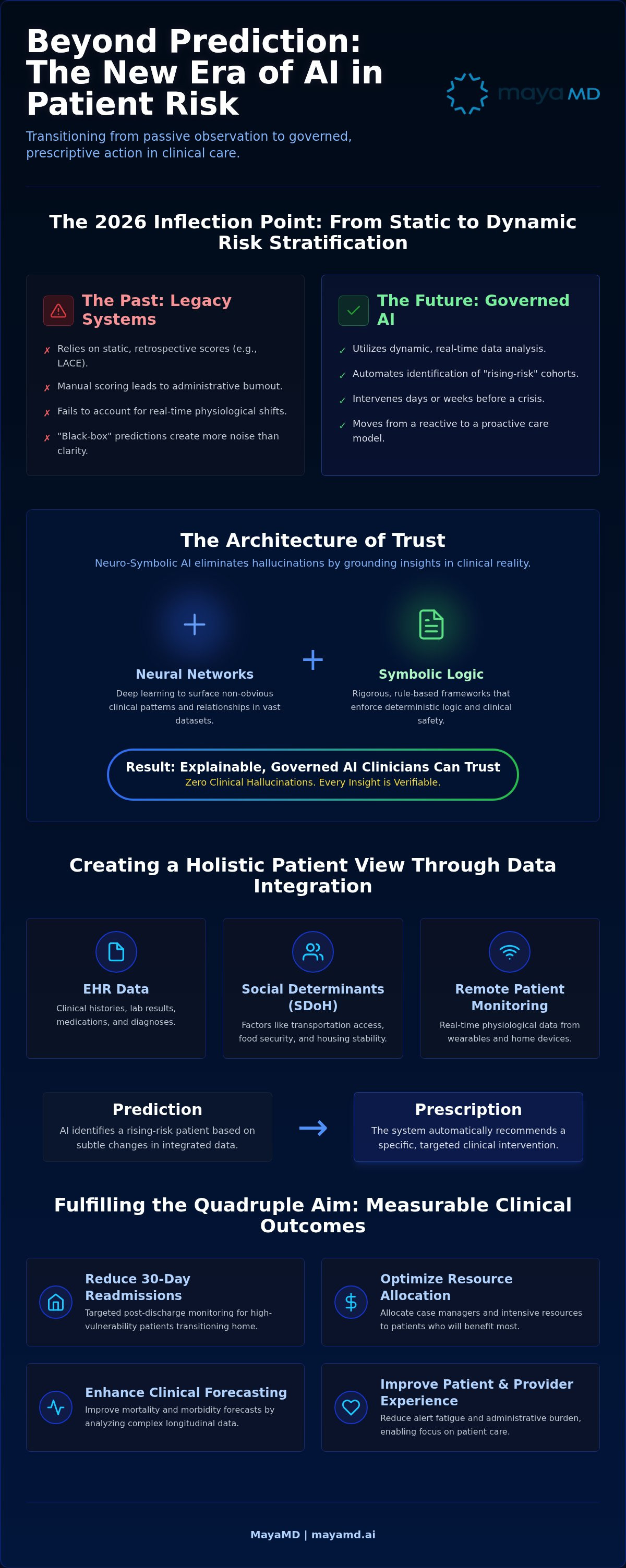
AI-driven risk stratification is the systematic application of machine learning algorithms to identify patients at high risk of adverse health events before they occur. For decades, clinicians relied on static scoring systems like the Charlson Comorbidity Index or LACE scores. These tools, while foundational, are often retrospective and fail to account for real-time physiological shifts. The Evolution of AI in healthcare has reached a critical inflection point in 2026. Static models are no longer sufficient because they lack the granularity needed for modern value-based care. Today, AI for patient risk stratification utilizes deep learning to surface non-obvious clinical patterns, such as the subtle interplay between medication adherence, social stressors, and glycemic variability, which traditional scores routinely miss.
From Reactive to Proactive: The Shift in Care Models
Manual risk assessment in high-volume clinics is fundamentally unsustainable. It creates a bottleneck where clinicians spend more time on administrative scoring than on the patients themselves. Real-time data integration has changed this dynamic by providing predictive accuracy that updates as patient conditions evolve. This transition is essential for programs like advanced primary care management, which necessitates automated stratification to manage complex cohorts effectively. By automating the identification of "rising-risk" patients, AI allows the care team to intervene days or weeks before a crisis necessitates an emergency room visit. It moves the needle from a reactive "sick-care" model to a proactive, governed health management strategy.
Key Clinical Outcomes of AI-Driven Stratification
The primary goal of advanced stratification is the fulfillment of the Quadruple Aim: improving population health, reducing costs, and enhancing both patient and provider experiences. AI-driven models excel in several measurable areas:
Reducing 30-day Readmissions
Identifying high-vulnerability patients during the transition from hospital to home allows for targeted post-discharge monitoring.
Resource Optimization
By accurately tiering patient acuity, health systems can allocate their most intensive resources, such as nurse case managers, to the patients who will benefit most.
Enhanced Forecasting
AI improves the precision of mortality and morbidity forecasts by analyzing longitudinal data points that human observation alone cannot synthesize.
These outcomes aren't just theoretical. They're the result of moving past "black-box" predictions toward a more transparent, deterministic logic that clinicians can trust. As we look toward the remainder of 2026, the integration of these tools into standard workflows is becoming the baseline for clinical excellence.
The Architecture of Trust: Deterministic Logic vs. Generative AI
Clinicians often view generative AI with a mix of intrigue and justified skepticism. The "black box" problem, where a model provides a high-risk score without explaining its logic, is a non-starter in a high-stakes clinical environment. Transparency is non-negotiable. While large language models (LLMs) excel at processing unstructured data, they're often prone to hallucinations, fabricating clinical details that don't exist. This is why the industry is moving toward Neuro-Symbolic AI. This approach combines the pattern-recognition power of neural networks with the rigorous, rule-based logic of symbolic AI to ensure that every output is grounded in medical reality.
By using deterministic logic as a safety rail, systems can ensure that every risk summary is anchored in verified medical facts. This prevents the "creative" leaps that standard generative models might take when analyzing complex patient histories. Effective AI for patient risk stratification must be explainable. If a patient is flagged for rising cardiovascular risk, the system must point to specific data points, such as a recent spike in blood pressure readings or a missed medication refill. This level of detail eliminates the ambiguity that often leads to physician burnout and alert fatigue.
Governed AI: Prioritizing Clinical Safety
Safety in healthcare requires a fundamental shift from probabilistic predictions to governed logic. Probabilistic models guess the most likely outcome; governed logic ensures the outcome adheres to strict clinical parameters. MayaMD prioritizes this approach by maintaining HIPAA compliance and rigorous data integrity throughout the stratification process. Neuro-symbolic AI serves as the bridge between raw data and clinical validity. For organizations looking to implement these safeguards, exploring reliable AI healthcare solutions is a critical first step in protecting patient safety.
Integrating Clinical Guidelines into AI Models
Trust is built when technology mirrors the clinical protocols physicians already use. By mapping AI risk outputs to established evidence-based medicine, systems provide recommendations that feel like a natural extension of the care team. Research into AI and Social Determinants of Health shows that when models incorporate diverse data types within a structured framework, the results are both more accurate and more actionable. Explainable AI (XAI) reduces physician skepticism by showing the "why" behind every alert. This alignment ensures that AI for patient risk stratification supports rather than replaces clinical judgment, fostering a collaborative environment where data and human expertise work in harmony.
Data Integration: EHR, Social Determinants, and RPM
Effective AI for patient risk stratification requires a data architecture that transcends the limitations of the Electronic Health Record (EHR). While 71% of hospitals currently utilize predictive AI for risk prediction, the efficacy of these models depends on the breadth and quality of the ingested data. A sophisticated hierarchy exists within clinical data; structured data, such as ICD-10 codes and laboratory results, provides the foundation. However, the most nuanced insights often reside in unstructured clinical notes. Advanced AI agents parse these narratives to identify subtle changes in patient status that traditional scoring systems frequently overlook, creating a more comprehensive longitudinal risk profile.
Remote Patient Monitoring (RPM) serves as the critical link between episodic clinical visits and continuous health oversight. By integrating real-time vitals into a patient's risk profile, clinicians can move past the "snapshot" approach of traditional medicine. This connectivity allows for the detection of physiological trends, such as a gradual increase in resting heart rate or a decline in oxygen saturation, before they manifest as acute clinical crises. The result is a dynamic risk score that reflects the patient's current state rather than their historical average.
Breaking Down Data Silos in Chronic Care
Achieving clinical precision requires the seamless integration of disparate data streams. Interoperability standards are essential for the successful deployment of remote patient monitoring software. When wearable device data flows directly into the risk stratification engine, it enables the prediction of acute exacerbations with high accuracy. Normalizing data from different healthcare systems remains a challenge; yet, it's a necessary step to ensure that a patient's risk is understood across the entire continuum of care. This integration reduces the 13 hours per week clinicians typically spend on paperwork by automating the synthesis of complex data sets.
The Impact of SDOH on Risk Stratification
Economic and environmental factors often exert a greater influence on health outcomes than genetic predispositions. This reality makes Social Determinants of Health (SDOH) a non-negotiable component of modern risk modeling. AI identifies patterns related to housing instability, food insecurity, and transportation barriers by analyzing geographic and socioeconomic data. By incorporating these variables, digital healthcare for chronic disease becomes truly personalized. Understanding that a patient's risk is elevated by their environment allows the care team to tailor interventions, such as coordinating pharmacy deliveries or community support, which directly addresses the root causes of non-adherence and hospital readmission.
Operationalizing Risk: From Prediction to Prescriptive Care
Identifying a high-vulnerability patient is only half the battle. To achieve true clinical precision in 2026, organizations must operationalize these insights through a structured, four-step prescriptive framework. This process transforms AI for patient risk stratification from a passive alert system into an active engine for clinical intervention. First, the platform automatically identifies rising-risk patient cohorts by analyzing real-time data streams. Second, the system suggests dynamic care plan adjustments based on these risk shifts, ensuring that the intervention matches the patient's immediate needs.
Third, the platform triggers clinical workflow automation solutions to handle immediate follow-up tasks, such as scheduling a telehealth visit or adjusting a remote monitoring threshold. This reduces the burden on clinical staff while ensuring no patient falls through the cracks. Finally, continuous feedback loops allow clinicians to validate or refine the risk model based on actual patient outcomes. This iterative process creates a self-optimizing ecosystem where the AI becomes more accurate with every interaction.
Managing Chronic Populations at Scale
For practices focused on Principal Care Management (PCM), the ability to prioritize the most critical cases is paramount. Effective risk stratification reduces the "noise" of non-essential alerts by applying intelligent prioritization logic. Instead of a flood of notifications, care managers receive actionable, high-priority worklists that highlight patients requiring immediate attention. This focus prevents burnout and ensures that high-acuity chronic patients receive the level of oversight required to prevent hospital readmissions. By filtering out the clinical noise, practitioners can focus their expertise where it is most needed, fostering a deeper connection with the patients at highest risk.
Prescriptive Intervention: The Next Frontier
The industry is moving beyond simply asking "who is at risk" to determining "what is the best next action." Prescriptive care models analyze the patient's specific risk profile and suggest the most effective clinical pathway. This automation extends to clinical documentation, where AI captures the details of the risk-triggered intervention, significantly reducing administrative overhead. Clinicians spend over 13 hours per week on paperwork; automating these summaries directly recovers that time for direct patient care. These systems also streamline Medicare RPM reimbursement by ensuring that all monitoring activities and interventions are accurately logged and categorized according to the latest 2026 requirements. To see how these workflows can be implemented in your practice, explore our digital healthcare solutions for providers today.
Clinical AI Agents: The Future of Governed Risk Management
The deployment of a clinical ai agent for primary care represents the final evolution of risk management. These agents don't just calculate scores; they actively monitor patient status to ensure that the risk models discussed in previous sections translate into real-world safety. By acting as persistent observers, they facilitate post-discharge care with a level of consistency that human teams cannot maintain alone. This continuous oversight is a primary driver in reducing 30-day readmission rates, as the agent identifies early signs of decompensation that would otherwise lead to an emergency room visit.
Engagement is equally critical to this process. AI-driven risk education empowers patients to understand their own vulnerability, turning them into active participants in their care journey. When a patient understands why their risk profile has shifted, they are more likely to adhere to prescriptive interventions. This closing of the care gap ensures that no high-risk individual falls through the cracks of a fragmented healthcare system. By maintaining a constant connection with the patient, the agent ensures that AI for patient risk stratification leads to measurable improvements in health outcomes.
The Human-AI Partnership in 2026
The efficacy of AI for patient risk stratification depends on a symbiotic relationship between technology and clinical expertise. AI agents are designed to absorb the immense administrative burden that currently contributes to clinician burnout, allowing providers to focus on complex decision-making. However, clinical safety requires a strict clinician-in-the-loop framework. Every automated suggestion must be subject to human oversight to ensure it aligns with the specific nuances of an individual's history. The Clinical AI Agent acts as a vital bridge between complex data points and the delivery of high-touch human care.
Next Steps: Implementing AI Stratification Today
Transitioning to a governed AI model requires a strategic approach to vendor evaluation. Interoperability and safety must be the primary benchmarks for any clinical AI partner. Organizations often find the most immediate success by focusing on high-impact cohorts such as patients with hypertension, COPD, or diabetes. These populations provide the most measurable opportunities for reducing readmissions and improving Medicare reimbursement through better stratification. Integrating these tools into your workflow is no longer a visionary goal; it is a clinical necessity for 2026. Your journey toward a more connected, prescriptive care model begins with MayaMD’s clinical AI ecosystem.
Advancing Toward Prescriptive Clinical Excellence
The healthcare landscape of 2026 demands a fundamental shift from observing risk to actively managing it through governed, prescriptive action. By moving beyond the "black box" limitations of legacy systems, providers can now leverage AI for patient risk stratification to deliver interventions that are both timely and evidence-based. This transition is powered by a synthesis of real-time monitoring, social determinants, and an architecture of trust that prioritizes clinical safety above all else.
MayaMD provides a HIPAA-compliant, cloud-based platform that utilizes Neuro-symbolic AI to ensure hallucination-free documentation and risk summaries. Our technology integrates seamlessly with your existing RPM and APCM workflows, allowing your team to focus on the human connection that defines high-quality care. This connectivity ensures that no rising-risk patient is overlooked while reducing the administrative fatigue that often hinders clinical performance. To discover how our platform can optimize your patient outcomes and streamline your operations, Request a Demo of MayaMD’s AI-Driven Risk Stratification Platform. Embracing these advanced tools today will define your success in the era of continuous, governed care.
Frequently Asked Questions
What is patient risk stratification in the context of AI?
It's the application of machine learning algorithms to categorize patients based on their probability of experiencing adverse health events. Unlike manual scoring, AI for patient risk stratification processes vast datasets to identify subtle physiological and behavioral patterns. This allows clinicians to tier their populations with high precision, ensuring that resources are directed toward the individuals with the most urgent clinical needs before a crisis occurs.
How does AI improve the accuracy of risk stratification compared to traditional methods?
AI improves accuracy by analyzing longitudinal data points that traditional scores like LACE or Charlson often overlook. It synthesizes real-time vitals, unstructured clinical notes, and social determinants to provide a dynamic rather than static risk profile. By identifying non-obvious correlations across thousands of variables, AI-driven models reduce the false positives that lead to alert fatigue while capturing high-risk patients who would otherwise remain undetected.
Can AI for patient risk stratification help reduce hospital readmissions?
Yes, it significantly reduces 30-day readmissions by enabling proactive post-discharge monitoring. By identifying patients at high risk of decompensation immediately following a hospital stay, care teams can initiate targeted interventions like telehealth follow-ups or medication adjustments. This governed approach ensures that clinical oversight remains continuous during the most vulnerable periods of a patient's recovery, preventing the acute exacerbations that necessitate a return to the hospital.
Is AI-driven risk stratification HIPAA compliant?
HIPAA compliance is a foundational requirement for any clinical AI platform. Governance frameworks ensure that data is encrypted both in transit and at rest, while access is strictly limited to authorized clinical personnel. By using secure, cloud-based architectures, these systems protect sensitive patient information while enabling the seamless data integration required for accurate modeling. This ensures that the benefits of advanced analytics are achieved without compromising patient privacy or regulatory adherence.
What data sources are required for effective AI risk modeling?
Effective modeling requires a synthesis of diverse data streams. Key sources include:
• Structured EHR data such as ICD-10 codes and lab results.
• Unstructured clinical narratives and physician notes.
• Real-time vitals from Remote Patient Monitoring (RPM) devices.
• Social Determinants of Health (SDOH) including geographic and economic data.
Combining these sources creates a holistic view of the patient's health status and environmental vulnerabilities.
How does AI handle Social Determinants of Health (SDOH) in risk scores?
AI processes SDOH by identifying environmental and economic stressors that correlate with poor health outcomes. It analyzes variables like housing stability, transportation access, and food security to adjust a patient's risk score. This level of granularity allows providers to address the root causes of health disparities. By incorporating these factors, the AI ensures that risk models reflect the reality of a patient's daily life rather than just their clinical symptoms.
What is the difference between predictive and prescriptive risk stratification?
Predictive stratification identifies who is likely to experience an adverse event, whereas prescriptive stratification suggests the specific clinical action needed to prevent it. While predictive models flag high-risk cohorts, prescriptive AI uses deterministic logic to recommend interventions like medication adjustments or care plan updates. This shift turns raw data into a roadmap for clinical teams, ensuring that identification is always followed by an appropriate and governed medical response.
How can AI reduce physician burnout while performing risk stratification?
AI reduces burnout by automating the time-consuming process of manual risk scoring and data synthesis. Clinicians currently spend an average of 13 hours per week on paperwork; AI agents reclaim this time by providing prioritized worklists and automated clinical documentation. By filtering out non-essential alerts and focusing on high-priority cases, the technology allows physicians to practice at the top of their license, focusing on patient care rather than administrative data entry.




See The MayaMD Difference
Fill the form below
Download Our Apps
MayaMD for patients and MayaPro for physicians - available on iOS and Android.
FOR PATIENTS
MayaMD App
AI-powered symptom assessment, triage, and secure access to your care team.


FOR PHYSICIANS
MayaPro App
MayaPro brings patient vitals, RPM/PCM care plans, and clinical decision support to your pocket.