
AI for Virtual Care Management: Orchestrating Clinical Excellence in 2026

By 2026, the success of a chronic care practice is no longer measured by the number of remote devices it deploys, but by the sophistication of the logic governing the data they produce. You've likely experienced the mounting pressure of fragmented patient metrics and the relentless documentation requirements that define modern clinical workflows. Implementing AI for virtual care management is no longer a speculative venture; it's a strategic necessity for orchestrating a system that prioritizes clinical precision over administrative volume.
We recognize that concerns regarding AI hallucinations and physician burnout often stall the adoption of advanced technology. This article provides a comprehensive look at how a governed Clinical AI Agent streamlines workflows to eliminate documentation fatigue and enhance patient outcomes. You'll learn how to navigate the 2026 Medicare reimbursement landscape, including new CPT codes like 99445 and 99470, to build a scalable framework that reduces hospital readmissions. We'll outline a roadmap for utilizing deterministic AI logic to restore the focus to high-stakes patient care while maintaining rigorous clinical oversight.
Key Takeaways
• Understand the shift from reactive symptom management to a proactive clinical ecosystem that prioritizes continuous patient oversight and early intervention.
• Discover how a deterministic-generative hybrid model ensures clinical validity by eliminating AI hallucinations in high-stakes healthcare environments.
• Learn to navigate the 2026 reimbursement landscape, utilizing new CPT codes for RPM and APCM to ensure the financial sustainability of your virtual programs.
• Explore how implementing AI for virtual care management can drastically reduce administrative burden and physician burnout through automated clinical documentation.
• Identify the strategic steps required to integrate a Clinical AI Agent into your existing workflows while maintaining strict HIPAA compliance and data security.
The Evolution of Virtual Care Management in 2026
The landscape of remote patient oversight has undergone a radical transformation. By 2026, virtual care management has transitioned from a reactive "sick care" model into a proactive, continuous clinical ecosystem. This evolution was necessitated by the limitations of the 2020-2024 era, where traditional patient portals often introduced more administrative friction than they resolved. Providers found themselves drowning in fragmented data points that lacked actionable context. Today, the mandate is clear: healthcare organizations must scale the quality of care for chronic populations without a proportional increase in clinical headcount.
Success in this environment requires a sophisticated application of AI for virtual care management. It isn't enough to simply collect data; the system must orchestrate it. This shift represents a move toward high-stakes reliability, where technology serves as a bridge between disparate data points and human intervention. For a foundational perspective on these technological shifts, an Overview of AI in Healthcare illustrates how these tools have moved from experimental phases into proven clinical applications.
The Administrative Burden Crisis
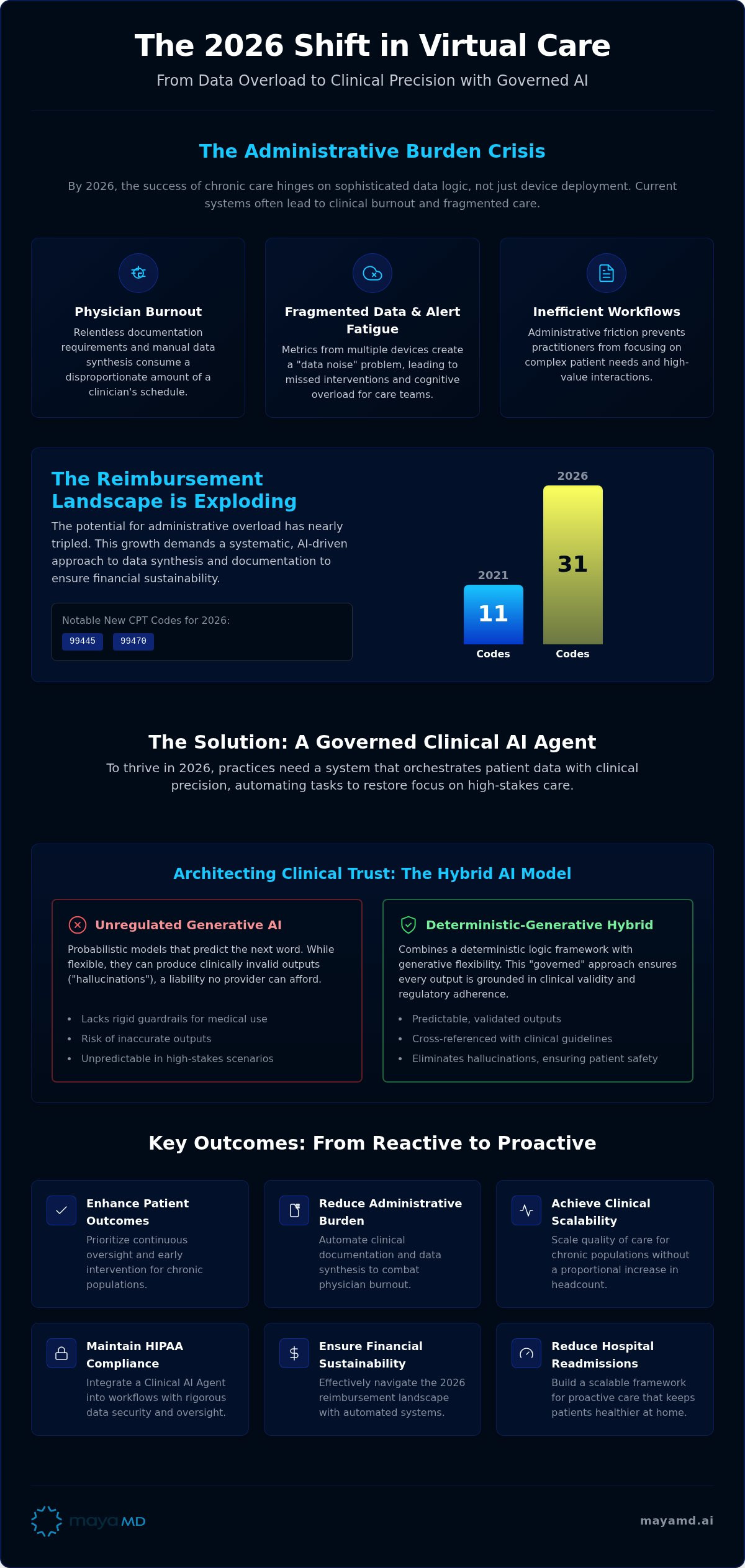
Physician burnout remains a critical threat to clinical excellence in 2026. The primary culprit is often the documentation requirements associated with Remote Patient Monitoring (RPM) and Chronic Care Management (CCM). When RPM data is fragmented, it creates a "data noise" problem rather than a clinical solution. With the expansion of reimbursable virtual care codes from 11 in 2021 up to 31 in 2026, the potential for administrative overload has tripled. This volume demands a systematic approach to data synthesis.
• Manual data synthesis often consumes a disproportionate amount of a clinician's daily schedule.
• Fragmented metrics from multiple devices lead to alert fatigue and missed interventions.
• Administrative friction prevents practitioners from focusing on complex patient needs.
AI alleviates this by automating the synthesis of remote data into structured clinical notes. This capability-to-outcome approach ensures that every data point contributes to a measurable improvement in provider efficiency. By reducing the time spent on manual entry, clinicians can redirect their focus toward high-value patient interactions.
The Shift to Governed AI
The industry has moved past the era of unregulated generative AI. In a clinical setting, hallucinations are a liability that no provider can afford. Governed AI utilizes a deterministic logic framework to ensure that every output is grounded in clinical validity and regulatory adherence. Integrating AI for virtual care management within a HIPAA-compliant, cloud-based architecture provides the necessary oversight to manage chronic conditions at scale. This "Authoritative Pioneer" approach prioritizes safety and precision, establishing a secure environment where technology fosters deeper patient connection rather than just mechanical data processing.
Architecting Clinical Trust: How AI Logic Powers Virtual Care
Trust in digital health isn't built on potential; it's built on predictability. For chronic care providers, implementing AI for virtual care management requires a shift from experimental tools to governed systems. Clinical validity is non-negotiable when managing high-risk populations. While generative models offer flexibility, they lack the rigid guardrails necessary for medical decision support. A robust architecture must prioritize safety through a hybrid logic model that ensures every output aligns with established medical protocols.
Deterministic Logic vs. Generative AI
Deterministic logic operates on a fixed set of rules where a specific input always produces the same, validated output. This predictability is essential for clinical triage and symptom assessment. In contrast, generative AI is probabilistic, meaning it predicts the next most likely word or concept, which can lead to inaccuracies. By integrating deterministic guardrails with generative flexibility, MayaMD creates a "governed" environment. This hybrid approach allows for natural patient engagement while ensuring the underlying clinical logic remains anchored in evidence-based medicine.
Predictability
Ensuring consistent responses to critical patient data.
Validation
Cross-referencing AI outputs with clinical guidelines.
Reliability
Maintaining accuracy in high-stakes environments.
Eliminating Hallucinations in Documentation
The risk of AI-generated clinical notes includes the fabrication of symptoms or patient history, known as hallucinations. Mitigating these risks requires systematic frameworks that cross-reference generative outputs against structured clinical data. Neuro-symbolic AI serves as the fundamental safeguard for virtual care documentation by combining the learning capabilities of neural networks with the hard logic of symbolic reasoning. This ensures that documentation for RPM or PCM remains accurate and audit-ready.
This technical precision translates directly into clinical outcomes. When a system provides high-fidelity data, clinicians can make faster, more confident interventions. This reduces the time spent verifying automated notes and increases the time spent on direct patient support. You can explore how these governed systems enhance provider workflows through the MayaMD Clinical AI Agent. By prioritizing logic over hype, organizations establish a scalable framework that patients and providers can trust.
Navigating the Virtual Care Landscape: RPM, PCM, and APCM
The 2026 clinical landscape demands a nuanced approach to patient oversight. Practitioners must now distinguish between Remote Patient Monitoring (RPM), Principal Care Management (PCM), and the newly expanded Advanced Primary Care Management (APCM). While these programs share a goal of reducing readmissions, their execution requires distinct data workflows. Utilizing AI for virtual care management allows a single platform to navigate these pathways simultaneously, ensuring that no patient falls through the cracks of a fragmented system. This systematic integration is essential as the number of reimbursable virtual care codes has grown to 31 in 2026.
Remote Patient Monitoring (RPM) Strategies
RPM remains the cornerstone for managing physiological data in patients with hypertension or heart failure. The 2026 CMS updates have introduced greater flexibility, such as CPT code 99445, which allows reimbursement for 2 to 15 days of monitoring. This change reduces the financial risk for providers when patients don't meet the traditional 16-day threshold. Integrating these metrics into the future of remote patient monitoring software ensures that data isn't just stored, but synthesized into actionable clinical insights.
• Automated triage identifies hypertensive crises before they require emergency intervention.
• Continuous data streams provide a more accurate longitudinal view of patient health than episodic visits.
• AI-driven alerts prioritize high-risk patients, optimizing the time of clinical staff.
By automating the monitoring process, the Clinical AI Agent ensures that continuity of care is maintained post-discharge. This proactive oversight is critical for chronic patients who require constant adjustment of their treatment plans based on real-time biometric feedback.
The APCM and PCM Framework
While RPM focuses on device data, PCM and APCM address the complexities of chronic disease logic. Principal Care Management targets patients with a single, high-risk condition that requires specialist-level attention. Managing these complex chronic conditions with advanced primary care management allows for a more holistic, provider-led approach to population health. This model is particularly effective in Indianapolis and Phoenix, where scalable frameworks are needed to support diverse patient populations.
The 2026 mandate emphasizes the use of specialized principal care management tools to coordinate care across disparate specialist hubs. By utilizing a Clinical AI Agent, practices can automate the documentation required for codes like 99470, which covers non-face-to-face services. This capability-to-outcome flow transforms administrative necessity into a driver for clinical excellence. Automated documentation ensures that every minute of clinical effort is captured, maximizing Medicare reimbursement while allowing physicians to focus on the human impact of their care.
Operationalizing AI for Virtual Care: Scale and Compliance
Operationalizing AI for virtual care management requires a methodical transition from legacy systems to cloud-native, governed platforms. Unlike the prolonged implementation cycles of the past, the 2026 standard emphasizes rapid, modular deployment that respects clinical autonomy. This process begins with a rigorous assessment of existing workflows to identify where manual friction points reside. Precision leads to trust. Ensuring HIPAA compliance and data security isn't just a checkbox; it's the foundation of the Authoritative Pioneer approach to patient care.
The integration process typically follows five distinct phases:
Phase 1: Workflow Analysis.
Identifying high-friction documentation tasks within the current chronic care model.
Phase 2: Security Validation.
Confirming that the cloud-based architecture meets all current regulatory and HIPAA standards.
Phase 3: Protocol Alignment.
Training the Clinical AI Agent on specific practice protocols to ensure decision support aligns with provider preferences.
Phase 4: Communication Deployment.
Implementing automated post discharge communication solutions to bridge the gap between hospital and home. To streamline these interactions, learn more about Aglaé By ClicFone, an intelligent telephone assistant that provides 24/7 support for healthcare professionals.
Phase 5: Performance Auditing.
Continuously monitoring clinical outcomes and the accuracy of automated documentation to maintain the "no hallucination" standard.
Local Deployment Considerations
Scaling these systems across diverse healthcare environments requires attention to regional nuances. In Houston and Phoenix, large-scale systems benefit from the Clinical AI Agent's ability to manage high-volume patient data without increasing staff burnout. Conversely, addressing the specific demographics in Las Vegas and Chicago requires an AI that can adapt to varying levels of health literacy and language needs. Clinics in Indianapolis prioritize systematic frameworks that ensure strict local regulatory adherence while maintaining the scalability of their chronic care programs.
Workflow Automation and EHR Integration
The capability-to-outcome flow of AI deployment is most evident in its connectivity with Electronic Health Records (EHR). Eliminating manual data entry through clinical workflow automation solutions transforms the EHR from a data silo into a dynamic care tool. Deployment of the Clinical AI Agent delivers an immediate reduction in administrative burden by automating the synthesis of complex patient data into audit-ready clinical notes. This seamless integration allows practitioners to reclaim hours of their day, shifting their focus back to the human connection that defines clinical excellence. To begin your transition to a governed AI environment, explore the MayaMD Clinical AI Agent today.
The MayaMD Advantage: Elevating Virtual Care Management
The MayaMD platform represents the culmination of years of rigorous clinical validation. It is an ecosystem where technology serves the practitioner, rather than the other way around. In the pursuit of clinical excellence, AI for virtual care management must transcend simple automation to become a truly collaborative entity. By 2026, the transition from experimental pilots to integrated clinical reality is complete. Our approach prioritizes a "governed" logic that ensures every interaction is precise, secure, and medically sound. This stability allows healthcare leaders to move past the uncertainty of early-stage AI and embrace a framework built for high-stakes reliability and long-term partnership.
A Visionary Partnership for Providers
Chief Medical Officers require more than just a software vendor; they need a sophisticated partner that understands the nuances of population health. MayaMD acts as a collaborative expert, providing the data depth necessary to drive measurable performance across complex networks. By tracking readmission rates and patient engagement metrics with granular accuracy, the platform enables a level of oversight previously unattainable in remote settings. Integrating a clinical AI agent for primary care allows organizations to scale their expertise across Indianapolis, Phoenix, and beyond without diluting the quality of care. This capability-to-outcome model ensures that technical sophistication translates directly into improved Medicare reimbursement and superior clinical outcomes for chronic patients.
Improved Patient Engagement and Support
The true value of advanced technology lies in its ability to foster human connection by removing the barriers of administrative friction. By automating the routine, clinicians can dedicate their focus to the patients who need it most. MayaMD enhances the digital healthcare for chronic disease experience by providing empathetic, AI-driven communication that keeps patients engaged between clinical visits. This continuous support loop empowers patients to manage their conditions proactively while feeling supported by a systematic framework of care. Looking toward 2027, the vision is clear: AI-governed continuous care will be the standard for all chronic care providers. This evolution ensures that virtual care is not a supplementary service but a core component of clinical excellence. Schedule a consultation to see the MayaMD Clinical AI Agent in action and discover how to orchestrate a more resilient, patient-centered future.
Orchestrating a Resilient Future for Chronic Care
The transition toward continuous, proactive oversight represents the definitive standard for clinical excellence in 2026. By implementing a neuro-symbolic AI architecture, providers can eliminate the risks of hallucinations while ensuring strict HIPAA compliance across every patient interaction. This governed approach to AI for virtual care management allows practices to scale their chronic care programs without compromising the quality of human connection or provider well-being. It's the logical progression for organizations that value technical depth alongside clinical validity.
Whether you're serving patient populations in Las Vegas, Indianapolis, Chicago, Phoenix, or Houston, the ability to automate complex clinical documentation is essential for financial and operational sustainability. Our specialized solutions have delivered a proven reduction in administrative documentation time, allowing physicians to reclaim their focus for direct patient support. The future of healthcare isn't just about better data; it's about the sophisticated logic that turns that data into life-saving action. We invite you to lead this evolution with a partner that understands the nuances of the clinical workflow.
Empower your clinical team with the MayaMD Clinical AI Agent
Common Questions About AI for Virtual Care Management
What is AI for virtual care management?
AI for virtual care management is a proactive clinical ecosystem that utilizes advanced logic to monitor chronic conditions and coordinate interventions outside traditional facility settings. It acts as a bridge between patient-generated data and provider-led care plans. This technology enables clinics in cities like Houston and Chicago to maintain continuous oversight of high-risk populations; it moves beyond episodic visits to a model of persistent, data-driven support.
How does a Clinical AI Agent reduce physician burnout?
A Clinical AI Agent reduces burnout by automating the synthesis of fragmented patient data into structured, audit-ready clinical documentation. This capability-to-outcome approach eliminates hours of manual data entry, allowing providers in Indianapolis and Phoenix to focus on complex medical decision-making. By handling routine triage and post-discharge follow-ups, the agent restores the physician's role to direct patient care, significantly mitigating the documentation fatigue that characterizes modern clinical workflows.
Is AI for virtual care management HIPAA-compliant?
Yes, professional AI for virtual care management is built on HIPAA-compliant, cloud-based architectures that prioritize data security and regulatory adherence. MayaMD utilizes encrypted transmission and secure storage frameworks to ensure that all patient-generated health data remains protected. This systematic oversight provides healthcare executives with the confidence to scale virtual programs across highly regulated urban markets while maintaining the highest standards of patient privacy and legal compliance.
What is the difference between RPM and PCM in an AI framework?
Remote Patient Monitoring (RPM) focuses on the continuous collection of physiological data, such as blood pressure or glucose levels, via connected devices. Principal Care Management (PCM) targets the comprehensive oversight of a single, high-risk chronic condition through specialized clinical logic. Within an AI framework, these pathways are integrated into a single hub, allowing specialists in Las Vegas to receive prioritized alerts based on both biometric trends and disease-specific symptom assessments.
How does MayaMD prevent AI hallucinations in clinical notes?
MayaMD prevents hallucinations by utilizing a deterministic-generative hybrid logic model, often referred to as neuro-symbolic AI. This framework subjects generative outputs to rigid, evidence-based clinical rules; it ensures that every note is grounded in verified medical protocols. This sober approach to technology prioritizes precision over probabilistic guesses, providing clinicians with reliable documentation that reflects the actual patient state rather than a statistically likely but fabricated narrative.
Can AI virtual care management integrate with my current EHR?
Seamless EHR integration is a core technical feature of modern virtual care platforms. The system functions as a bridge that bi-directionally syncs patient data, ensuring that remote metrics and automated notes are immediately accessible within the existing clinical record. This connectivity eliminates data silos for providers in Chicago and Houston, facilitating a unified view of the patient's health and streamlining the transition from remote monitoring to in-office intervention.
What are the reimbursement benefits of AI-driven care management?
AI-driven care management optimizes Medicare reimbursement by ensuring meticulous documentation for 2026 CPT codes like 99445 and 99470. The platform automatically tracks the time spent on non-face-to-face services, providing the audit-ready evidence required for successful claims. This systematic tracking enables clinics in Phoenix and Indianapolis to maximize their revenue potential while demonstrating the measurable performance required for value-based payment models and the latest Physician Fee Schedule requirements. To calculate the ROI of these digital tools, it is helpful to explore Monthly SaaS Subscription Fees for platforms like GraiaCX that automate patient interactions.
Patients typically report higher levels of satisfaction and empowerment when using AI-driven engagement tools that provide immediate, empathetic feedback. These solutions foster a sense of continuous support, reducing the anxiety often associated with chronic disease management. By providing automated guidance between scheduled appointments, the technology strengthens the patient-provider connection, ensuring that individuals across all demographics feel heard and supported throughout their specific care journey.




See The MayaMD Difference
Fill the form below
Download Our Apps
MayaMD for patients and MayaPro for physicians - available on iOS and Android.
FOR PATIENTS
MayaMD App
AI-powered symptom assessment, triage, and secure access to your care team.

FOR PHYSICIANS
MayaPro App
MayaPro brings patient vitals, RPM/PCM care plans, and clinical decision support to your pocket.