
AI for RPM and PCM: 2026 Clinical Care Framework

If your AI assistant suggests a high-risk clinical intervention, can you verify the deterministic logic behind the prompt, or are you simply waiting for the next hallucination to compromise patient safety? This fundamental question defines the current tension in digital medicine. Most practitioners agree that the disconnect between chronic monitoring and specialist oversight remains a primary driver of fragmented data and physician burnout. You're likely exhausted by the repetitive manual documentation required to bridge these operational silos. Effective AI for RPM and PCM integration is no longer a luxury; it's a clinical necessity for maintaining a unified view of patient health across complex care pathways.
This article outlines a 2026 clinical care framework designed to unify these workflows through governed, neuro-symbolic AI that prioritizes precision over hype. You'll discover how a structured approach to automation can lower readmission rates for high-risk chronic patients while ensuring full HIPAA compliance. We'll examine the latest 2026 CMS reimbursement codes, such as the new 99445 and 99470 benchmarks, and discuss how the June 2026 FDA draft guidance on AI-enabled devices reshapes the digital landscape. By moving past experimental software into proven application, your practice can finally achieve the seamless connectivity required for superior clinical outcomes.
Key Takeaways
• Understand why the 2026 clinical landscape mandates the convergence of physiologic data and specialty care to eliminate the dangerous "Silo Crisis."
• Learn how neuro-symbolic AI architectures mitigate hallucination risks by combining deterministic logic with generative language models for high-stakes clinical documentation.
• Discover a unified workflow for AI for RPM and PCM integration that connects remote devices to clinical AI agents and specialist care teams.
• Master a two-step implementation roadmap focused on clinical gap analysis and the establishment of a robust, HIPAA-compliant data governance framework.
• Identify how a unified clinical AI ecosystem reduces physician burnout by automating documentation and providing a holistic view of patient health.
The Convergence of RPM and PCM in 2026: Why Integration is Mandatory
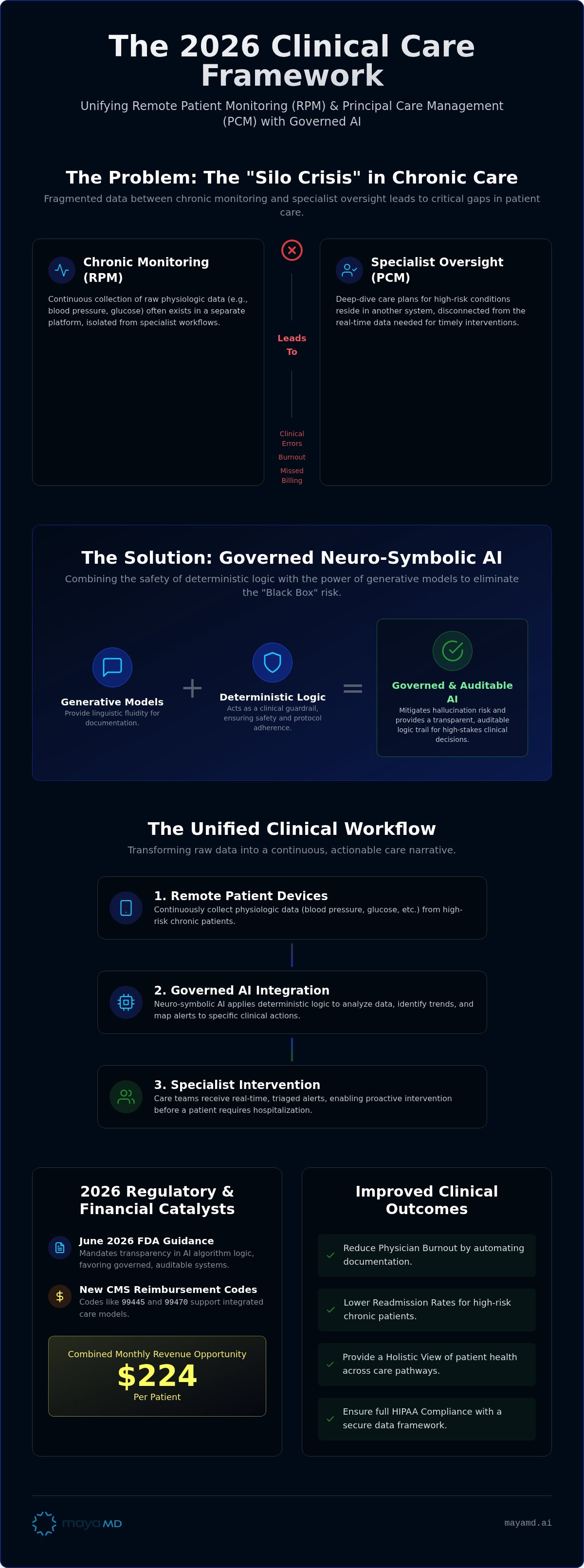
The 2026 clinical environment is defined by a massive demographic shift, with the 65+ population reaching approximately 35.9 million across 15 major states. Within this high-stakes demographic, the traditional separation between primary chronic monitoring and specialist intervention has reached a breaking point. This "Silo Crisis" occurs when physiologic data exists in one platform while specialist care plans reside in another; this fragmentation leads to clinical errors, redundant documentation, and significant missed billing opportunities. Advanced Primary Care Management (APCM) has emerged as the necessary unifying framework to bridge these gaps. By utilizing AI for RPM and PCM integration, providers can finally transform raw data into a continuous care narrative that serves both the primary physician and the specialist.
AI serves as the connective tissue in this new framework. It doesn't just move data; it applies deterministic logic to ensure that every physiologic alert is mapped to a specific clinical action. This systematic approach reduces the administrative friction that typically prevents specialists from participating in remote care programs. When documentation is automated and data is unified, the risk of clinical oversight drops, allowing for a more stable and predictable care delivery model.
From Remote Monitoring to Principal Care
While Remote Patient Monitoring (RPM) focuses on the continuous collection of physiologic data like blood pressure or glucose levels, Principal Care Management (PCM) requires a deep-dive into a single, high-risk chronic condition. The transition from general monitoring to specialized intervention often fails due to manual triage delays. AI agents solve this by identifying specific physiologic trends that mandate escalation to a PCM workflow. When a heart failure specialist receives real-time alerts backed by governed AI logic, they can intervene before a patient requires hospitalization. This capability-to-outcome model ensures that specialists aren't just reacting to old data but are actively managing high-risk patients through an integrated digital ecosystem.
The 2026 Regulatory Catalyst
CMS reimbursement structures in 2026 have shifted to favor those who adopt integrated care models. New codes like 99445 for device supply and 99470 for the initial 10 minutes of clinical management provide the financial infrastructure for more flexible programs. Layering these with PCM codes allows practices to generate a combined monthly revenue of approximately $224 per patient. However, this financial opportunity requires strict adherence to the June 2026 FDA draft guidance on AI-enabled medical devices, which demands transparency in algorithm logic. Successful AI for RPM and PCM integration relies on a HIPAA-compliant cloud platform that ensures data provenance while protecting patient privacy across every specialist touchpoint.
AI Governance: Solving the 'Black Box' and Hallucination Risks
The "Black Box" phenomenon remains the greatest barrier to wide-scale AI adoption in clinical settings. When a model provides a recommendation without an auditable logic trail, it creates a liability risk that most specialists simply won't accept. Standard Generative AI models, while impressive in their linguistic fluidity, operate on probabilistic patterns rather than clinical certainty. For high-stakes PCM documentation, where a single misinterpretation of physiologic data can lead to adverse events, these systems are insufficient. Effective AI for RPM and PCM integration requires a neuro-symbolic approach: a sophisticated architecture that marries the flexibility of large language models with the rigid safety of deterministic logic.
Deterministic logic acts as a clinical guardrail. It ensures that the AI's output is governed by established medical protocols rather than statistical likelihood. This transition from experimental technology to governed application is what separates a visionary framework from a mere software trend. By prioritizing precision, healthcare organizations can move toward a model where AI supports decision-making without introducing the risk of hallucinations. Governed AI provides the transparency required for regulatory adherence, transforming a mysterious "black box" into a reliable clinical partner.
Eliminating Hallucinations in Clinical Documentation
Clinical safety depends on the verification of every automated output. Deterministic logic uses hard-coded medical rules to cross-reference AI-generated summaries against the patient's actual physiologic data. This prevents the "hallucinations" common in standard LLMs, ensuring that documentation remains a factual reflection of the patient's state. MayaMD's Clinical AI Agent utilizes this neuro-symbolic architecture to ensure that every note in the PCM workflow meets the highest standards of accuracy and clinical validity.
The Role of the Clinical AI Agent
The AI Agent functions as a sophisticated filter between raw data and the specialist. It is designed to gather patient-reported outcomes (PROs) through natural conversation, providing context that RPM devices alone cannot capture. By filtering out the "noise" from continuous monitoring, the agent ensures that only clinically significant alerts reach the provider's desk. This systematic triage reduces the administrative burden of charting and documentation by approximately 40 percent. This efficiency allows specialists to focus on high-risk interventions rather than manual data entry. To see how this logic applies to your specific workflow, you can explore our clinical AI solutions.
Strategic Integration: Unifying Chronic and Specialist Care Workflows
A unified workflow is the foundation of modern chronic care. It begins with the patient's interaction with an RPM device, which transmits physiologic data to a Clinical AI Agent for immediate analysis. This agent acts as the primary triage layer, ensuring that only clinically significant insights are routed to the PCM specialist. In a siloed care model, data often sits idle in a portal, requiring manual intervention that wastes physician time and risks patient safety. Transitioning to AI for RPM and PCM integration ensures that physiologic alerts trigger immediate clinical responses without manual triage delays.
Specialists in high-density markets like Houston or Chicago face immense pressure when managing high-acuity chronic patients. These practitioners require a shared data architecture that bridges the gap between primary monitoring and specialized intervention. This shift toward digital healthcare for chronic disease ensures that specialist care is a continuous, AI-governed process rather than a series of disjointed visits. By unifying these workflows, practices can reduce the risk of clinical oversight while maximizing the efficiency of their specialized staff.
Workflow Automation in Complex Chronic Care
AI automates the transition from an RPM alert to a PCM treatment plan update, creating a "System of Action" that operates alongside the EHR. While the EHR remains the "System of Record," the AI platform handles the dynamic logic required for daily management. Using clinical workflow automation solutions, data syncs across platforms without the need for manual entry. This ensures that the PCM specialist always has the most current physiologic data when making high-stakes adjustments to a patient's care plan.
Enhancing Patient Engagement and Adherence
Integrated AI provides a single, consistent point of contact for the patient, which is essential for long-term engagement. Personalized AI interactions significantly improve medication adherence in PCM programs by providing timely reminders and answering patient questions in real time. For Indianapolis-based hospital systems, this model is particularly effective for post-discharge monitoring. By maintaining a continuous digital connection, providers can identify early signs of decompensation and intervene before a readmission becomes necessary. Successful AI for RPM and PCM integration ultimately fosters a deeper connection between the patient and their care team, leading to more stable long-term outcomes.
Implementation Roadmap for Integrated Remote Care
Successful deployment of integrated care models requires a methodical transition from legacy monitoring to a governed, AI-driven ecosystem. Strategic deployment begins with a structured roadmap that prioritizes clinical safety and operational continuity. By following a tiered implementation strategy, organizations can ensure that AI for RPM and PCM integration moves from a visionary concept to a measurable clinical asset. This process is not merely about software installation; it's about re-engineering the care pathway to support continuous, data-driven intervention.
Step 1: Conduct a Clinical Gap Analysis.
Identify high-risk RPM patients whose physiologic trends indicate a need for escalating to a PCM specialist.
Step 2: Establish a HIPAA-Compliant AI Data Governance Framework.
This ensures that every automated recommendation is backed by deterministic medical logic.
Step 3: Integrate AI Agents with existing EHR systems.
Seamless data exchange with platforms like Epic or Cerner is mandatory for maintaining a unified system of record.
Step 4: Train clinical staff on AI-assisted PCM documentation.
Mastery of automated charting tools is the primary solution for reducing physician burnout.
Step 5: Launch a pilot in targeted markets.
Testing the framework in high-growth senior hubs like Las Vegas or Phoenix allows for precise ROI measurement before a full-scale rollout.
Local Considerations for US Healthcare Hubs
Staffing requirements for integrated programs vary significantly across major metro areas. In Chicago, for example, the local payer landscape is increasingly receptive to AI-driven care, provided that the data provenance is transparent and auditable. Organizations in cities like Indianapolis require robust local clinical AI support to manage the complex needs of their high-acuity patient populations. Understanding these regional nuances is essential for tailoring the AI agent's logic to meet specific community health challenges while maximizing reimbursement opportunities.
Ensuring Scalability and Security
Cloud-based AI platforms provide the necessary infrastructure for multi-site integration across large health systems. Maintaining SOC2 and HIPAA compliance is non-negotiable when selecting remote patient monitoring software that handles sensitive specialist data. Large health systems must also address data residency and encryption protocols to protect against evolving cybersecurity threats. A secure, scalable architecture allows for the seamless expansion of PCM services without compromising the integrity of the patient's health information. To ensure your organization meets these rigorous standards, you can request a clinical AI platform demo to see these security features in action.
The MayaMD Advantage: A Unified Clinical AI Ecosystem
MayaMD functions as a sophisticated bridge within the modern healthcare ecosystem. By unifying disparate data points, the platform resolves the historical friction between physiologic monitoring and specialized intervention. The platform's ability to synchronize principal care management tools with real-time RPM data ensures that specialists operate with absolute clinical clarity. It's a system where logic governs every interaction to produce measurable performance. This is the essence of effective AI for RPM and PCM integration: a framework that prioritizes safety while maximizing clinical throughput. As an authoritative pioneer, MayaMD utilizes a neuro-symbolic architecture that marries deterministic logic with generative capability, ensuring that clinical outcomes remain the primary metric of success.
Beyond Monitoring: Advanced Primary Care Management
The synergy between advanced primary care management and specialist care creates a continuous loop of patient oversight. The Clinical AI Agent serves as a 24/7 extension of the care team, gathering patient-reported outcomes and filtering physiologic alerts with high-stakes reliability. This technical capability results in a significant reduction in physician burnout, as automated documentation handles the administrative burden that typically consumes clinical hours. When documentation is both HIPAA-compliant and logically sound, providers can focus on high-acuity interventions rather than manual data entry. Patient satisfaction also rises when individuals feel supported by a responsive, intelligent system that understands the nuances of their specific chronic conditions.
The Future of AI-Driven Care Coordination
Looking toward 2027, the shift toward fully autonomous yet strictly governed clinical documentation will become the industry standard. Providers who adopt these integrated frameworks today will be best positioned to navigate the evolving regulatory and reimbursement environment. Transitioning from fragmented monitoring to an AI-governed ecosystem is a strategic imperative for modern practices. This integration moves the clinical team away from a reactive posture toward a proactive, predictive model of care. We invite providers to schedule a comprehensive demo of the MayaMD platform to experience the future of care coordination firsthand. For healthcare leaders in Las Vegas, Chicago, and Houston, the time to unify your RPM and PCM workflows is now to ensure long-term clinical and financial stability.
Unifying the Future of Chronic and Specialist Care
The 2026 clinical landscape demands a shift from reactive monitoring to proactive, governed management. By prioritizing a systematic approach, healthcare organizations can finally eliminate the "Silo Crisis" that currently fragments chronic and specialist care workflows. Implementing a robust framework for AI for RPM and PCM integration is the definitive path toward operational stability and superior patient outcomes in a high-stakes environment. This evolution moves the care team away from disjointed data points toward a unified, actionable patient narrative.
MayaMD provides the necessary bridge between physiologic data and specialized intervention through a sophisticated, neuro-symbolic architecture. Our platform utilizes a HIPAA-compliant cloud architecture and deterministic logic for clinical safety, ensuring that every automated insight is auditable and precise. The Clinical AI Agent for documentation further reduces the administrative friction that drives physician burnout while enhancing the overall patient experience. We invite you to schedule a demo of MayaMD’s integrated clinical AI platform to see how unified care coordination can transform your specific practice. Embracing this integrated digital ecosystem ensures your organization remains a leader in clinical excellence and long-term performance.
Frequently Asked Questions
How does AI specifically integrate RPM and PCM data?
AI acts as a sophisticated translation layer between continuous physiologic data and specialized care plans. It maps real-time streams from RPM devices to the specific chronic condition goals defined within a PCM framework. This creates a "System of Action" where data triggers specific specialist workflows based on clinical severity. This level of AI for RPM and PCM integration ensures that specialists aren't flooded with raw data but receive actionable insights that align with their chronic care objectives.
Is the AI documentation HIPAA-compliant?
Yes, MayaMD's platform is built on a HIPAA-compliant cloud architecture designed for high-stakes clinical reliability. Every interaction and data point is encrypted both in transit and at rest to maintain the highest standards of patient privacy. This systematic focus on security ensures that automated documentation meets all federal regulatory requirements. By prioritizing a governed approach, the platform provides a secure environment for specialists to manage sensitive chronic care data without compromising compliance or safety.
Can AI for RPM and PCM integration reduce physician burnout?
Effective AI for RPM and PCM integration reduces physician burnout by automating the most time-consuming aspects of clinical documentation and data triage. Clinical AI agents handle the gathering of patient-reported outcomes and the initial filtering of physiologic alerts, which can reduce the administrative burden by approximately 40 percent. This efficiency allows practitioners to focus on high-acuity interventions. It restores the connection between provider and patient by removing the friction of manual charting and fragmented data management.
What is the difference between Generative AI and Deterministic Logic in healthcare?
Generative AI uses probabilistic models to create natural language responses, while deterministic logic follows rigid, pre-defined medical rules to ensure clinical safety. In a high-stakes clinical setting, relying solely on generative patterns can lead to dangerous hallucinations. MayaMD utilizes a neuro-symbolic architecture that combines both technologies. The deterministic component acts as a clinical guardrail, verifying that every AI-generated summary or recommendation is logically sound and clinically valid before it reaches the specialist's desk.
How do I bill for integrated RPM and PCM services in 2026?
Billing for integrated services requires layering specific CPT codes to reflect the multi-faceted nature of the care provided. In 2026, providers can utilize codes like 99453 and 99454 for RPM alongside PCM codes 99424 and 99426. New 2026 codes, such as 99445 for device supply and 99470 for the first 10 minutes of clinical management, provide additional flexibility. This strategic combination allows a practice to generate a combined monthly revenue of approximately $224 per patient.
Does MayaMD integrate with my existing EHR like Epic or Cerner?
MayaMD is designed for seamless integration with major EHR platforms, including Epic and Cerner. The platform functions as a "System of Action" that operates alongside your EHR "System of Record," ensuring that data flows bidirectionally without manual entry. This connectivity is essential for maintaining a unified view of patient health. By syncing physiologic data and specialist care plans automatically, the platform eliminates the data silos that often lead to clinical errors and administrative delays.
What is the role of a Clinical AI Agent in chronic care management?
A Clinical AI Agent serves as a 24/7 extension of the care team by engaging patients and managing complex data triage. It gathers patient-reported outcomes through natural conversation and filters out "noise" from RPM devices so specialists only see clinically significant alerts. This proactive interaction improves medication adherence and provides a single point of contact for the patient. The agent ensures that care coordination is continuous rather than episodic, leading to more stable long-term outcomes.
Are there specific CMS codes for integrated APCM and PCM?
CMS utilizes a combination of Advanced Primary Care Management (APCM) and Principal Care Management (PCM) codes to reimburse for integrated care. APCM codes provide a unifying framework for primary care, while PCM codes like 99424 through 99427 focus on the intensive management of a single high-risk chronic condition. Utilizing these codes in tandem requires clear documentation of the specialized care provided. This integrated billing model reflects the 2026 regulatory shift toward proactive, value-based care coordination.




See The MayaMD Difference
Fill the form below
Download Our Apps
MayaMD for patients and MayaPro for physicians - available on iOS and Android.
FOR PATIENTS
MayaMD App
AI-powered symptom assessment, triage, and secure access to your care team.

FOR PHYSICIANS
MayaPro App
MayaPro brings patient vitals, RPM/PCM care plans, and clinical decision support to your pocket.