
AI-Driven RPM: Clinical Governance for Readmissions 2026

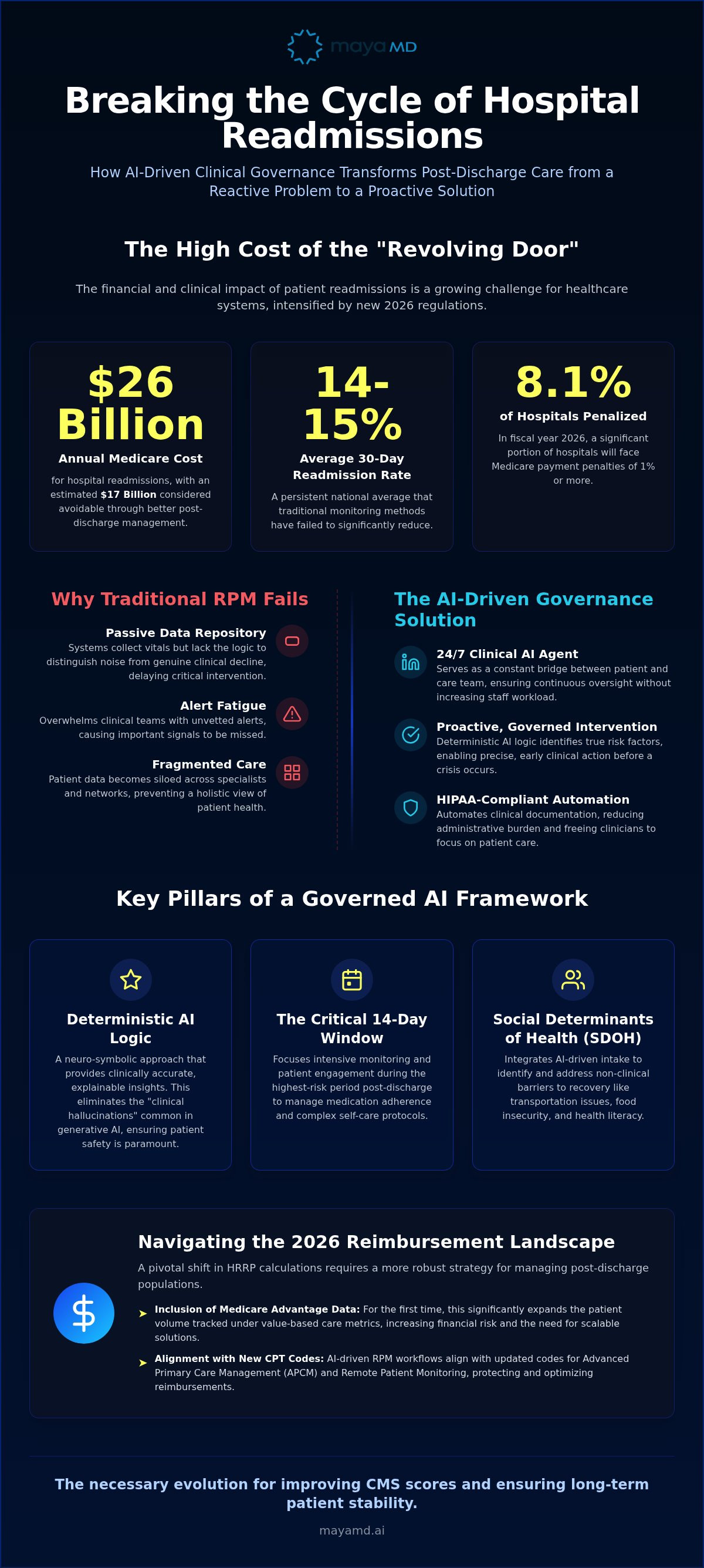
In fiscal year 2026, 8.1% of assessed hospitals will face Medicare payment penalties of 1% or more due to excessive readmissions, representing a notable rise from previous years. For healthcare executives, the "revolving door" of chronic care management is a systemic drain on both fiscal resources and staff morale. You've likely observed how traditional predictive models often flag risks too late or overwhelm your teams with alert fatigue from unvetted data streams. Implementing AI-driven RPM for reducing hospital readmissions requires more than passive monitoring. It demands a governed framework that bridges the gap between raw data and precise clinical intervention.
We recognize that your priority is maintaining high standards of care without exacerbating physician burnout or increasing headcount. This article demonstrates how integrating deterministic AI with Remote Patient Monitoring transforms post-discharge care from a reactive waiting game into a proactive, governed clinical process. We'll examine the impact of including Medicare Advantage data in 2026 metrics and detail how a neuro-symbolic approach ensures clinical accuracy while scaling chronic care management. We provide a clear analysis of why shifting from simple prediction to continuous clinical governance is a necessary evolution for improving CMS reimbursement scores and ensuring long-term patient stability.
Key Takeaways
• Identify why traditional, passive monitoring systems fail to prevent the "revolving door" of 30-day readmissions and how to transition toward a more active clinical governance model.
• Discover the operational benefits of AI-driven RPM for reducing hospital readmissions, specifically how a Clinical AI Agent serves as a 24/7 bridge between patients and care teams.
• Learn how deterministic AI logic frameworks prioritize patient safety by eliminating clinical hallucinations, providing a "governed" alternative to standard generative models.
• Navigate the 2026 reimbursement landscape by aligning post-discharge workflows with updated CPT codes for Advanced Primary Care Management (APCM) and Remote Patient Monitoring.
• Explore scalable strategies for integrating HIPAA-compliant, cloud-based AI solutions into local healthcare ecosystems without increasing administrative headcount or physician burnout.
The 30-Day Readmission Challenge: Why Traditional RPM Falls Short
The "revolving door" of hospital readmissions remains one of the most persistent obstacles in modern healthcare delivery. In fiscal year 2026, the clinical and financial stakes have reached a critical threshold. National data indicates that the average 30-day all-cause readmission rate persists between 14% and 15%, contributing to an annual cost of $26 billion to the Medicare program. Approximately $17 billion of this expenditure is considered avoidable. Traditional Remote Patient Monitoring (RPM) often fails because it functions as a passive repository for data rather than an active clinical tool. While these systems collect vitals, they frequently lack the governed logic required to distinguish between minor fluctuations and genuine physiological decline. This gap creates a dangerous delay in intervention, often resulting in the very emergency room visits the technology was intended to prevent.
Effective AI-driven RPM for reducing hospital readmissions necessitates a shift from "Remote Monitoring" to "Remote Clinical Governance." In major metropolitan hubs like Houston and Chicago, post-discharge care is often fragmented across multiple specialists and primary care networks. Without a centralized, AI-governed framework, critical patient data becomes siloed, leaving care teams reactive rather than proactive. By implementing a system that prioritizes clinical oversight through deterministic logic, providers can bridge these gaps and ensure continuity of care regardless of the patient's geographic location or the complexity of their care network.
The Financial Impact of CMS Readmission Penalties
The regulatory environment in 2026 has intensified the pressure on hospital systems. For the first time in five years, the number of hospitals facing significant penalties has increased. Specifically, 240 hospitals will receive a penalty of 1% or more on their Medicare payments due to excessive readmissions. A pivotal shift this year is the inclusion of Medicare Advantage data in Hospital Readmissions Reduction Program (HRRP) calculations. This expansion significantly increases the volume of patients tracked under value-based care metrics. Beyond direct penalties, the administrative burden of manually tracking post-discharge adherence is a hidden cost that drains resources. Implementing AI-driven RPM for reducing hospital readmissions allows systems to automate this oversight, protecting reimbursements while reducing the documentation load on clinical staff.
The Human Element: Patient Adherence and SDOH
Clinical outcomes are heavily influenced by the critical 14-day window following discharge. During this period, patients often struggle with complex medication regimens and self-management protocols. AI-driven intake processes now allow providers to identify Social Determinants of Health (SDOH), such as lack of transportation or food insecurity, which are primary drivers of non-adherence. Utilizing digital healthcare for chronic disease ensures that high-risk populations receive the continuous support necessary to remain stable at home. When a platform combines empathetic patient engagement with rigorous data science, it addresses the human barriers to recovery that traditional, data-only RPM solutions consistently overlook.
How AI-Driven RPM Transforms Post-Discharge Clinical Governance
Clinical governance in the post-discharge phase requires a shift from periodic check-ins to a continuous, 24/7 presence. The Clinical AI Agent acts as this vital bridge, maintaining a constant connection between the patient and the care team without increasing the administrative burden on staff. By automating clinical documentation, these agents allow physicians to focus on intervention rather than data entry, all while maintaining strict HIPAA compliance. This level of oversight ensures that the high-stakes period following a hospital stay is managed with the same rigor as an inpatient environment.
One of the primary barriers to effective remote care is the sheer volume of data generated. Standard monitoring tools often flood providers with "noise," leading to alert fatigue and missed signals. Advanced AI and automation to reduce readmissions solve this by applying real-time triage. The system filters thousands of biometric data points to flag only those shifts that are clinically significant. This precision allows providers to deploy AI-driven RPM for reducing hospital readmissions effectively, focusing their limited time on the patients who are actually trending toward a crisis. Integrating sophisticated remote patient monitoring software directly into existing EMR/EHR systems ensures that these insights are instantly actionable within the established clinical workflow.
The Mechanism of Continuous Monitoring
The transition from data collection to clinical governance follows a logical, four-step progression. It begins with automated enrollment and AI-guided patient onboarding to ensure immediate post-discharge adherence. Next, the platform facilitates continuous biometric data ingestion, tracking vitals like blood pressure, glucose, and SpO2 levels. This data undergoes AI-driven analysis using deterministic clinical protocols to eliminate guesswork. Finally, the system triggers immediate escalation to the care team if high-risk anomalies are detected. This systematic approach transforms AI-driven RPM for reducing hospital readmissions into a reliable safety net for chronic care populations.
Streamlining Chronic Care Management
Scaling chronic care requires more than just better software; it requires a redesign of the administrative process. Specialized clinical workflow automation solutions handle repetitive tasks such as scheduling and billing code preparation, freeing up staff for patient-facing care. This is particularly effective for Principal Care Management (PCM), where specialists must coordinate complex interventions for high-risk patients. By utilizing natural language processing (NLP) interfaces, these systems enhance patient engagement, making it easier for individuals to report symptoms in plain language. If you're looking to optimize your system's performance, exploring a clinical AI platform can provide the necessary framework for these advanced interventions.
Beyond Prediction: Preventing Readmissions with Deterministic AI Logic
Prediction without a clear path to intervention is an incomplete strategy. Traditional predictive modeling identifies who might return to the hospital, yet it often fails to provide the clinical rationale required for safe, immediate action. Deterministic AI solves this by utilizing logic-based frameworks that strictly adhere to established medical protocols. This approach eliminates the risk of clinical hallucinations, which are common in standard generative models. By choosing a governed system, healthcare organizations move from speculative risks to actionable insights. Evidence shows that AI-enabled RPM improves care by focusing on specific, evidence-based outcomes rather than vague probability scores. The "Authoritative Pioneer" model successfully pairs generative AI for patient engagement with deterministic logic for clinical safety, ensuring a balance between empathy and precision.
"Black Box" AI represents a significant liability in readmission prevention programs. When a system cannot explain the reasoning behind an alert, clinicians are left to second-guess the technology, leading to delayed responses. Effective AI-driven RPM for reducing hospital readmissions must be transparent. It requires an engine built on clinical validity, ensuring that every automated triage or documentation summary is rooted in real-time patient data and peer-reviewed logic. This transparency allows providers to act with confidence, knowing the underlying data has been rigorously vetted against clinical standards.
Eliminating Hallucinations in Clinical Documentation
The distinction between standard Large Language Models (LLMs) and neuro-symbolic AI is fundamental to patient safety. While LLMs excel at generating natural-sounding text, they lack the intrinsic logic to prevent factual errors or "hallucinations." Neuro-symbolic AI combines the flexibility of generative models with the rigid constraints of symbolic logic. This ensures that clinical summaries are not just readable but factually grounded in the patient's actual biometric readings. Clinical AI Governance is the systematic application of logic-based AI to patient safety.
Trust and Transparency in AI-Driven Care
Clinicians need to understand the "why" behind every alert to maintain confidence in the system. Explainability isn't just a feature; it's a requirement for high-stakes decision-making in post-discharge environments. By maintaining a "Human-in-the-Loop" approach, the technology supports the physician's expertise rather than attempting to replace it. The integration of a clinical ai agent for primary care helps build this trust by providing clear, logic-backed justifications for every intervention. This transparency ensures that AI-driven RPM for reducing hospital readmissions remains a collaborative tool that enhances the provider's ability to deliver safe, effective care without increasing administrative friction.
Implementing AI-Driven RPM in Local Healthcare Ecosystems
Scaling advanced clinical technology requires more than a universal software patch. In healthcare hubs like Las Vegas, Indianapolis, and Phoenix, success depends on aligning technology with specific regional demographic challenges. High-stakes reliability is the priority for these multi-site systems. By deploying AI-driven RPM for reducing hospital readmissions, these systems provide a standardized layer of oversight across disparate facilities. This governed approach ensures that a patient discharged in North Las Vegas receives the same rigorous post-acute monitoring as one in Summerlin. It's a method that prioritizes safety over experimental hype, ensuring that every patient remains within a secure clinical framework.
The 2026 reimbursement landscape offers new avenues for funding these initiatives. Navigating CPT codes for RPM and Principal Care Management (PCM) requires a systematic framework that captures every billable minute of clinical review. While national readmission rates hover around 14.67%, regional variation is significant. Idaho maintains a low of 13.3%, while states like Massachusetts reach 15.3%, highlighting the need for localized strategies. By building a regional network through Advanced Primary Care Management (APCM), hospitals can foster closer collaboration with local specialists to target specific conditions like heart failure or pneumonia. It's a scalable model that doesn't require an immediate increase in headcount.
Regional Case Study: The Houston and Chicago Models
Large-scale deployments in Houston and Chicago demonstrate how to manage diverse urban populations with high chronic disease prevalence. These multi-site hospital systems use AI to maintain data security while adhering to state-specific HIPAA considerations. The primary challenge in these environments is fragmentation. AI-governed platforms bridge this gap by centralizing patient data, ensuring that "lost to follow-up" is no longer a clinical reality. It's about creating a cohesive care journey that spans different zip codes and socioeconomic backgrounds, providing a stable bridge between the hospital and the home.
Maximizing ROI Through APCM and PCM
Financial sustainability is achieved by using advanced primary care management to fund the initial implementation of RPM. Measuring ROI involves tracking the reduction in emergency department visits against implementation costs, which often reach $325,000 for a 500-patient deployment in the first year. Using principal care management tools allows specialists to provide targeted care for complex diabetic or cardiac patients. This targeted oversight directly influences CMS reimbursement scores by preventing the unplanned returns that trigger HRRP penalties. To see how these tools integrate into your current workflow, you can explore our clinical AI solutions.
The MayaMD Clinical AI Agent: A Scalable Solution for Readmission Reduction
MayaMD bridges the critical gap between inpatient discharge and home-based recovery by integrating the Clinical AI Agent directly into existing post-discharge workflows. This integration ensures that the transition from hospital to home isn't a period of isolation but a continuation of governed care. By utilizing a HIPAA-compliant, cloud-based ecosystem, health systems maintain a persistent connection with high-risk populations, ensuring that no patient falls through the cracks due to administrative silos. The platform's ability to automate complex monitoring tasks allows providers to deploy AI-driven RPM for reducing hospital readmissions across entire patient populations without the need to increase clinical headcount. It's a scalable methodology that transforms clinical expertise into a 24/7 digital presence.
The transition from pilot programs to system-wide implementation requires a partner that understands the nuances of clinical governance. MayaMD provides the infrastructure necessary to move beyond simple data collection, offering a framework where every automated interaction is rooted in medical logic. As hospitals face increasing pressure from the 2026 CMS mandates, the ability to scale clinical oversight becomes a competitive necessity. By leveraging AI-driven RPM for reducing hospital readmissions, organizations can ensure long-term financial stability and superior patient outcomes through a unified, reliable platform.
A Vision for Hallucination-Free Healthcare
Safety is the cornerstone of the MayaMD platform. Our commitment to clinical precision is reflected in our "Authoritative Pioneer" approach, which prioritizes deterministic logic to eliminate the risk of AI-generated errors. This governed model ensures that every summary and alert is factually grounded in the patient's real-time biometric data. We invite healthcare executives and clinical leaders to view a clinical demonstration of the MayaMD platform to see how this rigorous oversight functions in practice. It's an opportunity to witness how high-stakes technology can foster deeper human connection and more precise medical intervention.
Getting Started with MayaMD
We provide specialized consultation services for hospital systems in Indianapolis, Houston, and other major medical hubs to ensure seamless regional integration. Our team works closely with your clinical leads to customize the Clinical AI Agent for specific chronic condition protocols, such as heart failure or COPD management. This tailored approach ensures that the technology aligns perfectly with your existing clinical standards and patient needs. If you're ready to lead your organization into a new era of precision, you can Experience the Future of Clinical AI Governance with MayaMD. Our experts are prepared to help you navigate the complexities of 2026 clinical mandates with confidence and clarity.
Advancing Post-Discharge Care Through Governed Innovation
The trajectory of post-acute care in 2026 demands a transition from passive data collection to active clinical governance. By implementing a framework that prioritizes logic-based oversight, health systems can effectively mitigate the systemic gaps that lead to avoidable 30-day returns. This evolution ensures that every biometric fluctuation is analyzed with clinical precision, providing a reliable bridge between hospital discharge and long-term patient recovery. Moving beyond simple prediction allows care teams to intervene with confidence, ensuring that the critical window following discharge is managed with rigorous clinical authority.
Utilizing AI-driven RPM for reducing hospital readmissions empowers your organization to scale clinical expertise without expanding your administrative headcount. Our HIPAA-compliant, cloud-based architecture provides the specialized support required to optimize APCM and PCM billing while delivering zero-hallucination care through deterministic logic. We invite you to Request a Clinical AI Demonstration for Your Hospital System to see how these governed solutions can secure your clinical outcomes and protect your reimbursements. Your path toward a more integrated and efficient care model begins with a commitment to technological precision and patient safety.
Frequently Asked Questions
How does AI-driven RPM specifically reduce hospital readmissions?
AI-driven RPM for reducing hospital readmissions identifies subtle physiological trends before they escalate into acute crises. The platform utilizes continuous biometric data ingestion to monitor patients in their home environment during the critical post-discharge window. By applying governed clinical logic, the system filters non-essential data and flags only significant anomalies. It's a method that allows care teams to intervene with targeted treatments, effectively stopping the "revolving door" of unplanned returns and improving CMS quality scores.
Is AI for remote patient monitoring HIPAA compliant?
Yes, MayaMD's platform is HIPAA-compliant and utilizes a cloud-based architecture designed for the rigorous security requirements of modern healthcare. Every data point is encrypted both in transit and at rest to ensure total privacy. Our system maintains strict regulatory adherence, so patient identity and biometric readings remain secure. This framework allows for the safe exchange of clinical data across diverse ecosystems, ensuring that institutional security protocols aren't compromised during remote monitoring.
What is the difference between generative AI and deterministic AI in healthcare?
Generative AI creates content based on probabilistic patterns, which can lead to clinical inaccuracies or "hallucinations" in high-stakes environments. Deterministic AI, however, operates within a logic-based framework that strictly follows established medical protocols. MayaMD combines these approaches, using generative AI to enhance patient engagement while relying on deterministic logic for clinical decision support. This hybrid model ensures that patient safety is never compromised by the creative unpredictability inherent in standard large language models.
Can RPM software integrate with my existing EHR system like Epic or Cerner?
MayaMD is designed for deep integration with major EHR platforms, including Epic, Cerner, and Meditech. By utilizing standard HL7 and FHIR protocols, the software ensures that biometric data and AI-generated summaries flow directly into the patient's existing medical record. This connectivity eliminates the need for clinicians to toggle between disparate systems, maintaining a single source of truth. Such integration is essential for scaling AI-driven RPM for reducing hospital readmissions across complex, multi-site hospital networks.
What are the CPT codes for RPM and PCM reimbursement in 2026?
Providers can leverage several CPT codes for reimbursement in 2026, including 99453 for initial setup and 99454 for device supply. Clinical monitoring time is captured under 99457 and 99458, while Principal Care Management (PCM) uses codes 99424 through 99427. Additionally, the new Advanced Primary Care Management (APCM) codes facilitate bundled payments for chronic care. These financial structures provide the necessary ROI to sustain long-term RPM initiatives while lowering the total cost of care.
How does the Clinical AI Agent reduce physician documentation burden?
The Clinical AI Agent reduces documentation burden by automatically capturing and summarizing patient interactions and biometric trends. Instead of manually reviewing raw data, physicians receive concise summaries that are ready for EHR integration. This automation handles repetitive administrative tasks and pre-populates documentation for billing. By streamlining these workflows, the system helps mitigate physician burnout. It's a solution that lets practitioners dedicate more time to direct clinical intervention rather than data entry.
Is MayaMD available for large-scale hospital systems in cities like Chicago or Phoenix?
Yes, MayaMD is built on a scalable cloud infrastructure that supports large-scale deployments in major metropolitan areas like Chicago, Phoenix, and Houston. Our platform is designed to handle the high volume and demographic diversity typical of urban health systems. We provide regional customization to align with local chronic condition protocols and state-specific regulatory requirements. This scalability ensures that even the largest hospital networks can implement a unified clinical governance model across all facilities.
What happens if the AI flags a high-risk patient alert?
When the AI detects a high-risk anomaly, it triggers an immediate escalation protocol based on your specific clinical guidelines. The system triages the alert to determine its severity and notifies the care team in real time. This ensures that critical shifts receive attention before the patient's condition necessitates an emergency room visit. Our "Human-in-the-Loop" model ensures that while the AI provides the alert, the final clinical decision always remains with the provider.




See The MayaMD Difference
Fill the form below
Download Our Apps
MayaMD for patients and MayaPro for physicians - available on iOS and Android.
FOR PATIENTS
MayaMD App
AI-powered symptom assessment, triage, and secure access to your care team.


FOR PHYSICIANS
MayaPro App
MayaPro brings patient vitals, RPM/PCM care plans, and clinical decision support to your pocket.