
AI Agents for Remote Patient Monitoring: 2026 Guide

The era of passive data collection in healthcare has reached its breaking point. While the promise of connected health was vast, the reality often involves physician burnout from relentless data streams and the persistent risk of generative AI hallucinations. Deploying a sophisticated AI agent for remote patient monitoring is no longer a peripheral experiment; it's a clinical necessity for providers navigating the rigorous 2026 Medicare landscape. You understand that the value of RPM isn't found in the volume of data, but in the precision of the action it triggers.
This guide demonstrates how autonomous clinical AI agents transform remote patient monitoring from a source of administrative fatigue into a proactive, hallucination-free system for chronic care management. You'll discover how integrating deterministic logic with generative capabilities allows your practice to achieve scalable, HIPAA-compliant patient engagement without increasing staff burden. We'll show you how to reduce documentation time while improving clinical outcomes for complex conditions.
We'll examine the 2026 CMS reimbursement updates, including the latest requirements for CPT codes 99457 and 99458, and the updated FDA guidance on clinical decision support. By the end of this guide, you'll have a clear roadmap for implementing governed intelligence that bridges the gap between high-frequency data and meaningful clinical intervention.
Key Takeaways
• Learn how the role of an AI agent for remote patient monitoring has evolved from simple data collection into an interactive, software-driven clinical partner that enhances patient engagement.
• Understand the mechanics of neuro-symbolic AI, which eliminates the risk of clinical hallucinations by grounding generative fluency within deterministic medical logic.
• Discover how to automate Advanced Primary Care Management (APCM) workflows to identify early signs of health deterioration in patients with chronic hypertension and diabetes.
• Identify the necessary protocols for assessing clinic readiness and integrating autonomous agents seamlessly with your existing EHR systems and RPM hardware.
• Explore strategies for consolidating APCM and PCM into a unified, HIPAA-compliant patient journey that significantly reduces documentation time for primary care providers.
What is an AI Agent for Remote Patient Monitoring?
The Clinical AI Agent represents a fundamental shift in how we approach chronic care management. It isn't a passive data processor. Instead, it's an autonomous entity designed to interpret physiological data and execute actions within a strictly governed clinical framework. Deploying an AI agent for remote patient monitoring allows practices to move beyond simple data collection. While traditional Remote Patient Monitoring focused on the hardware, such as blood pressure cuffs and glucose monitors, the current standard of care relies on the software-driven intelligence that interprets these metrics in real-time.
These agents bridge the gap between a patient's home and the provider's dashboard. They don't simply transmit numbers; they synthesize them into actionable insights. This capability is especially critical for automated post discharge communication solutions, where the first 48 hours after a hospital stay are vital for preventing readmission. By maintaining this continuous connection, agents ensure chronic care stability without requiring constant manual oversight from clinical staff. It's a method of extending the reach of the clinic into the patient's daily life, fostering a sense of constant support.
Agent vs. Algorithm: Understanding the Difference
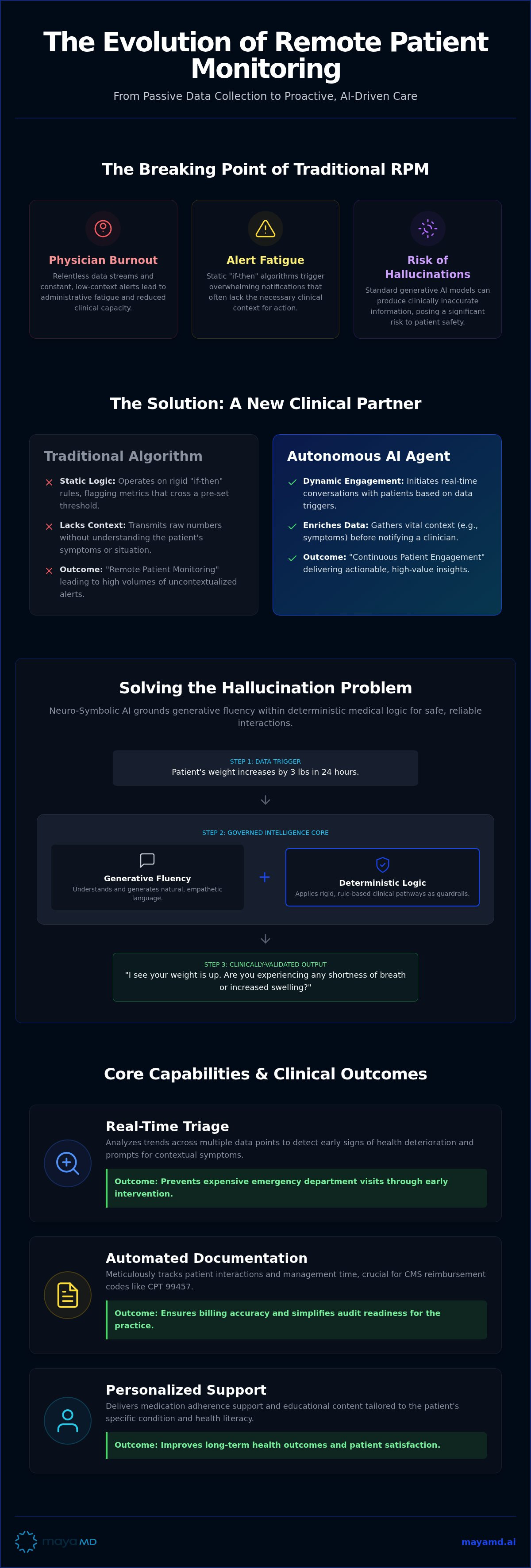
Algorithms are static. They operate on "if-then" logic that flags a metric if it exceeds a pre-set threshold. This often results in "alert fatigue," where clinicians are overwhelmed by notifications that lack context. An AI agent for remote patient monitoring is different. It engages patients in real-time conversation based on data triggers. If a patient's weight increases by three pounds in 24 hours, the agent doesn't just send an alert. It initiates a dialogue to ask about symptoms like shortness of breath or increased swelling. This shifts the model from "Remote Patient Monitoring" to "Continuous Patient Engagement," ensuring that by the time a clinician is notified, the data is already enriched with vital context.
The Core Capabilities of Clinical AI Agents in 2026
The modern clinical AI agent functions as an extension of the care team. Its primary capabilities are designed to optimize both patient safety and practice efficiency through a capability-to-outcome structure:
Real-time Triage
The agent detects health deterioration early by analyzing trends across multiple data points, which allows for interventions that prevent expensive emergency department visits.
Automated Documentation
In 2026, CMS reimbursement codes like CPT 99457 require meticulous tracking of management time. Agents automate this documentation, ensuring billing accuracy and audit readiness for the practice.
Personalized Support
By providing medication adherence support and educational content tailored to the patient's specific health literacy, the agent improves long-term health outcomes and patient satisfaction.
This systematic approach ensures that every data point serves a purpose. It turns a stream of information into a comprehensive ecosystem of care that supports both the provider's workflow and the patient's recovery.
Governed Intelligence: Solving the AI Hallucination Problem in RPM
Precision is the non-negotiable prerequisite for clinical adoption. In high-stakes chronic care management, the "black box" nature of standard generative models presents an unacceptable risk. When an AI agent for remote patient monitoring interacts with a patient, the responses must be grounded in clinical reality, not probabilistic guesswork. Hallucinations, while perhaps acceptable in creative fields, are potentially catastrophic in a medical context where a misunderstood symptom could lead to a missed intervention.
Reliability requires a shift toward governed intelligence. This approach prioritizes safety by ensuring that every interaction follows established clinical pathways. By utilizing neuro-symbolic AI, the system combines the linguistic fluency of generative models with the rigid, rule-based logic of medical science. This dual-layer architecture integrates generative fluency with rule-based logic, resulting in a system that maintains conversational engagement without sacrificing clinical accuracy. It's a systematic methodology that allows the AI to function as a reliable clinical partner rather than a unpredictable chatbot.
Deterministic Logic vs. Generative Probability
For healthcare organizations seeking to develop their own production-ready artificial intelligence solutions to meet these rigorous standards, learn more about Omdena.
Medical protocols must be hard-coded, not predicted. MayaMD utilizes deterministic frameworks to ensure that patient-facing AI agents for remote patient monitoring never deviate from clinician-approved logic. While generative AI predicts the next most likely word, deterministic logic follows a fixed set of rules that cannot be bypassed. Neuro-symbolic AI is the union of rule-based logic and deep learning. This structure creates essential guardrails; the AI can understand a patient's colloquial description of "chest tightness" but will only respond with a protocol-driven triage path rather than an improvised suggestion. This systematic oversight builds profound clinician trust by providing transparent, evidence-based responses that mirror the provider’s own decision-making process.
HIPAA Compliance and Data Governance
Security is the foundation of digital connectivity. For clinics in Las Vegas and Phoenix, implementing a sophisticated monitoring system requires a cloud-based, HIPAA-compliant platform that manages the secure flow of data between consumer wearables and the Electronic Health Record (EHR). This integration ensures that patient data is not only accessible but also protected by rigorous encryption and governance standards. Understanding these technical requirements is central to Defining the Role of a Clinical AI Agent for Primary Care in 2026. By maintaining a governed environment, practices can scale their monitoring efforts without compromising patient privacy or data integrity. If you're ready to modernize your practice, you can explore our clinical AI solutions to see how governed intelligence functions in a real-world setting.
Top Use Cases for AI Agents in Remote Patient Monitoring
Practical application is the ultimate validator of clinical technology. While early iterations of telehealth focused on simple connectivity, the deployment of a sophisticated AI agent for remote patient monitoring in 2026 addresses the specific complexities of chronic disease management. For patients with hypertension and diabetes, these agents provide a level of vigilance that human care teams cannot maintain manually. By analyzing physiological trends in real-time, the agent identifies early indicators of health deterioration, such as a subtle but consistent rise in systolic blood pressure or erratic glucose fluctuations, before they escalate into acute events.
The administrative utility of these agents is equally transformative. We see this most clearly in the automation of Advanced Primary Care Management (APCM) and Principal Care Management (PCM) workflows. For specialists managing complex chronic conditions, the AI agent serves as a digital extension of the practice, ensuring that the continuity of care remains unbroken between office visits. This systematic oversight allows providers to scale their patient panels without compromising the quality of individual attention. It also addresses the primary driver of physician burnout: the overwhelming burden of documentation. By automatically generating clinical summaries and tracking engagement metrics, the agent ensures that the medical record is both comprehensive and audit-ready.
Chronic Care Management (CCM) and RPM Synergy
Financial sustainability is built into the architecture of the modern clinical AI agent. In 2026, CMS reimbursement for CPT code 99457 requires at least 20 minutes of clinical staff time spent on RPM treatment management. AI agents manage this threshold with mathematical precision, documenting every second of patient interaction and data analysis. This capability allows practices in high-growth markets like Chicago and Indianapolis to scale their CCM programs efficiently. By automating the routine aspects of monitoring, clinical staff can focus their expertise on high-risk patients who require direct human intervention, maximizing both the clinical impact and the practice's revenue potential.
Post-Discharge and Transitional Care
The transition from hospital to home is a period of heightened vulnerability. Automated post discharge communication solutions act as a 24/7 bridge, ensuring that patients adhere to new medication regimens and recognize red-flag symptoms immediately. This proactive engagement is a critical component in reducing 30-day readmission rates, which remains a primary metric for value-based care success. Integrating these agents into the recovery journey provides patients with a constant sense of support while delivering high-fidelity data back to the primary care team. Understanding The Future of Remote Patient Monitoring Software requires recognizing this shift toward a comprehensive, agent-led ecosystem that prioritizes patient stability above all else.
Implementation Strategy: Deploying AI Agents in Local Clinical Workflows
Successful deployment of an AI agent for remote patient monitoring requires a structured methodology that prioritizes clinical integration over simple software installation. Before implementation, clinics must conduct a rigorous readiness assessment to evaluate digital maturity and current hardware interoperability. This process ensures that the AI agent functions as a cohesive extension of the existing care team rather than an isolated tool. Transitioning staff from manual data collectors to care orchestrators is a vital component of this evolution. By allowing the agent to handle routine data synthesis, clinicians can focus their expertise on high-value interventions prompted by the system's high-fidelity triage insights.
Navigating the 2026 Medicare reimbursement landscape is equally critical for sustainable operations. The 2026 Physician Fee Schedule provides clear pathways for RPM billing, including CPT code 99453 for initial setup and the updated rates for device supply and data transmission. Utilizing specialized connectivity from Choice IoT helps practices ensure that these devices maintain the persistent connection required for accurate billing. With the 2026 conversion factor set at approximately $33.40 for non-qualifying APM participants, practices must ensure their workflows are optimized to capture these codes accurately. A governed AI agent automates the necessary time-tracking and documentation, which results in a significant reduction in administrative overhead and improved audit readiness.
Administrative pressures vary significantly by region. In high-volume clinical hubs like Houston and Las Vegas, the sheer density of chronic care patients requires a scalable solution to prevent provider burnout. Implementing robotic process automation in healthcare assists local staff by handling repetitive data entry and scheduling tasks, allowing them to remain focused on patient-facing care. For healthcare systems in Indianapolis, local partnerships and on-site support models ensure that the transition to AI-driven monitoring remains seamless and aligned with state-specific healthcare initiatives.
Measuring ROI and Clinical Outcomes
The value of an AI-driven RPM program is measured through a combination of financial and clinical key performance indicators. Long-term cost savings are achieved through prevented hospitalizations, as early detection of deterioration allows for timely outpatient adjustments. Practices should monitor several core metrics to validate their investment:
Patient Engagement
Tracking the frequency and quality of patient interactions with the AI agent.
Clinical Outcomes
Measuring the stability of chronic conditions like hypertension and diabetes over a six-month period.
Administrative Efficiency
Quantifying the reduction in manual documentation time per patient.
High patient satisfaction scores often follow these improvements, as patients feel more connected to their care team through the agent's 24/7 availability. If you are ready to optimize your practice’s efficiency, you can schedule a clinical workflow assessment to identify the best integration path for your team.
The MayaMD Advantage: A Governed Clinical AI Agent
MayaMD occupies a unique position as the authoritative pioneer in the clinical AI sector for 2026. While other platforms offer fragmented tools, MayaMD provides a unified architecture that integrates Advanced Primary Care Management (APCM) and Principal Care Management (PCM) into a single, cohesive patient journey. This integration ensures that the continuity of care remains unbroken as patients move between primary care visits and specialist consultations. By leveraging a sophisticated AI agent for remote patient monitoring, your practice can transition from reactive data collection to a model of governed, proactive intervention that prioritizes clinical validity.
A Comprehensive Chronic Care Ecosystem
The platform's strength lies in its ability to support the full spectrum of primary and specialist care through a capability-to-outcome framework. For primary care providers, the agent automates the routine triage and documentation tasks that often lead to burnout. For specialists, it provides the high-fidelity data needed for complex decision-making. This holistic approach is central to modern Digital Healthcare for Chronic Disease, where the focus shifts from episodic visits to continuous monitoring. By utilizing specialized Principal Care Management Tools, specialists can maintain precise oversight of high-risk patients without increasing their administrative burden. This connectivity fosters a deeper sense of patient support while ensuring every action is recorded and audit-ready.
Future-Proofing Your Practice with MayaMD
Adopting MayaMD is a strategic move to stay ahead of the industry's shift toward value-based care models. The scalability of our AI agent for remote patient monitoring allows your practice to manage increasingly complex patient populations with the cold, hard logic of advanced data science. Our platform ensures your practice remains at the forefront of clinical innovation by providing:
Deterministic Clinical Logic
Eliminating the risk of hallucinations through a neuro-symbolic AI architecture that prioritizes patient safety.
Seamless Connectivity
Integrating high-frequency data from wearables directly into your existing clinical workflows and EHR systems.
Billing Automation
Streamlining the documentation required for 2026 Medicare reimbursement codes to ensure financial sustainability.
It's a system designed for high-stakes reliability, ensuring that every patient interaction is HIPAA-compliant. This isn't just about software; it's about building a long-term partnership that prioritizes measurable performance and patient experience. If you're ready to see how governed intelligence can transform your practice, Schedule a MayaMD Consultation to explore our HIPAA-compliant, AI-driven platform.
Modernizing Chronic Care Through Governed Intelligence
The transition toward autonomous clinical intelligence represents the definitive path for practices seeking to scale chronic care without compromising patient safety. By implementing a sophisticated AI agent for remote patient monitoring, you replace passive, overwhelming data streams with active, governed clinical oversight. We've examined how the union of deterministic logic and generative fluency serves as a critical safeguard against hallucinations, ensuring that every patient interaction remains grounded in established medical protocols. This systematic approach doesn't just improve outcomes for complex conditions like hypertension and diabetes; it fundamentally restores the clinician’s focus by automating the rigorous documentation required for 2026 reimbursement standards.
MayaMD stands as your partner in this evolution, providing a HIPAA-compliant platform that seamlessly integrates RPM, APCM, and PCM into a single, cohesive ecosystem. The era of fragmented monitoring is over, replaced by a model of continuous, intelligent engagement that supports both the provider and the patient journey. Ready to modernize your clinical workflow? Request a Demo of the MayaMD Clinical AI Agent to see our governed intelligence in action. Embrace the next evolution of connected health and lead your practice into a more efficient, evidence-based future.
Frequently Asked Questions
What is the difference between an AI algorithm and an AI agent in RPM?
An AI algorithm typically follows static "if-then" rules to process data points, whereas an AI agent for remote patient monitoring functions as an autonomous clinical partner. While algorithms generate passive alerts that often lead to clinician fatigue, agents engage patients in real-time dialogue based on physiological triggers. This shift allows providers in cities like Chicago and Houston to move from simple monitoring to continuous patient engagement, where the agent synthesizes data into actionable clinical insights.
Is an AI agent for remote patient monitoring HIPAA compliant?
Yes, a Clinical AI Agent must be fully HIPAA compliant to operate within a regulated healthcare environment. MayaMD provides a cloud-based, HIPAA-compliant platform that ensures all data transmitted from patient wearables to the provider dashboard is encrypted and governed by strict security protocols. For clinics in Las Vegas and Phoenix, this level of regulatory adherence is non-negotiable for maintaining patient privacy while scaling remote monitoring programs across complex chronic populations.
How does an AI agent prevent hallucinations in clinical documentation?
An AI agent prevents hallucinations by integrating deterministic logic with generative AI, a framework known as neuro-symbolic AI. Unlike standard generative models that predict the next most likely word based on probability, MayaMD’s architecture forces the AI to follow hard-coded medical protocols. This ensures that clinical documentation and patient interactions are always grounded in verified medical science. This systematic oversight eliminates the guesswork that can lead to dangerous medical errors in chronic care.
Can an AI agent help with Medicare RPM reimbursement?
AI agents significantly streamline the Medicare RPM reimbursement process by automating the documentation required for CPT codes 99457 and 99458. These codes require at least 20 minutes of monthly treatment management, which the agent tracks with mathematical precision. By providing audit-ready logs of every patient interaction, the platform helps practices in Indianapolis and Houston capture revenue more efficiently. It reduces the administrative burden that often prevents clinics from fully utilizing RPM billing opportunities.
How does MayaMD integrate with my existing EHR system?
MayaMD facilitates secure, bidirectional data flow between consumer wearables and your existing Electronic Health Record (EHR) system. The platform acts as a bridge, ensuring that high-fidelity data from an AI agent for remote patient monitoring is accessible within your established clinical workflow. This connectivity allows providers to view patient trends and agent-generated clinical summaries without switching between multiple software interfaces. It creates a unified ecosystem for managing Advanced Primary Care Management and Principal Care Management.
What chronic conditions are best suited for AI-driven remote monitoring?
AI-driven remote monitoring is exceptionally effective for managing hypertension, diabetes, and heart failure. These conditions require continuous physiological tracking and frequent patient engagement to prevent acute deterioration. For specialists in Phoenix and Houston, using an agent for Principal Care Management (PCM) allows for precise oversight of complex chronic conditions. The agent identifies subtle trends in glucose levels or blood pressure, prompting early interventions that can prevent expensive hospital readmissions and improve long-term stability.
Does an AI agent replace the need for clinical staff in RPM?
No, an AI agent is designed to augment clinical staff rather than replace them. The primary goal is to transition your team from manual data collectors into care orchestrators. By automating routine triage and administrative documentation, the agent allows clinicians to focus their time on high-risk patients who require direct human intervention. This optimization is vital for high-volume clinics in Las Vegas and Chicago, where reducing physician burnout is essential for maintaining a sustainable practice.
What is the implementation timeline for a Clinical AI Agent in a primary care clinic?
The implementation timeline for a Clinical AI Agent typically ranges from four to eight weeks, depending on the complexity of your EHR integration. This process begins with a clinic readiness assessment to ensure your current hardware and digital workflows are compatible. Following the setup, staff training focuses on interpreting agent-generated insights and managing the care orchestration process. Local support for Indianapolis-based healthcare systems ensures that the transition is seamless and aligned with your specific clinical goals.




See The MayaMD Difference
Fill the form below
Download Our Apps
MayaMD for patients and MayaPro for physicians - available on iOS and Android.
FOR PATIENTS
MayaMD App
AI-powered symptom assessment, triage, and secure access to your care team.
FOR PHYSICIANS
MayaPro App
MayaPro brings patient vitals, RPM/PCM care plans, and clinical decision support to your pocket.