
What Is Remote Patient Monitoring? Houston Provider Guide

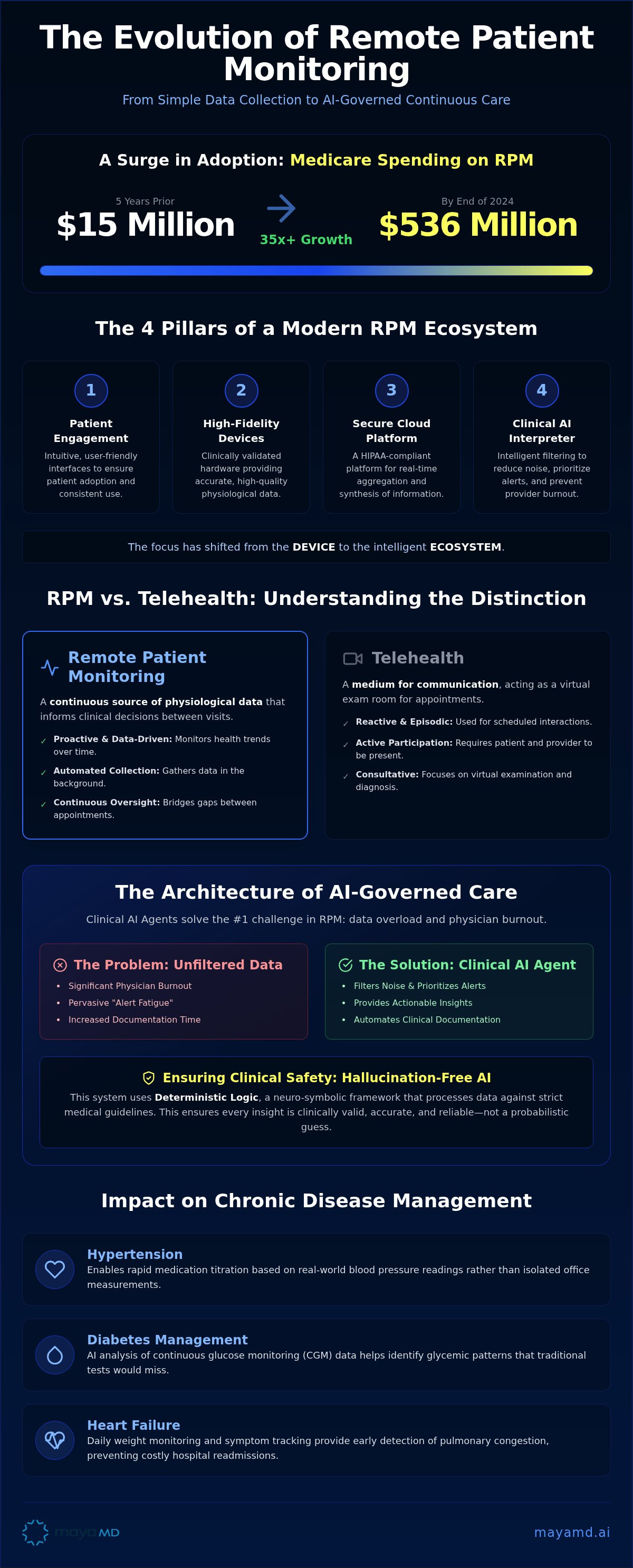
By the end of 2024, Medicare spending on remote monitoring services surged to over $536 million, a staggering leap from just $15 million five years prior. This rapid expansion reflects a fundamental shift in how we manage chronic conditions, yet many clinicians find themselves drowning in the very data intended to help them. To truly define what is remote patient monitoring in 2026, one must look beyond the hardware and focus on the intelligence that governs the flow of information. You've likely experienced the frustration of fragmented data points that demand more documentation time than they provide clinical value.
This guide demonstrates how modern RPM is evolving from simple data collection into an AI-governed continuous care model that improves clinical outcomes and significantly reduces provider burnout. We'll explore how integrating clinical AI agents with deterministic logic creates a bridge between disparate data points and human care, ensuring HIPAA compliance without the risk of AI hallucinations. By adopting these sophisticated frameworks, Houston providers can achieve streamlined documentation and secure sustainable reimbursement through updated CMS codes like 99457 and 99458. We're moving past the experimental phase into a proven era of clinical precision and reliable oversight.
Key Takeaways
• Understand what is remote patient monitoring in the 2026 landscape, where the focus has shifted from simple hardware to comprehensive platforms that facilitate continuous, AI-governed care.
• Learn how deterministic logic and clinical AI agents mitigate physician burnout by automating documentation and filtering data to prevent alert fatigue.
• Explore the measurable impact of RPM on clinical outcomes, specifically regarding reduced hospital readmissions and improved management of high-risk chronic conditions.
• Identify the critical steps for strategic implementation, from defining patient populations to selecting HIPAA-compliant solutions that integrate seamlessly with existing EHR systems.
• Discover how hallucination-free AI ensures clinical safety by adhering to strict medical guidelines while providing actionable insights for provider decision-making.
Defining Remote Patient Monitoring in the 2026 Healthcare Landscape
In the current healthcare environment, the question of what is remote patient monitoring has evolved from a discussion about hardware into a conversation about systematic intelligence. Historically, Remote patient monitoring (RPM) was viewed as the simple transmission of physiological data from a patient's home to a clinician's dashboard. By 2026, this definition has matured. It's now a digital healthcare delivery method that facilitates the continuous oversight of patients outside traditional clinical settings, utilizing a sophisticated architecture of connectivity. This year marks a definitive shift where the platform takes precedence over the individual device. While a blood pressure cuff or a scale is a necessary tool, the value lies in the cloud-based ecosystem that synthesizes that data into actionable clinical intelligence.
A functional RPM ecosystem comprises four essential pillars. First, the patient must be engaged through intuitive interfaces. Second, the physiological device must provide high-fidelity data. Third, a secure cloud platform must aggregate this information in real time. Finally, a clinical AI interpreter must filter the noise to ensure that physicians only receive relevant, prioritized alerts. Ultimately, remote patient monitoring is an ecosystem of connectivity that bridges the gap between the patient's home and the clinical environment, ensuring care isn't episodic but truly continuous.
RPM vs. Telehealth: Understanding the Distinction
Clinicians often conflate RPM with telehealth, yet their functions are distinct. Telehealth serves as a medium for synchronous or asynchronous communication, essentially acting as a virtual exam room. In contrast, RPM acts as a source of continuous physiological data that informs those conversations. This data-driven approach is a cornerstone of Advanced Primary Care Management (APCM), providing a holistic view of the patient's health between scheduled visits. When a provider uses real-time data monitoring alongside video visits, they move from reactive treatment to proactive, governed care.
Common Chronic Conditions Managed via RPM
The application of RPM is most impactful when addressing chronic diseases that require tight control and frequent adjustments. For hypertension, continuous monitoring allows for rapid medication titration based on real-world readings rather than isolated office measurements. In diabetes management, integrating continuous glucose monitoring (CGM) with AI analysis helps identify patterns that traditional finger-stick tests miss. For heart failure patients, daily weight monitoring and symptom tracking provide early detection of pulmonary congestion, allowing for intervention before a costly hospital readmission occurs. These systematic frameworks ensure that high-stakes care remains precise and reliable.
The Architecture of AI-Governed Continuous Care
The primary challenge in modern healthcare isn't a lack of data, but rather an overwhelming surplus of it. When considering what is remote patient monitoring in a clinical context, we must address the "alert fatigue" that often accompanies high-frequency data streams. Without a governing layer, constant notifications from blood pressure cuffs or glucose monitors can lead to significant physician burnout. This is where the Clinical AI Agent for Primary Care becomes indispensable. It acts as a first-line triage, ensuring that only clinically significant deviations reach the provider's attention while lower-level data points are logged for trend analysis.
To maintain safety, the architecture relies on deterministic logic. Unlike standard generative models that may produce "hallucinations," neuro-symbolic frameworks use strict medical guidelines to interpret physiological inputs. This systematic approach ensures that every data point is processed through a lens of clinical validity. By combining deterministic rules with sophisticated processing, providers can trust that the insights generated are both accurate and reliable. It's a shift from probabilistic guessing to governed, logic-based interpretation.
The necessity of neuro-symbolic frameworks cannot be overstated. In high-stakes clinical settings, the unpredictability of pure generative AI is a liability that most practices can't afford. By anchoring AI within a deterministic framework, the system follows established medical protocols with absolute precision. This creates a hallucination-free environment where data interpretation is grounded in hard logic rather than statistical probability. This level of rigor is what separates experimental technology from a professional clinical tool designed for long-term practice stability.
Data Acquisition and HIPAA-Compliant Transmission
Reliable RPM begins with high-fidelity hardware, including cellular and Bluetooth-enabled scales, blood pressure cuffs, and pulse oximeters. These devices must transmit sensitive health information through secure, encrypted channels. For instance, data moving from a patient's home in Phoenix to a clinic in Indianapolis requires end-to-end encryption to maintain HIPAA compliance. Modern cloud-based infrastructure now supports 2026 interoperability standards, allowing for seamless integration into existing hospital systems while protecting patient privacy at every node of the network.
From Raw Data to Clinical Insights
Raw data is essentially noise until it's synthesized into a meaningful trend. AI-governed platforms filter out minor fluctuations to highlight physiological shifts that require immediate intervention. The balance between deterministic logic and generative AI is critical here. While deterministic logic ensures safety and regulatory adherence, generative components can assist with natural, empathetic patient interactions. This dual-layered approach streamlines clinical documentation by automatically synthesizing data into concise clinical notes. Implementing these clinical AI solutions allows practices to reclaim their time and focus on high-value patient interactions instead of manual data entry.
Clinical and Operational Impact: Why Providers are Adopting RPM
The adoption of remote monitoring technology is driven by a necessity for clinical precision and operational stability. Understanding what is remote patient monitoring in a practical sense requires looking at its ability to mitigate the "revolving door" effect of hospital readmissions. Post-discharge monitoring provides a safety net that captures physiological decline before it necessitates an emergency department visit. This continuous oversight transforms reactive medicine into a governed, proactive model. Beyond clinical safety, providers are leveraging Chronic Disease Management technology to ensure financial sustainability through high-value reimbursement models that reward consistent patient oversight.
Patient engagement also sees a measurable boost when individuals receive real-time feedback on their health status. This connectivity fosters a sense of partnership between the clinician and the patient, replacing the anxiety of "white coat hypertension" with the confidence of continuous support. It's a shift that empowers patients to take ownership of their conditions while knowing their data is being monitored by a sophisticated, reliable system. When Houston providers ask what is remote patient monitoring in terms of ROI, the answer lies in the combination of clinical staff time savings and the prevention of high-cost acute events.
Improving Outcomes in Complex Chronic Care
In cities like Las Vegas and Chicago, clinical teams have documented significant improvements in blood pressure control by utilizing RPM to bridge the gap between office visits. Specialists are increasingly using Principal Care Management (PCM) to focus on single, high-risk conditions with greater intensity. This model is particularly effective at identifying "silent" symptoms, such as subtle weight gains in heart failure patients or nocturnal hypertensive peaks, that would otherwise go unnoticed until a crisis occurs. By closing these care gaps, providers maintain a rigorous standard of care that prioritizes patient safety and long-term health stability.
Operational Efficiency and Workforce Support
Physician burnout remains a critical threat to practice viability, often exacerbated by the administrative burden of manual data entry. Modern RPM platforms address this by automating clinical documentation, which some industry professionals report can save up to two hours of staff time daily. By integrating clinical workflow automation solutions, practices can handle routine check-ins and data synthesis without manual intervention. This creates a "force multiplier" effect, allowing a small clinical team to scale their care to a larger patient population without a corresponding increase in headcount. The result is a more resilient workforce supported by reliable, AI-governed systems.
Strategic Implementation: Launching an RPM Program
Transitioning from a traditional clinical model to an AI-governed ecosystem requires a methodical approach. When defining what is remote patient monitoring for your specific organization, the process begins with identifying high-risk populations, such as hypertension patients in Houston who require tight titration. Success isn't merely about deploying devices. It's about building a governed framework where technology serves the clinical workflow rather than disrupting it.
Implementation follows a rigorous five-step sequence:
Define Objectives
Establish clear clinical goals, such as reducing A1c levels or systolic blood pressure within a specific cohort.
Platform Selection
Choose a HIPAA-compliant solution that prioritizes deterministic logic to ensure data safety and interoperability.
Workflow Design
Map how incoming data triggers clinical interventions, ensuring the AI agent triages alerts to prevent physician fatigue.
Education
Train staff and patients on the technical mechanics of the physiological devices to ensure consistent data transmission.
Compliance Setup
Integrate billing and documentation protocols that align with current CMS requirements for 2026.
To see how these steps function in a live environment, you can explore clinical AI solutions that automate much of this operational burden.
EHR Integration and Interoperability
The technical core of a sustainable RPM program is bidirectional data flow. Data silos are a significant risk to patient safety, making it essential that specialists and primary care providers access the same longitudinal record. Modern platforms must adhere to HL7 and FHIR standards, facilitating seamless connectivity between the monitoring software and the EHR. The 2026 HIPAA updates further emphasize the need for secure, interoperable data exchange that maintains patient privacy while ensuring clinical transparency across the care continuum. Ensuring that data doesn't just exist but moves intelligently is the hallmark of a mature program.
Reimbursement and Billing Framework (2026)
Financial sustainability is anchored in the 2026 Medicare Physician Fee Schedule. Providers must navigate specific CPT codes to secure reimbursement for their monitoring efforts. For the initial setup and patient education, CPT 99453 offers a national average of $21.71 per patient. Standard device use and data transmission for 16 or more days in a 30-day period are billed under CPT 99454 at $52.11. Clinical staff time is captured through CPT 99457, which provides $51.77 for the first 20 minutes of monitoring, while CPT 99458 covers additional 20-minute increments at $41.42. Maintaining the 16-day monitoring threshold remains critical for compliance and maximizing practice revenue across Indiana, Illinois, and the broader US market.
MayaMD: The Future of AI-Driven Patient Monitoring
MayaMD represents the next iteration of remote monitoring technology by moving beyond passive data collection into a realm of AI-governed continuous care. By combining deterministic logic with advanced clinical AI, the platform ensures that every patient interaction and data point follows established medical protocols with absolute precision. This systematic framework is essential for providers who need more than just alerts; they require a reliable partner that understands the nuances of clinical workflows. When evaluating what is remote patient monitoring for a modern health system, the focus must be on the synthesis of data into actionable intelligence that supports, rather than replaces, the physician's final judgment.
Safety remains our primary objective. In clinical documentation, there's no room for error, which is why MayaMD utilizes a "hallucination-free" AI architecture. By employing neuro-symbolic frameworks, we ensure that the AI Agent's outputs are grounded in hard logic and verified medical facts. This level of rigor allows for comprehensive care delivery, integrating RPM with Principal Care Management tools to support specialists managing high-risk conditions. This scalable infrastructure currently supports diverse provider networks from Las Vegas to Chicago, proving that sophisticated AI can function effectively across different regulatory and clinical environments.
The Clinical AI Agent in Action
The Clinical AI Agent functions as a tireless extension of the care team. It engages patients in natural, empathetic conversations while strictly adhering to clinical protocols defined by the practice. This interaction serves a dual purpose: it provides 24/7 support for chronic care patients between office visits and simultaneously reduces administrative friction. By automating high-fidelity documentation, the agent captures patient status updates and physiological trends in real time. This ensures that the clinical record is always current, allowing providers to focus on complex decision-making rather than manual data entry.
Partnering for Success
MayaMD doesn't just provide software; we offer a collaborative partnership designed for long-term practice stability. Our implementation strategy is methodical, moving from initial pilot programs to full-scale deployment with continuous clinical and technical support. We understand that adopting new technology is a significant transition, so our team remains available to ensure the platform integrates seamlessly with your existing EHR and staff workflows. To see how our governed approach can transform your practice, you can request a demo of MayaMD's AI-governed RPM platform today.
Advancing the Standard of Continuous Care
The healthcare landscape has moved beyond the era of simple data transmission. Modern medicine now relies on a governed synthesis of physiological information, where the focus is on clinical outcomes rather than the mechanics of the device itself. Understanding what is remote patient monitoring in 2026 requires a shift toward AI-driven ecosystems that prioritize patient safety through deterministic logic. We've explored how these frameworks reduce hospital readmissions and provide a sustainable path for practice growth through updated CMS reimbursement structures.
By integrating a HIPAA-compliant, hallucination-free Clinical AI into your workflow, you can achieve seamless EHR integration and a proven reduction in administrative documentation time. This transition doesn't just improve the patient experience; it protects your clinical staff from the exhaustion of alert fatigue. The future of chronic care is continuous, precise, and deeply connected. Schedule a Consultation to Modernize Your Care Delivery and discover how a reliable, visionary partner can help you navigate these complexities with confidence. Your practice is ready for the next level of clinical excellence.
Frequently Asked Questions
Is Remote Patient Monitoring covered by Medicare in 2026?
Medicare continues to provide robust coverage for these services under the 2026 Physician Fee Schedule. Providers can bill for initial setup (99453), device supply (99454), and treatment management time (99457 and 99458). Defining what is remote patient monitoring coverage involves documenting at least 16 days of physiological data transmission within a 30-day period. These codes ensure that practices receive sustainable reimbursement for the continuous oversight of chronic conditions.
How does RPM improve patient outcomes for hypertension?
Remote monitoring facilitates tighter blood pressure control by providing clinicians with a longitudinal view of a patient's cardiovascular health. This continuous data stream eliminates the "white coat effect" often seen in clinical settings, allowing for more precise medication titration. By identifying hypertensive trends early, providers can intervene before a patient experiences a cardiac event. This proactive approach significantly reduces the risk of stroke and long-term renal complications associated with uncontrolled hypertension.
What is the difference between RPM and Chronic Care Management (CCM)?
The primary distinction lies in the nature of the data and the focus of the service. What is remote patient monitoring focuses specifically on the collection and interpretation of physiological data, such as heart rate or blood glucose levels. Chronic Care Management (CCM) involves broader care coordination, including medication reconciliation and care plan development for patients with multiple chronic conditions. While distinct, these services often work in tandem to provide a comprehensive care ecosystem.
Can AI help reduce physician burnout in RPM programs?
AI agents serve as a first-line triage system that filters out physiological "noise," ensuring clinicians only review significant health deviations. This governing layer effectively eliminates the alert fatigue that contributes to widespread physician burnout. By automating the synthesis of incoming data into high-fidelity clinical notes, AI reduces the time spent on manual documentation. This capability allows providers to refocus their energy on direct patient care rather than exhaustive administrative data entry.
What devices are typically used for remote patient monitoring?
Programs typically utilize FDA-cleared physiological devices equipped with cellular or Bluetooth connectivity. Common examples include:
• Digital blood pressure cuffs for hypertension management.
• Weight scales for monitoring congestive heart failure.
• Continuous glucose monitors (CGM) for diabetes oversight.
• Pulse oximeters for chronic respiratory condition tracking.
These tools ensure high-fidelity data transmission directly from the patient's home to the clinical platform without requiring manual reporting or patient data entry.
How does MayaMD ensure HIPAA compliance for its RPM platform?
MayaMD utilizes a HIPAA-compliant, cloud-based platform that employs end-to-end encryption for all transmitted physiological data. This ensures that sensitive patient health information remains secure from the point of collection to the clinical dashboard. Our infrastructure adheres to the latest 2026 interoperability standards, maintaining rigorous security protocols and audit logs. By prioritizing regulatory adherence, we provide a stable environment where providers can manage high-stakes patient data with absolute confidence in its privacy.
What happens if a patient's RPM data shows a critical health event?
When the platform detects a physiological reading that exceeds pre-defined clinical thresholds, it triggers an immediate alert for the care team. The AI agent triages these events based on severity, ensuring that life-threatening deviations receive priority attention. Providers then follow their established clinical protocols to intervene, which may include medication adjustments or directing the patient to emergency care. This system ensures that critical changes don't go unnoticed between scheduled office visits.
Is there an upfront cost for patients to start remote monitoring?
Patient costs vary depending on their specific insurance coverage and the provider's program structure. Medicare typically covers the majority of the service cost, though patients may be responsible for standard co-payments or deductibles. Many providers choose to provide the monitoring devices at no upfront cost to the patient to encourage engagement. It's best to consult with your clinical team to understand specific financial responsibilities before starting a monitoring program.




See The MayaMD Difference
Fill the form below
Download Our Apps
MayaMD for patients and MayaPro for physicians - available on iOS and Android.
FOR PATIENTS
MayaMD App
AI-powered symptom assessment, triage, and secure access to your care team.
FOR PHYSICIANS
MayaPro App
MayaPro brings patient vitals, RPM/PCM care plans, and clinical decision support to your pocket.