
Remote Patient Monitoring Services in Las Vegas: The 2026 Provider’s Guide to Clinical AI Platforms

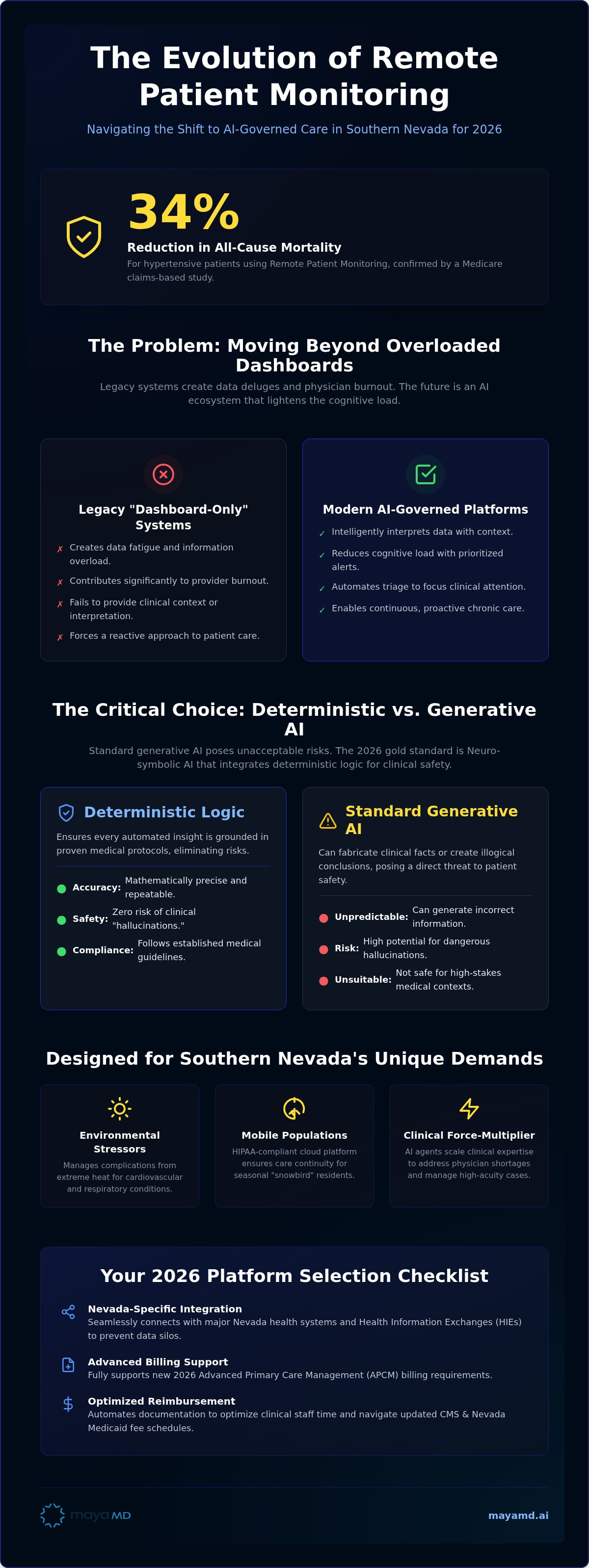
A Medicare claims-based study recently confirmed that remote patient monitoring use is associated with a 34% reduction in all-cause mortality for hypertensive patients. For providers in Southern Nevada, the shift toward these digital solutions isn't just a financial strategy; it's a clinical necessity. You likely recognize that while the right remote patient monitoring platform Las Vegas utilizes can bridge the gap between clinic visits, the resulting data deluge often contributes to significant physician burnout. The challenge lies in transitioning from simple connectivity to a governed AI ecosystem that actually lightens the cognitive load.
We understand that navigating Nevada’s unique reimbursement landscape and the extreme climate factors affecting patient adherence requires more than just hardware. You need a system that ensures accuracy through deterministic logic to eliminate the risk of AI hallucinations. This guide explores how to evaluate 2026 clinical AI platforms to automate documentation and optimize Medicare and Medicaid revenue. We will detail the specific frameworks needed to improve patient outcomes in the Las Vegas heat while eliminating the administrative friction that stalls practice growth.
Key Takeaways
• Understand why legacy "dashboard-only" systems are failing and how a modern remote patient monitoring platform Las Vegas providers trust must transition to continuous, AI-governed care models.
• Learn to distinguish between deterministic logic and standard generative AI to ensure clinical documentation remains accurate and free from dangerous hallucinations.
• Evaluate platforms based on their integration with Nevada-specific EHR systems and their ability to support new 2026 Advanced Primary Care Management (APCM) billing requirements.
• Navigate the updated 2026 CMS and Nevada Medicaid fee schedules to maximize reimbursement through optimized clinical staff time and device monitoring codes.
• Discover how Clinical AI Agents act as force-multipliers for local clinics, reducing hospital readmissions for high-acuity chronic patients in the Southern Nevada region.
The Evolution of Remote Patient Monitoring Services in Las Vegas
The healthcare infrastructure in Southern Nevada is undergoing a fundamental structural transformation. Legacy systems that merely aggregated physiological data are no longer sufficient for the complexities of modern practice. Today, a Remote Patient Monitoring (RPM) framework must do more than display numbers on a screen; it must interpret them within a strictly governed clinical context. Las Vegas healthcare providers are increasingly abandoning "dashboard-only" solutions that exacerbate data fatigue and contribute to provider burnout. By selecting a sophisticated remote patient monitoring platform Las Vegas clinics can leverage clinical AI to provide continuous, high-fidelity oversight. This evolution directly addresses the region's acute physician shortage. It allows practitioners to scale their expertise through automated triage and prioritized alerts, ensuring that clinical attention is directed exactly where it's most needed.
Why 2026 is the Turning Point for RPM
2026 represents a definitive shift in how regulatory bodies and payers view virtual care. CMS has moved beyond transactional reimbursement, now prioritizing longitudinal engagement and patient-reported outcomes. This regulatory pressure accelerates the adoption of digital healthcare for chronic disease, where the focus is on preventing acute exacerbations rather than reacting to them. Modern platforms must now integrate deterministic logic to ensure that every patient interaction follows established medical protocols. This transition from episodic to continuous care ensures that chronic conditions are managed with the same rigor as in-person visits. It fosters a deeper connection between the provider and the patient, utilizing technology to bridge the physical distance while maintaining clinical safety.
Local Market Dynamics in Southern Nevada
Managing patient health in the Las Vegas valley presents unique geographical and demographic challenges. The region's high-risk populations often struggle with environmental stressors, such as extreme heat, which can complicate the management of cardiovascular and respiratory conditions. Additionally, the seasonal influx of "snowbird" residents requires a HIPAA-compliant cloud platform that ensures continuity of care across state lines. A robust remote patient monitoring platform Las Vegas providers deploy must provide a unified view of the patient's health history. This systematic approach ensures that patient data remains secure, accessible, and actionable. Key features for this market include:
• Seamless integration with major Nevada health systems and Health Information Exchanges (HIEs) to prevent data silos.
• Cloud-based accessibility to track mobile populations during seasonal migrations, ensuring no gap in monitoring occurs.
• Scalable logic to manage high-acuity cases in a region where specialist density remains a significant concern.
By utilizing these advanced tools, Southern Nevada practices can deliver a level of precision medicine that was previously unattainable in a traditional office-based model. This shift toward an integrated, AI-governed ecosystem is the only viable path to improving outcomes while reducing the administrative load on clinical staff.
Evaluating Clinical AI: Deterministic Logic vs. Generative AI
The sheer volume of physiological data generated by a remote patient monitoring platform Las Vegas clinics implement requires more than just storage; it requires intelligent, safe interpretation. While standard generative AI has captured significant interest, its tendency toward "hallucinations"-the fabrication of clinical facts or illogical conclusions-presents an unacceptable risk in chronic care management. For 2026, the gold standard for provider safety is Neuro-symbolic AI. This framework integrates deterministic logic with generative capabilities, ensuring that every automated insight remains grounded in proven medical protocols. By utilizing a Clinical AI Agent, providers move past simple, unpredictable chatbots to a system that understands high-stakes medical context with mathematical precision.
The MayaMD Safety Standard
Our clinical ai agent for primary care utilizes deterministic logic as its primary safeguard to ensure that every patient interaction is medically sound. This approach ensures that clinical documentation is not just automated, but inherently accurate and compliant with the latest standards for CMS and Nevada Medicaid reimbursement. By eliminating the administrative burden of manual data verification, the platform allows clinical staff to focus on high-acuity interventions. Instead of reacting to data spikes hours after they occur, clinicians receive real-time, governed oversight that identifies risks before they escalate into emergency room visits. This proactive stance is essential for maintaining the safety of chronic patients throughout the Southern Nevada region.
Workflow Automation for Clinicians
Efficiency in the Las Vegas healthcare market depends on how seamlessly technology interacts with existing infrastructure. Streamlining follow-ups in local hospitals requires clinical workflow automation solutions that bridge the gap between patient homes and the clinical desk. A reliable remote patient monitoring platform Las Vegas practices choose must maintain data integrity across disparate EHR systems like Epic, Cerner, or Athena. This level of automation reduces physician desk time, allowing doctors to dedicate their energy to complex diagnostic tasks rather than repetitive data entry. For practices looking to scale without increasing staff burnout, adopting a governed clinical AI ecosystem provides the necessary infrastructure for sustainable growth.
Deterministic Guardrails
Ensures AI outputs never deviate from established clinical guidelines.
Hallucination-Free Documentation
Automates progress notes without the risk of fabricated data.
EHR Synchronization
Maintains a single source of truth across all Nevada-based health networks.
Key Selection Criteria for Las Vegas RPM Platforms
Selecting a remote patient monitoring platform Las Vegas providers can depend on requires a rigorous assessment of technical interoperability and clinical governance. In a market where major health systems dominate alongside independent clinics in Henderson, scalability is paramount. The platform must offer seamless bi-directional integration with established EHRs such as Cerner, Epic, and Athena. This ensures that data doesn't just sit in a silo but actively informs the patient's primary medical record in real time. Beyond simple connectivity, the system must support the 2026 CMS standards for Advanced Primary Care Management (APCM) and Principal Care Management (PCM) to ensure long-term financial sustainability.
Clinical and Technical Requirements
Data security remains the foundation of clinical trust. For 2026, HIPAA compliance must be paired with advanced encryption standards that protect patient data both at rest and in transit. Specialist practices, in particular, should prioritize principal care management tools that offer disease-specific logic. This specialized oversight is critical for managing complex chronic conditions where general RPM parameters might fall short. When evaluating hardware, consider the advantages of a device-agnostic approach. While proprietary hardware can sometimes offer tighter initial integration, device-agnostic platforms provide the flexibility to use a wider range of FDA-cleared medical devices, which often reduces the total cost of ownership for growing practices.
Operational Support and Vendor Reliability
A platform is only as effective as the clinical staff who manage it. Training requirements for Las Vegas medical teams should be comprehensive but intuitive, minimizing the learning curve to prevent additional administrative friction. Reliable vendors provide 24/7 technical support for both clinicians and patients, which is essential for maintaining high engagement metrics in a city that never sleeps. High patient adherence is the primary driver of clinical outcomes; therefore, the platform must include automated engagement features that encourage daily device use. Finally, investigate the vendor's track record in AI governance. You need a partner that has moved past the experimental phase into a proven, systematic application of clinical AI agents.
• Bi-directional EHR integration with Epic, Cerner, and Athena.
• Automated billing support for APCM and PCM reimbursement codes.
• Device-agnostic flexibility for a wide range of FDA-cleared hardware.
• Proven AI governance frameworks to eliminate documentation errors.
• Scalable infrastructure that supports both small clinics and large health networks.
Maximizing Reimbursement: CMS and Nevada Medicaid in 2026
The financial viability of a remote patient monitoring platform Las Vegas clinics adopt depends on a precise alignment with the 2026 CMS Physician Fee Schedule. For the current fiscal year, the introduction of codes like 99445 for device monitoring and 99470 for brief clinical staff engagement has expanded the billable surface area for practices. These updates allow for reimbursement even with lower-engagement patient cohorts, making comprehensive programs more sustainable. However, the Nevada Medicaid landscape requires additional scrutiny. Because Nevada Medicaid utilizes a fixed 2014 Medicare conversion factor of $35.8228, local providers must optimize their internal workflows to maintain healthy margins. Automating documentation is no longer optional; it's the only way to meet "audit-proof" standards without overwhelming administrative staff.
The APCM and PCM Advantage
Integrating advanced primary care management (APCM) with existing RPM workflows creates a powerful force-multiplier for revenue. By bundling these services, practices can capture longitudinal care value that legacy transactional models miss. Principal Care Management (PCM) specifically targets high-acuity patients with a single complex chronic condition, requiring rigorous documentation of clinical decision-making. Our Clinical AI Agent verifies these notes against deterministic logic, significantly reducing the risk of claim denials. This systematic verification ensures that every minute of clinical staff time is accounted for and billable under 2026 standards. This capability-to-outcome structure allows providers to focus on patient health while the platform handles the complexities of regulatory adherence.
Local Regulatory Compliance
Providers must also adhere to the 2026 Nevada State Board of Medical Examiners guidelines, which emphasize data privacy and equitable access. In underserved Las Vegas neighborhoods, addressing health equity is a regulatory priority that impacts reimbursement eligibility. Nevada’s specific data privacy laws necessitate a platform that provides high-stakes reliability and rigorous oversight of patient information. A governed AI framework ensures that while care is scaled, it remains compliant with both federal HIPAA mandates and local statutes. This approach prioritizes safety and precision, moving past the experimental phase into proven application. For practices seeking to secure their financial future, implementing an AI-governed remote patient monitoring platform is the most reliable path to maximizing 2026 reimbursements.
CPT 99453
Initial setup and patient education, essential for establishing the monitoring foundation.
CPT 99454
Monthly device monitoring for 16 or more days of data transmission.
CPT 99457/99458
Clinical staff time for interactive communication and care management.
Nevada Medicaid
Requires adherence to the state's fixed conversion factor and specific telehealth modifiers.
Why MayaMD is the Leading RPM Partner for Las Vegas Providers
MayaMD represents the pinnacle of clinical AI integration for Southern Nevada. It's the only remote patient monitoring platform Las Vegas clinics can utilize that effectively synthesizes deterministic logic with a Clinical AI Agent. This dual-layered approach ensures that data interpretation is both expansive and strictly governed, providing a level of safety that standard generative AI cannot match. For providers, this means a significant reduction in hospital readmissions, particularly in high-acuity cases across the valley. By embedding safety directly into the software's logic, we've created a system that acts as a force-multiplier for existing staff, allowing for continuous oversight without increasing the cognitive burden on clinicians.
Transforming Patient Outcomes in Clark County
In Clark County, the practical application of our neuro-symbolic AI has already demonstrated measurable success. For instance, in AI-driven hypertension management, the platform facilitates personalized engagement that adapts to the patient's specific health literacy and behavioral patterns. This tailored interaction significantly improves adherence compared to static, legacy systems. The resulting clinical stability doesn't just benefit the patient; it directly addresses the root causes of physician burnout. When documentation is automated and triage is precise, staff retention improves because clinicians can finally practice at the top of their license. Our platform transforms raw physiological data into actionable clinical insights, ensuring that every patient interaction is meaningful and medically sound.
Getting Started with MayaMD
Selecting the right remote patient monitoring platform Las Vegas practices use is a decision that impacts both clinical safety and financial health. Implementation with MayaMD is designed to be methodical and non-disruptive, mirroring the steady rhythm of a clinical workflow. Our team works closely with your clinical leadership to customize the platform for your specific chronic condition protocols, whether you're managing complex cardiovascular cases or metabolic health. The timeline is structured to ensure that your staff is fully trained and your EHR integration is verified before the first device is deployed. This commitment to operational excellence is why local leaders trust MayaMD as their long-term partner in digital health. It's time to move past experimental tools and adopt a proven, secure framework for continuous care. Schedule a clinical AI consultation for your Las Vegas practice to begin your transition to a governed AI ecosystem.
Safety First
Deterministic logic eliminates the risk of AI hallucinations in clinical documentation.
Reduced Readmissions
Proven success in managing high-acuity chronic cases in Southern Nevada.
Workflow Synergy
Seamless integration with Epic, Cerner, and Athena to maintain data integrity.
Scalable Efficiency
Automates administrative tasks to reduce provider burnout and improve staff retention.
Securing the Future of Chronic Care in Southern Nevada
The transition toward continuous, AI-governed oversight is no longer a peripheral option for Southern Nevada practices. You've seen how Zero-Hallucination Deterministic Logic serves as the essential safeguard against documentation errors, ensuring that your clinical notes remain accurate and audit-proof. By aligning with 2026 CMS standards, providers can finally stabilize revenue while addressing the chronic physician shortage in the Las Vegas valley.
Selecting a robust remote patient monitoring platform Las Vegas clinicians trust requires a partner that prioritizes HIPAA-Compliant AI Governance. MayaMD provides the systematic framework necessary to bridge the gap between complex physiological data and actionable human care. Our platform is Optimized for 2026 APCM Billing, allowing your practice to focus on patient outcomes rather than administrative friction.
Request a Demo of MayaMD’s Las Vegas RPM Solutions to experience a new standard of clinical precision. We're ready to help you lead the shift toward a more connected and sustainable future for healthcare in Nevada.
Frequently Asked Questions
What are the specific Nevada Medicaid reimbursement rates for RPM in 2026?
Nevada Medicaid reimbursement for 2026 utilizes a fixed 2014 Medicare conversion factor of $35.8228. While specific per-code amounts are published in the state fee schedule, the activation of new 2026 CPT codes on April 27, 2026, ensures that local providers can bill for a wider range of monitoring services. This systematic approach to reimbursement supports the financial viability of any remote patient monitoring platform Las Vegas clinics implement for their Medicaid populations.
How does MayaMD ensure its Clinical AI Agent does not hallucinate?
MayaMD eliminates hallucinations by utilizing a neuro-symbolic AI architecture that prioritizes deterministic logic over standard generative patterns. This framework ensures that every clinical output is grounded in established medical protocols rather than statistical probability. By enforcing these logical guardrails, the Clinical AI Agent maintains rigorous oversight of patient data. This approach provides a level of safety and precision that is essential for high-stakes chronic care management in modern clinical environments.
Can I use MayaMD with my existing EHR system in my Las Vegas clinic?
Yes, MayaMD is designed for seamless bi-directional integration with major EHR systems used throughout Southern Nevada, including Epic, Cerner, and Athena. This connectivity ensures that patient data flows directly into the primary medical record without manual entry. By maintaining a single source of truth, the platform reduces administrative friction and prevents data silos. It's a scalable solution that fits the workflow of both independent Henderson clinics and large Las Vegas health systems.
What is the difference between RPM, APCM, and PCM under 2026 CMS rules?
RPM focuses on the digital transmission of physiological data, while APCM and PCM represent longitudinal management models. Advanced Primary Care Management (APCM) is a comprehensive framework for primary care, whereas Principal Care Management (PCM) targets patients with a single, high-acuity chronic condition. Under 2026 CMS rules, these services can often be bundled to optimize revenue. This integrated approach ensures that patients receive continuous, specialized oversight rather than episodic, transactional care.
How much time will my clinical staff save with automated documentation?
Clinical staff typically experience a significant reduction in administrative desk time through automated, hallucination-free documentation. By utilizing a remote patient monitoring platform Las Vegas teams can automate the transcription of patient interactions and the initial triage of physiological data spikes. This efficiency allows nurses and medical assistants to focus on direct patient intervention rather than repetitive data entry. It directly addresses physician burnout by streamlining the most time-consuming aspects of chronic disease management.
Is MayaMD compliant with the latest 2026 HIPAA and Nevada data privacy laws?
MayaMD maintains full compliance with the latest 2026 HIPAA standards and all specific Nevada data privacy statutes. Our cloud-based infrastructure utilizes advanced encryption protocols to protect patient information both at rest and during transmission. This commitment to security ensures that high-stakes clinical data remains protected against evolving cyber threats. We prioritize regulatory adherence as the foundation of our partnership with Southern Nevada healthcare providers, ensuring long-term stability and patient trust.
Does MayaMD provide the monitoring devices, or can I use my own?
MayaMD operates as a device-agnostic platform, meaning it integrates with a wide variety of FDA-cleared medical hardware. While we don't manufacture hardware, we ensure that the devices your practice selects can digitally transmit data to our governed AI ecosystem. This flexibility allows Las Vegas clinics to choose the most cost-effective tools for their specific patient populations. It eliminates the need for proprietary hardware lock-in, providing greater budgetary control for growing practices.
How does the platform handle patients with multiple chronic conditions?
The platform utilizes specialized clinical logic to manage patients with multiple comorbidities through integrated care protocols. By synthesizing disparate data points into a unified health profile, the Clinical AI Agent identifies potential interactions between various chronic conditions. This comprehensive oversight is particularly effective for managing the complex needs of high-risk populations in Clark County. The system ensures that every condition is monitored with the necessary precision to prevent acute exacerbations and hospital readmissions.



See The MayaMD Difference
Fill the form below
Download Our Apps
MayaMD for patients and MayaPro for physicians - available on iOS and Android.
FOR PATIENTS
MayaMD App
AI-powered symptom assessment, triage, and secure access to your care team.

FOR PHYSICIANS
MayaPro App
MayaPro brings patient vitals, RPM/PCM care plans, and clinical decision support to your pocket.