
Remote Patient Monitoring Platform Indianapolis: The 2026 Clinical AI Guide

What if the primary barrier to scaling your chronic care programs isn't patient compliance, but the sheer weight of the administrative documentation required to support it? Most Indianapolis healthcare leaders recognize that while chronic care management is vital, the complexity of managing RPM, PCM, and APCM programs often pushes clinical staff toward exhaustion. You've likely experienced the frustration of navigating disparate data points while worrying about the accuracy of automated tools. Finding a reliable remote patient monitoring platform Indianapolis providers can trust requires moving beyond simple hardware toward a governed, clinical AI approach that prioritizes safety and precision.
This 2026 guide demonstrates how neuro-symbolic AI transforms the burden of chronic care into a streamlined, automated workflow that eliminates the risk of hallucinations. You'll discover how to leverage the latest Medicare reimbursement updates, including new codes like 99445 and 99470, to build a scalable revenue stream without adding to your team's workload. We'll explore the integration of Clinical AI Agents that foster deeper patient connection while ensuring strict adherence to Indiana's telehealth regulations. By the end of this analysis, you'll understand how a systematic, AI-governed ecosystem can finally bridge the gap between high-volume data and high-quality human care.
Key Takeaways
• Learn why Central Indiana providers are transitioning from basic connected scales to a sophisticated remote patient monitoring platform Indianapolis healthcare systems can use to drive continuous care.
• Understand the role of the Clinical AI Agent as a governed tool that eliminates documentation burnout by automating clinical workflows and patient engagement.
• Discover how to maximize revenue by effectively utilizing 2026 Medicare reimbursement codes for RPM, PCM, and Advanced Primary Care Management (APCM).
• Explore the technical superiority of neuro-symbolic AI, which combines deterministic logic with generative capabilities to eliminate hallucinations in high-stakes clinical environments.
• Identify the critical criteria for evaluating RPM platforms, focusing on the shift from passive data portals to active, HIPAA-compliant AI ecosystems.
The Evolution of Remote Patient Monitoring in Indianapolis
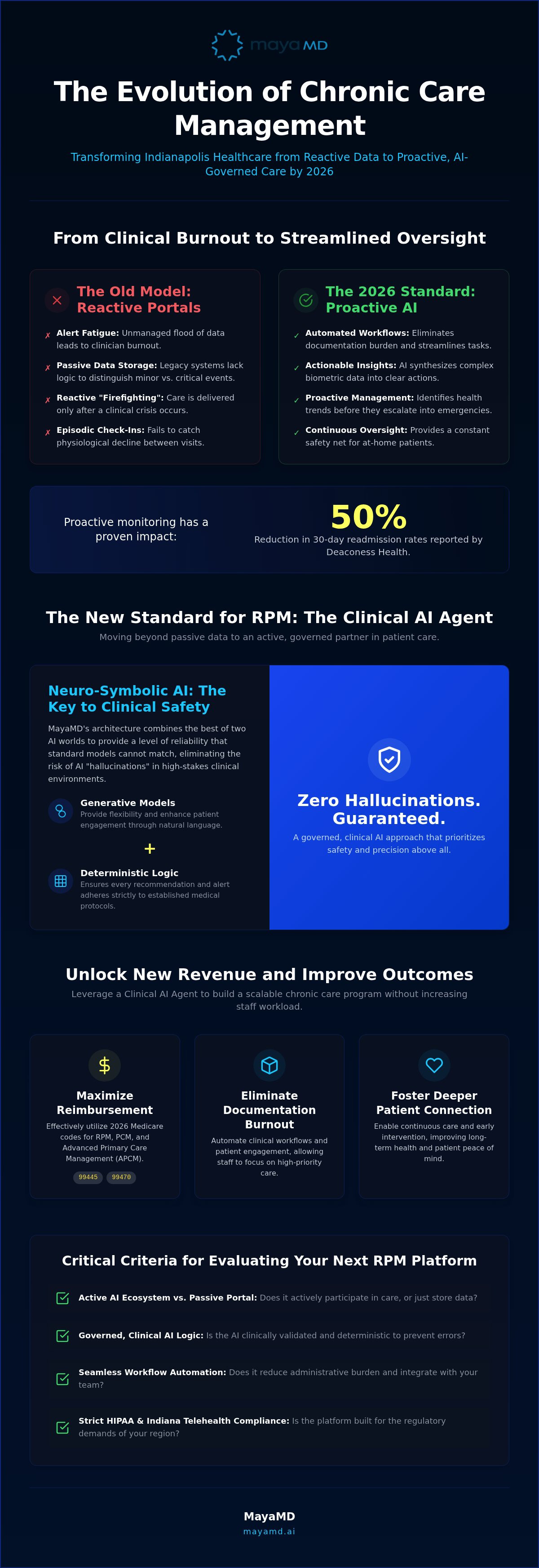
The healthcare landscape in Central Indiana is undergoing a fundamental transition. For decades, chronic disease management relied on episodic hospital visits, a reactive model that often failed to catch physiological decline until a clinical crisis occurred. Today, a sophisticated Remote Patient Monitoring (RPM) framework is replacing these intermittent check-ins with continuous, home-based oversight. Indianapolis providers are no longer satisfied with basic "connected scales" that merely transmit isolated data points. Instead, they require a comprehensive remote patient monitoring platform Indianapolis clinics can use to synthesize complex biometric data into actionable clinical insights. This evolution is essential as Indiana faces a dual challenge: a growing chronic care population and a persistent clinical staffing shortage. Technological force multipliers are no longer optional; they are the infrastructure required to maintain care quality in a high-demand environment.
Why Traditional RPM Portals are Failing Indianapolis Clinicians
Traditional portals often exacerbate the very problem they aim to solve. Many clinicians report an "alert fatigue" crisis, where an unmanaged flood of data from standard EHR-integrated portals leads to administrative burnout rather than better care. These legacy systems frequently lack the governed logic needed to distinguish between a minor fluctuation and a clinical emergency. For a remote patient monitoring platform Indianapolis systems can truly rely on, the software must move beyond passive data storage. Moving to high-acuity remote care models is a financial necessity, as it allows practices to capture scalable revenue through Medicare RPM and PCM codes while ensuring staff focus on the patients who need them most.
Proactive vs. Reactive Care: The 2026 Standard
Proactive care defines the 2026 clinical standard for Indianapolis healthcare systems. By utilizing continuous data streams, providers can identify subtle trends in a patient’s health before they escalate into an avoidable ER visit. For example, Indiana-based Deaconess Health reported a 50% reduction in their 30-day readmission rate through diligent monitoring, illustrating the tangible impact of early intervention. This shift from reactive "firefighting" to proactive management improves long-term clinical outcomes and stabilizes the patient experience. When a platform applies deterministic logic to these data streams, it creates a safety net that supports both the practitioner’s decision-making and the patient’s peace of mind.
The Clinical AI Agent: A New Standard for RPM Intelligence
Intelligence in healthcare must be governed, not just generative. While many competitors offer basic hardware and passive caregiver apps, the next evolution of the remote patient monitoring platform Indianapolis providers utilize is the Clinical AI Agent. A Clinical AI Agent is an AI-driven tool that streamlines documentation and enhances engagement. This technology moves beyond simple data transmission by applying rigorous clinical logic to every patient interaction, ensuring that the information reaching the clinician is both relevant and verified. By acting as an active participant in care, these agents bridge the gap between high-volume data collection and meaningful clinical action. It represents a shift from being a mere spectator of data to becoming a partner in patient outcomes.
Neuro-Symbolic AI: The Bridge Between Safety and Innovation
The safety of clinical AI depends on its architecture. MayaMD utilizes neuro-symbolic AI, a framework that combines the flexibility of generative models with the rigid, deterministic logic of medical protocols. This approach effectively eliminates the risk of AI hallucinations, which are non-negotiable failures in a clinical setting. Deterministic logic ensures that every recommendation or alert adheres strictly to established guidelines, providing a level of reliability that standard large language models cannot match. For practices focused on long-term stability, integrating a clinical ai agent for primary care provides the necessary oversight to manage complex patient populations safely and efficiently. This systematic framework allows for innovation without sacrificing the precision that Indianapolis clinicians demand for their high-risk patients.
Automating the Administrative Burden
Burnout often stems from the documentation required to prove care rather than the care itself. AI-driven tools now automate the manual entry of biometric trends and patient responses, allowing Indianapolis nurses to focus on direct intervention rather than data entry. This automation extends to automated post-discharge communication solutions, which maintain patient connectivity after they leave the hospital. According to data tracked by the Center for Connected Health Policy, the shift toward these intelligent frameworks is supported by evolving reimbursement models that reward high-engagement monitoring. By triaging data intelligently, a Clinical AI Agent ensures that physicians only review the most critical information, directly reducing the cognitive load on the care team. This creates a sustainable environment where revenue grows without a proportional increase in administrative tasks. Establishing this level of efficiency is the only way to scale a modern remote patient monitoring platform Indianapolis healthcare systems can sustain long-term.
Evaluating Remote Patient Monitoring Platforms in Indianapolis
Indianapolis healthcare executives must look beyond simple device catalogs when selecting a long-term partner. A truly scalable remote patient monitoring platform Indianapolis providers can implement must balance technical security with clinical safety. Passive data portals, which act merely as a pass-through for biometric readings, are no longer sufficient for the complex needs of Central Indiana's patient populations. In 2026, the distinction between a passive portal and an active AI platform is defined by the system’s ability to interpret data within a governed clinical framework. Security remains a cornerstone, requiring a HIPAA-compliant, cloud-based architecture that integrates seamlessly with the EHR systems commonly used by Indiana providers. The FCC's Role in Connected Health highlights the federal emphasis on secure, reliable infrastructure to support these advanced monitoring capabilities.
The Trust Framework: Safety, Logic, and Reliability
Clinical leads now prioritize hallucination-free documentation above all other AI features. Verification of AI-generated patient insights is essential to ensure that every alert is rooted in deterministic logic rather than probabilistic guesswork. This reliability is the foundation of a successful digital healthcare for chronic disease strategy, ensuring that care remains continuous and safe. By focusing on clinical validity, providers can trust that the platform acts as a precise extension of their own medical expertise. It's about creating a systematic environment where data is never just noise, but a reliable indicator of patient health.
User Experience: From Patient Engagement to Provider Workflow
Engagement rates depend heavily on the simplicity and accessibility of the patient-facing application. If the interface is too complex, compliance drops, and the data stream becomes unreliable. Conversely, the provider dashboard must be designed for maximum efficiency, presenting a workflow-centric view that triages alerts based on clinical severity. Implementing clinical workflow automation solutions is a necessity to ensure that staff time is spent on intervention rather than navigation. This focus on usability ensures that the platform supports the daily reality of clinical practice without adding unnecessary friction. When technology handles the heavy lifting of data organization, clinicians can return to the high-value work of treating patients.
APCM and PCM: Maximizing Outcomes and Reimbursement
Integrating a remote patient monitoring platform Indianapolis clinics use is only the first step toward clinical excellence. True transformation occurs when RPM data is synthesized with Advanced Primary Care Management (APCM) and Principal Care Management (PCM). This synergy allows for a holistic view of the patient, moving beyond isolated biometric readings to a comprehensive management strategy. According to recent industry standards, "advanced primary care management enables continuity of care by providing a structured framework for continuous monitoring and proactive intervention." By aligning these programs, providers can bridge the gaps in traditional episodic care, ensuring that high-risk patients remain within a governed safety net.
Strategic Implementation of APCM for Indianapolis Practices
Enrolling patients in APCM requires a methodical approach that balances daily RPM data with longitudinal care goals. For specialists in Central Indiana, principal care management tools are essential for managing high-acuity chronic conditions like congestive heart failure or COPD. Practitioners should first identify eligible patients through EHR data mining, then establish a baseline using the RPM initial setup (CPT 99453). Maintaining engagement through automated Clinical AI Agents is critical to meeting the monthly thresholds required for CCM and PCM billing. This systematic approach ensures that every minute of clinical oversight is documented and reimbursed, maximizing the practice's operational efficiency.
The Financial Case: ROI of AI-Governed Care
The economic viability of a remote patient monitoring platform Indianapolis practices deploy is driven by billing accuracy and readmission reduction. By automating documentation, clinics can reliably bill for codes like 99454 at approximately $52.11 per month and 99457 at $51.77 per month. The Midwest has already seen significant success; Deaconess Health in Evansville reported $500,000 in savings after a 50% reduction in 30-day readmissions. This financial performance proves that AI-governed care isn't just a clinical upgrade, but a necessary strategy for practice sustainability. To see how these workflows integrate into your practice, explore our Clinical AI Agent solutions.
MayaMD: Your Indianapolis Partner for AI-Driven RPM
MayaMD serves as a specialized partner for Indianapolis healthcare providers who require more than a generic data portal. As the industry moves toward 2026, the necessity for a remote patient monitoring platform Indianapolis clinicians can trust becomes paramount to maintaining care standards. Our platform is built on a HIPAA-compliant cloud architecture, ensuring that sensitive patient data remains secure while providing the clinical depth necessary for complex chronic care management. The heart of our solution is the Clinical AI Agent, a tool designed to operate with the precision and logic of a medical professional. It doesn't just collect data; it interprets it through a governed framework that prioritizes patient safety and provider reliability. By acting as a bridge between disparate data points and human care, we help local practices navigate the complexities of a highly regulated industry with calm confidence.
Customizing Clinical Workflows for Your Practice
MayaMD understands that no two practices in Central Indiana are identical. We adapt our deterministic logic to align perfectly with your specific clinical protocols, ensuring that the AI acts as a seamless extension of your existing care team. This customization eliminates the risk of hallucinations and ensures that all automated interactions remain clinically valid and safe. Our team provides ongoing support and AI governance to maintain long-term safety, allowing your staff to focus on high-value patient interventions rather than documentation. By integrating our AI patient engagement solutions and automated post-discharge communication solutions, you can establish a robust digital infrastructure that scales with your patient volume. This systematic approach ensures that every patient interaction, from post-surgical follow-up to daily chronic management, is handled with the same level of clinical rigor your patients expect in person.
The Future of Care in Indianapolis
The vision for healthcare in Indiana is one of total connectivity and intelligent oversight. By adopting an AI-supported ecosystem, Indianapolis providers can achieve the triple aim of better patient outcomes, higher scalable revenue through Medicare codes, and a significant reduction in physician burnout. Our implementation timelines for 2026 are structured to be methodical, starting with a comprehensive assessment of your current EHR integration needs and clinical goals. We prioritize a steady, predictable flow of technology adoption, allowing your staff time to digest the capabilities of the Clinical AI Agent. This isn't just a software installation; it's a long-term partnership focused on measurable performance and clinical validity. This is the moment to transition from reactive monitoring to a proactive, governed care model that protects both your patients and your practitioners. To see how our technology can transform your practice, Schedule a demo with MayaMD today.
Secure the Future of Indianapolis Chronic Care
The transition from reactive care to proactive, governed oversight is no longer a visionary goal; it's a clinical necessity for Central Indiana providers. By moving beyond simple data transmission, a sophisticated remote patient monitoring platform Indianapolis systems can adopt provides the systematic framework needed to manage high-acuity patients with precision. We've explored how neuro-symbolic AI logic eliminates the risk of hallucinations, ensuring that every automated interaction remains clinically valid. This technical reliability, paired with a HIPAA-compliant cloud architecture, allows practices to capture scalable revenue through RPM and PCM codes while protecting clinical staff from administrative exhaustion.
Establishing a connected healthcare ecosystem requires a partner that understands the nuances of clinical workflows and regulatory adherence. MayaMD provides the automated post-discharge solutions and intelligent triaging necessary to foster deeper patient connection without increasing provider burnout. It's time to elevate your practice's capability and performance. Request a Demo of MayaMD's Clinical AI Agent to begin your transition toward a safer, more efficient care model. We look forward to supporting your mission of delivering exceptional patient experiences through the power of advanced data science.
Frequently Asked Questions
What is the best remote patient monitoring platform for Indianapolis clinics?
MayaMD is the preferred remote patient monitoring platform Indianapolis providers use for high-acuity care. It excels by moving beyond passive data collection to active clinical intelligence. By using neuro-symbolic AI, the platform ensures that data is governed and safe for clinical decision-making. This local focus ensures compliance with Indiana’s specific telehealth laws while supporting the unique needs of Central Indiana's growing chronic care population.
How does a Clinical AI Agent reduce physician burnout?
A Clinical AI Agent reduces burnout by automating the most time-consuming aspects of chronic care, specifically administrative documentation and patient triaging. It handles routine post-discharge communication and biometric data organization, ensuring that clinicians only intervene when a patient’s status requires professional attention. This intelligent filtering prevents alert fatigue. By streamlining these workflows, the care team can focus on direct patient interaction rather than manual data entry.
Is MayaMD's RPM platform HIPAA compliant?
Yes, MayaMD utilizes a HIPAA-compliant cloud architecture to ensure the highest standards of data security and regulatory adherence. Every component of the platform is designed to protect sensitive patient information while facilitating seamless data sharing between disparate care points. This systematic approach to security provides Indianapolis healthcare executives with the confidence that their digital health infrastructure meets all federal and state privacy requirements for 2026 and beyond.
What is the difference between RPM, PCM, and APCM?
Remote Patient Monitoring (RPM) focuses on continuous biometric data collection. Principal Care Management (PCM) targets patients with a single high-risk chronic condition, often managed by specialists. Advanced Primary Care Management (APCM) is a comprehensive framework for primary care that prioritizes continuity and proactive intervention. While distinct, these programs work in harmony within MayaMD’s ecosystem. This integration allows practices to maximize clinical outcomes and capture multiple Medicare reimbursement streams.
Can AI really eliminate hallucinations in clinical documentation?
MayaMD eliminates hallucinations by utilizing neuro-symbolic AI, which anchors generative capabilities to deterministic clinical logic. Unlike standard large language models that rely on probability, this framework follows rigid medical protocols and logic trees. This ensures that every insight or documentation entry is clinically valid and safe. By prioritizing safety and precision, the platform provides a level of reliability that's essential for high-stakes clinical environments where accuracy is non-negotiable.
How much does Medicare reimburse for RPM in Indiana for 2026?
In 2026, national average Medicare rates include $21.71 for initial setup (99453) and $52.11 for monthly device supply (99454). Management services for the first 20 minutes (99457) reimburse at approximately $51.77. Indiana providers should verify exact local rates through WPS Government Health Administrators (WPS GHA), the state’s Medicare Administrative Contractor. These rates make a remote patient monitoring platform Indianapolis clinics deploy financially sustainable for long-term chronic care management.
Does MayaMD integrate with standard Indianapolis hospital EHR systems?
MayaMD is designed for seamless integration with the major EHR systems used by Indianapolis healthcare providers. The platform’s cloud-based architecture allows for efficient data exchange, ensuring that biometric trends and AI-generated insights are accessible within the existing clinical workflow. This connectivity eliminates the need for clinicians to toggle between disparate software programs. By integrating directly with your current infrastructure, the platform enhances efficiency and ensures a unified view of patient health.
How long does it take to implement an AI-governed RPM platform?
Implementation timelines typically follow a methodical, phased approach to ensure long-term success and clinical safety. Most Indianapolis practices can expect a full rollout within 60 to 90 days, depending on the complexity of EHR integration and the scope of the chronic care programs. This period includes technical setup, staff training on the Clinical AI Agent, and clinical protocol customization. This deliberate pace builds trust and ensures a smooth transition for providers.




See The MayaMD Difference
Fill the form below
Download Our Apps
MayaMD for patients and MayaPro for physicians - available on iOS and Android.
FOR PATIENTS
MayaMD App
AI-powered symptom assessment, triage, and secure access to your care team.
FOR PHYSICIANS
MayaPro App
MayaPro brings patient vitals, RPM/PCM care plans, and clinical decision support to your pocket.