
Remote Monitoring for Elderly: Clinical AI in 2026

By 2026, the mere collection of biometric data will no longer qualify as a sufficient standard of clinical care for our aging population. While the industry has embraced digital connectivity, the traditional model of remote monitoring for elderly patients has inadvertently created a secondary crisis of data fatigue and administrative exhaustion. You likely understand the frustration of managing fragmented care for seniors with multiple chronic conditions while simultaneously fearing the inaccuracies or hallucinations often associated with unregulated artificial intelligence.
This article demonstrates how AI-governed remote patient monitoring (RPM) transcends passive alerts to deliver proactive, clinically validated care that prioritizes patient longevity and safety. We will detail how deterministic logic eliminates the risks of generative uncertainty, allowing providers to secure higher Medicare reimbursement through streamlined documentation and Advanced Primary Care Management (APCM) protocols. You'll discover a systematic framework where sophisticated technology serves as a reliable bridge to superior clinical outcomes and operational stability.
Key Takeaways
• Understand the transition from reactive, button-press alerts to proactive health data streams that define clinical-grade care for the aging population.
• Explore how deterministic logic in Clinical AI agents eliminates the risk of hallucinations, ensuring every automated intervention remains safe and medically validated.
• Learn to integrate remote monitoring for elderly patients into a comprehensive framework that includes Principal Care Management and Advanced Primary Care Management for improved longevity.
• Identify strategies to overcome implementation barriers such as the digital divide while maintaining strict HIPAA compliance and data security for senior populations.
• Examine the technical mechanisms that facilitate higher Medicare reimbursement while simultaneously reducing the documentation burden on clinical staff.
The Evolution of Remote Monitoring for Elderly Patients
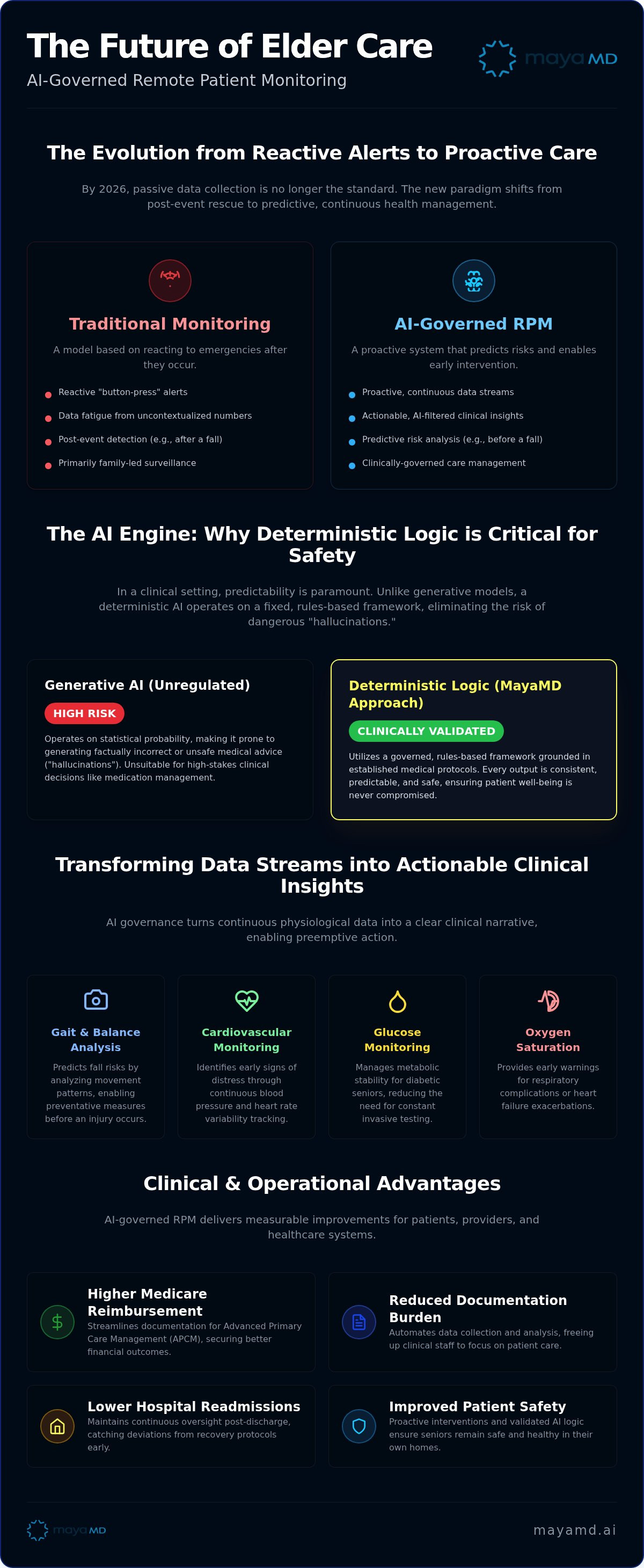
The distinction between consumer-grade wearables and clinical-grade systems has never been more critical. While consumer devices provide general wellness data, professional remote monitoring for elderly patients requires a level of precision that only medically validated platforms can provide. We've moved beyond the era of simple "button-press" emergency pendants. In 2026, passive monitoring is no longer the clinical standard. Today's systems rely on continuous, high-fidelity health data streams that allow for proactive intervention rather than reactive rescue.
The foundational principles of Remote patient monitoring (RPM) have transitioned into a predictive science. By applying Clinical AI to geriatric health patterns, we can now decode complex physiological signals that previously went unnoticed. This evolution marks a departure from family-led surveillance toward provider-governed chronic care management. It's a shift from merely observing a patient to actively managing their health trajectory through data-driven logic.
From Safety Alerts to Clinical Insights
Traditional safety measures often focused on post-event detection, such as identifying a fall after it occurred. Modern clinical AI shifts this focus toward gait analysis and balance assessment to predict fall risks before an injury occurs. This transition from reactive to proactive care is fueled by the continuous tracking of specific physiological markers:
Blood Pressure and Heart Rate Variability
Identifying early signs of cardiovascular distress.
Glucose Monitoring
Managing metabolic stability in diabetic seniors without constant invasive testing.
Oxygen Saturation
Providing early warnings for respiratory complications or heart failure exacerbations.
By shifting the monitoring burden to AI-governed systems, providers gain actionable insights that drive better long-term outcomes. This capability-to-outcome structure ensures that data isn't just collected but is immediately transformed into a clinical plan of action.
Meeting the Demands of an Aging Population
The "Silver Tsunami" is placing unprecedented pressure on healthcare infrastructure in high-growth senior hubs like Phoenix and Houston. The scarcity of geriatric specialists makes it impossible to rely on traditional in-person models alone. Clinical AI acts as a force multiplier, allowing a single practitioner to manage a larger cohort of complex patients with higher precision. This model is particularly effective in reducing hospital readmissions. By maintaining continuous oversight during the critical post-discharge window, AI agents identify early deviations from recovery protocols. This ensures that seniors remain safe in their homes while receiving the same level of scrutiny they would in a clinical facility.
Clinical AI: The Engine of Modern Remote Monitoring
The efficacy of remote monitoring for elderly patients hinges on the reliability of the underlying intelligence. While basic sensors often overwhelm providers with raw, uncontextualized data, Clinical AI serves as a rigorous filter that prioritizes safety and precision. This technological shift is validated by recent research on remote monitoring systems, which underscores the necessity of moving toward integrated platforms that directly impact health outcomes through systematic oversight. It's about transforming a chaotic stream of numbers into a coherent clinical narrative that a physician can trust. Without this layer of governance, monitoring becomes an administrative burden rather than a clinical asset.
Deterministic Logic vs. Generative AI
In a high-stakes clinical setting, the cost of an error is absolute. Standard generative AI, while impressive in its linguistic fluidity, is prone to "hallucinations" that can lead to catastrophic advice, particularly in complex geriatric medication management where drug-drug interactions are common. Deterministic logic operates on fixed, rules-based frameworks that ensure consistent, predictable outputs based on established medical protocols. This is where MayaMD differentiates its approach. By utilizing a "governed" clinical experience, the platform ensures that every recommendation is grounded in deterministic logic rather than mere statistical probability. Neuro-symbolic AI acts as the necessary bridge here, combining the pattern recognition of neural networks with the symbolic reasoning of expert systems. This allows for a platform that understands patient nuance without sacrificing the safety of a rules-based core.
Real-Time Data Synthesis
MayaMD’s Clinical AI Agent synthesizes complex biometric data into actionable provider alerts by applying clinically validated logic to real-time health signals.
This specific mechanism is vital for preventing alert fatigue, which remains a primary cause of physician burnout. By filtering out the "noise" of minor, non-clinical fluctuations and highlighting only the "signals" that indicate a genuine health decline, the system protects the provider's cognitive bandwidth. Natural language processing (NLP) further enhances this ecosystem by facilitating sophisticated patient-AI interactions that collect subjective data to complement objective vitals. These interactions feel human and empathetic but remain strictly within the bounds of clinical safety. If you're looking to implement a system that balances technological ambition with rigorous oversight, exploring a Clinical AI platform is the logical next step for modernizing your practice’s approach to remote monitoring for elderly patients.
Integrating RPM, PCM, and APCM for Seniors
Providing effective remote monitoring for elderly patients requires a multi-layered clinical framework that extends beyond data collection. While Remote Patient Monitoring (RPM) captures essential vitals, it represents only one component of a modern geriatric care strategy. Principal Care Management (PCM) allows specialists to focus on high-risk, single-condition complexities, while the introduction of Advanced Primary Care Management (APCM) in 2026 establishes a comprehensive standard for longitudinal wellness. Together, these programs form a robust safety net that enables aging in place by bridging the gap between home-based monitoring and clinical intervention.
Coordinating Care Across Multiple Conditions
Managing the "comorbidity challenge" is a primary concern for practitioners treating patients over 75. These individuals often present with a constellation of chronic issues that require simultaneous oversight from primary care physicians and various specialists. A study on remote health monitoring usability highlights that technical adherence remains high when systems are designed with the specific cognitive and physical needs of seniors in mind. Seamless data flow between these clinical actors ensures that no physiological deviation is viewed in isolation. By linking remote monitoring for elderly patients directly to APCM protocols, providers can maintain a unified record that reflects the patient’s complete health profile, reducing the risk of fragmented care or conflicting treatments.
Reimbursement and Financial Sustainability
The financial viability of senior care programs depends on a clear understanding of the evolving regulatory environment. In 2026, Medicare has refined its reimbursement codes to better reflect the intensive nature of chronic care management. These updates offer significant opportunities for organizations that can demonstrate rigorous adherence to monitoring and documentation requirements. AI-driven documentation tools play a pivotal role here; they provide the granular, time-stamped evidence necessary to justify medical necessity for higher-tier billing. This level of systematic oversight transforms RPM from a cost center into a sustainable revenue driver. For value-based care organizations, the return on investment is measured not just in reimbursements, but in the dramatic reduction of high-cost emergency interventions and hospitalizations. This capability-to-outcome model ensures that clinical excellence and financial performance remain perfectly aligned.
Overcoming Implementation Barriers in Geriatric Care
Deployment of remote monitoring for elderly patients often encounters significant logistical and technical hurdles. In urban centers like Indianapolis or Chicago, the "digital divide" remains a tangible reality where varying levels of technological literacy can impede care delivery. Overcoming this requires a dual approach: simplifying the end-user experience while maintaining rigorous HIPAA compliance and data security in cloud-based environments. Providers must also focus on staff training, ensuring that clinical teams can navigate AI-driven dashboards without adding to their existing cognitive load. Strategic implementation of remote monitoring for elderly patients requires more than just hardware; it demands a total integration into the clinical workflow.
Patient Engagement and AI Accessibility
Effective senior care technology must account for the physical and cognitive realities of aging. Designing AI interfaces for patients with cognitive or visual impairments involves high-contrast visuals, simplified navigation, and voice-activated interactions. The Clinical AI Agent serves as a friendly, consistent point of contact, providing a sense of continuity that traditional portals lack. This persistent engagement is essential for building trust through Digital Healthcare for Chronic Disease. When seniors feel supported rather than monitored, their adherence to health protocols increases, leading to more stable clinical outcomes and higher patient satisfaction scores.
Workflow Automation for Clinicians
MayaMD’s clinical workflow automation solutions eliminate repetitive data entry by auto-populating monitoring metrics directly into the patient's record. This capability addresses the primary driver of physician burnout: the administrative burden of data management. By integrating remote data directly into the Electronic Health Record (EHR), the platform ensures that vitals are available at the point of care without requiring manual retrieval. The system can even automate the "pre-visit" summary, using AI-captured remote data to highlight specific areas of concern before the patient enters the exam room. This allows the practitioner to focus entirely on the clinical encounter. To see how these tools can transform your geriatric care model, explore our governed AI solutions for providers.
The MayaMD Approach to AI-Governed Elder Care
MayaMD’s ecosystem represents the culmination of clinical rigor and advanced data science. It’s not just a software layer; it’s a systematic framework designed to support remote monitoring for elderly patients while adhering to the strictest regulatory standards. By integrating deterministic logic with generative capabilities, the platform provides a stable foundation for Advanced Primary Care Management (APCM). This is particularly vital for providers in aging population hubs like Las Vegas and Phoenix, where the demand for high-precision geriatric care is rapidly outstripping available clinical resources. The shift toward an AI-governed medical home ensures that care is continuous rather than episodic. This transition allows practitioners to move from a "wait and see" approach to a model of perpetual oversight, transforming the home into a clinically validated extension of the medical practice.
Clinical AI Agent for Primary Care
Defining the clinical ai agent for primary care involves understanding its role as a force multiplier for the physician. This agent doesn’t just collect data; it actively assists in real-time patient triage and automated documentation. By capturing subjective patient feedback and correlating it with objective biometric vitals, the agent creates a high-resolution health profile. Success is measured through tangible metrics: reduced time spent on manual chart updates and a measurable improvement in patient adherence. Providers can finally reclaim their cognitive bandwidth, focusing on complex decision-making while the AI handles the routine synthesis of data. It’s a partnership that prioritizes the human element of care by automating the mechanical aspects of health management.
Getting Started with MayaMD
Implementing a sophisticated platform shouldn't disrupt the existing clinical workflow. MayaMD offers scalable strategies that accommodate the needs of both large hospital systems and independent clinics. We understand that remote monitoring for elderly patients isn't a one-size-fits-all solution. Our platform allows for the customization of monitoring protocols based on specific chronic conditions, ensuring that a patient with congestive heart failure receives a different oversight framework than one managing advanced type 2 diabetes. This modularity ensures that your practice can grow its monitoring capabilities at a sustainable pace. Whether you’re looking to improve your APCM documentation or seeking to reduce hospital readmissions within a value-based care model, the first step is a clinical AI demonstration. Contact our team to see how our governed ecosystem can provide the stability and precision your practice requires to lead in 2026 and beyond.
Advancing Toward Proactive Senior Care Governance
The landscape of 2026 demands a transition from traditional observation to active, AI-governed intervention. We've explored how deterministic logic provides the necessary safety rails for clinical care, ensuring that every automated insight is grounded in medical truth rather than statistical guesswork. By integrating these systems, providers can finally resolve the tension between high-quality geriatric management and the administrative burden that leads to burnout. Implementing sophisticated remote monitoring for elderly patients is no longer just a technical upgrade; it's a strategic necessity for clinical and financial stability.
MayaMD offers a HIPAA-compliant, cloud-based infrastructure optimized for 2026 APCM and PCM reimbursement protocols, providing the precise documentation needed to maximize value-based care outcomes. The future of senior health lies in this seamless connectivity between data and human care. Request a Demo of MayaMD's AI-Governed RPM Platform to secure your practice's role as a pioneer in proactive medicine. We look forward to supporting your journey toward superior patient longevity and safety.
Frequently Asked Questions
Is remote patient monitoring covered by Medicare for seniors in 2026?
Yes, Medicare coverage for RPM remains robust in 2026, specifically through updated codes for Advanced Primary Care Management. These regulations favor systems that provide continuous, data-driven oversight rather than episodic checks. Providers can secure higher reimbursement by demonstrating rigorous adherence to these monitoring protocols. This framework ensures that the financial sustainability of a practice aligns perfectly with the improved safety and longevity of the senior population.
How does AI help prevent falls in elderly patients without invading privacy?
AI helps prevent falls by analyzing gait and balance metrics through non-invasive movement sensors. Instead of intrusive cameras, the system relies on pattern recognition that respects the patient's privacy. By detecting minor deviations in walking patterns, the Clinical AI Agent alerts providers to a heightened fall risk. This allows for proactive interventions such as physical therapy, significantly improving safety without continuous visual oversight.
Can remote monitoring work for patients with dementia or Alzheimer's?
Yes, remote monitoring for elderly patients with dementia is highly effective when using passive data collection that doesn't require active participation. Sensors track activity levels and physiological markers to establish a baseline of normal behavior. When the AI detects wandering or significant changes in sleep patterns, it notifies the care team immediately. This systematic oversight provides a critical safety layer for those with complex cognitive needs.
What is the difference between consumer wearables and clinical RPM?
The primary difference lies in clinical validity; RPM uses medically cleared devices that transmit data directly into a physician's workflow. Unlike consumer wearables that track general fitness, clinical systems provide the high-fidelity data necessary for managing chronic conditions. These platforms operate under strict regulatory oversight and use deterministic logic to ensure that every data point is actionable. It's the difference between a wellness gadget and a professional medical tool.
How do AI agents handle clinical documentation for elderly care?
AI agents handle documentation by automatically synthesizing biometric data and patient feedback into structured, audit-ready clinical notes. This automation captures the specific data points required for Medicare reimbursement under APCM and PCM frameworks. By handling the heavy lifting of manual entry, these agents reduce physician burnout and ensure that records are consistently audit-ready. The result is a more efficient clinic that prioritizes patient interaction over paperwork.
What happens if the remote monitoring system detects a critical health change?
The system triggers an immediate, prioritized alert to the clinical team when it detects a critical health change. These notifications are sent directly to the designated care team to facilitate rapid intervention. Because the system filters out non-essential data noise, clinicians can trust that every alert requires their professional attention. This speed of response is essential for preventing hospitalizations and managing acute exacerbations in chronic conditions.
Is MayaMD HIPAA-compliant for remote monitoring in all 50 states?
Yes, MayaMD is a fully HIPAA-compliant platform that meets all regulatory requirements for remote monitoring across all 50 states. The platform's cloud-based architecture is designed to protect patient privacy while enabling seamless connectivity between providers and seniors. By utilizing rigorous encryption and systematic access controls, we ensure that every data point remains secure. This allows healthcare organizations to deploy monitoring solutions with total confidence in their regulatory standing.
How does deterministic logic reduce risk in elderly patient monitoring?
Deterministic logic reduces risk by following strict, rules-based algorithms that eliminate the hallucinations common in traditional AI. For remote monitoring for elderly patients, where medication interactions and comorbidities are complex, this precision is non-negotiable. Every recommendation is grounded in established medical protocols rather than statistical probability. This governed approach ensures that the technology acts as a reliable partner to the physician, prioritizing clinical safety at every stage.



See The MayaMD Difference
Fill the form below
Download Our Apps
MayaMD for patients and MayaPro for physicians - available on iOS and Android.
FOR PATIENTS
MayaMD App
AI-powered symptom assessment, triage, and secure access to your care team.
FOR PHYSICIANS
MayaPro App
MayaPro brings patient vitals, RPM/PCM care plans, and clinical decision support to your pocket.