
Remote Diabetes Monitoring: 2026 AI-Governed Care Guide

What if the relentless stream of data flooding your EHR wasn't a burden to manage, but a self-governing clinical intervention that reached your patients before a crisis occurred? For many providers, remote patient monitoring for diabetes has historically meant drowning in data silos while facing the constant threat of physician burnout from excessive documentation. You've likely felt the frustration of traditional programs that fail to engage patients or, worse, provide unreliable AI insights that lack clinical rigor.
This guide demonstrates how advanced Clinical AI Agents are transforming diabetes management from passive data collection into proactive, hallucination-free clinical intervention. By integrating deterministic logic with generative AI, these systems ensure high-stakes reliability and precision. You'll discover how a governed AI framework streamlines clinical documentation and improves HbA1c levels across your population. We'll also examine the technical methodology required to reduce avoidable hospital admissions and successfully capture APCM and PCM reimbursement in 2026. This is the transition from experimental software to proven, scalable clinical application.
Key Takeaways
• Understand how Clinical AI Agents transition diabetes care from passive data collection to proactive, governed clinical intervention.
• Discover the role of deterministic logic in eliminating AI hallucinations to ensure safe, high-stakes medical oversight and decision support.
• Analyze the measurable impact of remote patient monitoring for diabetes on HbA1c levels and the reduction of avoidable hospital readmissions.
• Follow a structured roadmap to integrate AI-driven workflows into your existing EHR without increasing physician documentation burdens.
• Explore how a unified ecosystem for RPM, APCM, and PCM maximizes clinical reimbursement while improving the quality of chronic care management.
The Evolution of Diabetes Management: Beyond Passive Monitoring
Remote patient monitoring (RPM) in 2026 is a sophisticated ecosystem rather than a simple collection of hardware. It represents a fundamental departure from the static, device-centric models of the past decade. Modern remote patient monitoring for diabetes functions as a continuous, high-fidelity feedback loop that integrates patient data with rigorous clinical logic. This shift replaces the traditional snapshot approach of quarterly office visits with a persistent, AI-augmented oversight model that monitors patient health in real-time.
The proliferation of data creates a distinct paradox. While clinicians have more visibility than ever, they're often overwhelmed by data noise. Without an intelligent layer to filter and interpret these streams, the result is profound physician burnout. Constant alerts for non-critical glucose fluctuations distract from the patients who require immediate intervention. Remote patient monitoring for diabetes only succeeds when it's supported by "Governed Care." This framework uses deterministic AI to manage documentation and triage, ensuring that only clinically significant events reach the provider.
The Clinical Burden of Chronic Diabetes Care
The demand for specialized care is outstripping supply. With more than 37 million Americans living with diabetes and a persistent shortage of endocrinologists, primary care providers are shouldering the weight of complex chronic management. Traditional RPM programs often exacerbate this by triggering "alert fatigue," where clinicians are bombarded with raw data points that lack context. As clinical workflows become strained, "we need a bridge between patient data and clinical action" to prevent practitioners from being buried under administrative tasks that don't directly improve patient outcomes.
Why 2026 Demands a Shift to AI-Governed Systems
The transition to value-based care models, such as the Medicare Shared Savings Program (MSSP), has made continuous care a financial and clinical necessity. Managing diabetes effectively requires more than reactive treatment; it demands a system that prevents complications before they result in expensive hospitalizations. This evolution is detailed in our pillar on Digital Healthcare for Chronic Disease. By shifting to AI-governed care, organizations can finally align patient outcomes with reimbursement goals like APCM and PCM, ensuring that high-quality care is both sustainable and scalable.
The Role of Clinical AI Agents in Diabetes Remote Monitoring
A Clinical AI Agent is not merely a conversational interface; it's a sophisticated oversight system built on deterministic logic. In the context of remote patient monitoring for diabetes, these agents serve as the primary filter between raw physiological data and clinical intervention. Unlike standard monitoring tools that simply transmit numbers, a Clinical AI Agent interprets data points against established medical protocols in real-time. This ensures that the care team isn't distracted by routine glucose fluctuations that are within a patient's expected range. Instead, the system identifies specific patterns indicating clinical deterioration, alerting providers only when a specific intervention is required.
High-stakes chronic care requires a robust, HIPAA-compliant cloud infrastructure to maintain data integrity and security. By integrating generative AI within a strictly governed deterministic framework, providers can leverage the communicative flexibility of AI without risking the "hallucinations" common in standard large language models. This hybrid approach allows for a more responsive RPM program for diabetes management, where the system provides precise, logic-bound support while maintaining a seamless experience for the user. To explore the technical architecture behind these systems, you can review our detailed guide on the Clinical AI Agent for Primary Care.
Deterministic Logic vs. Generative AI in Healthcare
"Unplugged" generative AI is fundamentally dangerous for diabetes management. Because these models prioritize linguistic probability over medical accuracy, they can provide incorrect guidance regarding medication titration or dietary adjustments. MayaMD eliminates hallucinations by forcing the AI to operate within a deterministic logic framework, where every response is validated against clinical truth. This ensures that the system never deviates from evidence-based protocols, providing a level of reliability that human-led programs often struggle to maintain at scale. This level of governed clinical intelligence is essential for protecting both patient safety and provider liability.
Automated Engagement and Patient Adherence
Traditional monitoring programs often fail because of low patient engagement. Patients lose interest when their data feels like it's disappearing into a void. Clinical AI Agents solve this by creating a real-time feedback loop. When a patient logs a glucose level, the AI provides immediate, governed responses that offer context and encouragement. This persistent connectivity keeps patients motivated and compliant with their care plans. Because the AI manages these routine interactions autonomously, the clinical staff is freed from the burden of manual follow-ups, allowing them to focus on complex cases that require human expertise.
Clinical Outcomes and ROI: Measuring the Impact of AI-Driven RPM
Measuring the success of remote patient monitoring for diabetes requires looking past simple data collection toward tangible clinical shifts. Clinical AI Agents provide the necessary oversight to correlate continuous monitoring with significant HbA1c reduction. By identifying glycemic trends before they escalate, these systems enable timely medication adjustments and lifestyle interventions. This proactive model directly reduces the frequency of acute diabetic complications; these are the primary drivers of avoidable hospital admissions that drain system resources.
Automated documentation through Clinical AI Agents transforms billing efficiency. Instead of physicians spending hours on manual entries, the AI synthesizes monitoring data into structured clinical notes. This streamlines the capture of billable time for RPM and PCM, ensuring that practices aren't leaving revenue on the table due to administrative friction. When the documentation burden is removed, clinicians can return to the high-value work of direct patient care, effectively solving the burnout crisis that often plagues traditional monitoring programs.
Improving Patient Outcomes in Local Markets
In urban centers like Houston and Chicago, providers are leveraging AI-governed RPM to bridge health equity gaps. These systems ensure that patients in underserved areas receive the same level of continuous oversight as those with easier access to specialists. In Phoenix, healthcare systems utilize these agents for automated post-discharge communication, significantly lowering the risk of readmission for patients transitioning from acute care. The AI-driven feedback loop also helps reduce "no-show" rates by maintaining a constant, supportive connection with the patient between scheduled appointments. This persistent connectivity fosters a sense of security that keeps patients engaged in their own care plans.
The Financial Logic of APCM and PCM
The ROI of an AI-driven program is anchored in its ability to satisfy the rigorous requirements of 2026 CPT codes. For specialists in Indianapolis, implementing Principal Care Management (PCM) via a Clinical AI Agent provides a scalable way to manage high-risk diabetic populations while maximizing reimbursement. The software automates the tracking of the required clinical staff time, making the billing process for codes like 99457 and 99458 virtually seamless. For a comprehensive breakdown of these billing frameworks, clinicians should refer to the APCM Definitive Guide. This integration ensures that the move toward value-based care is both clinically effective and financially viable for the modern practice.
Implementing an AI-Governed RPM Program: A Roadmap for Providers
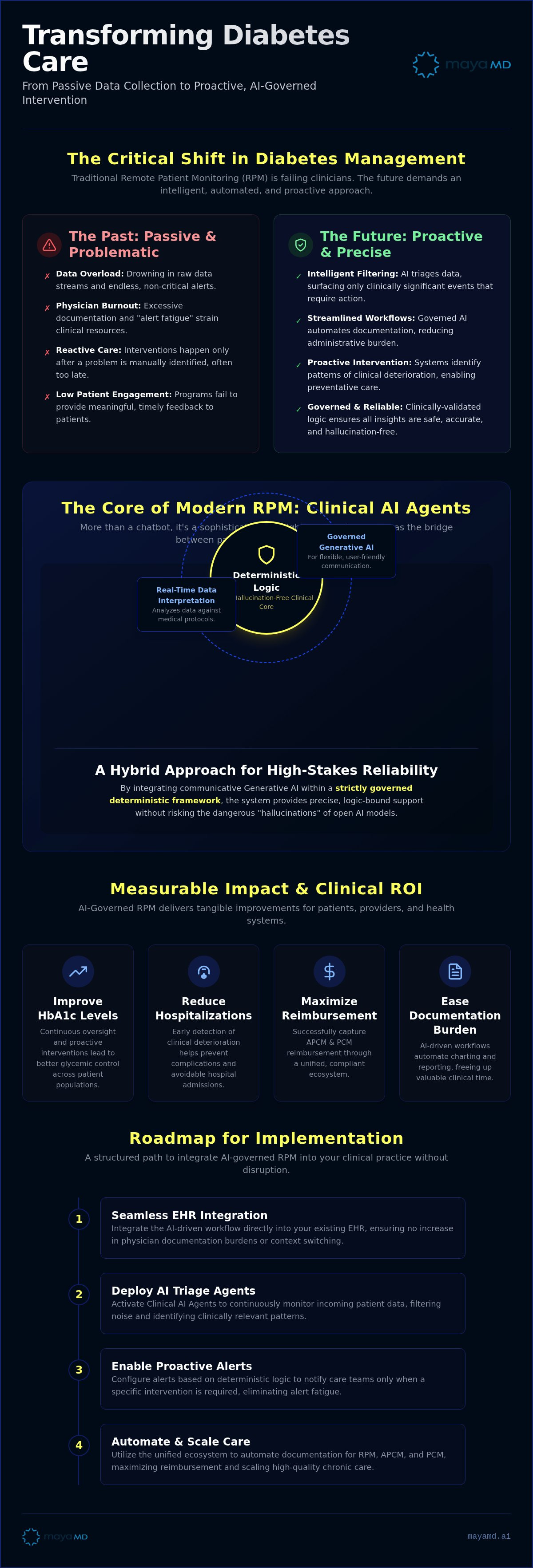
Deploying a robust system for remote patient monitoring for diabetes requires a methodical transition from legacy manual processes to automated, governed workflows. This roadmap ensures that the integration of a Clinical AI Agent enhances care delivery without disrupting existing clinical operations. Successful implementation begins with a Clinical Workflow Assessment to identify documentation bottlenecks that currently consume provider time. By pinpointing these friction points, organizations can configure the AI to handle the administrative load, allowing clinicians to focus on high-risk patients.
The technical phase involves connecting the Clinical AI Agent directly to your EHR system through secure, cloud-based interfaces. Once the infrastructure is established, the focus shifts to patient enrollment and device provisioning. AI-driven onboarding can automate the initial setup and education required for Medicare CPT code 99453, which provides a national average reimbursement of approximately $19.73. Continuous monitoring then relies on specific governance parameters; these logic-bound rules dictate when the system should autonomously engage a patient and when it must escalate a critical glucose reading to the medical staff.
Finally, the system must automate the reporting necessary for Medicare compliance. To satisfy the requirements for CPT code 99454, the AI tracks data transmission for the mandatory 16 days in a 30-day period, securing a reimbursement of approximately $43.03. It also logs the 20-minute interactive communication thresholds for codes 99457 and 99458. You can schedule a consultation with MayaMD to see how this automation secures your practice's financial sustainability.
Integrating AI into Clinical Workflows
Minimizing disruption for nursing staff is critical during an RPM rollout. By utilizing automated post-discharge communication, healthcare systems in Las Vegas have successfully bridged the gap between hospital release and home care without increasing staff workloads. When selecting HIPAA-compliant patient monitoring software, providers should use this checklist:
• Full bidirectional EHR interoperability.
• Deterministic logic frameworks to prevent hallucinations.
• Automated patient engagement and education tools.
• Built-in compliance tracking for APCM and PCM billing.
Scaling Care Through Workflow Automation
Robotic process automation (RPA) handles the repetitive administrative tasks that often cause RPM programs to stall. By automating data entry and reconciliation, RPA ensures that the diabetes management team has access to real-time data visualization without manual effort. This connectivity allows for a comprehensive view of patient health across the entire population. For specific deployment strategies, refer to our guide on Robotic Process Automation in Healthcare to streamline your 2026 clinical workflows.
MayaMD’s Clinical AI Agent: The Future of Diabetes Care Management
MayaMD represents the convergence of clinical validity and advanced data science. Unlike generic monitoring dashboards, our Clinical AI Agent provides a governed environment where deterministic logic oversees every interaction. This architecture is specifically designed to handle the complexities of remote patient monitoring for diabetes, ensuring that every data point is validated against rigorous medical protocols before it ever reaches the clinician. By consolidating RPM, APCM, and PCM within a single ecosystem, we offer a unified solution that addresses both the clinical outcomes and the financial requirements of modern healthcare organizations. This integrated approach ensures that providers can capture maximum reimbursement while maintaining a high standard of oversight.
Our sophisticated framework for remote patient monitoring for diabetes ensures that the care team is always informed but never overwhelmed. This is the transition from experimental software to a proven, scalable clinical application that prioritizes safety and precision. By removing the "data noise" that often plagues traditional programs, we allow the clinical staff to return to the human side of medicine, supported by the cold, hard logic of advanced data science.
Seamless Connectivity and Patient Support
MayaMD facilitates seamless connectivity across disparate data points, transforming fragmented patient logs into a cohesive care narrative. This integration allows physicians to shift their focus from manual data review to high-stakes intervention for their most vulnerable patients. The platform's ability to foster connection means that patients don't feel abandoned between office visits, which is a primary driver of long-term adherence. Our automated documentation tools are engineered to alleviate the administrative strain that often leads to provider fatigue. By automating the synthesis of daily monitoring sessions into structured, EHR-ready clinical notes, the platform significantly reduces the time spent on manual documentation, directly addressing the core cause of physician burnout.
Leading the Shift to AI-Governed Healthcare
As an authoritative pioneer in the field, MayaMD remains committed to a "governed" approach that prioritizes safety and regulatory adherence. We recognize that the future of specialized digital healthcare depends on precision rather than the breathless hype often associated with new technology. Our HIPAA-compliant platform is ready for immediate deployment in local markets such as Indianapolis and Chicago, where healthcare systems are moving rapidly toward value-based care models and MSSP goals. For providers ready to move past the experimental phase into proven application, the transition is seamless. We invite clinical directors and healthcare executives to experience a clinical demonstration of our Clinical AI Agent. This is the definitive step toward establishing a scalable, sustainable framework for chronic disease management that values both patient outcomes and clinical integrity.
Advancing the Standard of Governed Diabetes Care
The transition toward remote patient monitoring for diabetes has evolved from simple data collection into a sophisticated, AI-governed clinical intervention. By utilizing deterministic logic, providers can finally eliminate the risk of hallucinations while ensuring that every alert is clinically valid and actionable. This shift not only improves HbA1c levels across patient populations but also secures the financial sustainability of chronic care through streamlined APCM and PCM reimbursement. It's the move from experimental data gathering to a proven, scalable model of medical oversight.
To see how these technologies integrate into your existing clinical practice, you can Schedule a Clinical AI Agent Demonstration. MayaMD provides a HIPAA-compliant, cloud-based infrastructure designed specifically for high-stakes clinical safety and regulatory adherence. Our platform offers specialized support for APCM and PCM workflows, allowing your team to focus on high-risk interventions rather than the burden of administrative documentation. Embracing a governed approach to AI is the most reliable way to bridge the gap between complex patient data and high-quality human care.
Frequently Asked Questions
How does remote patient monitoring for diabetes improve HbA1c levels?
It provides a continuous feedback loop that identifies glycemic trends before they become acute. By monitoring glucose levels daily, clinicians can adjust medication titration and lifestyle plans in real-time rather than waiting for quarterly office visits. This persistent oversight ensures that patients remain within their target range more consistently. The result is a measurable reduction in HbA1c across the entire population, as documented in various value-based care studies.
Is RPM software for diabetes management HIPAA compliant?
Modern RPM software must adhere to strict HIPAA regulations to ensure the security of protected health information. MayaMD utilizes a HIPAA-compliant cloud-based infrastructure that encrypts data both at rest and in transit. This ensures that patient glucose readings and communication logs are accessible only to authorized clinical staff. Maintaining this level of security is essential for provider liability and patient trust in a digital care environment.
What is the difference between RPM and Principal Care Management (PCM) for diabetes?
What is the difference between RPM and Principal Care Management (PCM) for diabetes?
Remote patient monitoring focuses on the collection and interpretation of physiological data, while Principal Care Management centers on comprehensive care for a single, high-risk chronic condition. RPM tracks daily glucose metrics via devices, whereas PCM involves managing the patient's entire care plan, including medication management and coordination. For help with specialized compounding or prescription refills as part of this coordination, click here. Many practices combine these services to provide a holistic oversight model that maximizes clinical outcomes and reimbursement potential.
A Clinical AI Agent prevents hallucinations by integrating deterministic logic with generative AI frameworks. Instead of relying on probabilistic language models that might guess medical advice, the system validates every response against established clinical protocols and logic-bound rules. This governed approach ensures that all documentation and patient interactions remain clinically accurate. It eliminates the risk of the AI inventing data or providing unsafe medical guidance during the monitoring process.
Can Medicare reimbursement cover the costs of diabetes RPM software?
Medicare reimbursement covers several components of a remote patient monitoring for diabetes program through specific CPT codes. For example, CPT 99454 pays approximately $43.03 for the monthly supply of monitoring devices and data transmission. Additional codes like 99457 and 99458 cover clinical staff time for interactive communication. These payments often offset the software costs while generating additional revenue for practices that successfully meet the monthly monitoring requirements.
How do Clinical AI Agents reduce physician burnout in chronic care?
These agents reduce burnout by automating the synthesis of monitoring data into structured clinical notes. Instead of manually reviewing thousands of routine data points, physicians only engage when the AI identifies a clinically significant escalation. The system handles the repetitive administrative tasks and documentation required for Medicare compliance. This allows clinicians to focus on direct patient care, potentially reducing the time spent on EHR documentation by up to 40 percent.
What devices are typically used for remote diabetes monitoring in 2026?
The most common devices include FDA-cleared continuous glucose monitors, cellular-enabled blood glucose meters, and smart insulin pens. In 2026, most of these devices utilize cellular or Bluetooth connectivity to transmit data automatically to the RPM platform without requiring manual entry by the patient. These Class II medical devices must undergo 510(k) clearance to ensure they're substantially equivalent to established monitoring tools, providing the high-fidelity data needed for clinical oversight.
How long does it take to implement an AI-governed RPM program?
A typical implementation can be completed in a few weeks, depending on the complexity of the existing EHR integration. The process begins with a clinical workflow assessment followed by technical connectivity and staff training. Once the cloud-based infrastructure is linked to the practice's systems, patient enrollment and device provisioning can begin immediately. This modular approach ensures that providers can start monitoring and billing for services without the year-long delays common in legacy research-setups.



See The MayaMD Difference
Fill the form below
Download Our Apps
MayaMD for patients and MayaPro for physicians - available on iOS and Android.
FOR PATIENTS
MayaMD App
AI-powered symptom assessment, triage, and secure access to your care team.
FOR PHYSICIANS
MayaPro App
MayaPro brings patient vitals, RPM/PCM care plans, and clinical decision support to your pocket.