
Generative AI for Chronic Care: 2026 Clinical AI Guide

The era of experimental "black box" algorithms in healthcare has ended, replaced by a mandate for clinical precision that many legacy systems simply cannot meet. As we enter 2026, the implementation of generative AI for chronic care management is no longer about the novelty of the technology, but about the rigor of its governance. You likely recognize that while the promise of automation is vast, the risk of unverified clinical hallucinations remains a barrier to widespread adoption. This guide addresses that tension directly, moving beyond the hype to explore how neuro-symbolic architectures are finally making AI a safe, reliable extension of the clinical team.
You've felt the weight of documentation burdens that turn healers into data entry clerks and seen how staffing shortages make scaling remote patient monitoring feel like an impossible task. We understand that clinical safety is non-negotiable and that any tool must serve the provider as much as the patient. This article reveals how governed generative AI transforms these challenges into streamlined workflows and proactive interventions. You'll discover how to automate clinical documentation, reduce readmission rates, and maximize Medicare reimbursement through advanced APCM and PCM frameworks that prioritize both fiscal health and patient outcomes.
Key Takeaways
• Learn how the evolution of generative AI for chronic care management has shifted from simple text generation to advanced clinical reasoning and proactive patient engagement.
• Understand the role of neuro-symbolic architecture in preventing clinical hallucinations by anchoring neural networks with deterministic logic for patient safety.
• Identify how Clinical AI Agents alleviate physician burnout by automating administrative documentation and streamlining remote patient monitoring workflows.
• Follow a structured implementation roadmap to integrate clinical AI with your current EHR platform without disrupting established clinical workflows.
• Analyze the financial incentives of the 2026 Medicare landscape, specifically how AI-driven continuous care models unlock higher APCM and PCM reimbursement rates.
Defining Generative AI for Chronic Care Management in 2026
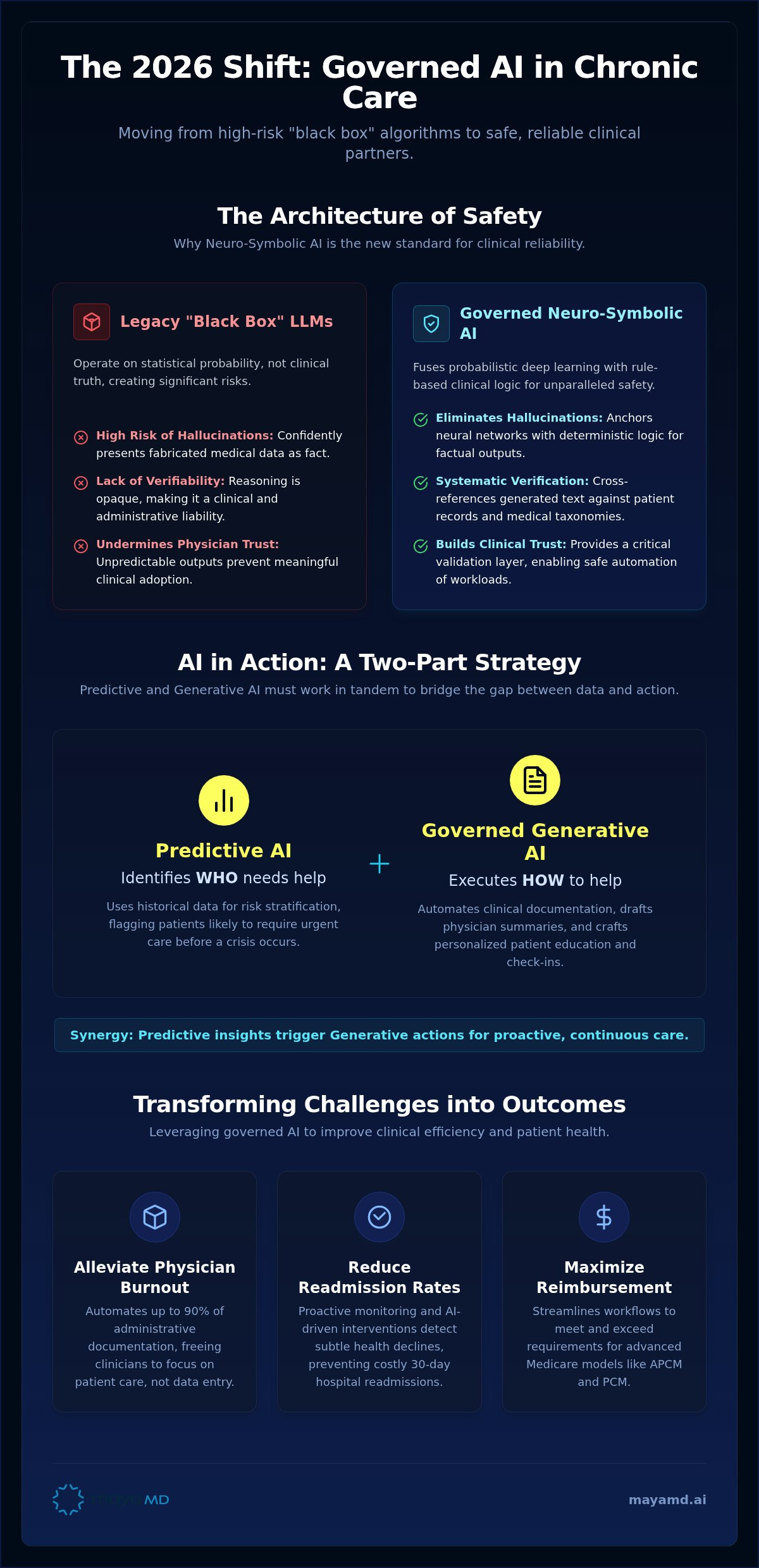
In the current clinical environment, generative AI for chronic care management has evolved beyond the simple synthesis of text. It now functions as a sophisticated system capable of clinical reasoning, utilizing patient data to suggest evidence-based interventions. While general-purpose models often struggle with accuracy, specialized clinical AI leverages deterministic frameworks to ensure every output remains grounded in medical reality. This shift ensures that technology serves as a reliable partner rather than a source of administrative risk.
2026 marks a definitive shift. The industry has moved past the era of experimental pilots into a phase of governed implementation. Unlike the reactive patient portals of the past, today’s Clinical AI Agents operate with a sense of proactive urgency. They don't wait for a patient to log a symptom; they identify subtle physiological trends and prompt the necessary clinical action before a crisis occurs. This transition is powered by the realization that general LLMs, while impressive, lack the specialized guardrails required for high-stakes medical decision-making.
The Evolution of Digital Healthcare for Chronic Disease
The trajectory of digital healthcare for chronic disease has transitioned from passive data collection to active, AI-governed oversight. This shift is critical for reducing 30-day hospital readmissions, as continuous monitoring allows for the early detection of decompensation. By providing patients with real-time, AI-driven guidance, providers see a measurable increase in treatment adherence. Patients feel more connected to their care teams. This connection fosters the long-term engagement necessary for managing complex, multi-morbid conditions without increasing the workload on human staff.
Generative vs. Predictive AI: A Necessary Distinction
Precision requires clarity. Predictive AI excels at risk stratification, identifying which patients are most likely to require urgent care based on historical data. Conversely, generative AI focuses on the execution of care, automating clinical documentation and crafting personalized education materials that resonate with a patient's specific health literacy level. The broader field of Artificial Intelligence in Healthcare demonstrates that neither technology is sufficient in isolation. They must work in tandem to bridge the gap between data and action.
True operational efficiency is found in the synergy of these two systems within remote patient monitoring software. When predictive models flag a rising blood pressure trend, generative AI can immediately draft a summary for the physician and a supportive check-in message for the patient. This integrated approach ensures that data doesn't just sit in an EHR. Instead, it actively drives better clinical outcomes by providing the right information at the right time.
The Architecture of Safety: Neuro-Symbolic AI and Deterministic Logic
Standard Large Language Models (LLMs) operate on statistical probability rather than clinical truth. This fundamental design often leads to the hallucination problem, where an AI confidently presents fabricated medical data as factual. Within the specialized field of generative AI for chronic care management, such inaccuracies are more than technical errors; they're clinical liabilities. Ensuring safety requires a departure from purely neural architectures in favor of systems that prioritize rigorous, governed oversight.
Eliminating Hallucinations in Clinical Documentation
Governed AI provides a critical validation layer for every clinical output. By cross-referencing generated documentation against established patient records and medical taxonomies, the system ensures that every claim remains grounded in clinical reality. This systematic verification process fosters the physician trust required for meaningful adoption. When clinicians interact with a system that validates its own reasoning against factual data, they can confidently reduce their administrative workload. Neuro-symbolic AI is the fusion of probabilistic deep learning and rule-based clinical logic.
Deterministic Logic for Patient Safety
Safety in chronic care is engineered through logical constraints rather than statistical likelihood. By utilizing deterministic logic in clinical ai, healthcare organizations can effectively standardize care protocols across diverse patient populations. This architecture allows for the seamless integration of ACCA/AHA guidelines into the AI’s core reasoning, preventing the system from suggesting interventions that contradict evidence-based standards. This structural guardrail ensures that the Clinical AI Agent operates as a reliable partner in the care journey, providing support that aligns with established medical consensus.
Data security and HIPAA compliance form the final pillar of this safety architecture. A cloud-based, HIPAA-compliant platform ensures that patient data is encrypted both at rest and in transit, maintaining the integrity of the clinical workflow. This systematic approach to security protects sensitive information while allowing the AI to synthesize disparate data points into actionable insights. Providers seeking a secure, governed solution can explore how MayaMD’s clinical AI platform integrates these safety protocols to deliver hallucination-free clinical interventions.
Transforming Outcomes: GenAI vs. Legacy Chronic Care Management Tools
Legacy chronic care management traditionally relies on manual outreach, a labor-intensive process that fundamentally limits clinical scalability. By implementing generative AI for chronic care management, healthcare organizations transition from reactive monitoring to proactive, intelligent intervention. This shift replaces fragmented spreadsheets and manual phone calls with a unified, AI-governed workflow that synthesizes longitudinal patient data in real-time. The result is a system that understands the clinical context of every data point rather than just recording a value.
The resulting efficiency gains are both measurable and transformative. While manual care coordination often consumes excessive time per patient each month, AI-augmented workflows significantly reduce the administrative burden of clinical documentation. Reclaiming these minutes per patient encounter allows clinical teams to redirect their focus toward high-risk interventions rather than repetitive data entry. It's a move toward a model where technology handles the synthesis while providers handle the healing.
Scalability isn't just a goal; it's a necessity for modern practice survival. A traditional care team might struggle to manage a few hundred patients with the necessary frequency. With the integration of a Clinical AI Agent, a single practice can oversee 1,000+ patients without the need to double their clinical staff. This ensures that high-stakes care remains consistent across the entire population, providing a level of oversight that was previously impossible without significant hiring.
Advancing Remote Patient Monitoring (RPM)
Modern RPM has moved beyond mere data collection. It now encompasses intelligent intervention, where generative AI for chronic care management summarizes thousands of physiological data points into concise, actionable briefs for rapid physician review. In clinics across Houston and Phoenix, this capability is currently utilized to manage complex hypertension and diabetes cases. The technology identifies subtle trends in blood glucose or blood pressure, prompting medication adjustments days earlier than traditional models would allow, thereby preventing avoidable emergency department visits.
Principal Care Management (PCM) for Specialists
Specialists managing single, complex chronic conditions require high-precision data that reflects the nuances of their specific field. Utilizing principal care management tools allows cardiologists, endocrinologists, and nephrologists to deploy specialist-specific AI agents tailored to their unique clinical logic. These agents streamline the transition of care between primary providers and specialists by maintaining a continuous clinical narrative. This systematic integration reduces the friction often found in co-managed care, ensuring that specialist-driven treatment plans are executed with the same rigor as primary care interventions.
Strategic Implementation: Deploying AI Agents in Local Clinical Settings
Successful deployment of generative AI for chronic care management requires a methodical, four-step integration process that prioritizes clinical stability. First, providers must conduct a rigorous assessment of current chronic care workflows to identify specific documentation bottlenecks that drain staff resources. Second, the Clinical AI Agent must be integrated with existing EHR systems, such as Epic, Cerner, or Athena, to ensure a seamless exchange of data across the care continuum. This technical connectivity allows the AI to function as a bridge between disparate data points and human intervention.
The third phase focuses on training clinical staff to transition from manual data entry to AI-augmented patient engagement. This step emphasizes that the AI is a partner, not a replacement, designed to enhance the human connection by handling the cognitive load of data synthesis. Finally, practices must establish a systematic monitoring framework to track clinical outcome metrics and AI performance. Continuous oversight ensures that the system maintains the high-stakes reliability required for chronic care management while delivering measurable improvements in patient health.
Adapting Workflows for Major US Metro Areas
Metro-specific implementation requires a nuanced understanding of local patient demographics and regulatory landscapes. In Chicago and Indianapolis, clinics utilize AI to address diverse language needs and cultural health literacy, ensuring that chronic care instructions are accessible to all populations. Meanwhile, providers in Nevada and Indiana must navigate specific state-level telehealth and RPM regulations to maintain compliance while expanding their digital reach. High-volume areas like Las Vegas benefit from resource optimization, where AI agents manage the influx of patient data, allowing clinics to maintain a high quality of care despite staffing challenges.
Automating Clinical Documentation and Billing
Administrative exhaustion remains a primary driver of physician burnout. Modern clinical workflow automation solutions significantly reduce "pajama time" by generating precise encounter summaries in real-time. These AI-generated notes are systematically mapped to ICD-10 and CPT codes, facilitating accurate billing and higher Medicare reimbursement through efficient APCM and PCM capture. This rigorous adherence to documentation standards ensures that every encounter meets the stringent audit requirements of 2026, protecting the practice from fiscal and regulatory risk.
Implementing these advanced systems is a strategic investment in the future of your practice. To see how a governed AI framework can transform your clinical operations, explore the capabilities of MayaMD’s Clinical AI Agent today.
Scaling Advanced Primary Care Management with MayaMD’s Clinical AI
Advanced Primary Care Management (APCM) represents the next frontier in value-based reimbursement, offering a pathway to sustainable practice growth through higher per-member per-month (PMPM) payments. However, the "continuous care" requirements of this model present a significant operational challenge for traditional clinical teams. By implementing generative AI for chronic care management, practices can automate the real-time surveillance and reporting necessary to secure these enhanced rates. This ensures that the financial incentives of APCM are fully realized without the burden of manual data tracking.
MayaMD’s Clinical AI Agent provides the infrastructure needed to meet these rigorous standards while maintaining a lean operational footprint. The system consistently reduces administrative overhead by 40%, allowing your existing staff to focus on high-value patient interactions rather than clerical checklists. This "Authoritative Pioneer" model doesn't just record data; it synthesizes it into actionable insights that align with the long-term goals of value-based care. By shifting the cognitive load of documentation to a governed AI, you protect your practice’s fiscal health and your team’s professional well-being.
The Definitive Guide to APCM Implementation
Success in the 2026 landscape requires more than just meeting basic monitoring thresholds. Utilizing MayaMD to satisfy advanced primary care management quality metrics ensures that your practice remains compliant with the latest Medicare performance standards. The platform acts as a centralized AI communication hub, coordinating care teams and ensuring that every stakeholder has access to a unified clinical narrative. MayaMD serves as the bridge between disparate data points and human-centric chronic care, providing the connectivity required for truly integrated management.
Next Steps: Partnering with MayaMD
Moving from a reactive model to a proactive, AI-augmented practice requires a strategic approach tailored to your specific clinical environment. We recommend scheduling a comprehensive clinical workflow audit to identify the precise areas where automation can deliver the highest return on investment. Our team assists in customizing AI agents for your specific chronic condition protocols, ensuring the technology reflects your practice’s unique clinical logic and patient needs. To see the impact of a governed AI framework firsthand, Schedule a demo of the MayaMD Clinical AI Agent today.
Securing the Future of Clinical Intervention
The transition toward generative AI for chronic care management represents a fundamental shift in how we approach long-term patient health. We've moved beyond simple data collection into a phase where governed intelligence provides the clinical reasoning necessary for proactive intervention. By anchoring neural networks with deterministic logic, your practice can finally eliminate the risk of hallucinations and build a foundation of trust that legacy systems cannot match.
Embracing this evolution allows providers to reclaim their time while meeting the rigorous documentation standards of 2026. Whether you're managing complex cases in Houston, Indianapolis, or Las Vegas, the path to scalable, high-reimbursement care is through a partner that understands the nuances of your clinical workflow. MayaMD offers a HIPAA-compliant, cloud-based clinical AI platform that utilizes a neuro-symbolic architecture to ensure every encounter is documented with absolute precision.
Optimize Your Chronic Care Workflow with MayaMD
The tools to transform your practice and improve patient outcomes are within reach. It's time to lead the next era of medicine with confidence and clinical rigor.
Frequently Asked Questions
Is generative AI safe for making clinical decisions in chronic care?
Yes, it's safe if it uses a governed, neuro-symbolic architecture rather than a standard large language model. Safety is achieved by anchoring probabilistic neural networks with deterministic clinical logic. This ensures that any suggestion or documentation stays within the bounds of established medical guidelines. While the AI assists in reasoning and data synthesis, the final clinical decision always rests with the licensed provider.
Can generative AI help with Medicare RPM and CCM reimbursement?
Generative AI for chronic care management significantly enhances the accuracy and efficiency of billing for RPM and CCM services. By automating the capture of time spent on patient interactions and mapping encounter notes to specific CPT codes, the system ensures that no billable activity is overlooked. This systematic approach reduces the risk of audit failures while maximizing the capture of monthly management fees through consistent documentation.
How does MayaMD prevent AI hallucinations in patient documentation?
MayaMD utilizes a neuro-symbolic AI architecture that integrates deterministic logic with generative capabilities to eliminate the risk of hallucinations. Every clinical output is cross-referenced against a structured medical knowledge base and the patient's actual record before it's presented. This dual-layer validation ensures that the AI's reasoning is grounded in clinical truth, providing a reliable documentation tool that maintains the high-stakes precision required in chronic care environments.
Does a Clinical AI Agent replace human care coordinators?
A Clinical AI Agent's designed to act as a partner, not a replacement, for human care coordinators. It manages the cognitive load of data synthesis and administrative documentation, letting coordinators focus on complex patient engagement and emotional support. By handling the repetitive elements of chronic care, the AI empowers the clinical team to scale their efforts and manage larger patient populations without sacrificing the human connection.
What is the difference between APCM and traditional Chronic Care Management?
Advanced Primary Care Management (APCM) is a more comprehensive, value-based model that offers higher per-member per-month payments compared to traditional CCM. While CCM focuses on specific billable minutes for chronic conditions, APCM requires continuous, proactive care coordination and meeting specific quality metrics. Generative AI for chronic care management is essential for this transition, as it automates the continuous monitoring and reporting required to satisfy APCM’s rigorous standards.
How long does it take to integrate a Clinical AI Agent with my current EHR?
Integration timelines typically vary based on the specific EHR system and the complexity of the practice's existing workflows. Most standardized integrations with major platforms like Epic, Cerner, or Athena can be established within a few weeks. The process involves technical connectivity followed by a structured workflow audit to ensure the AI agent aligns perfectly with your team’s clinical protocols and documentation requirements for chronic care.
Is MayaMD’s generative AI platform HIPAA compliant?
Yes, the platform's fully HIPAA compliant and built on a secure, cloud-based infrastructure. All patient data is encrypted both at rest and in transit, ensuring that sensitive health information stays protected throughout the generative process. MayaMD prioritizes regulatory adherence and security frameworks, providing healthcare organizations with a stable and reliable environment for deploying advanced AI solutions in a clinical setting.




See The MayaMD Difference
Fill the form below
Download Our Apps
MayaMD for patients and MayaPro for physicians - available on iOS and Android.
FOR PATIENTS
MayaMD App
AI-powered symptom assessment, triage, and secure access to your care team.

FOR PHYSICIANS
MayaPro App
MayaPro brings patient vitals, RPM/PCM care plans, and clinical decision support to your pocket.