
Enhancing Patient Engagement in Chronic Care: The 2026 Clinical AI Framework

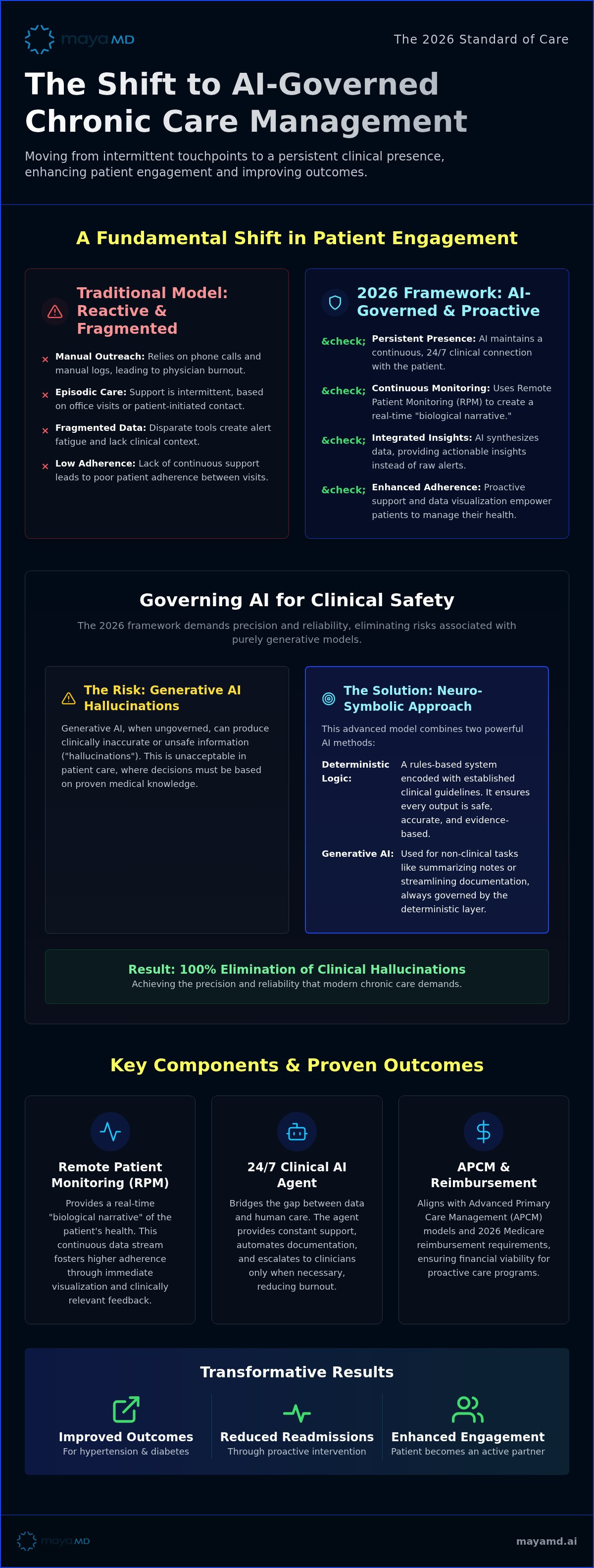
If your patient engagement strategy still relies on manual logs and reactive phone calls, your chronic care program is likely struggling to keep pace with the 2026 standard of care. Most clinical leaders agree that the burden of manual documentation and fragmented data from disparate tools has pushed physician burnout to a breaking point. It's clear that the traditional model fails to provide the continuous support patients need to maintain adherence between office visits. To effectively enhance patient engagement in chronic care, we must shift from intermittent touchpoints to a governed, persistent clinical presence.
This article details how the 2026 Clinical AI Framework leverages deterministic logic and AI-driven remote monitoring to create a seamless bridge between data and human care. You'll learn how this integrated approach eliminates AI hallucinations and streamlines documentation, allowing your team to focus on high-value clinical interventions. We'll examine the specific methodologies that improve outcomes for hypertension and diabetes, reduce hospital readmissions, and transform remote monitoring from a logistical hurdle into a sophisticated, proactive engine for patient health. By moving past the experimental phase into proven application, your organization can finally achieve the precision and reliability that modern chronic care management demands.
Key Takeaways
• Learn how to effectively enhance patient engagement in chronic care by transitioning from reactive, manual outreach to a continuous, AI-governed framework.
• Discover how Remote Patient Monitoring (RPM) provides a real-time biological narrative that fosters higher patient adherence through immediate data visualization.
• Understand the neuro-symbolic approach that combines deterministic logic with generative AI to ensure clinical safety and eliminate the risk of hallucinations.
• Master the integration of AI within Advanced Primary Care Management (APCM) to align with the latest 2026 Medicare reimbursement requirements.
• Evaluate the role of a Clinical AI Agent in providing 24/7 support, bridging the gap between disparate data points and high-quality human care.
The Shift to AI-Governed Patient Engagement in 2026
Patient engagement is no longer a peripheral metric for healthcare satisfaction. In 2026, it represents the core operational framework for successful chronic care management. True engagement in a digital-first environment means moving beyond patient portals and sporadic emails. It requires a system where the patient is an active, informed participant in a continuous care loop. To enhance patient engagement in chronic care, providers must transition from a reactive posture to an AI-governed model that anticipates clinical needs before they escalate into emergencies.
The shift is fundamental. Traditional models relied on patient initiative or manual provider outreach. 2026 models utilize deterministic AI to maintain a persistent clinical presence. This "activation"—the measure of a patient's willingness and ability to manage their health—serves as the primary indicator of long-term stability. As an Authoritative Pioneer in this space, MayaMD understands that technology shouldn't just automate tasks; it must foster a deeper connection through reliable, governed oversight. By prioritizing precision over hype, we ensure that every digital interaction strengthens the therapeutic alliance.
Why Traditional Engagement Models Fail
Manual outreach doesn't scale. In high-density clinical environments like Chicago or Houston, the sheer volume of patients makes manual follow-up impossible without triggering severe physician burnout. When providers are buried under documentation, the quality of patient connection inevitably suffers. Additionally, fragmented data from disparate RPM tools creates "alert fatigue." Patients stop responding when they're bombarded with disconnected notifications that lack clinical context. This gap between documentation and real-time needs is where most traditional programs fail, leading to low adherence and poor clinical outcomes.
The Role of Digital Healthcare for Chronic Disease
Effective digital healthcare for chronic disease replaces episodic office visits with continuous monitoring loops. 2026 standards demand real-time patient-provider connectivity that is both secure and actionable. By integrating physiological data with AI-driven insights, clinicians can observe the "biological narrative" of a patient's life. This constant visibility ensures that interventions are timely, precise, and documented automatically. To enhance patient engagement in chronic care, the technology must act as an invisible but omnipresent support structure that bridges the gap between disparate data points and human care.
Harnessing Remote Patient Monitoring (RPM) for Active Participation
Remote Patient Monitoring (RPM) serves as the primary conduit for the "biological narrative" of the patient, transforming static clinical records into a dynamic history of daily health. When we integrate continuous physiological data with sophisticated oversight, we move beyond the limitations of episodic care. This visibility is essential to evidence-based patient engagement strategies, as it allows both the provider and the patient to observe real-world trends in hypertension and diabetes management. By 2026, the industry has moved toward more flexible monitoring structures, such as the introduction of CPT 99445 which facilitates shorter, more intensive 2-15 day monitoring periods. This shift ensures that data collection remains relevant to acute clinical needs rather than just meeting monthly administrative thresholds.
For urban populations in cities like Phoenix or Houston, where chronic disease prevalence often outpaces clinical capacity, RPM provides a scalable solution for persistent connection. Data without context is merely noise; however, when biometric signals are visualized through a clinical lens, they become a powerful tool for behavior modification. You can explore this evolution further in our analysis of the future of remote patient monitoring software. This technological ambition is tempered by a focus on clinical safety, ensuring that every data point serves the ultimate goal of patient stability.
Automating the Feedback Loop
A Clinical AI Agent acts as the immediate interpreter of incoming RPM data, providing patients with instant feedback that traditionally required a clinician's manual review. This immediacy significantly reduces the time-to-insight for patients in Phoenix and Las Vegas clinics, where rapid intervention can prevent costly emergency department visits. When patients see how their diet or medication adherence directly impacts their readings in real-time, their motivation to follow protocols increases. Remote Patient Monitoring serves as the technical foundation for patient-led self-management. This automated loop ensures that engagement remains high without increasing the documentation burden on the provider.
RPM as a Tool for Principal Care Management (PCM)
Principal Care Management (PCM) focuses on complex, single-specialty chronic conditions that require high-intensity oversight. In Indianapolis, specialist workflows are being streamlined through PCM tools that integrate HIPAA-compliant data transmission directly into the clinical workflow. This level of integration is critical for maintaining regulatory adherence while managing high-stakes conditions like advanced heart failure or stage IV renal disease. By utilizing a governed AI framework, specialists can manage these complex cases with greater precision. It's a strategic way to deploy RPM and PCM programs that prioritize clinical outcomes over administrative complexity, ensuring that the most vulnerable patients receive continuous, expert-level support.
Governing AI: Deterministic Logic vs. Generative Hallucinations
The primary barrier to the widespread adoption of artificial intelligence in clinical settings remains the legitimate fear of generative hallucinations. In high-stakes environments, an AI that fabricates medical advice or misinterprets a physiological trend isn't just a technical glitch; it's a significant clinical risk. To effectively enhance patient engagement in chronic care, the underlying technology must move beyond the "black box" of general-purpose models. We utilize a neuro-symbolic approach that strategically combines the conversational fluidity of generative AI with the unyielding precision of deterministic logic. This governed framework ensures that every digital interaction is rooted in clinical truth rather than statistical probability.
As an Authoritative Pioneer in healthcare technology, MayaMD recognizes that safety is the essential prerequisite for patient adoption and provider trust. Regulatory adherence isn't a secondary consideration; it's the foundation of the entire architecture. By prioritizing rigorous oversight over breathless hype, we provide clinicians with the confidence that their patients are receiving reliable, 24/7 support. This transition from experimental technology to proven application is what defines the 2026 standard for chronic care management.
Ensuring Clinical Validity in AI Interactions
General AI lacks the specialized medical context required for managing complex comorbidities. Clinical AI, however, uses deterministic logic as a structural guardrail to prevent the system from drifting into unverified territory. This logic ensures that if a patient's blood pressure exceeds a specific threshold, the response is dictated by established medical protocols rather than a generative guess. MayaMD eliminates hallucinations through systematic logic frameworks that ensure every AI response adheres to established clinical guidelines. This distinction is vital for healthcare systems in Indianapolis or Las Vegas that require high-stakes reliability for their hypertension and diabetes populations.
Building Trust Through Transparency
Patients are significantly more likely to adhere to protocols when they receive insights that are "explainable" rather than merely directive. When a Clinical AI Agent cites specific data points from a patient's own biological narrative, it creates a sense of personalized care that generic advice cannot match. This transparency transforms the AI from a monitoring tool into a collaborative partner. While the platform operates on a HIPAA-compliant, cloud-based infrastructure, the focus remains on the human impact of the technology. By providing clear, data-driven reasoning, we enhance patient engagement in chronic care and foster a connection that feels both supportive and intellectually rigorous. This logical, cause-and-effect flow is what allows patients to move from passive recipients of care to active participants in their own health journey.
Practical Strategies for APCM and PCM Implementation
Integrating AI into Advanced Primary Care Management (APCM) requires a methodical transition from legacy administrative processes to a governed digital ecosystem. This integration is a strategic alignment with the 2026 Medicare Physician Fee Schedule, which includes a 10% increase in reimbursement across all Chronic Care Management codes. To enhance patient engagement in chronic care, clinics in Chicago, Phoenix, and Houston are utilizing Clinical AI Agents to manage the high-frequency touchpoints required for compliance. By automating data capture for codes like CPT 99457, organizations can capture the layered revenue potential of $200 to $300 per patient per month when CCM and RPM are billed concurrently. This financial sustainability allows for a more robust, patient-centered care model that doesn't compromise on clinical quality.
The deployment process follows a systematic sequence. First, the platform establishes a HIPAA-compliant connectivity bridge between existing EHR systems and remote monitoring devices. Second, deterministic logic frameworks are mapped to specific clinical protocols for conditions like hypertension and diabetes. Finally, the system initiates proactive engagement loops that mirror the provider's own clinical logic. For a deeper technical analysis of these workflows, consult our definitive guide to APCM. This structured approach ensures that the technology serves as a reliable partner in clinical decision-making.
Optimizing Clinical Documentation Workflows
Administrative friction remains the primary driver of physician burnout. In Indianapolis, primary care providers are utilizing AI to capture patient-reported outcomes (PROs) automatically through governed digital interactions. This capability-to-outcome model eliminates the need for manual data entry, which significantly reduces the administrative burden on clinical staff. When documentation is handled by a systematic AI framework, physicians regain valuable face time with their patients. This shift ensures that the clinical record is both comprehensive and real-time, providing a more accurate foundation for medical decision-making without the traditional documentation lag.
Engaging Families and Caregivers
Chronic care management is rarely a solitary journey. AI tools extend the engagement circle by providing family caregivers with governed access to health insights and coordination tools. By centralizing communication within a digital hub, primary care teams and specialists can synchronize their efforts more effectively. This systematic coordination leads to measurable economic benefits, including a reduction in avoidable emergency department visits. Better coordination ensures that caregivers feel supported rather than overwhelmed by the complexities of multi-specialty care. To see how these frameworks apply to your specific clinical environment, explore our AI patient engagement solutions.
The MayaMD Advantage: A Clinical AI Agent for 24/7 Support
MayaMD represents the next evolution in digital health by providing a Clinical AI Agent that functions as a persistent, governed extension of the medical team. Unlike traditional platforms that focus primarily on administrative compliance, this system prioritizes direct patient interaction to enhance patient engagement in chronic care. By maintaining a constant presence, the platform supports post-discharge care and ensures long-term chronic stability for patients with complex needs. This visionary ecosystem integrates Remote Patient Monitoring (RPM), Advanced Primary Care Management (APCM), and Principal Care Management (PCM) into a single, unified interface. For healthcare leaders in Las Vegas, Indianapolis, and beyond, this represents a transition from fragmented data collection to a holistic model of continuous oversight.
The platform acts as a bridge between disparate data points and high-quality human care. It utilizes deterministic logic to ensure that every interaction remains clinically valid and safe, providing a level of reliability that generative-only models cannot match. This capability-to-outcome structure allows providers to scale their services without increasing the documentation burden on staff. By automating the routine aspects of patient education and monitoring, clinicians can focus their expertise on the most critical medical interventions.
Proven Outcomes with AI-Driven Engagement
The synergy between clinical AI and human care teams has yielded measurable improvements in patient adherence. In hypertension management, for example, systematic feedback loops have led to higher rates of medication compliance and more consistent biometric reporting. These proven outcomes demonstrate that patients respond positively to technology that provides "explainable" health insights rather than generic advice. MayaMD serves as the reliable partner for 2026 healthcare challenges by ensuring that engagement is both proactive and clinically grounded. This partnership fosters a deeper sense of security for patients, knowing their health is being monitored by a system that understands their specific biological narrative.
Getting Started with MayaMD
Integrating the Clinical AI Agent into existing EHR workflows is a streamlined process designed for clinical efficiency. The platform’s cloud-based infrastructure ensures scalability for large hospital groups in Phoenix and Chicago, allowing for a standardized approach to chronic care across multiple facilities. This integration minimizes disruption while maximizing the impact on patient-provider connectivity. Ultimately, the human impact is the most significant result of this technology. By restoring the connection between the patient and the care team through reliable, 24/7 support, we can finally achieve the quality of care that chronically ill populations deserve. To learn how to transform your clinical operations, contact us to explore our digital healthcare solutions.
The Evolution of Governed Patient Connection
The 2026 standard for chronic care demands a transition from reactive touchpoints to a persistent, digital-first presence. By utilizing a framework that combines deterministic logic with the biological narrative of RPM, providers can finally achieve the precision required for complex populations. We've seen how this approach doesn't just simplify compliance; it restores the therapeutic alliance by providing patients with explainable, real-time insights. To truly enhance patient engagement in chronic care, the technology must act as a reliable, HIPAA-compliant extension of your clinical expertise.
MayaMD is proud to serve as the authoritative bridge between advanced data science and the daily reality of patient management. Our AI-governed clinical platform provides specialized support for APCM and PCM workflows, helping healthcare leaders in Chicago, Houston, and Phoenix scale their impact. It's time to move past the experimental phase into proven application.
Empower your clinical team with MayaMD's AI-driven RPM and engagement solutions today.
The path toward a more connected, efficient, and empathetic healthcare system is now within reach.
Frequently Asked Questions
How does AI enhance patient engagement in chronic care without losing the human touch?
AI provides a persistent, 24/7 clinical presence that human staff cannot maintain, ensuring patients receive immediate responsiveness for routine inquiries. By automating baseline monitoring and data visualization, the technology filters noise and identifies clinical trends that require human intervention. This capability-to-outcome model preserves the quality of the patient-provider relationship by allowing clinicians to focus their time on high-stakes medical conversations rather than administrative follow-up.
What is the difference between CCM and APCM in terms of patient engagement requirements?
Chronic Care Management (CCM) focuses on the broad coordination of care for patients with multiple chronic conditions. Advanced Primary Care Management (APCM) requires a more intensive, real-time connectivity framework that aligns with the 2026 Medicare Physician Fee Schedule. While both models aim to enhance patient engagement in chronic care, APCM necessitates sophisticated clinical documentation and higher-frequency digital touchpoints to manage multifaceted stability between office visits.
How can Clinical AI agents help reduce physician burnout in chronic care management?
Clinical AI agents automate the collection of patient-reported outcomes and physiological data, significantly reducing the manual documentation burden. By acting as a first-line responder for biometric trends, the system prevents "alert fatigue" and eliminates the documentation lag common in traditional RPM programs. Clinicians in high-volume environments like Chicago or Houston can leverage these agents to maintain oversight without increasing their personal administrative workload.
Is MayaMD's Clinical AI platform HIPAA-compliant and secure for patient monitoring?
Yes, the MayaMD platform utilizes a HIPAA-compliant, cloud-based infrastructure that prioritizes stability and regulatory adherence. The system integrates deterministic logic to ensure that all data transmission and patient interactions are both secure and clinically valid. We operate as an authoritative partner that values long-term security over fleeting trends, providing healthcare leaders with a governed environment for persistent patient monitoring.
What are the common barriers to patient engagement in chronic care, and how does technology solve them?
Common barriers include fragmented data from disparate tools, lack of immediate feedback, and the administrative friction of manual outreach. Technology solves these challenges by creating a continuous monitoring loop that provides patients with a real-time biological narrative. By visualizing how lifestyle choices impact biometric readings, digital platforms increase patient adherence and transform reactive care into a proactive, collaborative process.
Can AI-driven engagement tools be used for patients with low digital literacy?
AI-driven engagement tools are engineered with intuitive interfaces and conversational capabilities that prioritize accessibility over technical complexity. By delivering "explainable" health insights through simple, governed interactions, the technology remains accessible to diverse patient populations. This ensures that the benefits of continuous monitoring are available to all patients, regardless of their familiarity with advanced digital health software.
How does deterministic logic prevent AI hallucinations in clinical documentation?
Deterministic logic acts as a clinical guardrail by grounding the system in established medical protocols and systematic frameworks. Unlike general-purpose generative AI, which may produce statistical guesses, a neuro-symbolic approach ensures that every documented insight is rooted in verified medical logic. This eliminated risk of hallucinations provides a level of precision and clinical validity that is essential for high-stakes chronic care environments.
What role does RPM play in improving adherence for hypertension and diabetes?
Remote Patient Monitoring (RPM) provides the dynamic data necessary for patients to observe the immediate impact of adherence on their health metrics. When patients with hypertension or diabetes see how medication or diet directly influences their readings, their motivation to follow protocols increases. This real-time feedback loop is a fundamental tool to enhance patient engagement in chronic care by fostering a sense of agency and informed self-management.




See The MayaMD Difference
Fill the form below
Download Our Apps
MayaMD for patients and MayaPro for physicians - available on iOS and Android.
FOR PATIENTS
MayaMD App
AI-powered symptom assessment, triage, and secure access to your care team.
FOR PHYSICIANS
MayaPro App
MayaPro brings patient vitals, RPM/PCM care plans, and clinical decision support to your pocket.