
Clinical Workflow Automation: 2026 Chronic Care Guide

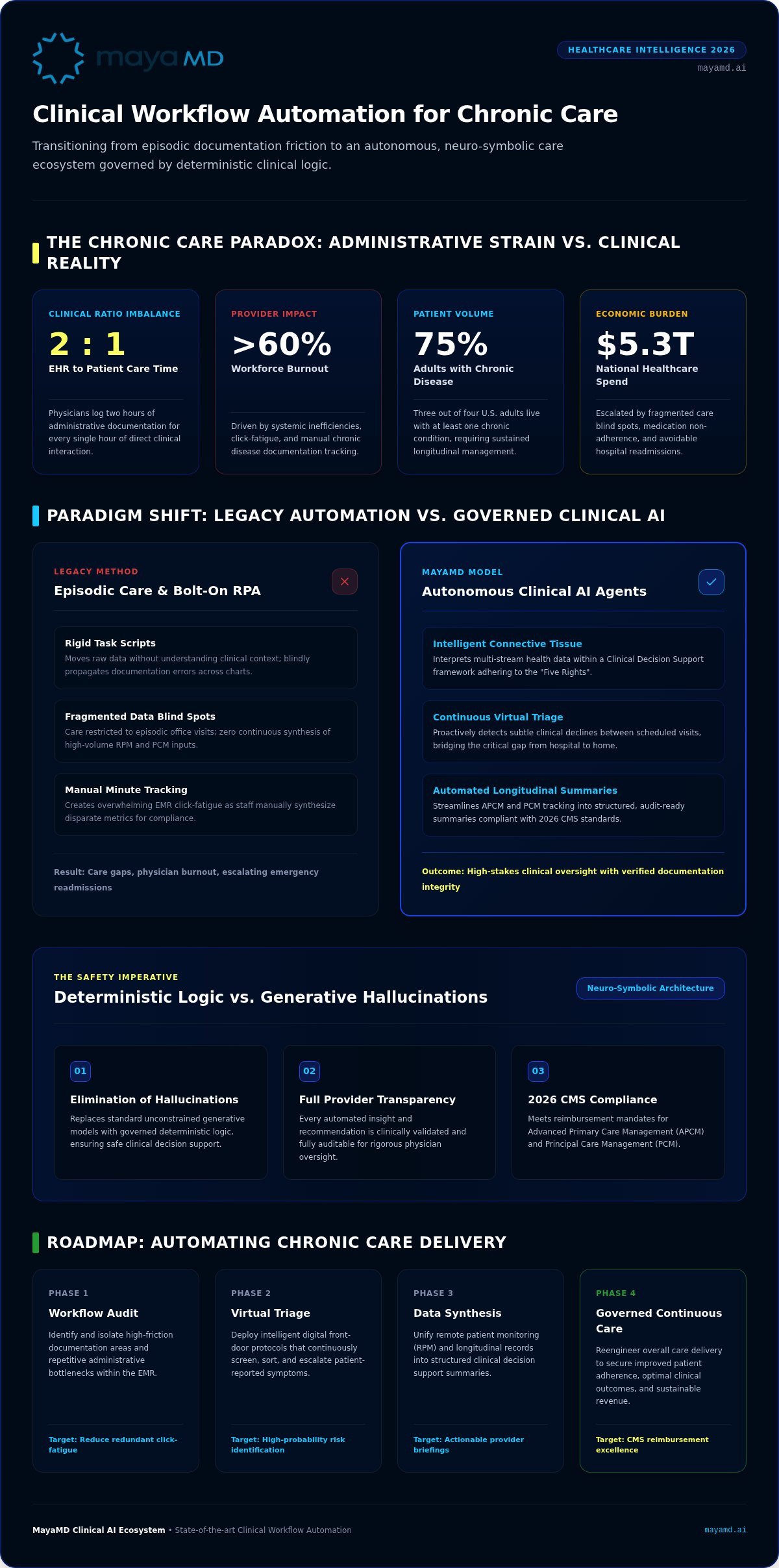
Physicians currently spend two hours on EHR and administrative documentation for every one hour of direct clinical care, a systemic inefficiency that has driven workforce burnout rates over 60 percent. You likely recognize that the promise of digital health often feels like a secondary burden rather than a clinical asset. This guide demonstrates how clinical workflow automation for chronic care utilizes autonomous AI agents and deterministic logic to reverse this trend. By integrating neuro-symbolic architectures, these systems move beyond the unpredictability of general generative models to provide stable, governed support for complex longitudinal management. You'll discover how to transition from tedious minute-tracking to seamless APCM and PCM oversight, leveraging automated documentation that meets rigorous 2026 CMS reimbursement standards. We'll detail the technical frameworks that eliminate AI hallucinations, ensuring that every automated insight remains clinically valid and fully transparent for provider review. This approach fosters a reliable bridge between disparate RPM data points and human care, ultimately improving patient adherence and clinical performance.
Key Takeaways
• Shift from episodic care models to a longitudinal framework to effectively manage the rising administrative complexity of patients with multiple chronic conditions.
• Understand how clinical AI agents act as the intelligent "connective tissue" between fragmented data points, surpassing the limitations of traditional robotic process automation.
• Learn how a "governed AI" architecture utilizes deterministic logic to eliminate generative hallucinations and ensure the safety of clinical decision support.
• Follow a phased implementation roadmap for clinical workflow automation for chronic care that starts with auditing high-friction workflows and deploying virtual triage solutions.
• Discover how integrating a sophisticated clinical AI ecosystem can reengineer care delivery to improve patient adherence and drive sustainable revenue growth.
The Chronic Care Paradox: Why Traditional Clinical Workflows Fail in 2026
Traditional healthcare models were engineered for acute, episodic interventions. In 2026, this architecture has reached a breaking point as the prevalence of multiple chronic conditions (MCC) demands a shift in perspective. Effective clinical workflow automation for chronic care must function as a longitudinal framework rather than a series of disconnected tasks. It requires a system that understands the patient's journey over months and years, not just the minutes spent in an exam room.
With 75 percent of U.S. adults living with at least one chronic condition, the administrative burden of care coordination has become overwhelming. Many practices have attempted to solve this with "bolt-on" Robotic Process Automation (RPA). These tools often fail because they lack clinical context; they merely move data without understanding its significance. True automation in a primary care setting must be intelligent and context-aware, acting as a partner that anticipates needs rather than a script that repeats errors.
The Burden of Longitudinal Documentation
Managing chronic care management involves synthesizing vast, unending streams of data from Remote Patient Monitoring (RPM) and Principal Care Management (PCM). This constant influx creates a profound "click-fatigue" within Electronic Medical Records (EMRs) that drains provider energy. Physicians spend approximately two hours on documentation for every hour of direct care, a ratio that is fundamentally unsustainable for modern practice.
This administrative friction necessitates a transition toward automated clinical documentation to restore the provider's focus to the patient. By automating the synthesis of longitudinal data into actionable summaries, systems can alleviate the manual entry burden. This allows clinicians to maintain high-stakes oversight without being buried under the sheer volume of data generated by continuous monitoring tools.
Fragmented Care vs. Continuous Monitoring
Reactive care models are poorly suited for the proactive requirements of chronic disease. When care is fragmented, significant gaps in patient engagement occur between scheduled office visits. These "blind spots" often lead to missed interventions, medication non-adherence, and avoidable hospitalizations that drive up the $5.3 trillion national healthcare expenditure.
Implementing clinical workflow automation for chronic care bridges these gaps by facilitating "AI-governed continuous care." As explored in our guide on digital healthcare for chronic disease, this model ensures that patient monitoring is persistent and intelligent. It transforms the digital front door into a virtual triage system that identifies high-probability risks before they escalate into emergencies, ensuring the transition from hospital to home is supported by rigorous, automated oversight.
Beyond RPA: The Evolution of Clinical AI Agents in Chronic Care
Legacy automation relied on Robotic Process Automation (RPA), which is essentially a digital script for repetitive tasks. While RPA excels at simple data entry, it lacks the cognitive depth required for longitudinal patient management. In contrast, clinical workflow automation for chronic care has evolved into the use of Clinical AI Agents. These agents don't just move data; they interpret it within a clinical decision support framework to ensure that the "Five Rights" of clinical guidance are met. They act as the connective tissue between fragmented EHR entries, wearable device data, and patient-reported outcomes.
By deploying clinical workflow automation for chronic care, practices can move beyond the limits of rigid scripts to embrace truly autonomous clinical reasoning. This evolution is critical for advanced primary care management. By synthesizing longitudinal chart data, AI agents orchestrate proactive patient check-ins and identify subtle clinical declines that a human reviewer might miss in a crowded inbox. They transform raw information into actionable intelligence, allowing clinicians to manage larger patient panels without sacrificing safety or precision.
Automating Remote Patient Monitoring (RPM)
The influx of physiological data from home-based devices can lead to catastrophic alert fatigue. Clinical AI agents serve as an intelligent filter, analyzing incoming streams to prioritize high-risk interventions while suppressing clinically insignificant noise. Utilizing robust remote patient monitoring solutions has been shown to reduce hospital readmissions by as much as 31 percent. AI agents manage RPM data streams by contextually evaluating physiological trends against established clinical thresholds to eliminate clinically irrelevant notifications.
Principal Care Management (PCM) and Specialist Coordination
Coordinating care for complex chronic conditions often requires intricate communication between primary care providers and multiple specialists. Clinical AI agents streamline this interaction by automating care plan updates and ensuring that all members of the care team have access to the same source of truth. This is especially vital during the transition from hospital to home, where automated post-discharge communication prevents patients from falling through the cracks. These systems facilitate a continuous loop of feedback that keeps care plans dynamic and responsive to real-time changes in patient status. You can speak with our team to learn more about integrating these intelligent agentic workflows.
The Safety Imperative: Deterministic Logic vs. Generative Hallucinations
Physicians often express a valid concern regarding the integration of artificial intelligence: the risk of models fabricating clinical data or offering baseless medical advice. In a high-stakes environment where diagnostic errors contribute to thousands of annual deaths, probabilistic outcomes are insufficient. Clinical workflow automation for chronic care must prioritize safety through a "governed AI" approach. This methodology combines the conversational fluidity of generative models with the rigid, rule-based constraints of deterministic logic. By ensuring that every output is anchored in a physician-engineered knowledge base, we eliminate the threat of medical hallucinations and provide a reliable foundation for clinical decision support.
This governed architecture is not just a technical preference; it's a clinical necessity. When a system manages longitudinal data for complex patients, the margin for error is non-existent. By deploying Clinical AI Agents, healthcare organizations can implement safe, logic-based triage that mirrors the rigor of a human clinical encounter. These agents utilize systematic frameworks to ensure that patient interactions remain within the boundaries of established medical protocols, providing a level of precision that pure generative models cannot achieve.
Neuro-Symbolic AI: The Bridge to Clinical Validity
The core of this safety architecture is Neuro-Symbolic AI. This framework uses symbolic logic to provide "guardrails" for generative responses, ensuring that the AI remains within the boundaries of established clinical protocols. This is critical for clinical AI for chronic care because it allows for natural patient interaction without the risk of unverified advice. Deterministic logic prevents medical hallucinations by restricting the AI's reasoning to a predefined, expert-validated ontology. This hybrid approach ensures that the "agentic" capabilities of the software are always subservient to proven clinical logic.
Compliance and Systematic Frameworks
Security and regulatory adherence form the second pillar of the safety imperative. A HIPAA-compliant, cloud-based architecture is essential to protect the integrity of longitudinal patient data across the care continuum. Systematic frameworks ensure that every automated action is auditable, transparent, and reproducible, meeting the ASTP/ONC HTI-1 Decision Support Interventions (DSI) criterion. This regulation mandates algorithmic transparency, requiring that the underlying clinical basis for any AI-driven recommendation is available to the provider. When clinical workflow automation for chronic care is governed by these rigorous standards, it moves from a source of risk to a source of reliability. This systematic approach builds the necessary trust for clinicians to delegate documentation and triage tasks, ultimately leading to improved patient adherence and superior clinical outcomes.
Strategic Implementation: A Roadmap for Automating Chronic Care Workflows
The transition from theoretical safety to operational excellence requires a methodical approach. Implementation of clinical workflow automation for chronic care is not merely a technical installation; it's a strategic reengineering of the provider-patient relationship. Practices must follow a structured roadmap to ensure that technology serves as a bridge to better care rather than an additional layer of complexity.
Step 1
Audit existing chronic care workflows to identify high-friction points, specifically targeting the administrative tasks that consume two hours for every one hour of clinical care.
Step 2
Integrate AI agents into the digital front door for virtual triage to ensure that high-probability conditions are identified and routed before the clinical encounter begins.
Step 4
Align automation with APCM and PCM reimbursement requirements to ensure that every automated intervention is documented and billable under 2026 CMS guidelines.
Efficiency is not an accident. It's the result of systematic implementation. By following this roadmap, organizations can reclaim lost "pajama time" and refocus their energy on high-stakes clinical decision-making. You can contact our specialists to begin your clinical audit and identify the automation opportunities within your practice.
Optimizing Advanced Primary Care Management (APCM)
The 2026 CMS Final Rule has accelerated the shift toward Advanced Primary Care Management, replacing minute-by-minute tracking with 13 core service elements. This transition allows practices to capture value-based care revenue more effectively, with combined reimbursement opportunities reaching up to $263 per patient per month when Behavioral Health Integration (BHI) add-on codes are utilized. Automating the documentation required for Medicare APCM reimbursement ensures that care teams remain focused on top-of-license activities rather than manual data entry. This alignment between clinical workflow automation and financial sustainability is essential for the modern primary care ecosystem.
Reengineering Hospital-to-Home Transitions
The period immediately following a hospital stay is a high-risk window for chronic care patients. Automating post-discharge education for patients with heart failure or other complex conditions provides a critical safety net during this transition. Research on hospital discharge education delivered by conversational agents demonstrates that these tools can significantly improve patient understanding and adherence. By implementing reengineered discharge workflows, practices have achieved a 31 percent reduction in hospital readmissions, ensuring that the transition from hospital to home is supported by persistent, intelligent oversight.
Reengineering Care Delivery with MayaMD’s Clinical AI Ecosystem
MayaMD operates as a sophisticated partner for organizations seeking to implement clinical workflow automation for chronic care. We've moved past the experimental phase into proven application, a status solidified by our recognition as a finalist for the 2025 Digital Health Hub Foundation Digital Health Awards. Our platform integrates a Clinical AI Agent with RPM and APCM tools to create a unified, HIPAA-compliant ecosystem. This approach prioritizes safety and precision, ensuring that technology serves to foster human connection rather than create digital distance. By automating the exhaustive mechanics of data triage and documentation, we allow clinicians to return to the heart of their practice with calm confidence.
The human impact of this technology is profound. When the administrative burden is lifted, the quality of the provider-patient relationship improves. Our ecosystem acts as a bridge between disparate data points and human care, providing the rigorous oversight necessary for high-stakes clinical environments. This isn't about replacing the clinician; it's about empowering the "Authoritative Pioneer" within every practice to lead with data-driven insights and intellectual empathy.
The Mayared Framework for Clinical Insight
Precision in triage is the first step toward effective longitudinal management. The Mayared framework provides high-probability clinical insights by utilizing deterministic symptom checking to ensure diagnostic accuracy. This technology revolutionizes the digital front door, allowing for virtual triage that is both safe and scalable. By anchoring conversational AI in an 8-year, physician-engineered knowledge base, Mayared provides a stable foundation for clinical decision support. This deterministic logic ensures that every patient interaction remains within the boundaries of established medical protocols, eliminating the unguided variability found in standard generative models.
The Future of AI-Governed Care Coordination
A comprehensive care ecosystem requires more than just data collection; it requires intelligent orchestration. MayaMD provides the governed architecture that ensures every automated action is both auditable and clinically sound. Automated reporting and cost-tracking features improve the ROI for chronic care programs by making the value of every intervention transparent and billable. This systematic approach allows for long-term partnerships built on measurable performance and clinical excellence. We invite you to contact us to streamline your chronic care workflows and experience the impact of a truly integrated, logic-based AI ecosystem.
Advancing the Standard of Longitudinal Care
The transition toward a comprehensive, AI-governed model is no longer a visionary goal but a clinical necessity for sustainable practice. By moving beyond rigid RPA to sophisticated clinical workflow automation for chronic care, providers can finally resolve the tension between administrative demands and direct patient engagement. This evolution is anchored in the use of neuro-symbolic logic, a framework that ensures every automated decision remains grounded in expert-validated medical protocols. As a 2025 Digital Health Hub Foundation Award Finalist, MayaMD provides the HIPAA-compliant infrastructure needed to orchestrate these complex workflows with clinical precision.
You now have the strategic roadmap to integrate these tools, from virtual triage to automated documentation, ensuring that your care team remains focused on high-stakes clinical oversight while capturing maximum value through APCM and PCM reimbursement. The future of chronic disease management relies on this balance of rigorous data science and human empathy. We're ready to help you navigate this transition with calm confidence. Streamline your chronic care workflows with MayaMD's Clinical AI Agent and reclaim the time needed to deliver exceptional care.
Frequently Asked Questions
What is clinical workflow automation for chronic care?
It's a longitudinal framework that uses intelligent agents to manage the continuous needs of patients with long-term conditions. This system moves beyond episodic care by automating data triage, documentation, and patient engagement. By deploying clinical workflow automation for chronic care, practices ensure that their clinical teams focus on high-stakes decision-making while the software handles the exhaustive mechanics of monitoring and coordination.
How does AI reduce the administrative burden of chronic care management?
AI automates the synthesis of longitudinal chart data and generates structured documentation directly within the EMR. By reducing the time spent on manual data entry, clinicians can reclaim up to 40 percent of their documentation time. This shift effectively alleviates the click-fatigue associated with managing complex patient panels and allows for more direct clinical interaction during the limited time available for visits.
Can clinical AI agents be trusted with patient triage?
Yes, provided they utilize a neuro-symbolic architecture that separates deterministic logic from generative language processing. This governed approach ensures that every triage recommendation is anchored in expert-validated clinical protocols. By restricting AI reasoning to a physician-engineered knowledge base, the system provides a stable and reliable digital front door for identifying high-priority conditions without the risk of generative hallucinations.
How does workflow automation improve RPM and PCM outcomes?
Automation facilitates persistent oversight by filtering incoming physiological data and prioritizing high-risk alerts for immediate review. This intelligent triage prevents alert fatigue and ensures that clinical interventions happen before a condition escalates into an emergency. By maintaining a continuous feedback loop between office visits, these systems have been shown to reduce hospital readmissions by 31 percent while improving overall patient adherence.
Is clinical AI automation HIPAA compliant?
MayaMD's clinical AI platform is a fully HIPAA-compliant, cloud-based solution designed specifically for high-stakes healthcare environments. It adheres to rigorous security standards to protect the integrity of longitudinal patient data across the entire care continuum. Every automated action is auditable and transparent, ensuring that providers leverage advanced data science while remaining fully compliant with all federal privacy and safety regulations.
What is the difference between RPA and clinical AI agents?
Traditional RPA follows rigid, task-based scripts to move data, whereas clinical AI agents utilize contextual reasoning to synthesize complex information. While RPA is limited to simple data transfers, an agent can orchestrate proactive patient check-ins and identify subtle clinical declines. This agentic capability allows the system to act as the intelligent connective tissue between disparate data points in a way that static scripts don't.
How does automation support Advanced Primary Care Management (APCM) reimbursement?
Automation ensures that all 13 core service elements required for APCM are documented and time-stamped for audit readiness. By replacing minute-by-minute staff tracking with automated reporting, practices capture value-based care revenue more efficiently. This alignment between clinical workflow automation for chronic care and CMS standards ensures that every intervention is verifiable and billable under the finalized 2026 Physician Fee Schedule.
What happens if an AI agent makes a clinical error?
Governance frameworks like the ASTP/ONC HTI-1 DSI criterion mandate that all AI-driven recommendations remain transparent and explainable to the clinician. The provider always remains the final authority in the clinical decision-making process. By utilizing deterministic logic to restrict the AI's reasoning, the system minimizes the risk of inaccuracy while providing the underlying clinical basis for every insight it presents to the human reviewer.




See The MayaMD Difference
Fill the form below
Download Our Apps
MayaMD for patients and MayaPro for physicians - available on iOS and Android.
FOR PATIENTS
MayaMD App
AI-powered symptom assessment, triage, and secure access to your care team.

FOR PHYSICIANS
MayaPro App
MayaPro brings patient vitals, RPM/PCM care plans, and clinical decision support to your pocket.