
Automated Patient Data Collection: The 2026 Guide to AI-Governed Clinical Intelligence

By 2026, the traditional medical intake form isn't just obsolete; it's a clinical liability. Most healthcare leaders recognize that manual data entry remains the primary catalyst for administrative burnout and fragmented care delivery. You've likely felt the frustration of inconsistent patient reports and the persistent worry that vital information is slipping through the cracks of your current patient-generated health data platform. It's a high-stakes environment where security concerns regarding HIPAA and the risk of AI hallucinations often stall necessary innovation.
This guide demonstrates how advanced Clinical AI agents are transforming patient data collection from a manual burden into a high-fidelity, automated clinical asset. We'll explore how the integration of deterministic logic ensures rigorous accuracy while fostering seamless EHR connectivity. You'll discover the methodology behind achieving higher patient compliance rates and reliable, real-time clinical documentation. We're moving past the experimental phase into a new era of governed intelligence that prioritizes safety, precision, and the human impact of technology. This transition facilitates a more connected healthcare ecosystem where data serves the provider rather than exhausting them.
Key Takeaways
• Transition from manual intake to asynchronous, AI-governed interfaces to mitigate administrative burden and physician burnout.
• Leverage a sophisticated patient-generated health data platform to capture high-fidelity metrics through clinical AI agents using natural language processing.
• Adopt hybrid AI models that prioritize deterministic logic to eliminate hallucinations and maintain strict HIPAA compliance.
• Integrate automated data flows directly into EHR systems to support Advanced Primary Care Management while reducing the documentation tax on staff.
• Future-proof your care delivery by deploying Clinical AI Agents as specialized partners for post-discharge and chronic care management.
The Evolution of Automated Patient Data Collection
Automated patient data collection is defined as the systematic, intelligent gathering of health metrics and patient reports via AI-driven interfaces. This process represents a departure from the antiquated reliance on manual intake, moving instead toward modern, asynchronous digital communication. In the current clinical environment, a patient-generated health data platform must do more than simply host digital versions of paper forms. It must function as a dynamic intelligence layer that captures, validates, and contextualizes information in real time. The shift toward Patient-Generated Health Data (PGHD) as a core clinical requirement reflects a broader necessity for high-fidelity data that traditional episodic care can't provide. By 2026, the standard for excellence is defined by how effectively a system can bridge the gap between the patient’s home environment and the Electronic Health Record (EHR).
From Manual Entry to Clinical AI Agents
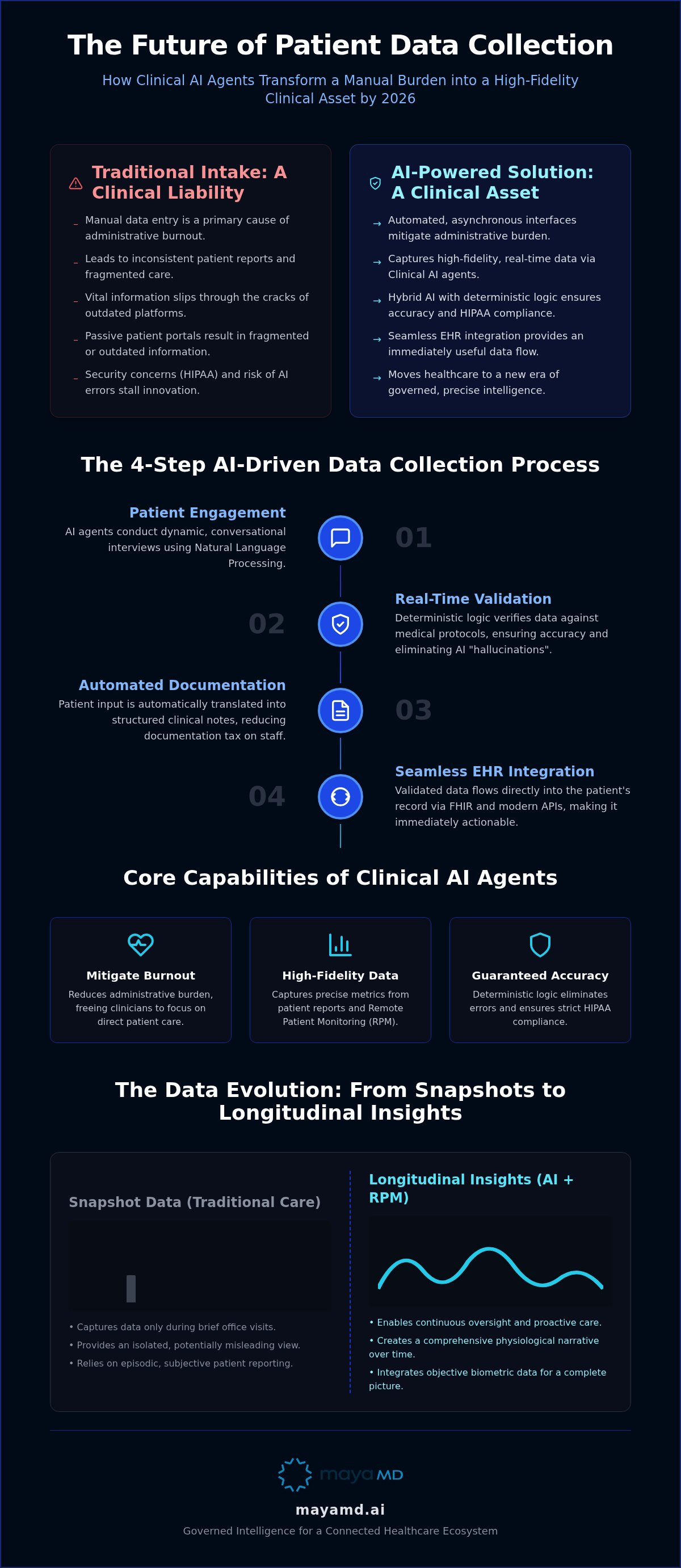
The patient portal has largely failed to meet its potential as a primary data collection point. Most portals are passive repositories that require significant patient initiative and technical literacy, often resulting in fragmented or outdated information. This failure contributes directly to the administrative burden that remains the leading cause of physician burnout. When clinicians are forced to reconcile inconsistent data or manually enter patient updates, their capacity for direct care diminishes. Clinical AI Agents provide a sophisticated alternative by acting as a 24/7 bridge between the patient and the provider. These agents utilize natural language processing to conduct intelligent check-ins, ensuring that a patient's Personal Health Record (PHR) is continuously updated with high-accuracy data. This capability transforms the data collection process from a chore into a seamless, automated clinical asset.
The Role of Remote Patient Monitoring (RPM)
Continuous oversight is essential for managing chronic conditions effectively. Integrating biometric data from wearable devices into the clinical record provides an objective baseline that subjective reporting alone doesn't match. Advanced remote patient monitoring software acts as the engine for this integration, processing vast streams of data into actionable intelligence. This technological framework allows the care team to move from snapshot data, which only captures a patient's state during a brief office visit, to longitudinal patient insights. By utilizing a robust patient-generated health data platform, providers can monitor trends in blood pressure, glucose levels, or heart rate variability over weeks or months. This long-term visibility enables a proactive approach to care, where interventions are based on comprehensive physiological narratives rather than isolated, potentially misleading data points.
How AI-Driven Data Collection Works in 2026
The operational framework of a modern patient-generated health data platform in 2026 relies on a structured, four-step methodology. First, patient engagement occurs through clinical AI agents that utilize natural language processing to conduct dynamic, conversational interviews. Unlike static forms, these agents adapt their inquiries based on patient responses, ensuring the dialogue remains clinically relevant. Second, the system employs deterministic clinical logic frameworks to perform real-time data validation. This ensures that the information collected is not just stored, but verified against established medical protocols. Providers don't need to manually reconcile disparate data points when the system handles the initial verification.
Third, the platform generates automated clinical documentation, translating raw patient input into structured notes for provider review. This significantly reduces the time clinicians spend on manual transcription. Finally, seamless EHR integration is achieved via FHIR and modern API standards, allowing the validated data to flow directly into the patient's record without manual intervention. This cause-and-effect flow ensures that every piece of information collected is immediately useful to the care team.
The Mechanics of Patient Engagement
Asynchronous communication is the cornerstone of improved patient response rates. By allowing patients to provide updates at their convenience, providers eliminate the barriers of traditional phone tag or rigid appointment windows. This flexibility is particularly vital in diverse urban centers like Phoenix and Chicago, where accessibility and varying schedules can often hinder consistent care. A sophisticated patient-generated health data platform personalizes these interactions based on specific chronic conditions, ensuring that a patient with congestive heart failure receives different prompts than one managing diabetes. This level of customization fosters deeper patient investment in their own health outcomes.
Data Validation and Governance
Collecting raw data is insufficient without the appropriate clinical context. A governed approach requires that every data point is scrutinized through a lens of medical validity. For instance, the FDA on AI/ML-enabled devices highlights the necessity for rigorous oversight in how these technologies interpret health metrics. During the collection process, the system automatically flags "red flag" symptoms, such as sudden weight gain or acute respiratory distress, for immediate clinical attention. This proactive governance ensures that sensitive PGHD is handled with strict HIPAA compliance, maintaining data integrity and security at every stage. For organizations looking to modernize their workflows, exploring clinical AI solutions can provide the necessary infrastructure to manage these complex data flows securely.
Accuracy vs. Automation: Solving the AI Hallucination Problem
The pursuit of clinical automation often encounters a critical barrier: the inherent unpredictability of purely generative artificial intelligence. While large language models offer impressive linguistic flexibility, their tendency to "hallucinate" information makes them unsuitable for high-stakes medical documentation. In a clinical setting, an error isn't just a technical glitch; it's a potential risk to patient safety. Accuracy is paramount. A robust patient-generated health data platform must prioritize clinical precision over mere conversational fluidness. This is achieved through a Governed AI model where established clinical protocols always override predictive text. By anchoring the AI in a framework of medical truth, organizations can automate data collection without compromising the integrity of the clinical record.
Generative AI vs. Deterministic Clinical Logic
The distinction between these two approaches is fundamental to care quality. Generative AI excels at engagement but lacks the guardrails necessary for medical validity. Conversely, deterministic logic operates on a systematic basis, adhering to strict, evidence-based medical protocols. The hybrid model represents the most sophisticated application of these technologies. It utilizes the engagement capabilities of AI to foster patient dialogue while relying on deterministic frameworks to validate every data point. This ensures that the role of deterministic logic remains central to the diagnostic process, providing a reliable foundation for provider decision-making. It's a balance of warmth and cold, hard logic.
Ensuring Clinical Validity in Indianapolis and Las Vegas
Healthcare providers in growing medical hubs like Indianapolis and Las Vegas face the challenge of meeting local clinical standards while managing increasingly complex patient populations. These regions require systems that can navigate state-specific healthcare regulations and the nuances of local care delivery models. When a patient-generated health data platform manages complex multi-morbidity data collection, it must reconcile disparate symptoms into a coherent, valid clinical narrative. Neuro-symbolic AI is the specific technical architecture that integrates neural learning with symbolic reasoning to effectively eliminate AI hallucinations. This systematic approach allows for the safe automation of documentation even in the most demanding regulatory environments. To maintain compliance in these settings, EmberHound offers data discovery tools that help identify sensitive information across an organization's digital footprint. It's this commitment to governed intelligence that transforms raw patient input into a reliable clinical asset.
Integrating Automation into Clinical Workflows
Integrating a sophisticated patient-generated health data platform into daily operations requires more than technical compatibility; it demands a fundamental realignment of the clinical workflow. When automated data collection feeds directly into advanced primary care management, the result is a significant reduction in the documentation tax currently burdening physicians and nursing staff. The documentation tax is a quantifiable drain on clinical resources. By 2026, many clinicians spend nearly two hours on administrative tasks for every hour of direct patient care. Automating this burden through a governed intelligence layer allows for the capture of longitudinal insights that are often missed in traditional episodic encounters. By automating the pre-visit intake process, clinics can maximize face-to-face clinical time, ensuring that the provider-patient interaction is focused on care rather than clerical reconciliation. This systematic approach also provides the necessary documentation to support Medicare reimbursement for Remote Patient Monitoring (RPM) and Principal Care Management (PCM), turning data collection into a sustainable revenue driver. It's a cause-and-effect relationship: better data leads to better care and more accurate reimbursement.
EHR Integration and Interoperability
In 2026, the role of Fast Healthcare Interoperability Resources (FHIR) is central to maintaining a cohesive data ecosystem. True interoperability means that a patient-generated health data platform can auto-populate specific clinical fields, thereby minimizing click fatigue for the care team. This seamless flow is particularly critical for large-scale practices in medical hubs like Phoenix and Houston, where high patient volumes demand extreme operational efficiency. When data moves without friction, clinicians can maintain a steady, methodical rhythm throughout their shift. This connectivity serves as a bridge, ensuring that disparate data points are unified into a single, reliable clinical narrative within the EHR.
Workflow Automation Case Study
The implementation of clinical workflow automation solutions has demonstrated a transformative effect on chronic care management. By redirecting clinical staff from manual data entry to high-value patient care, practices see measurable outcomes in reduced burnout and improved patient engagement. These outcomes aren't merely anecdotal. Practices utilizing these automated frameworks report a 30% reduction in time spent on pre-visit preparation, allowing for more comprehensive discussions during the actual appointment. This shift allows the care team to function at the top of their licenses, fostering a deeper connection with the patient population. To see how these technologies can stabilize your practice and optimize performance, consider exploring MayaMD's Clinical AI solutions for automated documentation.
Future-Proofing Care with MayaMD’s Clinical AI Agent
MayaMD stands as the authoritative pioneer for organizations seeking a rigorous transition to AI-governed data collection. The Clinical AI Agent provides unique value by bridging the critical gap between hospital discharge and long-term recovery, ensuring that the transition from acute care to the home environment is monitored with high-stakes reliability. By utilizing a HIPAA-compliant, cloud-based platform, healthcare providers can eliminate the risk of AI hallucinations while maintaining a secure environment for sensitive health information. Transitioning to an automated **patient-generated health data platform** begins with identifying high-impact clinical workflows where manual entry currently creates the most friction. To help pinpoint these areas, you can check out YPrtnrs, which offers a free assessment to identify AI opportunities in your organization. This sober approach to technology prioritizes clinical safety and precision over fleeting trends.
The platform’s modular architecture allows for seamless scaling across diverse healthcare settings. Small primary care clinics can deploy targeted engagement solutions to manage chronic populations, while large health systems utilize the full ecosystem to unify disparate data points across multiple facilities. Specialty care providers benefit from specialized principal care management tools that integrate directly into complex specialist workflows. This adaptability ensures that whether a practice is located in Indianapolis or Chicago, the implementation process is supported by rigorous professional oversight and clinical expertise. The resulting benefit is a systematic framework that evolves alongside the organization’s specific operational needs.
The Next Frontier: Predictive Health Insights
Moving from automated collection to predictive analysis represents the next frontier in clinical intelligence. A robust patient-generated health data platform does more than record medical history; it identifies physiological trends that precede acute events. This capability prepares providers for the shift toward value-based care, where clinical performance is measured by long-term patient outcomes rather than service volume. By integrating deterministic logic with advanced data science, MayaMD enables clinicians to intervene before symptoms escalate into costly emergencies. This proactive stance fosters a deeper sense of connection and support for the patient while stabilizing the provider's workload. It’s time to move past experimental technology into proven, governed application. To experience the stability and precision of this comprehensive ecosystem firsthand, schedule a demonstration of the MayaMD platform today.
Advancing Clinical Intelligence for Sustainable Care
The transition toward governed clinical intelligence is no longer a visionary concept; it's a practical necessity for modern practice stability. By prioritizing accuracy through a deterministic logic architecture, healthcare leaders can finally eliminate the documentation tax while enhancing the quality of care. A high-fidelity patient-generated health data platform ensures that every metric captured is both validated and immediately actionable within the EHR. This systematic approach fosters a deeper connection between providers and their patients, especially within complex frameworks like Advanced Primary Care Management (APCM).
MayaMD offers a secure, HIPAA-compliant cloud platform designed to stabilize clinical workflows and support long-term performance. We've moved past the experimental phase into a reality where technology serves the clinician rather than exhausting them. It's time to move beyond the manual burdens of the past and embrace a future defined by precision and connectivity. Request a Demo of the MayaMD Clinical AI Agent to see how this ecosystem can transform your practice today. We look forward to partnering with you in this new era of clinical excellence.
Frequently Asked Questions
Is automated patient data collection HIPAA compliant?
Yes, automated data collection is fully HIPAA compliant when conducted through a secure, cloud-based framework like MayaMD. The platform utilizes advanced encryption and rigorous access controls to protect sensitive health information during both transmission and storage. This ensures that every data point collected remains private and secure. Providers can trust that their systematic workflows adhere to all federal regulatory standards for data integrity and patient confidentiality, fostering long-term trust and reliability.
How does automated data collection integrate with existing EHR systems?
Integration occurs through modern API standards and Fast Healthcare Interoperability Resources (FHIR) to ensure seamless data flows across systems. A robust patient-generated health data platform auto-populates specific clinical fields within the Electronic Health Record, reducing the need for manual entry. This connectivity allows validated information to move directly from the patient's home to the clinician's interface. It creates a unified clinical record that supports better decision-making without increasing the administrative workload for practitioners.
What is the difference between automated forms and a Clinical AI Agent?
Automated forms are passive, static documents that often result in incomplete or inconsistent data. In contrast, a Clinical AI Agent is a dynamic interface that uses natural language processing to conduct intelligent, conversational interviews. It adapts its questions based on patient responses to ensure clinical relevance. This active engagement model captures higher-fidelity data and provides a more supportive experience for patients managing complex chronic conditions between scheduled office visits.
Can automated data collection reduce physician burnout?
Automated data collection significantly reduces physician burnout by eliminating the documentation tax associated with manual data entry. By capturing and validating patient reports before the appointment, the system allows clinicians to focus on direct patient care rather than clerical reconciliation. This shift in workflow helps restore the professional satisfaction of medical practice. It enables providers to function at the top of their licenses while maintaining a steady, manageable clinical rhythm.
How does MayaMD prevent AI hallucinations in patient data?
MayaMD prevents hallucinations by utilizing a hybrid deterministic logic architecture rather than relying solely on generative artificial intelligence. This Governed AI model ensures that established clinical protocols always override predictive text, maintaining strict medical validity at all times. Every piece of information is verified against a framework of evidence-based logic before it enters the clinical record. This rigorous oversight ensures that the data remains accurate, reliable, and safe for use in diagnostic planning.
What types of chronic conditions benefit most from automated monitoring?
Conditions requiring continuous oversight, such as congestive heart failure, diabetes, and COPD, benefit most from these tools. The platform facilitates Remote Patient Monitoring (RPM) and Chronic Care Management (CCM) by tracking physiological trends over time. This longitudinal visibility allows providers in cities like Las Vegas and Indianapolis to intervene before symptoms escalate. It provides a comprehensive narrative of the patient's health that episodic visits simply cannot capture, leading to improved clinical outcomes.
How do patients in cities like Houston or Chicago access these AI tools?
Patients in major hubs like Houston, Chicago, and Phoenix access these tools via user-friendly, asynchronous digital interfaces provided by their healthcare organizations. These solutions are designed for accessibility across diverse demographics, ensuring that patients can provide updates at their convenience. By utilizing a patient-generated health data platform, providers in these urban centers can maintain constant connectivity with their patient populations. This improves engagement and ensures that busy schedules don't hinder the delivery of care.
What are the reimbursement opportunities for automated data collection in 2026?
In 2026, Medicare continues to offer robust reimbursement opportunities through codes for Remote Patient Monitoring (RPM) and Advanced Primary Care Management (APCM). Automated systems provide the systematic documentation required to justify these claims, ensuring that practices are fairly compensated for continuous oversight. By integrating automated collection into their workflows, providers can turn data gathering into a sustainable revenue stream. This financial stability supports the long-term delivery of high-quality, value-based healthcare services.




See The MayaMD Difference
Fill the form below
Download Our Apps
MayaMD for patients and MayaPro for physicians - available on iOS and Android.
FOR PATIENTS
MayaMD App
AI-powered symptom assessment, triage, and secure access to your care team.

FOR PHYSICIANS
MayaPro App
MayaPro brings patient vitals, RPM/PCM care plans, and clinical decision support to your pocket.