
AI RPM for Hospital Readmission Reduction: A 2026 Clinical Strategy

What if the key to breaking the cycle of 30-day readmissions isn't more clinical staff, but a more disciplined form of intelligence? Most health systems recognize that the period following discharge remains a precarious gap where patient safety often falters due to fragmented data and delayed intervention. You're likely already feeling the strain of mounting CMS penalties and a workforce exhausted by the relentless noise of traditional monitoring systems. Implementing AI RPM for hospital readmission reduction offers a path forward that moves beyond passive data collection toward active clinical governance.
This clinical strategy explores how a Clinical AI Agent, governed by deterministic logic, transforms Remote Patient Monitoring from a source of alert fatigue into a precise tool for clinical oversight. You'll discover how closing care gaps with hallucination-free technology ensures that post-discharge protocols are followed with absolute rigor. We'll examine the architectural shift toward integrated, automated post-discharge solutions and how these systems function within 2026 workflows to ensure patient stability. By bridging the distance between the hospital and the home, providers can finally achieve the measurable performance and safety required in a high-stakes value-based environment.
Key Takeaways
• Analyze the 2026 financial implications of HRRP penalties and identify specific care gaps where traditional, passive monitoring fails to prevent avoidable readmissions.
• Understand how anchoring generative AI in deterministic logic provides the necessary clinical guardrails to eliminate hallucinations and ensure patient safety.
• Implement AI RPM for hospital readmission reduction to transition from reactive data dashboards to a proactive, agent-led model that drives meaningful clinical intervention.
• Optimize APCM and PCM workflows by integrating a Clinical AI Agent to manage high-risk cohorts through automated, HIPAA-compliant post-discharge communication.
• Scale clinical oversight without increasing staff burnout by utilizing a governed AI framework that maintains high-stakes reliability across the entire continuum of care.
The Crisis of 30-Day Readmissions and the Limits of Traditional Monitoring
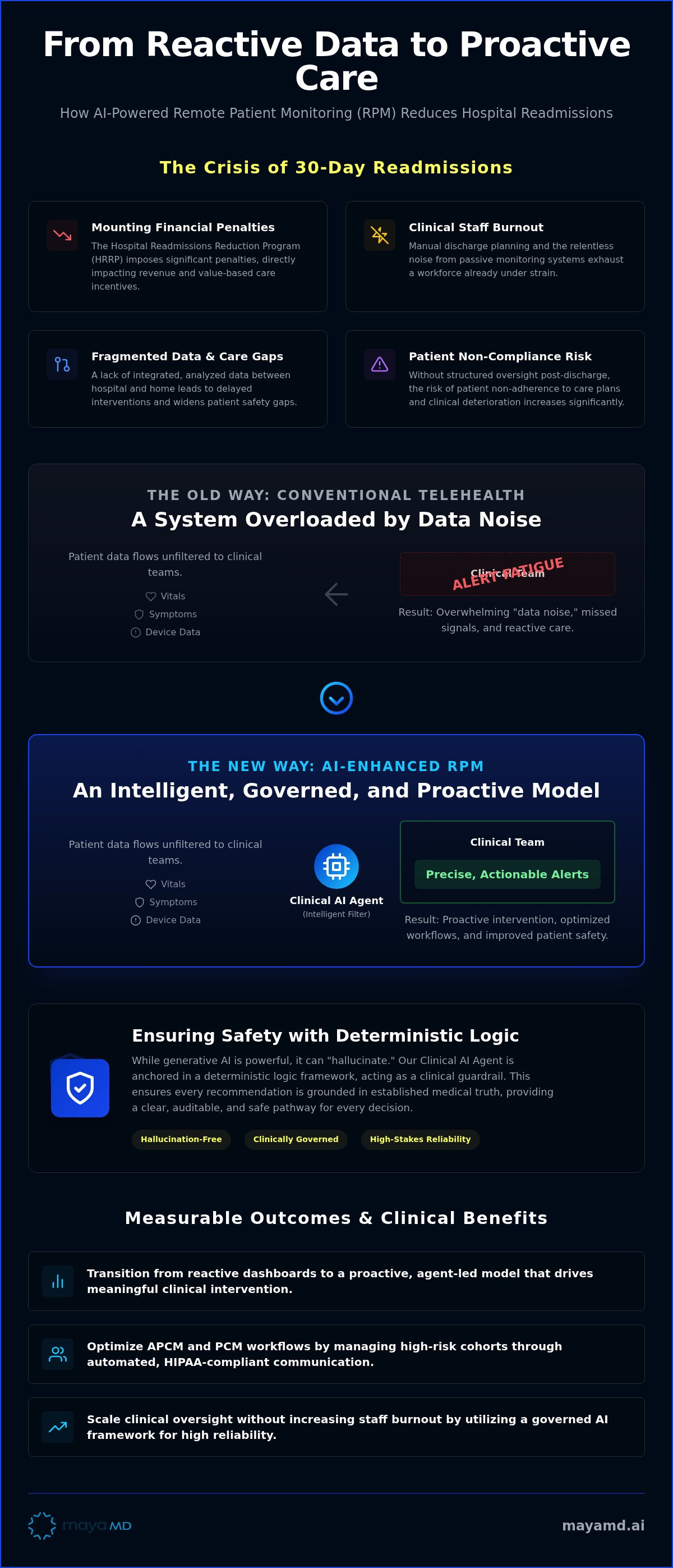
In 2026, the Hospital Readmissions Reduction Program (HRRP) remains a central pillar of healthcare regulation, imposing rigorous financial penalties on systems that fail to stabilize patients post-discharge. These penalties represent a direct hit to the bottom line, yet many organizations still struggle with the transition from acute to home-based care. Implementing AI RPM for hospital readmission reduction is no longer optional; it's a clinical necessity. The fundamental issue isn't a lack of data, but rather the "passive" nature of traditional monitoring. When systems merely collect data without analyzing it against clinical protocols, care gaps widen. This delay in identifying early warning signs leads to emergency department visits that could have been prevented with more proactive oversight.
The Economic Burden of Post-Discharge Care Gaps
Why Conventional Telehealth Falls Short
Conventional telehealth models, while a step forward, often prove insufficient for high-acuity post-discharge management. Relying on basic video check-ins or simple Bluetooth device syncing frequently results in "data noise." This phenomenon occurs when clinical teams are inundated with thousands of non-critical data points, making it nearly impossible to distinguish a minor fluctuation from a life-threatening trend. Standard dashboards are overwhelming. Data alone isn't enough. The primary bottleneck is the human inability to process this volume of information without error. AI RPM for hospital readmission reduction addresses this by introducing a Clinical AI Agent that serves as an intelligent, governed filter. By utilizing deterministic logic to analyze incoming vitals, the system ensures that clinicians only receive alerts that require immediate intervention. This transition from passive monitoring to active governance is the necessary evolution for any health system prioritizing clinical safety and operational efficiency.
Beyond Data Collection: How Deterministic AI Governs Post-Discharge Care
Effective AI RPM for hospital readmission reduction requires more than a steady stream of vital signs. It demands a system that can interpret those signs with the same clinical rigor as a human provider. While generative AI offers impressive conversational capabilities, its tendency toward "hallucinations" makes it inherently risky for high-stakes medical applications. MayaMD solves this by anchoring generative models within a deterministic logic framework. This ensures every response and recommendation is grounded in established medical truth rather than probabilistic guesswork. By moving beyond simple data collection, health systems can implement a truly governed model of digital care.
The Role of Deterministic Logic in Patient Safety
Ensuring patient safety in a digital environment requires transparency and predictability. Unlike "black box" algorithms that produce results through opaque processes, deterministic logic in clinical ai provides a clear, auditable pathway for every decision made. This framework acts as a set of clinical guardrails, preventing the AI from straying into unverified medical territory or providing unsafe advice. For complex chronic care management, these agents handle the heavy lifting of clinical documentation automatically. They capture patient interactions, categorize symptoms against standardized medical taxonomies, and update EHR records without human intervention. This maintains a high-stakes level of HIPAA-compliant oversight while freeing staff from the burden of manual data entry.
Automating Post-Discharge Communication
Post-discharge success often hinges on the first 72 hours at home. In major metropolitan hubs like Las Vegas and Phoenix, Clinical AI Agents are already managing these critical follow-up windows with precision. These agents don't just send static reminders; they engage in sophisticated, automated post-discharge communication that adapts to the patient's real-time RPM data. If a patient’s blood pressure spikes, the agent initiates a targeted dialogue to assess symptoms, medication adherence, and potential environmental factors. Deterministic AI transforms raw physiological data into actionable clinical insights, ensuring no red flag goes unnoticed. This level of responsiveness builds trust between the patient and the care team, even when they aren't in the same physical space.
This systematic approach allows health systems to scale their reach without diluting the quality of care. By automating the routine, providers can focus their expertise on the most complex cases. If you're ready to move beyond basic monitoring, exploring a Clinical AI Agent can provide the necessary bridge between hospital discharge and long-term stability.
Comparing AI-Enhanced RPM vs. Conventional Telehealth Models
Standard telehealth models are often criticized for being passive repositories of data. In these legacy systems, a clinician must manually review a dashboard, identify an anomaly, and then attempt to contact the patient. This workflow creates a significant "Time-to-Intervention" lag that can be the difference between a minor medication adjustment and a full clinical relapse. In contrast, AI RPM for hospital readmission reduction utilizes a Clinical AI Agent to perform immediate, automated triage. Instead of waiting for a human review, the system executes pre-defined clinical protocols the moment a physiological threshold is breached. This ensures that the transition from data collection to clinical action is instantaneous and governed by deterministic logic.
Scalability and Resource Allocation
In 2026, health systems in cities like Indianapolis are shifting from reactive monitoring to proactive care management. Conventional telehealth models are fundamentally limited by the number of screens a single coordinator can monitor. By deploying an AI-governed framework, one nurse can effectively manage 5x more patients than with manual dashboards. This doesn't replace the clinician; it amplifies their reach. The AI handles the vast majority of non-critical data points, allowing the human provider to focus exclusively on high-acuity interventions. This shift significantly lowers the cost-per-patient while maintaining rigorous clinical documentation and safety standards across populations of 10,000 or more.
Patient Adherence and Engagement
Patient engagement is the cornerstone of successful post-discharge recovery. Traditional models often suffer from low adherence because the patient feels isolated between appointments. Modern digital healthcare for chronic disease uses AI to personalize reminders and check-ins based on the patient's unique behavioral patterns. Having a 24/7 Clinical AI Agent available to answer questions provides a psychological safety net that standard portals cannot match. This continuous support effectively reduces "ER-anxiety," where patients rush to the emergency room for non-emergencies simply because they lack immediate guidance. By providing governed, real-time feedback, AI RPM for hospital readmission reduction fosters a deeper sense of patient-provider connection and ensures patients remain compliant with their recovery plans.
Strategic Implementation: Integrating AI RPM into APCM and PCM Workflows
Integrating AI RPM for hospital readmission reduction into existing clinical workflows requires a disciplined shift in how health systems allocate their most valuable resource: clinician time. Identifying high-risk patient cohorts, particularly those managing congestive heart failure or advanced respiratory conditions, ensures that monitoring efforts are targeted where they provide the highest clinical utility. The data flow between the hospital EHR and the Clinical AI platform must be seamless. This allows for real-time risk stratification immediately upon discharge, bridging the gap between acute care and the home environment. By establishing these technical links early, providers ensure that the patient's transition is governed by data rather than chance.
Aligning with 2026 APCM and PCM Standards
To maximize the financial and clinical sustainability of these programs, health systems must align their activities with advanced primary care management (APCM) billing codes. Utilizing specialized principal care management tools allows specialists to coordinate care with primary providers while ensuring all monitoring minutes are accurately captured for reimbursement. In 2026, the Clinical AI Agent handles the complex task of automated CPT code documentation for codes such as 99453, 99454, and 99457. This level of precision is vital for HIPAA-compliant data transmission across localized Chicago and Houston networks, where regulatory oversight remains a top priority for Chief Medical Officers.
Workflow Automation and EHR Integration
Clinical staff training should pivot away from the drudgery of manual data entry and toward sophisticated alert management. By implementing clinical workflow automation solutions, organizations can drastically reduce the "clicks-to-care" ratio that often hampers efficiency. Bi-directional data syncing keeps the primary care physician informed in real-time, creating a unified record of the patient's recovery journey. Integration of AI RPM into APCM workflows ensures that the continuum of care is never broken by administrative friction. This systematic approach allows for a feedback loop where care plans are continuously optimized based on real-world physiological data and patient responses.
Establishing these workflows is the final step in moving from a pilot program to an enterprise-wide standard of excellence. If your organization is ready to modernize its post-discharge strategy, you can explore how MayaMD facilitates these integrations to drive measurable performance and long-term patient stability.
Scaling Clinical Excellence with MayaMD’s Clinical AI Agent
MayaMD serves as the anchor for health systems that prioritize clinical safety over technological hype. By implementing AI RPM for hospital readmission reduction, organizations move beyond the experimental phase into a proven application of governed technology. This transition fosters a profound sense of patient-provider trust. Patients feel supported by a continuous, reliable presence, while clinicians operate with the confidence that their oversight is backed by rigorous data science. Precision matters. Safety is non-negotiable. Our platform ensures that the human impact of technology remains the central focus of every clinical intervention. To further ensure a secure environment for patients at home, families can check out The Wellbeing App for comprehensive safety monitoring.
The Hallucination-Free Guarantee
High-liability hospital settings cannot afford the unpredictability of standard generative models. MayaMD utilizes deterministic logic to eliminate hallucinations, ensuring that every patient interaction follows a validated clinical pathway. This is particularly critical when managing complex chronic conditions where a single erroneous suggestion could lead to adverse outcomes. The Clinical AI Agent acts as a permanent bridge between the intensive environment of hospital discharge and the long-term goal of patient wellness. For patients requiring dedicated human support for behavioral health during this phase, it is useful to explore Hourly or Retainer-Based Private Recovery Coaching and Case Management Fees to ensure comprehensive care. It provides the stability required to maintain safety across the entire care continuum, regardless of the patient's location.
Future-Proofing Your Health System
As we look toward the regulatory shifts anticipated in 2027, health systems in Houston, Phoenix, and Chicago must adopt scalable solutions that exceed current compliance standards. Preparing for these changes requires a partner that understands the nuances of clinical workflows and the cold, hard logic of advanced data science. MayaMD offers a reliable framework that integrates seamlessly into existing infrastructures, allowing for rapid expansion across large health networks. Leaders in Las Vegas, Indianapolis, and beyond are invited to pioneer this shift toward AI-governed care. It's time to move past passive monitoring and embrace active clinical governance.
The path to lowering readmission rates and reducing staff burnout is clear. It requires a commitment to precision and a move away from fragmented, noisy data tools. Organizations ready to evaluate these outcomes can initiate a clinical pilot or schedule a platform demonstration to see the Clinical AI Agent in action. Experience the future of governed clinical AI with MayaMD and secure your system's place at the forefront of clinical excellence.
Securing the Future of Post-Discharge Stability
The transition to a governed clinical model is no longer a visionary goal; it's a necessary evolution for health systems facing the complexities of 2026. By anchoring generative capabilities in deterministic logic, organizations can finally eliminate the risk of hallucinations and ensure every patient interaction adheres to rigorous safety standards. This shift from passive data collection to active intervention allows providers to close precarious care gaps while simultaneously automating advanced APCM and PCM documentation. It's a strategic move that replaces clinical noise with actionable, high-stakes reliability.
Major health networks across Chicago, Las Vegas, and Houston are already utilizing these frameworks to stabilize high-risk populations and protect their bottom line from HRRP penalties. Implementing AI RPM for hospital readmission reduction provides the precise oversight required to scale clinical excellence without exhausting your workforce. It's about moving toward a future where technology fosters deeper connectivity and measurable performance through systematic frameworks. This approach ensures that the quality of care remains consistent from the hospital bed to the patient's home.
Take the next step in future-proofing your clinical strategy. We invite you to request a clinical demonstration of MayaMD’s governed AI platform to see how deterministic logic can transform your post-discharge outcomes. Your path to enhanced patient safety and operational precision starts with a partner that values clinical truth.
Frequently Asked Questions
How does AI RPM specifically reduce 30-day hospital readmissions?
AI RPM for hospital readmission reduction functions by providing continuous clinical oversight during the high-risk period following discharge. Unlike traditional monitoring that relies on manual dashboard reviews, MayaMD’s Clinical AI Agent uses deterministic logic to identify early physiological shifts. In cities like Chicago, this proactive approach allows care teams to intervene before a patient’s condition requires an emergency department visit. It ensures that the recovery process remains stable and aligned with the original discharge plan.
Is MayaMD’s Clinical AI Agent HIPAA compliant?
Yes, the platform is built on a HIPAA-compliant cloud infrastructure that prioritizes patient data security and regulatory adherence. In 2026, maintaining the integrity of protected health information is paramount for health networks in Las Vegas and Phoenix. MayaMD ensures that all interactions with the Clinical AI Agent are encrypted and stored according to federal standards. This provides Chief Medical Officers with the peace of mind that their digital care strategies meet all necessary compliance frameworks.
Can AI RPM integrate with my hospital’s existing Epic or Cerner EHR?
MayaMD is designed for seamless bi-directional integration with major EHR systems, including Epic and Cerner. This connectivity allows patient data to flow directly from the hospital record into the AI-governed monitoring platform. By reducing the click-to-care ratio for clinicians in Houston, the system ensures that primary care physicians receive real-time updates without leaving their primary workflow. This integration's essential for maintaining a unified and accurate longitudinal patient record across the entire continuum of care.
What is the difference between generative AI and deterministic logic in healthcare?
Generative AI focuses on creating conversational responses based on probabilistic patterns, which can lead to hallucinations in a clinical setting. Deterministic logic follows rigid medical protocols to ensure accuracy and safety. MayaMD integrates these two approaches to provide a hallucination-free experience. This neuro-symbolic framework allows the Clinical AI Agent to engage patients in Indianapolis naturally while ensuring every piece of medical information is anchored in established clinical truth and systematic logic.
How much can a hospital save by implementing AI-governed RPM?
Health systems protect significant revenue by avoiding the direct financial penalties associated with the CMS Hospital Readmissions Reduction Program. Beyond penalty avoidance, the automation of post-discharge communication reduces the labor costs associated with manual outreach. In high-density markets like Phoenix, the ability for a single coordinator to manage five times more patients creates substantial operational efficiency. These savings allow organizations to reinvest in higher-acuity care while maintaining a robust safety net for chronic disease management.
Does the patient need a smartphone or technical expertise to use MayaMD?
The system's engineered for accessibility, requiring minimal technical expertise from the patient. While the Clinical AI Agent's accessed via common digital interfaces, the focus remains on a user-friendly experience that mirrors a natural conversation. This is particularly important for elderly populations in Las Vegas who may be managing multiple chronic conditions. By lowering the technical barrier to entry, MayaMD ensures high engagement rates and consistent adherence to post-discharge protocols across diverse patient demographics.
Which CMS CPT codes cover AI RPM and APCM in 2026?
In 2026, clinicians utilize a variety of CPT codes to support AI RPM for hospital readmission reduction, including 99453 for initial setup and 99454 for device supply. Additionally, codes 99457 and 99458 cover the clinical time spent on monitoring and intervention. The platform also automates the documentation required for Advanced Primary Care Management (APCM) and Principal Care Management (PCM). This ensures that health networks in Chicago can accurately capture every minute of billable clinical oversight.
What happens if the AI identifies a critical patient emergency?
When the AI identifies a critical physiological trend or a patient reports severe symptoms, the system initiates an immediate triage protocol. The Clinical AI Agent alerts the designated clinical team in real-time, providing the necessary data for an urgent intervention. In Indianapolis, this ensures that high-risk events are escalated to a human provider without delay. The system acts as a governed safety net, ensuring that no life-threatening red flag is lost in the noise of routine data collection.




See The MayaMD Difference
Fill the form below
Download Our Apps
MayaMD for patients and MayaPro for physicians - available on iOS and Android.
FOR PATIENTS
MayaMD App
AI-powered symptom assessment, triage, and secure access to your care team.

FOR PHYSICIANS
MayaPro App
MayaPro brings patient vitals, RPM/PCM care plans, and clinical decision support to your pocket.