
AI for Principal Care Management: Navigating Governed Clinical Intelligence in 2026

The promise of clinical automation often collapses when faced with the high-stakes reality of a specialist's workflow. While the potential for AI for principal care management is vast, the fear of algorithmic hallucinations and regulatory non-compliance keeps many providers tethered to manual, exhaustive documentation. You understand that managing complex chronic conditions requires more than just a digital assistant; it demands a system that respects the nuance of specialist expertise and the rigorous oversight required in modern medicine.
This article details how governed clinical intelligence provides a secure bridge between advanced data science and the daily reality of patient management. You'll discover how a Clinical AI Agent utilizes deterministic logic to automate documentation and streamline CMS reimbursement without compromising clinical safety. We'll examine the specific frameworks that allow practices in Indianapolis, Houston, Phoenix, and Las Vegas to scale their PCM enrollment while significantly improving patient outcomes. By the end of this guide, you'll see how integrating sophisticated AI tools into your practice doesn't just save time; it restores the human connection at the heart of specialized care.
Key Takeaways
• Understand the evolution of specialist-led care as 2026 marks a transition toward sophisticated, AI-governed models for high-risk chronic conditions.
• Discover how neuro-symbolic AI utilizes deterministic logic to provide clinical governance, ensuring HIPAA-compliant documentation without the risk of hallucinations.
• Learn how implementing AI for principal care management streamlines specialist workflows, resulting in enhanced revenue cycle management through automated CMS billing codes.
• Identify actionable steps for clinical workflow integration, beginning with high-risk patient panel assessments and concluding with seamless EMR connectivity.
• Explore the role of a Clinical AI Agent in fostering continuous patient-specialist connectivity while significantly reducing manual documentation burdens.
The Evolution of AI for Principal Care Management (PCM) in 2026
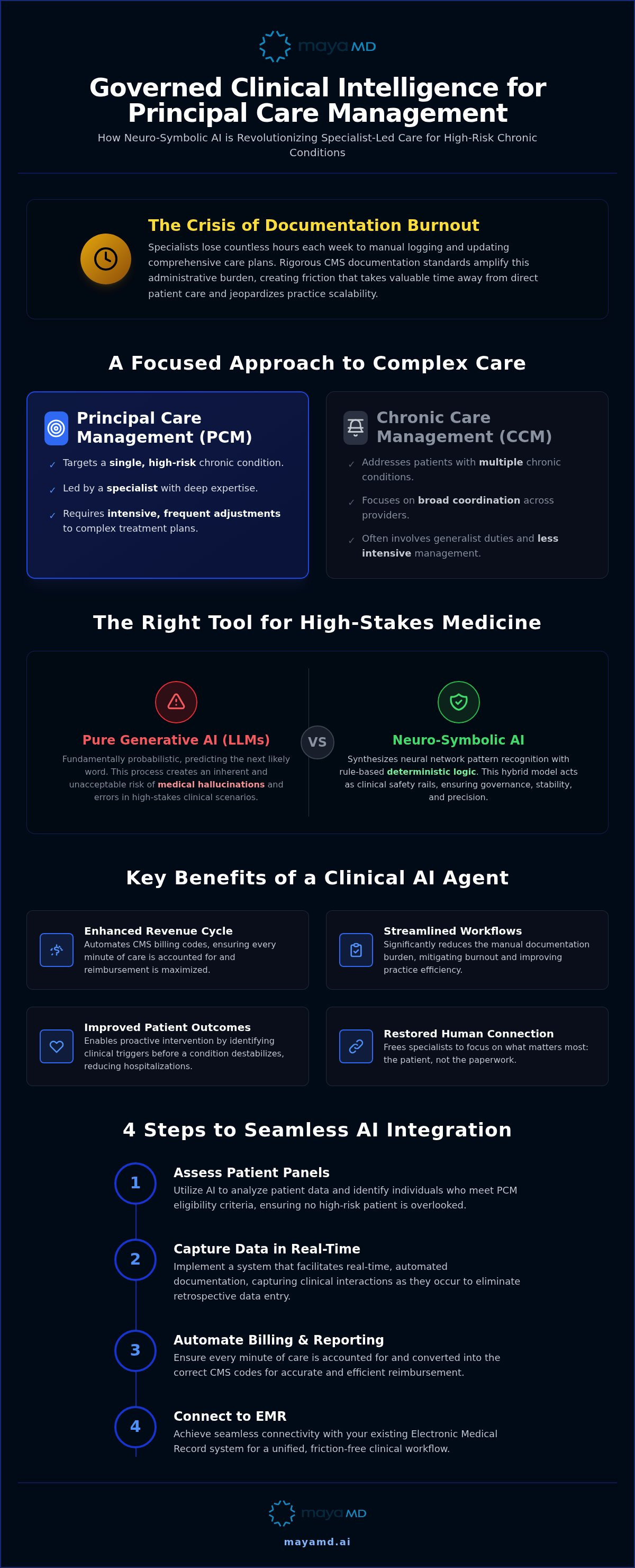
Principal Care Management (PCM) represents a specialized tier of clinical oversight dedicated to patients grappling with a single, high-risk chronic condition. Unlike historical models such as Primary Care Case Management (PCCM), which often focused on broad coordination, PCM places the specialist at the center of the care continuum. By 2026, the healthcare sector has moved decisively toward AI-governed models to manage these complex cases. The industry has matured beyond experimental pilot programs into proven, governed applications that prioritize safety and precision. This transition is a direct response to the increasingly rigorous documentation standards mandated by CMS. Specialists in high-volume hubs like Houston and Chicago face an unsustainable administrative burden that threatens the quality of specialized care. Integrating AI for principal care management has become a clinical necessity to bridge the gap between specialist expertise and regulatory adherence.
Why Specialists are Prioritizing PCM over CCM
While Chronic Care Management (CCM) addresses patients with multiple conditions, PCM is tailored for the intensive management of one specific, complex ailment. This single-condition focus allows specialists to apply deep expertise without the dilution of generalist duties. The intensity of care required for PCM patients is significantly higher; it often involves frequent adjustments to complex treatment regimens, a challenge often managed by specialized centers like Sunridge Medical. AI for principal care management serves as a critical diagnostic layer here. It analyzes patient panels to identify individuals whose clinical profiles meet PCM eligibility criteria, ensuring that high-risk patients don't slip through the cracks of a busy practice. By identifying specific physiological triggers and data patterns, AI enables the specialist to intervene before a condition destabilizes, leading to improved long-term patient stability and reduced hospitalizations.
Specialists often lose hours each week to manual PCM logging and the constant updating of comprehensive care plans. These administrative tasks create friction points in patient engagement. Clinicians frequently spend more time with digital charts than with the patients themselves. Traditional engagement methods rely on retrospective data entry, which is prone to errors and omissions. This isn't about replacing the physician's judgment but rather providing a stable framework that supports it through deterministic logic and advanced data science. AI mitigates these friction points by facilitating real-time documentation that captures clinical interactions as they occur. This systematic approach ensures every minute of care is accounted for, meeting CMS requirements while returning valuable time to the physician.
Neuro-Symbolic AI: The Standard for Clinical Governance
Governance. Stability. Precision. These are the pillars of clinical intelligence in 2026. While general artificial intelligence has captured public attention, its application in high-risk medical scenarios requires a more rigorous framework. Neuro-symbolic AI represents the synthesis of neural networks’ pattern recognition and symbolic logic’s rule-based reasoning. This dual-layered approach is the foundation of the Clinical AI Agent for primary care and specialized medicine alike. By embedding deterministic logic into generative models, we create a system that understands medical nuance without sacrificing clinical validity. For specialists in Indianapolis and Phoenix, it's clear that AI for principal care management is no longer an experimental risk but a stable operational standard.
Deterministic Logic vs. Pure Generative Models
Pure Large Language Models (LLMs) are fundamentally probabilistic. They predict the next likely word in a sequence, a process that inherently allows for medical hallucinations. In the context of high-risk Principal Care Management, where a single error in medication reconciliation or symptom tracking can lead to adverse outcomes, probabilistic outputs are insufficient. Deterministic logic serves as clinical safety rails. It forces the AI to adhere to established medical protocols and peer-reviewed logic. Research into AI-Driven Clinical Decision Support Systems confirms that hybrid models significantly reduce error rates compared to pure generative systems. MayaMD’s approach prioritizes this deterministic layer, ensuring that every clinical note and care plan update is grounded in verified medical truth. This methodology transforms a volatile technology into a structured asset for complex chronic care.
Ensuring HIPAA Compliance in AI-Driven Care
Security in 2026 requires more than simple password protection. As cloud-based AI becomes ubiquitous, the standards for HIPAA compliance have evolved to demand end-to-end encryption and rigorous data sovereignty. AI for principal care management tools must process vast amounts of Protected Health Information (PHI) across disparate networks. The shift toward digital healthcare for chronic disease highlights the necessity of a "privacy-by-design" architecture. This means data is anonymized at the edge before reaching the central processing unit, maintaining patient privacy while allowing the AI to generate actionable insights. Practices that adopt these governed frameworks protect their patients and their reputation simultaneously. If you're ready to stabilize your clinical documentation, exploring a governed Clinical AI Agent is the logical next step.
Key Benefits of AI Principal Care Management Tools
Precision care requires persistent oversight. The shift from episodic interventions to continuous, governed oversight is the primary driver of improved clinical outcomes in 2026. AI for principal care management facilitates this transition by maintaining a stable, reliable link between the specialist and the patient. This connectivity ensures that subtle physiological shifts are captured and addressed before they escalate into acute crises. Consequently, specialty practices see a measurable reduction in hospital readmissions, particularly among high-risk populations where single-condition stability is notoriously fragile. By automating the administrative layer of care, clinicians can refocus their intellectual capital on complex decision-making rather than repetitive data entry.
Optimizing Revenue and Reimbursement with AI
Revenue integrity depends on precise, systematic documentation. AI tools eliminate the administrative friction associated with CPT codes 99424 through 99427 by providing granular, time-stamped logs of all qualifying care activities. Whether it's the initial thirty minutes of physician-led oversight or subsequent clinical staff interactions, the system captures every 'between-visit' activity that often goes unbilled in traditional manual models. For large specialty groups in Las Vegas and beyond, this automation transforms PCM from an administrative burden into a predictable, sustainable revenue stream. The resulting ROI is driven by the systematic capture of previously invisible labor, ensuring that the financial health of the practice scales in lockstep with patient enrollment.
Elevating the Patient Engagement Experience
Patient adherence is the cornerstone of effective chronic care management. AI-driven communication protocols foster a sense of continuous support, encouraging patients to remain compliant with intricate specialty care plans. These systems are particularly effective at managing automated post-discharge follow-ups, bridging the critical gap between hospital release and the subsequent clinic visit. When these engagement tools are integrated with remote patient monitoring software, the specialist gains a 360-degree view of the patient’s real-world health status. This holistic data stream allows for proactive adjustments to care plans, reinforcing the patient's trust in their specialist while securing superior long-term outcomes. By utilizing AI for principal care management, practices move beyond reactive treatment to a model of proactive, governed wellness.
Implementing AI PCM Workflows in Your Practice
Integration is the bridge between technological potential and clinical performance. Successfully adopting AI for principal care management requires a methodical, five-step roadmap that prioritizes safety without disrupting the specialist's existing routine. This transition isn't merely a software installation; it's a structural realignment of how care is delivered and documented. A disciplined implementation ensures that the practice captures all billable activities while maintaining the highest standards of clinical governance.
Step 1: Panel Assessment.
Conduct a comprehensive review of your patient population to identify high-risk candidates who meet the single-condition criteria for PCM.
Step 2: Technical Integration.
Implement clinical workflow automation solutions that sync with your current EMR to prevent data silos.
Step 3: Agent Deployment.
Activate the Clinical AI Agent to handle automated patient intake, baseline assessments, and continuous symptom monitoring.
Step 4: Governance Establishment.
Define the protocols for reviewing AI-generated clinical notes to ensure every entry reflects the specialist’s expertise.
Step 5: Metric Monitoring.
Track PCM performance indicators and reimbursement cycles to verify the financial and clinical efficacy of the program.
EMR Integration Strategies for Specialists
Data interoperability remains a primary concern for specialists within the complex health systems of Chicago and Phoenix. In 2026, the standard for connectivity has shifted toward robust FHIR (Fast Healthcare Interoperability Resources) standards and API-based architectures. These technologies allow for a seamless exchange of information between the Clinical AI Agent and the primary record. By utilizing a modular integration approach, practices can minimize clinical disruption. This connectivity ensures that the AI for principal care management has access to real-time labs and imaging, allowing it to provide more accurate, context-aware documentation support.
Training Clinical Staff for AI Collaboration
The role of the clinical assistant is evolving from a data entry clerk to a data overseer. In Indianapolis-based practices, establishing trust in AI tools requires a clear understanding of the deterministic logic that powers the system. Staff must be trained to audit AI-generated care plans rather than create them from scratch. This shift reduces cognitive fatigue and allows nursing teams to focus on patient-facing care. When staff understand that the AI serves as a "clinical co-pilot" rather than a replacement, adherence to the new workflow increases. If you're ready to modernize your specialty practice, you can request a demonstration of our Clinical AI Agent to see these workflows in action.
MayaMD: The Authoritative Partner in Principal Care Management
MayaMD functions as the definitive bridge between high-level data science and the daily requirements of specialized medicine. We lead through governance. As an authoritative pioneer in clinical intelligence, our platform provides the stability required to manage high-risk patients outside the traditional clinic walls. We've successfully moved past the experimental phase of artificial intelligence into proven, real-world application. By choosing MayaMD, specialists gain access to sophisticated principal care management tools designed to uphold the highest standards of safety and precision. Our Clinical AI Agent doesn't just process data; it facilitates a continuous, governed connection between the patient and their care team.
Why MayaMD Outperforms Standard PCM Software
The primary differentiator of the MayaMD platform is the rigorous integration of deterministic logic with generative capabilities. While standard software often relies on probabilistic models that risk clinical inaccuracy, our neuro-symbolic framework ensures every output adheres to established medical protocols. This systematic approach directly addresses the documentation burnout that plagues modern specialty practices. By utilizing AI for principal care management, providers can automate the capture of complex patient interactions, ensuring that care plans remain current without manual intervention. This technical capability results in a measurable reduction in administrative overhead, allowing physicians to devote their cognitive energy to patient outcomes rather than software mechanics.
Getting Started with MayaMD AI
Implementing advanced clinical intelligence requires a partner who understands the nuances of local regulatory landscapes. MayaMD provides dedicated support and implementation expertise across major hubs, including Houston, Phoenix, Indianapolis, Chicago, and Las Vegas. We begin every partnership with a comprehensive clinical workflow audit to identify specific friction points within your practice. This thorough assessment ensures that the deployment of our Clinical AI Agent aligns perfectly with your existing EMR and staff protocols. By joining our network of AI-enabled providers, you're not just adopting a tool; you're securing a long-term partnership built on measurable performance and clinical validity. Transform your PCM program today by integrating a system that values the human impact of technology as much as its mechanical efficiency.
Securing the Future of Specialized Chronic Care
The transition toward governed clinical intelligence represents a fundamental shift in how specialists manage high-risk chronic conditions. By 2026, the integration of neuro-symbolic AI has moved from a technological luxury to a clinical necessity. This sophisticated approach utilizes deterministic logic to ensure zero hallucinations, providing the rigorous safety rails required for precise medical documentation. Successfully implementing AI for principal care management allows your practice to capture every billable interaction while restoring the human connection often lost to administrative friction.
Practices in Las Vegas, Indianapolis, and Chicago are already leveraging these frameworks to reduce burnout and improve patient retention. Our HIPAA-compliant platform bridges the gap between complex data points and empathetic care, ensuring your specialty practice remains both profitable and patient-focused. You're invited to Request a Demo of MayaMD’s Governed Clinical AI for PCM to explore how we can stabilize your clinical workflows. The path to a more efficient, authoritative specialty practice is clear and grounded in the proven logic of advanced data science. We look forward to partnering with you on this journey toward clinical excellence.
Frequently Asked Questions
What is the difference between AI for PCM and standard medical dictation tools?
AI for principal care management differs from dictation by providing an active, structured framework for care rather than simple transcription. While dictation tools passively record speech, our Clinical AI Agent utilizes deterministic logic to identify condition-specific data points and automate CMS-compliant documentation. This systemic approach ensures that specialists in Houston or Chicago can manage complex chronic cases without the cognitive load of manual data entry or retrospective logging.
Is AI for Principal Care Management HIPAA-compliant?
Yes, the platform is built on a HIPAA-compliant, cloud-based architecture designed specifically for the rigorous security standards of 2026. Data encryption and systematic frameworks ensure that protected health information remains secure throughout the patient engagement lifecycle. For providers in Phoenix or Las Vegas, this means maintaining regulatory adherence while scaling their PCM programs. The platform prioritizes data sovereignty and stability to protect both the patient and the clinical practice.
How does AI prevent medical hallucinations in PCM documentation?
We utilize neuro-symbolic AI to eliminate the risk of medical hallucinations in clinical documentation. By integrating deterministic logic with generative capabilities, the system operates within established clinical safety rails that prevent probabilistic errors. This hybrid model ensures that every note or care plan update is grounded in verified medical truth. Specialists in Indianapolis can rely on the precision of these outputs, knowing the AI is governed by rigorous clinical protocols.
Can AI PCM tools integrate with my existing EMR like Epic or Cerner?
The platform utilizes modern FHIR standards and API-based connectivity to ensure seamless integration with major EMR systems like Epic and Cerner. This connectivity allows for a bidirectional flow of information, ensuring that AI for principal care management has access to real-time labs and patient history. By reducing data silos, specialists in Chicago can maintain a unified clinical record without disrupting their existing workflows or requiring manual data migration between disparate software systems.
What are the 2026 CMS reimbursement requirements for AI-assisted PCM?
In 2026, CMS continues to require at least 30 minutes of clinical staff time per month for a single high-risk chronic condition to qualify for PCM reimbursement. The AI-driven platform automates the tracking of these minutes and maps them directly to CPT codes 99424 through 99427. This systematic capture ensures that between-visit care is fully documented, allowing practices in Houston to maximize revenue integrity while meeting the increasingly strict audit requirements of federal payers.
How much time can a specialist save by using a Clinical AI Agent for PCM?
Specialists typically experience a significant reduction in documentation burnout by offloading manual logging to the Clinical AI Agent. By automating post-discharge communication and care plan updates, clinicians can save several hours each week that were previously lost to administrative overhead. This reclaimed time allows providers in Indianapolis to focus on high-level clinical decision-making. The platform's ability to streamline workflows ensures that PCM enrollment can scale without requiring additional staffing or increasing physician fatigue.
Does MayaMD offer support for specialists in Las Vegas and Indianapolis?
MayaMD provides dedicated local support and implementation expertise for specialists in Las Vegas, Indianapolis, and across our other target hubs. Our team understands the specific regional challenges of health systems in Chicago and Phoenix, offering tailored clinical workflow audits to ensure a smooth deployment. We act as a sophisticated partner rather than just a software vendor, providing the technical depth and clinical validity required for long-term success in complex chronic care management.
What happens if the AI makes a clinical suggestion I disagree with?
The Clinical AI Agent functions as a co-pilot, and the specialist always maintains final authoritative oversight of every care plan. If you disagree with a suggestion, you simply override the system; the AI learns from your clinical expertise to refine its future logic. Our governance protocols are designed to support, not replace, the physician's judgment. This collaborative model ensures that patient safety remains the priority while the AI manages the cold, hard logic of data processing.



See The MayaMD Difference
Fill the form below
Download Our Apps
MayaMD for patients and MayaPro for physicians - available on iOS and Android.
FOR PATIENTS
MayaMD App
AI-powered symptom assessment, triage, and secure access to your care team.


FOR PHYSICIANS
MayaPro App
MayaPro brings patient vitals, RPM/PCM care plans, and clinical decision support to your pocket.